North Carolina Bison History Before Settlement
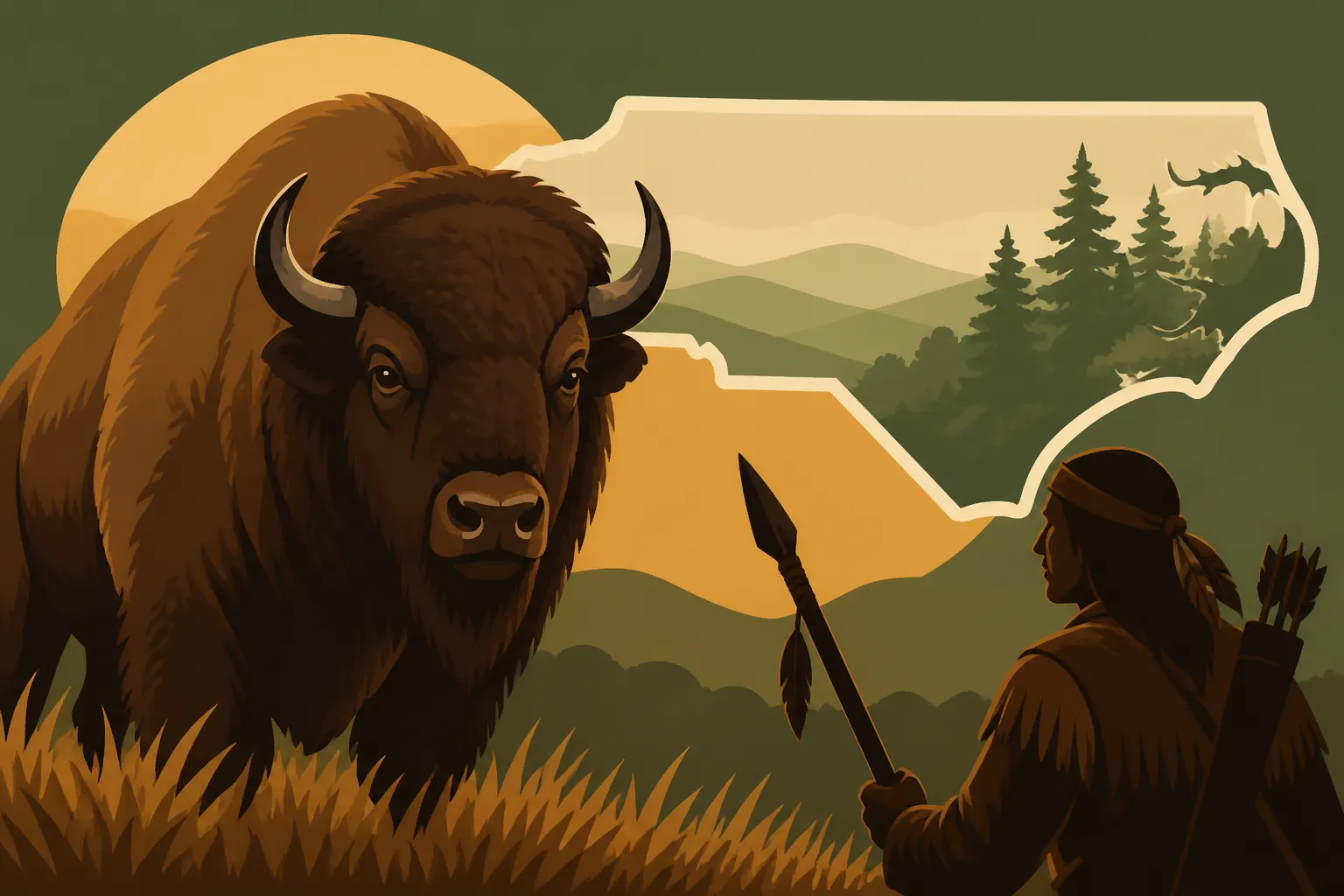
It’s easy to picture North Carolina as a land of whitetails, black bears, and wild turkeys, with a rich hunting heritage rooted in these familiar species. But imagine if I told you that once upon a time, massive bison herds roamed these very same forests and open woodlands. For many, it's a surprising thought, often because our minds immediately jump to the vast plains of the American West. This guide delves into the fascinating, yet often overlooked, history of bison in North Carolina before European settlement, exploring the evidence of their presence and the rich ecological tapestry they were once a part of.
The Ghost of Giants: Imagining North Carolina's Ancient Landscape
For a lot of us, the image of a bison is inextricably linked to the sweeping prairies and wide-open skies of states like Montana or Wyoming. We envision vast herds thundering across the plains, an iconic symbol of the American West. So, when someone suggests that these magnificent creatures once roamed the Blue Ridge Mountains, the thick Piedmont forests, or even the coastal savannas of North Carolina, it can feel a little bit like hearing a ghost story. It challenges our modern perception of what "wild North Carolina" even means.
Why It's Hard to Picture Bison Here
Our current landscape in North Carolina is dominated by dense forests, agricultural fields, and sprawling development. We have highways where old game trails once ran, and subdivisions where river cane thickets provided cover. Trying to superimpose a herd of bison onto this familiar backdrop feels almost impossible, like a scene from another continent entirely. It’s hard to reconcile the mental image of a creature built for open grasslands with the often-closed canopy environment we see today. This immediate dissonance is perfectly normal, and it highlights just how much our environment has changed over centuries.
However, the North Carolina of millennia ago, and even just a few hundred years back, was a different place. While never a wide-open prairie in the Western sense, it had extensive natural clearings, fire-maintained savannas, vast river bottoms with lush forage, and woodlands much more open than many of our timber tracts today. The presence of bison here speaks volumes about the historical ecology of the state and reminds us that nature is far more dynamic than we often give it credit for.
Unraveling the Historical Record: Where Do We Look for Clues?
Pinpointing the exact range and population numbers of bison in pre-settlement North Carolina is a complex puzzle. There weren't any biologists with GPS collars back then, and certainly no historical version of a hunting app like GoHunt to track game migrations! Instead, we rely on a patchwork of evidence that requires careful interpretation. This evidence comes primarily from three main sources: archaeological findings, the written accounts of early European explorers and settlers, and perhaps most importantly, the oral traditions and place names passed down through generations of indigenous communities.
Archaeological digs can unearth fossilized remains or bone fragments that definitively prove the presence of a species in a certain area at a certain time. Early European accounts, while sometimes prone to exaggeration or misunderstanding, can offer tantalizing glimpses into the wildlife encountered. These might be journal entries, letters, or even early maps noting "buffalo" in specific regions. Finally, the knowledge held by Native American tribes offers invaluable insights into the historical distribution and behavior of bison, often reflected in tribal stories, hunting practices, and geographical names that translate to "buffalo crossing" or "bison lick." Piecing these disparate clues together paints a picture of a magnificent animal that was once a vibrant part of North Carolina's natural heritage.
Evidence of Bison in North Carolina: A Deeper Dive
The idea of bison roaming North Carolina isn't just a romantic notion; it's supported by various forms of historical and scientific evidence. While perhaps not as abundant or dramatic as findings in the West, the clues are there for those willing to look.
Archaeological Discoveries and Fossil Records
One of the most concrete forms of evidence for past animal populations comes from the ground itself. Paleontologists and archaeologists have, over time, uncovered fossilized remains that tell a compelling story. While specific, widely publicized bison fossil sites within North Carolina might be less common than deer or mastodon finds, the broader distribution of what's known as the "Eastern bison" (more on this in the next section) across the Appalachian region suggests their presence here. For instance, skeletal fragments and teeth consistent with bison have been found in cave systems and riverbeds in neighboring states like Tennessee and Kentucky, which share similar historical ecological characteristics with western North Carolina. These finds indicate a range that would have almost certainly encompassed significant portions of North Carolina's mountain and piedmont regions.
These archaeological discoveries don't just confirm their presence; they also give us clues about the type of habitat they used. Finding remains in river bottoms, for example, suggests they frequented these areas for water and lush forage. Bones found near mineral licks indicate they sought out essential nutrients. While exact dates can be challenging, radiocarbon dating often places these remains within the Holocene epoch, well before significant European alteration of the landscape. This scientific evidence acts as a critical cornerstone, transforming speculation into substantiated fact about North Carolina's ancient megafauna.
European Colonial Accounts and Indigenous Knowledge
When European explorers and settlers first pushed into the interior of North Carolina, their journals and reports often documented the wildlife they encountered. While they typically used the term "buffalo" rather than "bison," their descriptions often clearly refer to these large bovines. For example, early colonial maps and surveys from the 17th and 18th centuries sometimes marked "buffalo trace" or "buffalo path" in areas that are now central and western North Carolina. While specific names might be lost to time, these geographical markers are powerful indicators. Reading a Ridge for Mountain Zone Deer today might involve looking for subtle game trails, but imagine trails worn deep by generations of bison!
Even more profound is the wealth of indigenous knowledge. Native American tribes, such as the Cherokee in the mountains, the Catawba in the Piedmont, and various Algonquian-speaking groups on the Coastal Plain, lived symbiotically with these animals for millennia. Their languages contain words for bison, their oral histories recount hunting techniques and reverence for the animal, and their settlements were often strategically located near buffalo crossings or grazing areas. These traditions are not just stories; they are historical records passed down, offering invaluable qualitative data on the bison's presence and cultural significance. For instance, certain tribal routes, which modern mapping tools like GoHunt might highlight for tracking modern game, very likely followed ancient bison trails. This blend of early written records and deeply rooted indigenous lore forms a compelling narrative of bison as an integral part of North Carolina's pre-colonial ecosystem.
The Eastern Bison: A Distinct Subspecies or Population?
It's important to understand that the bison of the eastern United States, including North Carolina, weren't necessarily identical to the vast herds that dominated the Great Plains in later centuries. While all are Bison bison, the eastern population is often considered a distinct group, sometimes referred to as the Eastern wood bison or, scientifically, Bison bison pennsylvanicus, though its exact taxonomic status is still debated among scientists.
Differentiating the Eastern Bison
The Eastern bison were generally thought to be more woodland-adapted than their prairie cousins. Imagine a creature that, while still massive and powerful, was perhaps slightly smaller, with a darker coat, and built for navigating through denser forests, river bottoms, and natural clearings rather than endless grass seas. Their diet would have included more browse – leaves, twigs, and bark – in addition to grasses. They weren't just grazers; they were mixed feeders, perfectly suited to the diverse mosaic of forests, wetlands, and scattered open areas that characterized much of pre-colonial North Carolina.
Their social structures might also have differed. While plains bison formed enormous, migratory herds, the Eastern bison likely lived in smaller, more dispersed groups, perhaps moving seasonally between different forest clearings, river valleys, and cane breaks. They were integral to the ecosystem, creating and maintaining open spaces through their grazing and trampling, distributing seeds, and providing a significant food source for both human populations and predators like wolves and mountain lions. This adaptability allowed them to thrive in a landscape that was far from a "prairie."
Why North Carolina Was Suitable Habitat
North Carolina, with its incredible ecological diversity, offered a surprising amount of suitable habitat for these forest-dwelling bison. From the rugged peaks of the Appalachian Mountains down to the sandy flatwoods of the Coastal Plain, different regions would have supported them in various ways:
- Mountains: High mountain valleys, natural balds (grassy clearings on mountain tops), and wide river bottoms like those along the French Broad River, would have provided abundant forage. These areas were often maintained as open woodlands or savannas by natural fires and indigenous land management. Imagine Hunting the Blue Ridge Escarpment Ridgelines today, but with bison pushing through the underbrush!
- Piedmont: This region, characterized by rolling hills and mixed hardwood forests, also had numerous natural clearings, river floodplains, and areas where Native Americans practiced controlled burns to create more open conditions for hunting and agriculture. These "forest-prairie" ecotones were ideal for bison. Hunting Piedmont Farmland Deer now happens in areas that were likely once prime bison foraging grounds.
- Coastal Plain and Sandhills: While we might think of swamps, parts of the Coastal Plain and especially the Sandhills region, with its longleaf pine savannas, were historically much more open than today. Frequent fires, both natural and set by indigenous people, maintained a grassy understory beneath widely spaced pines, creating perfect grazing conditions. River cane thickets along major drainages like the Cape Fear or Neuse rivers would have offered shelter and forage. Hunting Coastal Plain Pocosin Swamps would have meant encountering very different large game centuries ago.
This vast and varied landscape provided the necessary food, water, and cover for bison to not only survive but thrive for thousands of years, shaping the very environment around them.
| Trait/Characteristic | Great Plains Bison (Modern Perception) | Eastern Bison (Historical North Carolina) |
|---|---|---|
| Primary Habitat | Vast, treeless grasslands/prairies | Woodland openings, river bottoms, savannas, mixed forests |
| Diet | Predominantly grasses | Mixed feeder: grasses, browse (leaves, twigs, bark) |
| Herd Size | Enormous, often thousands | Smaller, more dispersed groups, less migratory |
| Appearance | Iconic hump, shaggy coat | Potentially slightly smaller, darker coat, adapted for forest navigation |
| Movement | Long-distance seasonal migrations | More localized movements within forest mosaics |
| Role in Ecosystem | Grazing to maintain prairies | Grazing & browsing to maintain open woodlands/savannas, seed dispersal |
The Decline and Disappearance of North Carolina's Bison
The story of the bison in North Carolina, like in many parts of the East, is one of gradual retreat followed by swift disappearance. Their extinction in the state, and indeed across the entire eastern seaboard, was a complex process driven primarily by human activity. It's a sobering reminder of how quickly even the most robust wildlife populations can vanish under pressure.
Human Impact: Overhunting and Settlement Pressure
While indigenous peoples had hunted bison sustainably for thousands of years, European arrival brought a dramatic shift. The initial wave of settlement in North Carolina, starting in the 17th and 18th centuries, saw an explosion of unregulated hunting. Bison were targeted for their hides, meat, and tallow, often without any thought for conservation. Market hunting, driven by demand from growing colonial towns and for export, rapidly decimated herds. A single hunter could kill dozens of animals, and there were no bag limits or seasons, let alone North Carolina Deer Bag Limit Rules or North Carolina Bear Checking Requirements to ensure sustainable harvest.
Beyond direct killing, the relentless march of European settlement brought massive habitat destruction. Forests were cleared for agriculture, creating farms that fragmented bison ranges and removed their crucial food sources and cover. Towns expanded, roads were built, and the very landscape that had supported bison for millennia was irrevocably altered. A species that required large, contiguous tracts of diverse habitat found itself squeezed into smaller and smaller pockets, making them increasingly vulnerable. Hunting the North Carolina Mountains or Hunting the Coastal Plain and Sandhills today gives us access to public lands that are often remnants of much larger, interconnected wild spaces.
Disease and Ecological Changes
While overhunting and habitat loss were the primary culprits, other factors likely contributed to the bison's demise. The introduction of European livestock brought with it new diseases to which native bison had no immunity. Pathogens from domestic cattle could have spread to wild bison populations, further weakening them and making them more susceptible to other pressures. Imagine a scenario where a local herd, already stressed by hunting and shrinking habitat, is suddenly hit by a foreign illness; the impact could be devastating.
Furthermore, the ecological balance was shifting. The historic fire regimes that helped maintain the open woodlands and savannas bison relied on were disrupted. Native American practices of controlled burning, which had shaped the landscape for centuries, were suppressed by European settlers who feared uncontrolled fires. Without these natural and human-managed fires, forests became denser, and prime bison foraging grounds diminished. The entire web of life, from White-Tailed Deer Across North Carolina to North Carolina's Black Bear Population, was undergoing profound changes, and the bison, being a large, slow-reproducing species, were particularly vulnerable.
The Last Sightings and Legacy
By the late 18th and early 19th centuries, bison sightings in North Carolina became exceedingly rare. The last confirmed records in the state are murky, but it's generally understood that by the early 1800s, they were functionally extinct in North Carolina and the rest of the East. The Eastern bison was officially declared extinct in the wild around the 1830s, long before their Western cousins faced their own near-annihilation.
Their disappearance represents a profound ecological loss. Bison were keystone species, actively shaping their environment, and their absence undoubtedly had cascading effects on vegetation, other wildlife, and ecosystem processes. Today, the notion of wild bison in North Carolina is a historical curiosity, a "ghost of giants" that once roamed our forests. Understanding this history, however, isn't just about looking backward. It reminds us of the incredible biodiversity that once existed and the fragility of even the most dominant species. It also underscores the importance of habitat preservation and responsible wildlife management for the species we do have today, from Wild Turkeys in North Carolina to Feral Hogs Across North Carolina. As hunters and conservationists, looking into the past can offer valuable lessons for the future, especially when considering land management and the potential for rewilding efforts or species reintroductions, though for bison in North Carolina, that remains a dream.
Disclaimer
This article is for general informational purposes only and does not constitute professional advice. Laws, prices and regulations vary by location and change over time. Consult a qualified professional for guidance on your specific situation.