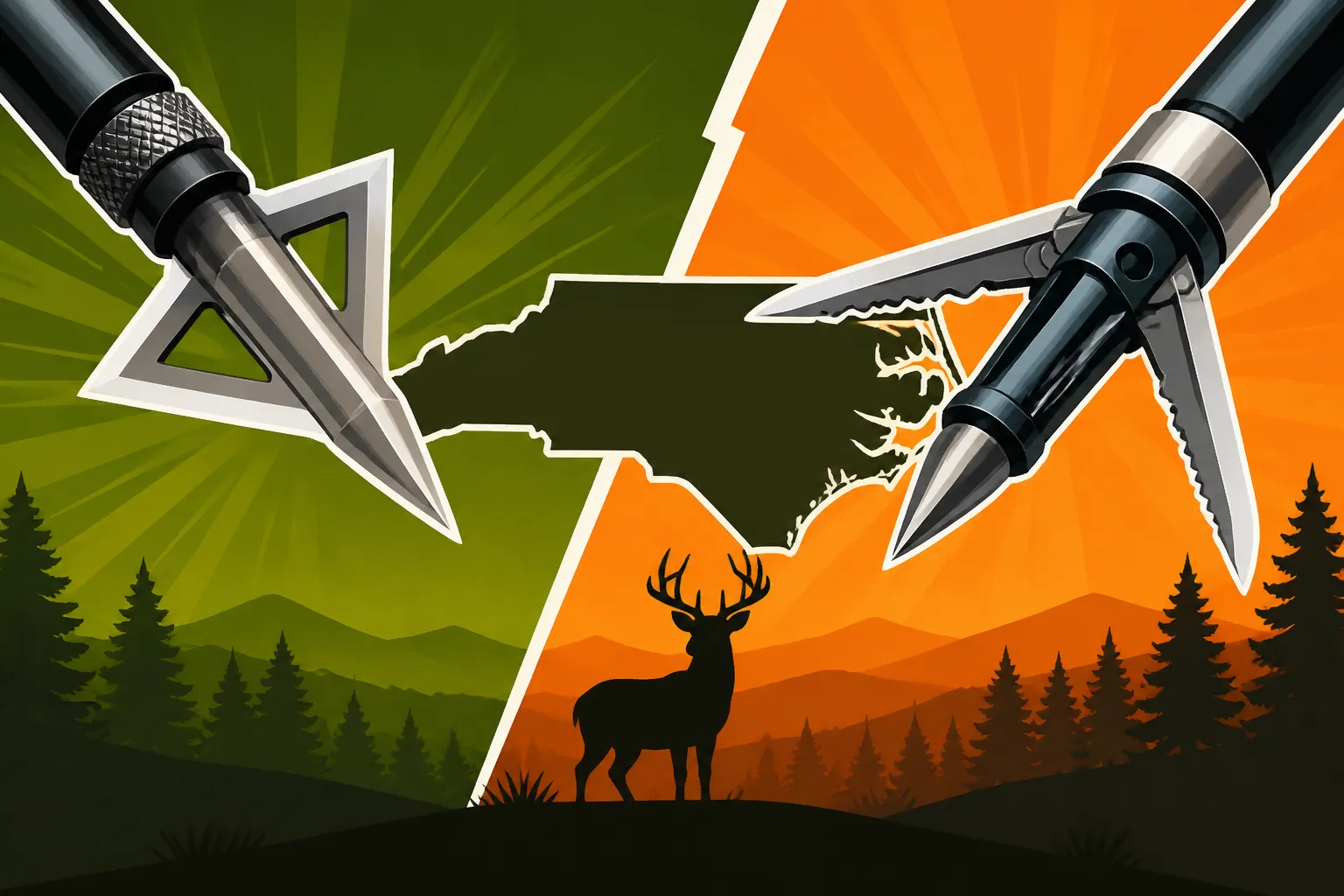
Fixed Versus Mechanical Broadheads
Every bowhunter in North Carolina eventually faces the same big question: fixed blade or mechanical broadheads? It's a decision that can feel overwhelming, especially with so many options out there, and the stakes are high – you want to make the most ethical, effective shot possible when that deer or bear finally steps into your shooting lane. This guide is going to cut through the noise, validate the confusion, and help you understand the core differences between fixed and mechanical broadheads, so you can make an informed choice that builds your confidence for success in our diverse North Carolina woods.
The Enduring Appeal of Fixed-Blade Broadheads
Fixed-blade broadheads are, in many ways, the bedrock of bowhunting. They're the tried-and-true workhorses that have been around since the dawn of archery hunting, and for good reason. When you look at a fixed-blade, what you see is what you get: a sturdy, often one-piece design where the blades are permanently attached to the ferrule. There's no moving parts, no deployment mechanisms, and no uncertainty about how they'll perform on impact.
This simplicity is a massive draw for many hunters, especially those who prioritize reliability above all else. Imagine you've spent hours meticulously Scouting North Carolina Public Land Before Season, found that perfect pinch point in the Uwharrie National Forest, and finally have a mature buck in your sights. The last thing you want is a question mark hanging over your equipment. With a fixed-blade, you know exactly what that broadhead is going to do when it hits its mark. It's going to drive forward, using its sharp edges and solid construction to cut and penetrate.
Simplicity and Reliability in the Field
The beauty of fixed-blade broadheads lies in their straightforward design. There are no O-rings to check, no tiny screws that might loosen, and no blades that need to deploy. This means fewer potential points of failure when you're out in the elements. Whether you're hunting in a cold, damp January or an early September heatwave, a fixed blade remains structurally sound. This robustness is incredibly appealing when you consider the knocks and bumps your arrows might take climbing into a Treestand Setups in Pisgah National Forest or navigating thick pocosin swamps in the Coastal Plain.
This reliability extends to their flight characteristics, too. While some hunters perceive fixed blades as harder to tune than mechanicals, once properly tuned to your bow and arrow setup, their flight path is incredibly consistent. There’s no blade flutter or unexpected deviation due to deployment issues. You practice with them, and they fly the same way every single time, shot after shot. This consistency builds immense confidence, which is paramount when you're drawing back on an animal. You trust your setup, and that trust helps you execute a clean, ethical shot.
Deep Penetration and Bone-Crushing Power
One of the most significant advantages of fixed-blade broadheads is their reputation for superior penetration, especially through tough material like bone. Because the blades are fixed and form a solid, continuous cutting surface from the moment of impact, all the kinetic energy of your arrow is focused directly into driving that sharp edge through whatever it encounters. There's no energy lost in overcoming blade deployment mechanisms or structural changes.
Consider a less-than-ideal shot angle, or a shoulder blade hit on a big bodied deer or a black bear. A well-designed, sharp fixed blade has a much better chance of breaking through or slicing around bone and continuing its path into the vitals. They essentially act like a chisel, maintaining their structural integrity even under extreme stress. This is particularly crucial when pursuing larger game like North Carolina's black bears, where thick muscle and bone require maximum penetration for a quick, humane kill. Many hunters chasing big bears in the North Carolina's Black Bear Population areas will lean heavily on the deep penetrating power of a sturdy fixed blade.
When Fixed Blades Shine Brightest in North Carolina
Fixed-blade broadheads truly excel in situations where maximum penetration and robust construction are paramount. Think about hunting in the dense, thick cover of the Coastal Plain or the steep, rugged mountains. An arrow might glance off a small sapling or hit a hidden branch on its way to the target. A fixed blade is far more likely to retain its integrity and still perform if it encounters minor interference before reaching the animal.
They are also the preferred choice for many hunters pursuing tough game or when expecting challenging shot opportunities. If you're Bear Hunting North Carolina's Coast and Mountains or targeting a large whitetail buck that might be quartering away, the ability of a fixed blade to punch through ribs, muscle, and even heavier bone is a significant advantage. The consistent flight after tuning, coupled with their sheer strength, gives many North Carolina bowhunters the peace of mind they need when facing a shot in our varied and often unforgiving landscapes. It’s about being prepared for the unexpected, and fixed blades offer that extra margin of confidence.
The Modern Edge of Mechanical Broadheads
Mechanical broadheads, also known as expandable broadheads, represent a significant evolution in archery technology. They've gained immense popularity over the last few decades, primarily by addressing some of the traditional challenges associated with fixed-blade broadheads, particularly in terms of arrow flight. A mechanical broadhead features blades that are tucked away or folded back during flight and then deploy upon impact, creating a much larger cutting diameter.
This design was a game-changer for many archers who struggled to get fixed blades to fly perfectly with their specific bow setup. The promise of "field point accuracy" was a powerful draw, meaning your broadheads would fly exactly like your practice tips, without needing extensive tuning efforts. It made getting ready for Bowhunting North Carolina's Statewide Archery Season feel a whole lot easier for many people.
Field Point Accuracy and Forgiving Flight
The biggest selling point for mechanical broadheads is often their claim of field point accuracy. Because their blades are retracted during flight, the broadhead presents a smaller, more aerodynamic profile to the wind. This significantly reduces drag and wind planing, common issues that can cause fixed blades to fly differently than field points. For hunters who struggle with arrow tuning, or simply want less hassle, this is a huge benefit.
You can often practice extensively with your field points, then screw on your mechanical broadheads, and expect them to hit the same spot out to reasonable hunting distances. This can be a huge time-saver and confidence booster, especially for newer archers or those with limited time for extensive tuning sessions. Imagine setting up for a Setting Up on a Piedmont Field Edge hunt; you've practiced all summer with field points, and now you can put on your mechanicals with high confidence they'll still land true. This ease of achieving accurate flight allows hunters to focus more on their shooting form and target acquisition, rather than wrestling with arrow tuning.
Massive Cutting Diameters and Devastating Blood Trails
Once deployed, mechanical broadheads reveal their true power: massive cutting diameters. While a typical fixed blade might offer a 1-inch to 1 1/4-inch cut, many mechanicals expand to 1 3/4 inches, 2 inches, or even larger. This drastically increases the size of the wound channel, leading to greater tissue damage and, ideally, more profuse and easier-to-follow blood trails. For hunters who have experienced the frustration of a sparse blood trail, the promise of a "superhighway" blood path is incredibly appealing.
A wider cutting diameter means more arteries, veins, and vital organs are severed, leading to a quicker and more ethical harvest. This can be particularly beneficial on broadside shots where maximum tissue damage through the vitals is achievable. In North Carolina's often thick terrain, a strong blood trail is invaluable for tracking a deer, especially if it runs into a thicket or a hard-to-access area like a Hunting a Funnel Between Two Pocosins or dense bottomland. Being able to quickly and efficiently recover your game is a priority for every ethical hunter.
Situations Where Mechanicals Can Be a Game Changer
Mechanical broadheads truly shine in situations where shot angles are optimal, and the hunter prioritizes a wider wound channel and easier tracking. They are particularly effective for broadside or slightly quartering-away shots on deer, especially in more open country where the arrow flight path is unobstructed. For example, if you're hunting an agricultural field edge in the Piedmont and anticipate a clean broadside shot, a mechanical broadhead's large cutting diameter can lead to devastating results.
They can also be a game-changer for archers with lower draw weights or those who may not be able to achieve the kinetic energy needed for reliable penetration with certain fixed-blade designs. While adequate kinetic energy is always important, the aerodynamic efficiency of mechanicals can sometimes mitigate minor power deficiencies. Furthermore, many hunters who use online mapping tools like GoHunt to scout and plan their hunts appreciate how mechanicals complement their meticulous preparation by offering that extra confidence in arrow flight and wound channel effectiveness. Knowing your arrow is going where you aim it, with maximum cutting potential, gives you one less thing to worry about on stand.
Making Your Choice: Factors to Consider for North Carolina Hunting
Deciding between fixed and mechanical broadheads isn't about one being inherently "better" than the other, but rather which one is best for you, your specific bow setup, the game you're pursuing, and the conditions you'll be hunting in here in North Carolina. It's a personal choice that requires honest self-assessment and some thoughtful consideration. Many hunters will even carry both types, depending on their target animal or the specific hunting scenario for the day.
This isn't a decision to rush. Like choosing the right arrow weight or finding that perfect Bow Draw Weight for North Carolina Whitetails, your broadhead choice is a critical component of your overall hunting strategy. There are many factors at play, from the physics of your setup to the practical realities of the North Carolina landscape.
Your Setup: Bow Weight, Arrow FOC, and Kinetic Energy
The power of your bow, expressed through draw weight and translated into kinetic energy at the shot, plays a crucial role in broadhead performance. If you're shooting a higher poundage bow (70+ lbs) with a heavier arrow and a good front-of-center (FOC) balance, you likely have plenty of kinetic energy to drive both fixed and most well-designed mechanical broadheads through an animal. For these setups, the choice often comes down to personal preference or the specific cutting diameter desired.
However, if you're shooting a lighter draw weight bow (40-50 lbs) or a lighter arrow, you'll need to be more discerning. In these cases, a fixed-blade broadhead with a smaller profile and robust construction might be a safer bet to ensure adequate penetration, especially on larger game. Some mechanical broadheads require a minimum kinetic energy threshold to ensure reliable deployment and penetration. Always check the manufacturer's recommendations for your specific broadhead and ensure your setup meets those requirements. You can calculate your bow's kinetic energy (KE) to help guide your choice, understanding that higher KE gives you more versatility.
The Game You Pursue and Expected Shots
The type of animal you're hunting in North Carolina significantly influences broadhead choice. For our primary big game, white-tailed deer, both fixed and mechanical broadheads can be highly effective with proper shot placement. However, if you're targeting larger, tougher game like black bears, particularly the massive ones found in our coastal pocosins or mountain regions, many veteran hunters lean towards fixed blades due to their superior bone-breaking and deep penetration capabilities. A bear's bone structure and thick hide demand a broadhead that won't fail to drive deep.
Consider also the range and angles of your typical shots. If you consistently hunt from a ground blind or treestand where shots are often broadside and within 30 yards, the large cutting diameter of a mechanical can be extremely effective. If you anticipate more challenging angles, or if you're Still-Hunting Nantahala Forest Ridges where shots might be through some light brush, a fixed blade might offer more peace of mind regarding its ability to stay true and penetrate. Understanding your hunting style and typical shot scenarios will help narrow down the options.
North Carolina's Diverse Terrain and Shot Opportunities
North Carolina's landscape is incredibly varied, from the dense, tangled swamps and pine plantations of the Coastal Plain to the rolling hardwood ridges of the Piedmont, and the steep, rocky slopes of the Blue Ridge Mountains. Each environment presents unique challenges and opportunities for bowhunters. In areas with extremely thick cover, like the Croatan National Forest or other coastal pocosins, an arrow's flight path might be slightly obstructed. A fixed-blade broadhead, with its simpler design and less likelihood of pre-deployment or deflection, might be preferred here.
Conversely, in more open areas, such as food plots, powerline cuts, or agricultural fields found across the Piedmont, where shots might be longer and require maximum accuracy, a mechanical broadhead's field point-like flight can be a distinct advantage. If you're using an app like GoHunt to scout specific terrain features, thinking about how those features might influence your shot opportunities will inform your broadhead decision. For example, Hunting a Ridge-Top Saddle for Rutting Bucks might mean clearer shots than navigating heavy laurel thickets.
| Feature | Fixed-Blade Broadheads | Mechanical Broadheads |
|---|---|---|
| Design | Blades permanently attached, no moving parts. | Blades fold/retract during flight, deploy on impact. |
| Aerodynamics/Flight | Can be more prone to wind planing; requires precise tuning for perfect flight. | Generally offers field point accuracy; more forgiving flight. |
| Penetration | Excellent deep penetration, superior for bone impact. Energy focused forward. | Can be good, but some energy used for blade deployment. Risk of shallower penetration on tough angles/bone. |
| Cutting Diameter | Typically 1" – 1.25" (smaller wound channel). | Much larger, 1.5" – 2.5"+ (larger wound channel, better blood trails). |
| Reliability | Very high; no moving parts to fail. | Generally high, but potential for pre-deployment or non-deployment (rare with quality products). |
| Durability | Often very robust, blades can be resharpened or replaced. | Blades typically designed for one-time use, can be damaged on impact. |
| Ease of Tuning | Can require more tuning effort to match field points. | Easier to tune, often flies like field points. |
| Ideal Use Cases | Tougher game (bear), challenging angles, thick cover, lower kinetic energy setups. | Broadside shots, open terrain, prioritizing large wound channels/blood trails, higher kinetic energy setups. |
Practice, Confidence, and Ethical Hunting
Ultimately, no matter which broadhead you choose, the most critical factor is your confidence in that broadhead and your ability to place it accurately. This comes down to consistent practice. You must practice with your chosen broadheads. Don't just screw them on the day before the season opens. Shoot several arrows with them to ensure they fly true with your specific setup. Pay attention to how they group compared to your field points. If there's a significant difference, you'll need to adjust your sight or broadhead tuning.
An ethical hunter always strives for a quick, humane kill. This means selecting a broadhead that is appropriate for your bow, your arrow, and the game you are pursuing, and then practicing until you can consistently make accurate shots. Whether you opt for fixed or mechanical, understanding its strengths and limitations will empower you to make the best decision when it matters most. Using all the resources at your disposal, from detailed gear reviews found on platforms like GoHunt to advice from experienced hunters, will help you build that foundational confidence.
No broadhead is magical, and none will compensate for poor shot placement. But when combined with a well-tuned bow, a sharp broadhead, and a confident archer, either fixed or mechanical can be an incredibly effective tool for success in the North Carolina woods.
Disclaimer
This article is for general informational purposes only and does not constitute professional advice. Laws, prices and regulations vary by location and change over time. Consult a qualified professional for guidance on your specific situation.