Hunting a Ridge-Top Saddle for Rutting Bucks
There’s nothing quite like the rush of hunting during the peak of the rut, especially when you’re strategically positioned in a prime location. Many hunters feel the frustration of pouring over maps, walking countless miles, and still struggling to intercept those cruising, lovesick bucks, particularly in the challenging ridge country of North Carolina. This comprehensive guide is designed to cut through that frustration, focusing specifically on how to effectively hunt ridge-top saddles for rutting bucks, providing you with actionable strategies to increase your success this season.
Understanding Ridge-Top Saddles for Whitetails
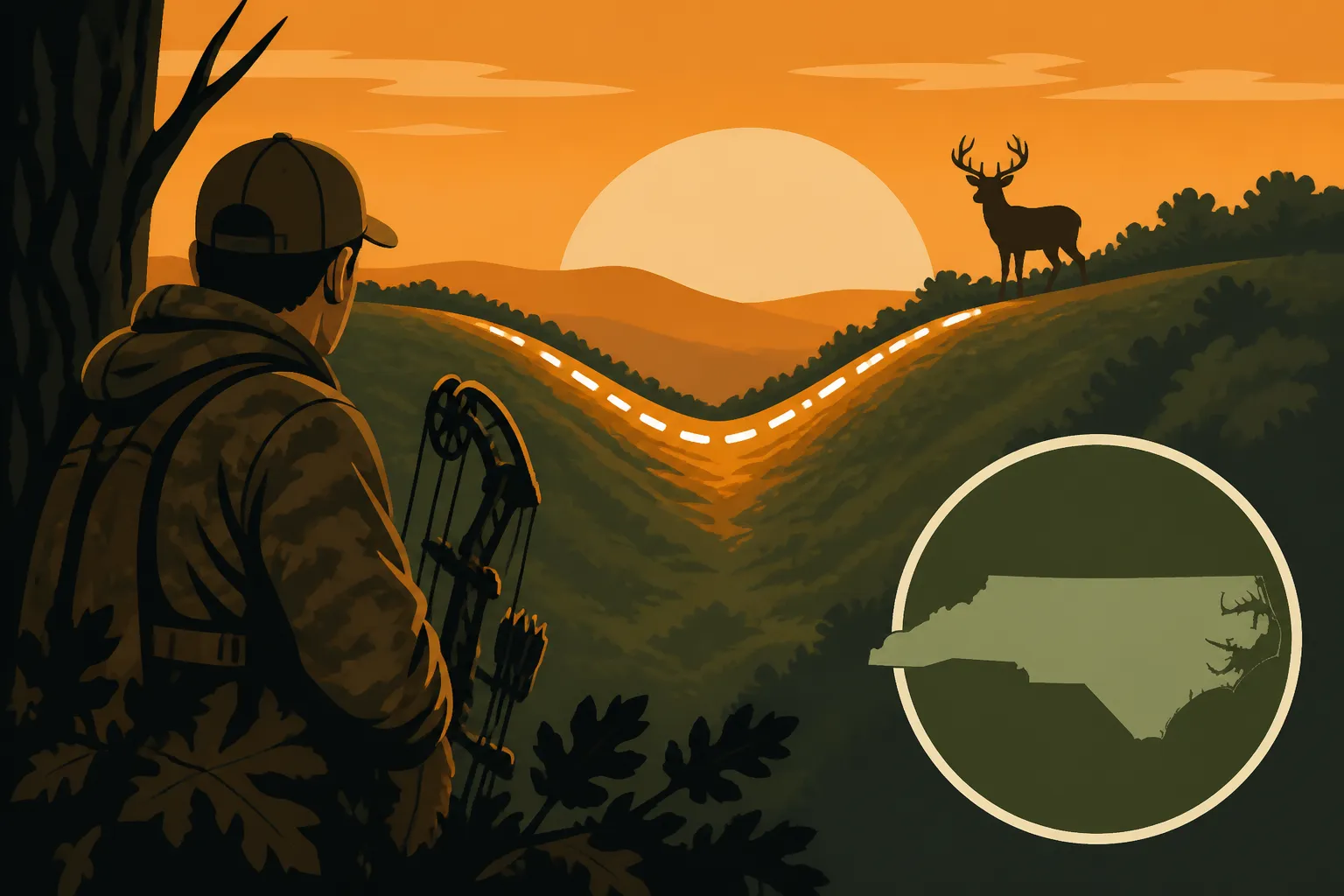
Ridge-top saddles, sometimes called draws or dips in the terrain, are natural funnels that can become absolute deer magnets, especially when bucks are on the move during the rut. These aren't just random low spots; they're strategic pathways that deer instinctively use.
Why Saddles are Deer Magnets During the Rut
Think about it from a deer's perspective, particularly a big rutting buck. He’s got one thing on his mind: finding does. He's covering ground, scent-checking, and looking for receptive females. Walking up and over every single peak along a ridge is incredibly energy-intensive. Saddles offer the path of least resistance. They are the natural highways connecting different drainages, bedding areas, and feeding zones on opposing sides of a ridge. During the rut, these natural corridors become major travel routes for bucks cruising between does or actively chasing.
Imagine a mature buck, nose to the ground, searching for estrous does. He’s not going to unnecessarily climb over a steep knob if there's a slight dip, a saddle, just a few yards away that gets him to the other side with less effort. This becomes even more critical when you consider the concept of a buck’s home range and how he’ll patrol it during the breeding season. These saddles provide a funneling effect, concentrating deer movement into a smaller, more predictable area, making them prime spots for an ambush. Bucks also use these areas to scent-check for does on both sides of the ridge without having to expose themselves over a crest. It’s a subtle advantage, but one they exploit constantly.
Identifying Productive Saddles in North Carolina Terrain
Not all saddles are created equal, and knowing how to pick out the hot spots is key. In North Carolina, our terrain varies wildly, from the dramatic peaks and valleys of the Blue Ridge to the more subtle rolling hills of the Piedmont. A productive saddle often connects two distinct features or areas that deer want to move between. This could be a bedding area on one side and a feeding area on the other, or simply two different ridge systems that offer various resources.
Start with topographical maps, whether paper or digital. Tools like the NC Wildlife App are invaluable for this. Look for contour lines that "pinch in" or create a noticeable dip between higher elevations on a ridge. A good saddle will typically have natural travel corridors leading into and out of it. On aerial imagery, you might see subtle changes in vegetation, worn-down trails, or even old logging roads that have become deer superhighways through these dips. For example, if you're looking at a steep ridge in Pisgah National Forest Hunting, a saddle might be a relatively flat, open area between two steep peaks. In the less dramatic Piedmont, it might be a subtle dip in a woodline separating two agricultural fields or clearcuts. The key is to find those natural funnels where deer movement is concentrated. Don't overlook saddles that might not look significant on a map but connect two crucial habitat types, like a dense thicket to a mature hardwood stand.
Scouting and Pre-Season Preparation for Saddle Hunting
Effective saddle hunting isn’t just about showing up on opening day. It requires diligent scouting, both on maps and on the ground, long before the season even begins.
Reading Sign and Anticipating Rutting Activity
Once you’ve identified a potential saddle on your map, it’s time to hit the woods. This is where you confirm your theories and start to really understand deer movement. Look for existing deer trails that converge in the saddle. Are there fresh tracks? Droppings? More importantly, during the pre-rut and early rut, keep an eye out for tell-tale signs of buck activity. Scrapes along the edges of the saddle or directly within it are gold. These are essentially communication hubs where bucks deposit scent and check for does. The bigger the scrape, and the more active it looks, the better. Similarly, look for rubs on trees. A series of rubs leading into or out of a saddle indicates a travel route that a buck is consistently using. The size of the rubs can also tell you something about the size of the buck using the area.
As the rut progresses, the sign will intensify. You’ll see more trails, more scrapes, and more rubs. You might even find sheds later in the season, giving you clues about the bucks that survived. Pay attention to how the sign relates to the wind. If you find a lot of fresh sign on one side of a saddle, consider what wind direction would favor a buck approaching from that side while scent-checking. Understanding these patterns is crucial for figuring out where to hang your stand. It’s a dynamic puzzle, and the deer are constantly leaving you clues.
Using Topographic Maps and Aerial Imagery
Modern hunting isn't complete without digital mapping tools, and for identifying and dissecting saddles, they are indispensable. Programs like GoHunt or even the NC Wildlife App allow you to view detailed topographic maps, aerial imagery, and property boundaries right on your phone or computer.
Start by zooming out and identifying major ridge systems. Then, slowly zoom in, looking for those "pinches" or dips in the contour lines that signify a saddle. Once you've found one, switch to aerial view. What kind of cover is around it? Is it mature timber, clear-cuts, thick pines, or agricultural fields? How do trails or old logging roads intersect the saddle? Use different map layers to understand elevation changes, vegetation, and potential bedding or feeding areas that the saddle connects. For instance, a saddle connecting a dense thicket known for bedding deer to an oak flat heavy with acorns is a prime candidate. Don't forget to mark potential stand locations, likely travel routes, and even your planned entry and exit paths to avoid disturbing the area. This kind of detailed planning, especially when Scouting North Carolina Public Land Before Season, can save you countless hours of wandering aimlessly.
Effective Hunting Strategies for North Carolina Saddles
Once you've done your homework, it's time to put boots on the ground with a well-thought-out plan.
Stand Placement and Wind Considerations
This is where many hunts are won or lost. Your stand placement in a saddle needs to consider several factors, with wind being paramount. Deer will almost always approach a saddle using the wind to their advantage, scent-checking for danger and for does. In mountainous terrain, this can be complicated by thermals. Early in the morning, cold air sinks, causing thermals to pull your scent downhill. In the afternoon, as the sun warms the ground, thermals reverse, pulling your scent uphill. You can read more about Wind and Thermals on a Blue Ridge Slope to truly master this.
Ideally, you want to set your stand on the downwind side of the most active trail or the side where you expect bucks to approach. This allows your scent to blow away from their likely travel path. However, in a saddle, deer can come from multiple directions. Often, the best spot is slightly off to the side, perhaps 20-30 yards from the primary trail, allowing you to cover both sides of the saddle without being directly in the main thoroughfare. Look for trees that offer good concealment and a clear shooting lane down into the saddle and along the connecting trails. When setting up a treestand, remember that Treestand Setups in Pisgah National Forest will require different considerations than in flatter areas, mainly due to the often-steep terrain and limited suitable trees. Always have a clear entry and exit route that minimizes disturbance, preferably using terrain features to mask your approach.
Rut-Specific Tactics: Calling and Decoys
The rut is a noisy time, and using calls can be highly effective in a saddle setup. Bucks are actively looking for does and challenging other bucks, making them more responsive to vocalizations. A grunt tube is a must-have. Short, aggressive grunts can pique a cruising buck's curiosity, pulling him off his path and into your shooting lane. Doe bleats can be equally effective, simulating a receptive doe. Don't be afraid to experiment with different sequences and volumes.
Rattling antlers can be particularly potent in a saddle, especially during the peak of the rut when bucks are actively fighting for breeding rights. The sound carries well in open timber, and the natural funnel of a saddle means a buck hearing the fight is likely to investigate by coming through the dip. Start with light sparring, then escalate to more aggressive crashing, followed by a series of grunts or bleats. Be ready for a quick shot, as bucks often charge in looking for the "culprits." Decoys can also play a role, especially a small doe decoy placed where it's visible but doesn't obstruct shooting lanes. This visual cue, combined with calling, can be irresistible to a rut-crazed buck. Just be sure to understand the nuances of Rattling and Grunting in North Carolina to maximize your chances.
Timing Your Hunt for Peak Rutting Movement
Timing is everything when hunting the rut. While bucks are generally more active throughout the entire day during peak rut, saddles are often most productive during specific windows. Early mornings are prime, as bucks are typically moving from bedding areas to feeding areas or actively cruising for does. As the sun rises and thermals begin to shift, deer will use these saddles to scent-check and travel.
Midday can also be surprisingly productive in saddles. While many hunters head back to camp, mature bucks often take advantage of the reduced human pressure to continue their search for does. If you're committed to an all-day sit, a comfortable setup is essential. Late afternoons, as deer begin to move back towards feeding areas or seek new bedding, can also be fantastic. Monitor local reports and understand when Hunting the Rut in the Eastern Zones or in the Western Zone is peaking. The key is to be in your stand before the action starts and stay put through the prime hours, remaining vigilant for any movement.
Adapting to North Carolina's Diverse Ridge Systems
North Carolina's geography presents unique challenges and opportunities for saddle hunting, from the steep mountains to the rolling Piedmont.
Mountainous Saddles in Western NC
Hunting mountainous saddles in Western North Carolina, particularly in areas like the Nantahala National Forest, requires a different approach than other parts of the state. The sheer elevation changes mean deer rely heavily on the paths of least resistance, making saddles even more critical. Here, saddles connect vast expanses of timber, often linking high-elevation benches or ridges where deer might bed to lower feeding areas or water sources.
When you're out on a Blue Ridge slope, understanding the interplay of wind and thermals becomes incredibly important. Your scent can be carried for long distances, both up and down, and a slight change in air current can blow your cover. Furthermore, the cover is often thick, with rhododendron and mountain laurel, so visibility can be limited. Focusing on glassing and listening is crucial. Consider hunting a saddle that connects to a known sanctuary or an area where deer are known to bed down, like where Nantahala Forest Bucks Bed. A stand positioned to catch deer moving from an upper ridge to a lower elevation or vice-versa, especially if you're Hunting a High Elevation Mountain Bench, can be deadly. Long, patient sits are often required, as deer might travel great distances to reach these funnels.
Piedmont and Eastern Edge Saddles
Moving eastward, the terrain softens, but saddles are no less important. In the Piedmont and along the eastern edge of North Carolina's deer zones, ridge-top saddles might be less dramatic in elevation but still serve the same purpose: funneling deer movement. Here, saddles often connect woodlots, creek bottoms, or fingers of timber that extend into agricultural fields. They might not be as pronounced as their mountain counterparts, sometimes appearing as subtle dips in a continuous hardwood ridge or a break in a fencerow that separates two different covers.
These types of saddles are often situated between a dense bedding area, like a thick pine plantation, and a food source, such as a standing cornfield in farm country or a freshly cut soybean field. Look for saddles that provide natural cover for deer moving between these areas. Deer might be less inclined to walk in the open, preferring the security of the timber edge through a saddle. In these areas, the focus might shift from thermals to general wind direction across flatter ground. Positioning your stand to catch a buck cruising a field edge, or moving from one woodlot to another via a small dip, can be incredibly effective. Pay close attention to human pressure in these areas; the more pressure, the more nocturnal bucks can become, making early morning and late evening sits even more critical in these funnels.
Disclaimer
Hunting is an inherently dangerous activity. Always prioritize safety by wearing appropriate safety gear, understanding and following all local and state regulations, and practicing ethical hunting methods. This guide is for informational purposes only and does not replace professional instruction or local wildlife commission guidelines. Always check current North Carolina Wildlife Resources Commission regulations before heading afield.