Hunting a Funnel Between Two Pocosins
Hunting deer in the dense, often impenetrable pocosins of North Carolina's coastal plain can feel like searching for a needle in a haystack – the sheer amount of cover makes it incredibly challenging to consistently encounter deer. But even in these thick, swampy havens, deer follow predictable patterns, and understanding how to identify and hunt the natural funnels connecting these vast expanses of cover is absolutely key to success. This guide will walk you through everything you need to know to effectively pinpoint and capitalize on these high-traffic deer highways, turning your frustrations into successful hunts.
Understanding Pocosin Habitat and Deer Movement
Before we can even think about setting up a stand, we need to truly grasp what a pocosin is and why deer gravitate to these challenging environments. It's not just a swamp; it's a unique ecosystem with its own set of rules, and deer have adapted to thrive within them. Without this foundational understanding, you're essentially just wandering aimlessly, hoping for a lucky break.
What Exactly is a Pocosin?
The term "pocosin" itself is of Algonquin origin, meaning "swamp on a hill," which can seem contradictory until you understand the geology. These aren't your typical low-lying floodplains. Instead, pocosins are broad, flat, upland swamps characterized by deep, peaty soils and dense, stunted vegetation. Think of a seemingly endless expanse of evergreen shrubs like gallberry, titi, and bay trees, often intertwined with thick vines and scattered, often fire-stunted pines. The water table is usually very close to the surface, making for wet, boggy, and often impassable terrain on foot. Walking through a pocosin can be an absolute nightmare – it’s a constant battle against clinging vines, deep mucky spots, and vegetation so thick you can barely see ten feet in front of you. This isn't your open, park-like hardwood bottom; this is primeval, tangled wilderness. This impenetrable nature is precisely why deer, especially mature bucks, absolutely love them. It's a sanctuary from human pressure and a safe haven where they can move largely undetected.
Why Deer Use Pocosins for Cover and Security
Deer are masters of survival, and their number one priority is security. Pocosins offer that in spades. The incredible density of the vegetation provides unparalleled hiding cover, shielding them from predators, both two-legged and four-legged. During hunting season, when human activity increases in more accessible areas, deer will naturally retreat deeper into these thickets. A big, mature buck might spend weeks, even months, holed up in a large pocosin, only venturing out during the hours of darkness or when the rut calls. Furthermore, these areas, while not always rich in diverse forage, do offer certain food sources. Browse such as switchcane, greenbrier, and various shrubs thrive in pocosin margins and even deeper within the thickets. They also provide crucial thermal cover during cold snaps and shade during hot periods. When you’re thinking about hunting, always remember that deer choose these places because they feel safe. Your job is to figure out the path of least resistance they take when leaving that safety.
Deer Travel Patterns in Coastal Plain Environments
Deer in the coastal plain often operate on a different rhythm than their mountain or piedmont cousins. Due to the vast, flat landscape and abundant cover, their movements can seem less predictable. However, certain patterns emerge. Daily routines usually involve moving from deep, secure bedding areas within the pocosin to feeding grounds, which might be agricultural fields, natural clearings, or pine plantations. This typically happens at dawn and dusk. During the rut, these patterns become more erratic as bucks actively search for does, often covering more ground and utilizing more open areas, but always with an escape route back to the safety of the pocosin. Understanding North Carolina Deer Season Structure Explained is vital here, as deer behavior changes significantly throughout the various phases of the season. Weather also plays a huge role; a cold front might get deer moving more during daylight, while heavy rain could keep them hunkered down. Learning to anticipate these shifts is part of the game.
Identifying Key Funnels Between Pocosins
Once you understand why deer are in these pocosins, the next step is to figure out how they move between them. Deer, like us, prefer the path of least resistance. These paths, often subtle in the coastal plain, are your funnels. Pinpointing them is a mix of technology and good old-fashioned scouting.
Using Aerial Imagery and Topo Maps
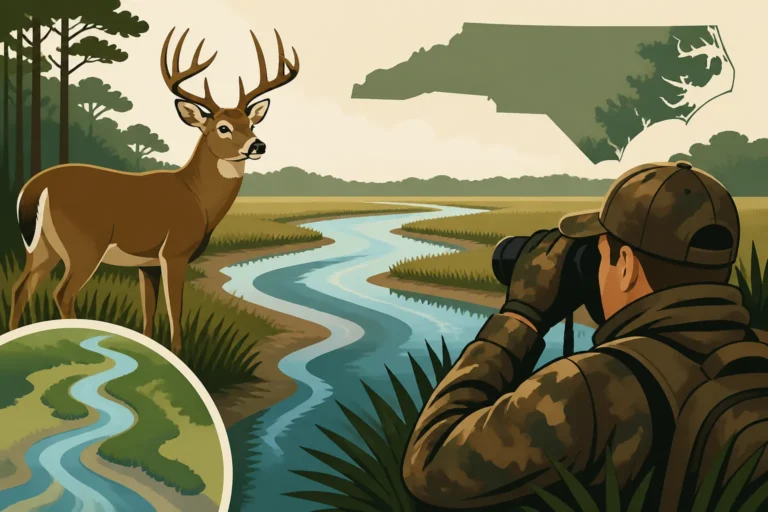
This is where your digital tools become your best friends. Services like GoHunt are invaluable for pre-season scouting without ever setting foot in the woods. Open up your aerial maps and zoom in on areas where two or more large blocks of pocosin cover are relatively close together. Look for narrow strips of timber, slightly higher ground, old logging roads, power lines, or even subtle changes in vegetation type that create a pinch point. A road, even a seldom-used dirt track, that bisects two pocosins will almost certainly be a funnel. A slight rise in elevation that stays drier than the surrounding bog can also concentrate deer movement. These subtle topographical features might not jump out at you on a basic map, but with high-resolution aerials, you can often discern changes in tree density or ground cover that indicate drier ground. Consider how a deer would naturally navigate from one security cover to another. They won't swim if they can walk, and they won't push through a wall of briars if there's a relatively clear path. Using your digital mapping tools to identify these potential pathways is the first critical step.
Boots-on-the-Ground Scouting Techniques
No amount of digital mapping can replace putting boots on the ground. Once you've identified potential funnels on your map, it's time to confirm them. Head into these areas, ideally before the season or during the off-season, to avoid spooking deer during the hunt. Look for well-worn deer trails, especially those that appear to lead directly from one pocosin edge to another. Pay close attention to crossings over small ditches or creeks – these are often major travel corridors. Search for rub lines and scrape lines; these indicate not just movement, but active buck behavior. A consistent rub line running along a narrow strip of hardwoods between two pocosins is a goldmine. While Scouting North Carolina Public Land Before Season, you'll want to focus on areas where the thick pocosin cover transitions into slightly more open timber or fields. This transition zone, combined with a natural pinch point, is often where deer feel safe enough to move during daylight. Remember to bring a good compass or GPS, as getting disoriented in thick coastal cover is incredibly easy.
Water Features as Natural Funnels
In a landscape dominated by water and thick vegetation, water features often serve as the most prominent natural funnels. Creeks, drainage ditches, and even the edges of larger swamps can act as barriers that concentrate deer movement into narrower, drier corridors. Imagine a deer wanting to get from one side of a wide, mucky creek to the other. They're going to find the narrowest, shallowest crossing point, or they'll walk along the bank until they find a drier section. These natural constrictions are prime funnel locations. Even a subtle change in the depth or width of a drainage ditch can force deer to cross at specific points. Don't overlook these subtle nuances. The confluence of two creeks, forming a "V" shape, can create a perfect pinch point where deer are forced together. When you are Reading North Carolina Mud for Fresh Deer Movement around these water features, look for hoof prints leading into and out of specific crossing spots. These are high-percentage areas for a stand or blind.
Setting Up for Success in Pocosin Funnels
You've done the hard work of scouting; now it's time to execute. Setting up properly in a pocosin funnel is all about maximizing your shot opportunity while minimizing your impact. This isn't the time for a quick, haphazard setup. Every detail matters, especially when dealing with the hyper-vigilant deer that call these thickets home.
Stand Placement for Optimal Shot Opportunity
Choosing the right tree and position for your treestand is paramount. First and foremost, consider the prevailing wind direction. In coastal North Carolina, winds can be notoriously shifty, so having a stand that offers multiple shot opportunities with varying winds is ideal. Try to position your stand 20-30 yards downwind of the primary trail you expect deer to use. This gives you a good scent cone away from their approach. Look for trees that offer natural cover, such as pines with dense needles or hardwoods with ample branches, to break up your silhouette. Don't just pick the tallest tree; pick the one that offers the best blend of concealment and shooting lanes. You'll likely need to do some trimming of shooting lanes, but be careful not to overdo it. Just enough to get a clear shot at the vital zone, usually out to about 30-40 yards in this thick cover. Think about your entry and exit routes too – can you get to and from your stand without spooking deer? For deeper dives into stand setups, consider exploring topics like Treestand Setups in Pisgah National Forest, keeping in mind that the terrain and tree types will differ in the coastal plain.
Ground Blind Options in Thick Cover
Sometimes, a suitable tree for a treestand just isn't available, or the ground is too soft and unstable to safely hang one. This is where a ground blind shines, especially in the dense confines of a pocosin funnel. A well-brushed-in pop-up ground blind can offer excellent concealment, allow for more movement, and keep your scent contained to some degree. When you’re Using a Ground Blind on North Carolina Public Land, the key is to brush it in naturally. Don't just set it out in the open. Use local vegetation – palmetto fronds, small branches, camouflaged netting – to make it blend seamlessly into the environment. Consider placing it just off a main trail, ideally in a thicket that offers good backdrop cover. Again, wind direction is crucial. Even in a blind, deer can bust you if your scent is blowing directly into their path. A good ground blind also offers protection from the elements, which can be a huge plus during a long, cold or wet sit.
Controlling Your Scent and Approach
Deer in high-pressure areas, and those that live in pocosin cover are often pressured, have an uncanny ability to detect human scent. Scent control is not a gimmick; it's a necessity. Start with showering in scent-free soap and washing your hunting clothes in scent-free detergent. Store your clothes in airtight bags or containers until you're ready to put them on. When approaching your stand, walk quietly and slowly, using the wind to your advantage. Try to use entry routes that avoid known bedding or feeding areas. If possible, have multiple stand locations for different wind directions. Even with the best scent control, a direct crosswind can ruin a hunt. The key is to be as undetectable as possible from the moment you leave your vehicle to the moment you return. Think like a deer: where would they least expect you to be? Minimize noise, minimize scent, and maximize patience.
Tactics for Hunting Pocosin Funnels
Now that your setup is dialed in, it's time to think about the actual hunt. Pocosin funnels are about interception, but knowing when and how to increase your odds is what separates a successful hunter from a frustrated one.
Timing Your Hunt for Peak Movement
Deer movement, especially in funnels, is often dictated by time of day, season, and weather. Early morning and late afternoon are prime times, as deer transition from bedding to feeding and back again. However, in extremely thick pocosins, deer might move more freely during the middle of the day, feeling safer under the heavy canopy. The rut is arguably the best time to hunt these funnels, as bucks will be actively cruising between cover blocks in search of does. Learning about Hunting the Rut in the Eastern Zones will give you specific insights into timing. Cold fronts often stimulate deer movement, as do light drizzles that muffle sound and make human scent harder to detect. Avoid hunting funnels during heavy rain or strong winds, as deer movement will likely be minimal, and your chances of success will plummet. Patience is critical; you might only get one chance in a single sit, so being present when deer are most active is paramount.
Calling and Decoying Strategies
While pocosin hunting often feels like a stealth game, strategic calling and decoying can sometimes tip the odds in your favor, especially during the rut. Grunt calls can be very effective in these tighter quarters, mimicking a buck cruising for does. A few soft grunts might be all it takes to pique a passing buck's curiosity and draw him into range. Rattling antlers can also work, particularly if you know bucks are in the area. Start with light sparring sounds and increase intensity if you don't get a response. Remember, in thick cover, loud rattling can be overwhelming, so sometimes less is more. For more insight, check out Grunt Calls in Mature North Carolina Timber. Decoys can be tricky in thick cover, but a well-placed doe or small buck decoy can be irresistible to a rutting buck using a funnel. Position it so it’s visible from the primary travel corridor but far enough away that a buck has to commit to come investigate. Make sure your decoy is also clear of your shooting lanes.
Still-Hunting the Edges
Sometimes, sitting and waiting isn't the only option. Still-hunting, or slowly moving through the woods, can be incredibly effective when done correctly, especially along the edges of a pocosin funnel. This tactic allows you to cover more ground and actively seek out deer that might be moving subtly within the fringes of the cover. Move incredibly slowly, taking only a few steps every few minutes, stopping frequently to scan ahead and listen. Use your binoculars to pick apart the thick vegetation. Look for horizontal lines (a deer's back) in a vertical world (trees and shrubs). Pay attention to any movement, flick of an ear, or flash of white. The key is to blend in so completely that you become part of the forest, allowing you to spot deer before they spot you. Hunting Coastal Plain Pocosin Swamps requires immense patience and keen observation skills. If you stumble upon fresh sign, like a new rub or scrape, you might want to hunker down and wait, as the deer that made it could still be in the immediate vicinity.
Comparison of Funnel Hunting Stand Types
| Feature / Stand Type | Treestand (Hang-on/Climber) | Ground Blind (Pop-up/Brushed-in) | Still-Hunting (No Stand) |
|---|---|---|---|
| Visibility | Excellent, elevated view | Limited, ground-level view | Dynamic, varies with movement |
| Concealment | Good (with natural cover) | Excellent (when properly brushed-in) | Requires constant active concealment |
| Scent Control | Good (elevated helps dispersion) | Moderate (can contain, but still escapes) | Difficult (constant movement) |
| Comfort | Good (depends on stand type) | Excellent (enclosed, can bring chair) | Low (constant movement, no dedicated rest) |
| Mobility | Low (takes time to set up/move) | Medium (can be moved, but takes effort) | High (always moving) |
| Shot Angle | Steeper, downward angle | Level, direct shot angle | Varies, often quick shots |
| Best For | Defined trails, consistent wind | High traffic areas, less suitable trees | Covering ground, active scouting |
| Pros | Elevated view, better scent control | Concealment, comfort, protection | Adaptability, covers more ground |
| Cons | Limited movement, setup time | Limited view, can be bulky, less scent dispersion | High chance of spooking deer, physically demanding |
Disclaimer
Hunting involves inherent risks, including injury and death. Always prioritize safety, follow all local, state, and federal hunting regulations, and ensure you have the necessary licenses and permits. The information provided here is for educational purposes only and should not be considered a substitute for professional guidance or formal hunter education. Always practice ethical hunting and respect wildlife and private property.