Arrow Weight for Short Shots
There's a common misconception among archers, especially those new to hunting in places like North Carolina, that faster is always better when it comes to arrow speed. While a lightning-fast arrow can be impressive on the range, the truth is, for many of our real-world hunting scenarios – those tight, short-range shots in thick cover or from a treestand overlooking a food plot – arrow weight often trumps raw speed for ethical, clean kills. This guide will dive deep into why arrow weight is so crucial for those close encounters and how you can optimize your setup for maximum effectiveness in the dense woods and varied terrain of North Carolina.
Understanding Arrow Weight Basics for North Carolina Hunting
When you’re standing on the edge of a Piedmont soybean field, or tucked into a treestand deep in the Uwharrie National Forest, the shot you get on that deer might be a lot closer than you think. In these tight quarters, the physics of your arrow really come into play. It’s not just about how fast the arrow leaves the string, but how much energy it carries and how efficiently it transfers that energy into the animal.
The Role of FOC and Total Arrow Weight
Let's talk about FOC first – Front of Center. This refers to the percentage of an arrow's total weight that is located in the front half of the arrow. Think about it like a dart: a heavy point helps it fly true and penetrate deep. The same principle applies to hunting arrows. A higher FOC (typically 10-15% for hunting, but sometimes even more for specialized setups) means better flight stability, especially through potential obstacles like small twigs or changing wind, and significantly improved penetration. For those quick, close shots where you might not have time to perfectly settle your pin, that extra stability can be a real game-changer.
Then there's total arrow weight. This is simply the combined weight of your shaft, fletching, insert, and broadhead, measured in grains. A heavier arrow, by virtue of its mass, retains more energy downrange and delivers a more forceful impact. While it might fly a bit slower than a super-light arrow, that increased mass directly translates into better penetration, which is absolutely critical for breaking through bone or creating a complete pass-through on a deer, especially at short distances where you’re aiming for maximum tissue damage. You want that arrow to push through, not get hung up.
Kinetic Energy vs. Momentum for Penetration
Many hunters focus solely on kinetic energy (KE), which is often calculated and advertised for bows. While KE is important, it primarily measures the ability to do work. However, for penetration, especially on larger game like North Carolina whitetails or even black bears, momentum (P) is arguably a more critical factor. Momentum is directly related to both the mass and velocity of your arrow, but a heavier arrow carries more momentum even at slightly lower speeds.
Imagine hitting a nail with a light hammer versus a heavy hammer, both swung at the same speed. The heavy hammer drives the nail deeper because it has more momentum. The same applies to your arrow hitting a deer. A heavier arrow with higher momentum will punch through hide, muscle, and bone with greater efficiency, leading to better pass-throughs and often shorter blood trails. For short shots, where arrow speed hasn't had a chance to decay much, maximizing that momentum by choosing a heavier arrow just makes good sense. It's about delivering a knockout punch, not just a quick jab.
Optimizing Arrow Weight for North Carolina's Hunting Environments
North Carolina hunting often means navigating dense forests, thick pine plantations, and swampy bottoms. These environments naturally lead to closer shot opportunities, making your arrow setup even more critical. You're not often shooting across wide-open plains like out west. Instead, it's typically tight windows and quick decisions.
Close-Quarters Hunting Scenarios in North Carolina
Think about hunting the coastal plain pocosin swamps or those thick creek bottoms in the Piedmont. You've got pines, hardwoods, briars, and underbrush that limit visibility to maybe 20-30 yards, sometimes even less. Setting up a treestand in Pisgah National Forest means dealing with steep terrain and thick rhododendron thickets. In these scenarios, a deer might pop up suddenly, offering a shot that's often 10 to 25 yards away. A super-fast, light arrow might perform well on an open range, but when you're punching through potentially light brush or need to ensure a pass-through on a quartering-away buck at 15 yards, that extra arrow weight provides a significant advantage. The margin for error is smaller, and having an arrow that carries serious punch helps mitigate those "less than ideal" scenarios that inevitably arise in the woods.
Even when hunting a food plot or field edge, say in the eastern zones, the shot might still be closer than you anticipate, particularly during the rut when bucks are cruising tight to cover. Hunting the Rut in the Eastern Zones can be intense, with deer moving fast. If you're using a ground blind on North Carolina public land, your shooting lanes are often constricted, and shots are almost always under 30 yards. In these situations, trajectory isn't as critical as the ability to drive through what's in front of you. A heavier arrow means greater confidence in that penetration.
Balancing Speed, Trajectory, and Penetration
For those shorter shots prevalent in North Carolina, the trade-off between speed and weight shifts dramatically. While a lighter arrow flies flatter and faster, making range estimation less critical at longer distances, its trajectory advantage diminishes rapidly under 30 yards. Most modern bows are plenty fast enough to make a heavier arrow fly flat enough for typical North Carolina hunting distances. What you gain with a heavier arrow is that increased momentum and improved penetration, which is far more valuable for a clean kill than an extra 20 feet per second of speed.
A good rule of thumb for North Carolina deer hunting might be an arrow weighing anywhere from 400 to 500 grains, especially if your primary shots are within 40 yards. This range provides a solid balance of momentum for penetration without sacrificing too much trajectory for those slightly longer, but still common, shots. For dedicated short-range setups, some hunters even go heavier, pushing 550+ grains, especially if hunting from a static position like a treestand where pinpoint range estimation is easier. Remember, a deer at 20 yards will hardly notice the slight arc of a heavier arrow, but it will certainly feel the extra smash upon impact.
Practical Considerations for Short-Shot Arrow Setups
Building an arrow setup for North Carolina's often close-range hunting means thinking about more than just the shaft itself. Your broadhead choice and how your bow is tuned are equally important pieces of the puzzle. It's an entire system working together, not just individual components.
Broadhead Selection and its Interaction with Arrow Weight
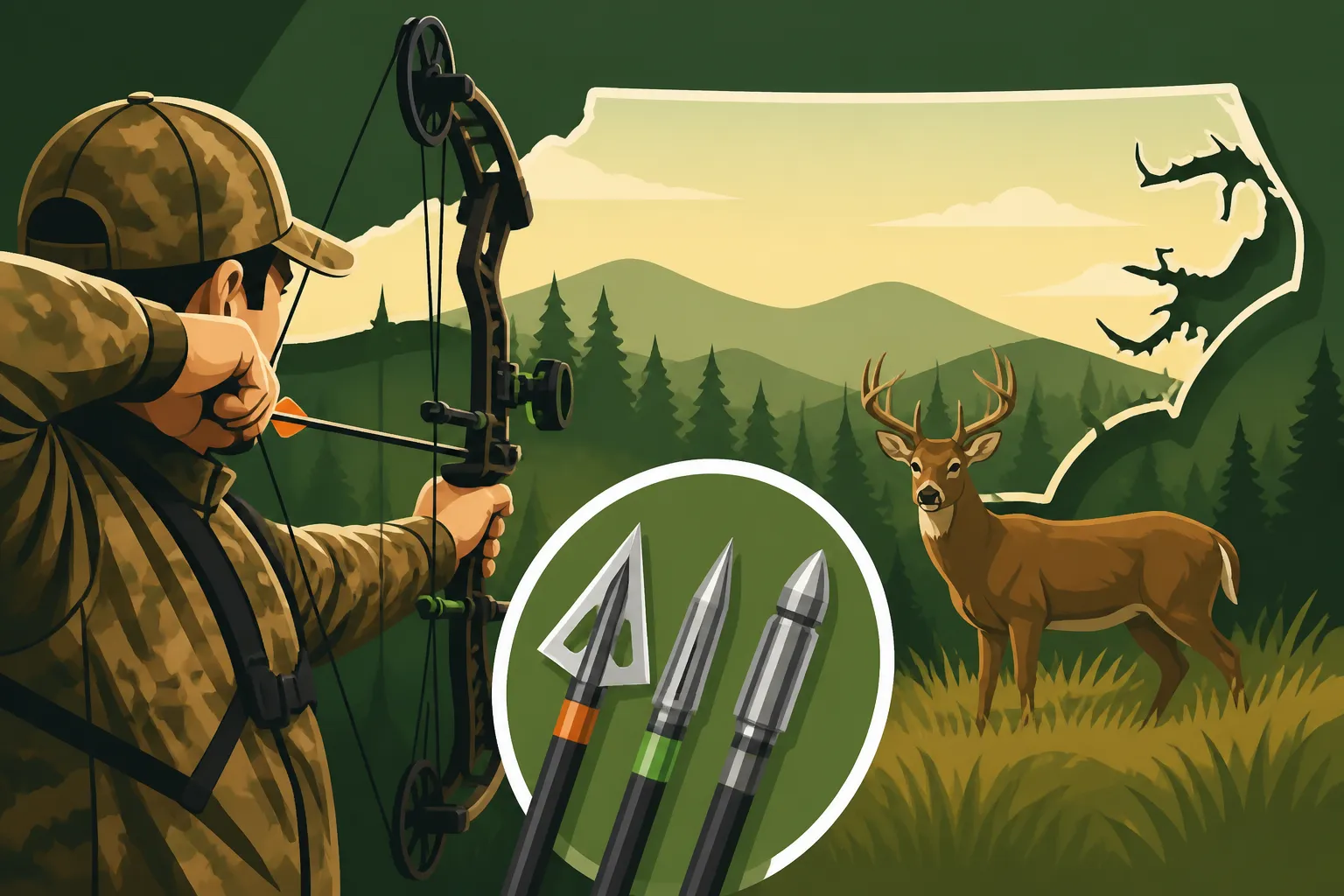
Your broadhead is the business end of your arrow, and its design plays a huge role in penetration, especially with a heavier arrow. Fixed-blade broadheads, known for their robust construction and bone-splitting capabilities, pair exceptionally well with heavier arrows. The increased momentum of a heavy arrow helps a fixed blade slice through tissue and bone more efficiently, making it a formidable combination for pass-throughs. For those inevitable close-range shots where a deer might be slightly quartering or bone is a concern, a fixed blade on a heavy arrow gives you maximum confidence. You can learn more about the options in Fixed Versus Mechanical Broadheads.
Mechanical broadheads can also work with heavier arrows, and some hunters prefer them for their larger cutting diameter and often field-point-like flight. However, ensure that if you choose a mechanical, it's a robust design that holds up to impact. A heavier arrow will help drive even larger-cutting mechanicals through, ensuring they deploy and perform as designed, even if they hit a rib. The key is to choose a broadhead that complements the arrow's weight and your expected hunting conditions. For aggressive penetration at short range, a good fixed blade is hard to beat when paired with a heavy arrow.
Tuning Your Bow for Optimal Short-Range Performance
No matter how perfect your arrow weight and FOC, if your bow isn't properly tuned, you're leaving performance on the table. Tuning is paramount for accuracy, consistency, and maximizing penetration. A well-tuned bow sends an arrow perfectly straight, minimizing any "fishtailing" or "porpoising" that can rob an arrow of energy and cause erratic flight, particularly crucial when that shot window is tight.
Paper tuning, bare shaft tuning, and walk-back tuning are all methods you should employ to ensure your bow is shooting bullet holes. When you increase arrow weight or FOC, it often requires a slight adjustment to your rest or cam timing to get the arrow flying perfectly. Don't overlook this step! It's not just about a pretty hole in paper; it's about making sure every ounce of that arrow's momentum is driving forward in a straight line towards your target. A properly tuned bow ensures that your heavy arrow system performs at its peak, whether you're taking a 10-yard shot from a ground blind or a 30-yard shot from a treestand.
Testing and Refining Your Short-Shot Arrow System
The real proving ground for any hunting setup isn't the pro shop; it's your own backyard range and eventually, the woods. You need to know exactly how your chosen arrow weight and broadhead combination performs under realistic North Carolina hunting conditions. Don't assume anything; test everything.
Field Testing at Realistic North Carolina Distances
Start by shooting your complete hunting setup – broadheads and all – at various short distances. Focus on 10, 20, 30, and maybe 40 yards. Pay attention to how your broadheads fly compared to your field points. Ideally, they should hit the same spot. If they don't, it's a sign you need further tuning. Don't be afraid to shoot through small gaps or from awkward positions that mimic real hunting scenarios. Set up a target at the base of a tree, or from a treestand, to simulate those downward angles you often encounter.
Practice shooting from your actual treestand or ground blind if possible. How does the arrow clear your bow accessories or the blind window? Does the heavier arrow feel different to shoot? What kind of groups are you getting at each distance? You're not just looking for tight groups; you're looking for consistent, repeatable accuracy that gives you absolute confidence when that moment of truth arrives. A heavy arrow might drop a touch more at 40 yards, but at 20, the difference is negligible, and the penetration boost is undeniable.
Data Tracking and Personal Preference
As you test, keep notes. Track your arrow weight, FOC, broadhead choice, and how they perform. This data becomes invaluable as you refine your setup. Tools and apps like those offered by GoHunt can help you log your shooting sessions, track your arrow builds, and even calculate kinetic energy and momentum. This kind of detailed tracking allows you to make informed decisions rather than just guessing.
Ultimately, personal preference plays a huge role. While the physics lean towards heavier arrows for penetration, you still need to be comfortable and confident with your setup. Does the heavier arrow feel good in your hand? Can you consistently make accurate shots with it? If you're struggling with accuracy, even a perfectly heavy, high-FOC arrow won't do you any good. Find that sweet spot where science meets comfort, where you know without a doubt that when you release that arrow on a North Carolina whitetail, it's going to do its job, delivering a swift and ethical harvest. Sometimes, simply knowing your setup is maximized for penetration can boost your confidence more than anything else.
| Arrow Component | Impact on Short Shots | Benefit for North Carolina Hunting |
|---|---|---|
| Heavy Shaft | Increased momentum, less speed | Better penetration through hide/bone, minimal trajectory impact at close range |
| High FOC | Improved stability, deeper penetration | Flies true through brush, enhances broadhead-first impact |
| Fixed Broadhead | Maximum cutting & bone-breaking | Reliable performance on quartering shots, no deployment issues |
| Robust Mechanical | Large cutting diameter, good flight | Wider wound channels (ensure good penetration with heavy arrow) |
| Proper Tuning | Pinpoint accuracy, energy retention | Consistent, ethical kills, especially from tight treestand angles |
When North Carolina's hunting season rolls around, especially during North Carolina's Gun Deer Season by Zone or Bowhunting North Carolina's Statewide Archery Season, you want to be as prepared as possible. Taking the time to dial in your arrow weight for those short, critical shots will significantly increase your chances of a successful and humane harvest.
Disclaimer
This article is for general informational purposes only and does not constitute professional advice. Laws, prices and regulations vary by location and change over time. Consult a qualified professional for guidance on your specific situation.