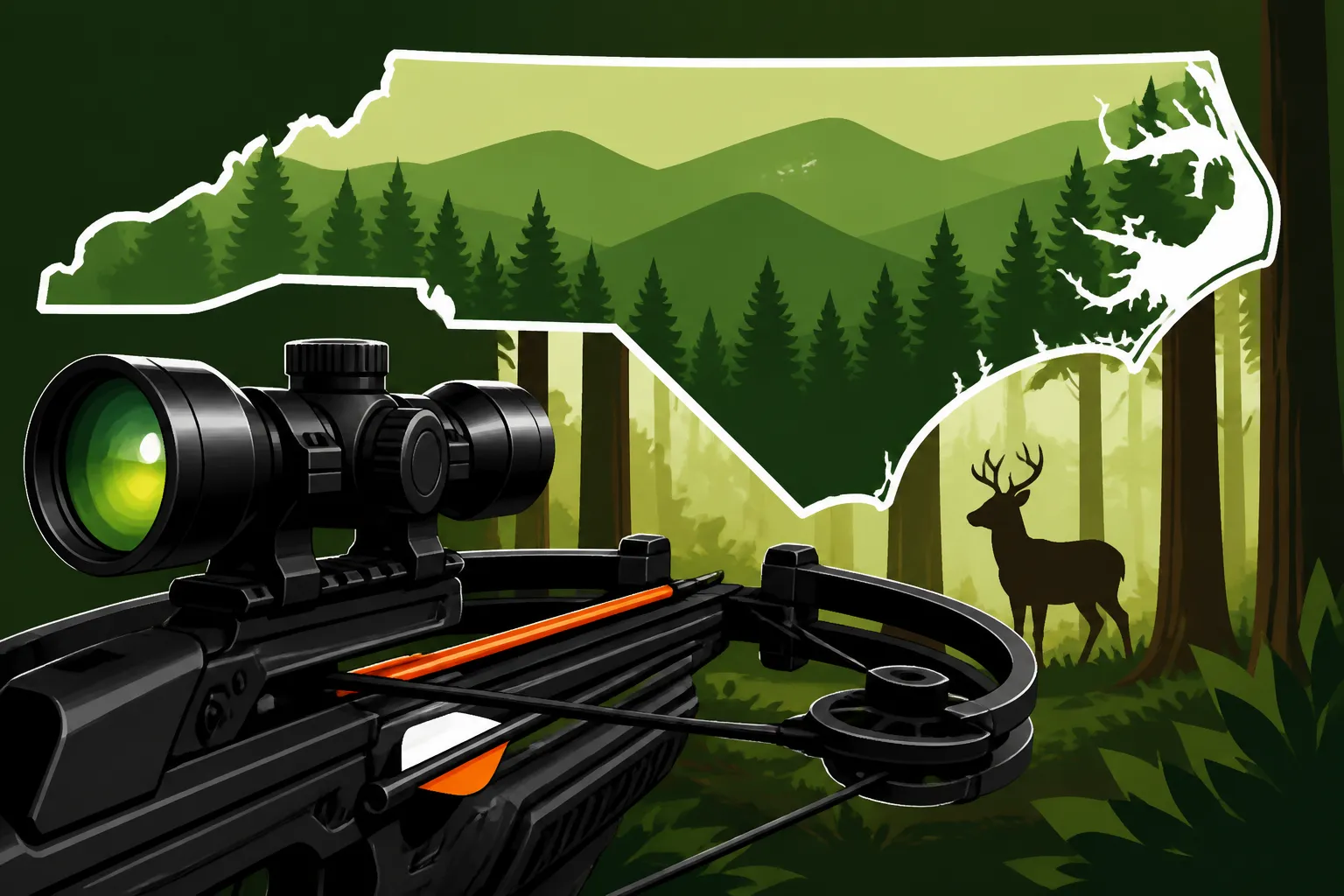
Crossbow Scopes for North Carolina Timber Ranges
There's nothing quite like the thrill of hunting North Carolina's timber, whether it's the dense hardwoods of the Piedmont, the steep slopes of the mountains, or the thick pocosin swamps of the coast. But let's be real, those tight, tangled woods can be a real headache for crossbow hunters. Estimating range, dealing with low light, and finding a clear shot through all that foliage makes choosing the right scope absolutely critical. This guide is here to help you cut through the confusion and select, set up, and use a crossbow scope that will genuinely give you an edge in our challenging timber ranges.
Understanding North Carolina Timber Hunting Challenges
Hunting in North Carolina's timber is a world away from open-field hunting, and your equipment needs to reflect that reality. The very things that make our woods so beautiful and productive for wildlife also make them incredibly demanding for hunters trying to get an ethical shot. We're not talking about wide-open Western landscapes here; we're talking about a landscape that often feels like a giant green (or brown, depending on the season) wall.
Navigating Low Light Conditions
One of the biggest frustrations when hunting North Carolina's timber is the perpetually dim light, especially during legal shooting hours. Think about it: early morning, late evening, cloudy days, or dense canopies of mature oaks and pines. All these factors combine to create an environment where light is at a premium. Your eyes are working overtime, and if your scope isn't up to the task, you'll struggle to clearly identify your target, pick out vital zones, or even see your reticle against a dark background. This isn't just about comfort; it's about ethical shot placement. You need a scope that gathers as much light as possible and presents a clear, bright image, even when the forest floor is shrouded in shadow.
It’s often those critical first and last 30 minutes of shooting light where deer are most active, moving through bedding areas or heading to feed. If your scope dims out too much, you’re essentially shortening your effective hunting window. Many a seasoned hunter has cursed a cheap scope when a trophy buck steps out of a thicket just as the sun dips below the horizon, rendering the crosshairs invisible. Having a scope with good glass and a decent objective lens size can make all the difference between a missed opportunity and a successful hunt.
Overcoming Dense Foliage and Range Estimation
North Carolina's timber is often synonymous with thick cover – undergrowth, vines, fallen logs, and a seemingly endless maze of trees. This dense foliage doesn't just block your view; it plays tricks on your eyes when it comes to range estimation. A deer at 30 yards can look like it's 50, and vice versa, especially when there are branches between you and the animal. Crossbows, like traditional bows, have specific effective ranges, and knowing that distance accurately is non-negotiable for a clean kill. Without proper range estimation, even the best scope is just a window. This is why many hunters rely on rangefinders, but your scope still needs to offer clarity through the clutter.
Imagine you're on a deer drive in one of our many Deer Drives With Three or Four Hunters scenarios, or still-hunting through a thick Piedmont woodlot. You might get a quick glimpse of a deer moving through the trees, with only a small shooting lane opening up for a second. In such a fleeting moment, you need a scope that allows you to pick out the animal quickly, gauge the distance with your rangefinding reticle (if equipped), and make a precise shot without delay. The ability to distinguish your target from the surrounding brush is paramount, and a poor scope will only amplify the "branch deflection" anxiety we all know too well.
Adapting to Varied Terrain
From the steep, rocky inclines of the Blue Ridge Mountains to the flat, boggy expanses of the coastal pocosins, North Carolina's terrain is incredibly diverse. Each environment presents its own set of challenges for your crossbow scope. In the mountains, you might be taking shots at varying upward or downward angles, which can subtly affect arrow trajectory. On the coast, constant humidity, sudden downpours, and even salt spray can fog up lenses or corrode unprotected components. Your scope needs to be robust enough to handle these extremes, resisting moisture, shock, and changes in temperature without losing its zero or clarity.
When you're Hunting Blue Ridge Escarpment Ridgelines or Hunting Coastal Plain Pocosin Swamps, your gear takes a beating. Scopes get bumped, scraped, and exposed to all sorts of weather. A cheap scope might fog up internally after a humid morning turns into a rainy afternoon, or lose its zero if you slip and fall on a rocky trail. Investing in a scope designed to withstand these conditions is not just about protecting your gear; it's about ensuring your crossbow is always ready for that critical moment. Reliability in varied terrain is a non-negotiable feature for any serious North Carolina hunter.
Key Features to Look for in a Crossbow Scope
When you're trying to pick out the perfect crossbow scope for North Carolina's diverse and often dense timber, it's easy to get overwhelmed by all the options. But focusing on a few key features will help you narrow down the field and find a scope that genuinely enhances your hunting experience.
Magnification and Reticle Design
For timber hunting, you generally don't need excessive magnification. In fact, too much zoom can be a hindrance, narrowing your field of view and making it harder to track a moving animal in thick cover. A fixed power of 3x or 4x, or a variable power scope in the 1.5-5x or 2-7x range, is usually ideal. The goal is to see enough detail for an ethical shot without losing situational awareness. More important than raw magnification, however, is the reticle design. Crossbow-specific reticles typically feature multiple aiming points (hash marks, circles, or dots) calibrated for different distances. These help you compensate for arrow drop without constantly adjusting your turrets, which is crucial for quick shots in the woods.
When I’m out chasing deer, I often find myself taking shots that are under 40 yards, sometimes even closer if I'm Hunting a Funnel Between Two Pocosins or set up tight in a thicket. A cluttered reticle with too many lines can be distracting, but having clear, distinct aiming points for 20, 30, and 40 yards is a game-changer. Some scopes even offer illuminated reticles, which can be incredibly helpful in those low-light timber scenarios, allowing you to see your aiming point clearly against a dark target without washing out the image. It's not about having the fanciest reticle, but the most functional one for the ranges you’ll actually encounter in our woods.
Durability and Weatherproofing
North Carolina weather can be notoriously unpredictable, swinging from humid warmth to chilly rain or even unexpected snow, sometimes all in the same week during deer season. Your crossbow scope will be exposed to it all. This is why durability and weatherproofing are non-negotiable. Look for scopes that are advertised as fog-proof, waterproof, and shock-proof. Fog-proofing usually means the scope is purged with inert gases like nitrogen or argon, preventing internal condensation. Waterproofing ensures that a sudden downpour or even an accidental dunk won't ruin your optics. Shock-proofing is critical for a device that will inevitably get bumped and jostled while navigating tough terrain or being transported.
A scope built to last will have a robust, single-piece tube construction, usually aircraft-grade aluminum. The turrets should feel solid and offer tactile clicks for adjustments, and the lens coatings should be tough enough to resist scratches while improving light transmission. Remember, if you’re heading out for Hunting North Carolina's Year-Round Feral Hogs or chasing turkeys in a spring rain, your gear needs to perform without fail. A scope that fogs up or loses its zero after a bump isn't just frustrating; it can mean a missed opportunity or, worse, a wounded animal. Investing in a well-made scope now will save you headaches and potentially ruined hunts down the road.
Eye Relief and Field of View
Good eye relief and a generous field of view (FOV) are often overlooked but incredibly important for timber hunting. Eye relief is the distance your eye needs to be from the eyepiece to see a full, clear image. Sufficient eye relief prevents "scope bite" (where the recoil drives the scope into your eyebrow) and allows for quick target acquisition, especially when you're wearing glasses or heavy clothing. A wider field of view, on the other hand, lets you see more of your surroundings through the scope, which is essential for tracking an animal moving through dense cover or scanning for other deer in a group.
Imagine you're tucked into a ground blind, waiting for a deer to emerge from a thick pine plantation. A wide field of view will let you spot movement on the periphery of your vision sooner, allowing you to react quicker. If you’re trying to track a moving deer in a situation like Deer Drives With Three or Four Hunters, a narrow field of view will make it feel like you’re looking through a soda straw. Combine good eye relief with a broad field of view, and you’ll find it much easier to acquire targets quickly and maintain awareness of the overall hunting scene, even in our tightest North Carolina woods.
Optimizing Your Crossbow Scope for North Carolina's Woods
Having a great crossbow scope is only half the battle; knowing how to optimize it for the unique conditions of North Carolina’s timber is where you really gain an advantage. It’s about more than just mounting it; it’s about making it an extension of your natural hunting instincts.
Sighting In for Different Ranges
The most crucial step in optimizing your crossbow scope is proper sighting in. For timber hunting, you'll want to focus on typical shot distances – usually 20, 30, and 40 yards, potentially 50 if your crossbow and skill allow. While most crossbow scopes have multiple aiming points, it's vital to verify each one with actual shooting. Don't just trust the factory calibrations; every crossbow, arrow, and broadhead combination will shoot slightly differently. Start by zeroing your main reticle at 20 yards, then move back to 30 and 40 yards, using the corresponding hash marks or dots. Make precise adjustments until your arrows consistently hit where those reticle points indicate.
I always recommend shooting a few practice broadheads (or broadhead-weight field points) to confirm your setup, especially before North Carolina's Archery Season Opening Day. There’s a noticeable difference between how field points and broadheads fly, and you want to be completely confident in your setup. If your scope has custom ballistic turrets or an app that helps you generate specific holdovers for your setup, take the time to use it. Many hunters use tools like a rangefinder and the GoHunt app to scout potential shooting lanes and estimate distances, then meticulously sight in their crossbow for those exact scenarios. Knowing your exact holds for various distances in the specific conditions you'll hunt is paramount for ethical shots.
Adjusting for Light and Weather
North Carolina timber often means hunting in varying light conditions. Your scope should ideally have multi-coated lenses that maximize light transmission, giving you a brighter, clearer image in dim light. Some scopes also offer an illuminated reticle with adjustable brightness settings. Learn to use these settings effectively. In bright sunlight, you might not need illumination at all, or just a low setting. In deep shadows or at dawn/dusk, a brighter setting can make your reticle pop, but be careful not to make it so bright that it creates glare or obscures your target. Practice adjusting your reticle's brightness quickly and instinctively.
Weather also plays a huge role. Rain, fog, and humidity can all impact visibility. Ensure your scope's external lenses are clean and treated with a good water-repellent coating. Keep lens caps on when not actively hunting to protect them. If you're using a crossbow scope for deer hunting during Muzzleloader Deer Hunting in North Carolina in December, you might even encounter some unexpected snow. The goal is to maintain clear vision no matter what Mother Nature throws at you. A little preparation and knowing your scope's capabilities in different light and weather can greatly reduce missed opportunities.
Utilizing Ballistic Reticles and Apps
Many modern crossbow scopes come equipped with ballistic reticles that have specific aiming points for various distances. These are incredibly useful for timber hunting, where shots can present quickly at unpredictable ranges. To optimize their use, first, accurately sight in your crossbow as described above. Then, get a reliable rangefinder. Use your rangefinder to get an exact distance to your target, and then use the corresponding aiming point on your reticle. This takes the guesswork out of holdover, allowing for faster, more confident shots.
Some newer scopes even integrate with smartphone apps or have built-in rangefinding capabilities. While these can be powerful tools, it's crucial to practice with them extensively before you're in the field. Don't let technology replace your fundamental hunting skills or add unnecessary complexity when a deer is in front of you. Tools like GoHunt can help you map out your hunting area, marking distances to potential shooting lanes or landmarks, which can then be directly applied to how you interpret your scope's ballistic reticle. Knowing the lay of the land and having a well-calibrated scope working in tandem is a recipe for success.
Practical Tips for Hunting with a Crossbow Scope in NC
Beyond simply having the right gear and knowing how to adjust it, there are practical, in-the-field tips that can truly elevate your crossbow hunting success in North Carolina's timber. These are the things that often separate a successful hunt from a frustrating one.
Pre-Season Practice and Familiarity
This might sound obvious, but you'd be surprised how many hunters don't put in enough quality practice with their crossbow and scope. For timber hunting, practice shooting from various positions: standing, kneeling, sitting, and even through small shooting lanes you create at home or on a range. Simulate real hunting scenarios. Are you shooting from a treestand? Practice from an elevated position. Are you using a ground blind? Practice shooting from within it. The more familiar you are with your crossbow and scope combo, the more instinctive your movements will be when a deer steps out.
One of the best pieces of advice I ever got was to shoot my crossbow in the clothes I planned to hunt in. Bulky jackets, facemasks, or even the way your backpack sits can affect your anchor point and scope alignment. Head out to the range or your backyard and practice acquiring targets quickly through your scope. Use a timer to see how fast you can identify a target, range it, and get a solid aim. This builds muscle memory, which is invaluable when that moment of truth arrives and you only have a few seconds to make a decision. Remember, confidence in your equipment comes directly from consistent, realistic practice.
On-Stand Setup and Shooting Lanes
When you get into your treestand or ground blind in North Carolina's timber, don't just sit down and wait. Take a few minutes to assess your shooting lanes through your scope. Identify any branches or foliage that might deflect an arrow at common deer travel routes. Use your rangefinder to mark exact distances to trees, stumps, or other landmarks within your effective shooting range. Knowing that the big oak is at 30 yards and the thick holly bush is at 25 can save you precious seconds when a deer appears. Use a tool like GoHunt to visualize your exact stand location and potential shot opportunities before you even climb up.
I’ve spent countless hours up in a stand, carefully trimming shooting lanes for Treestand Setups in Pisgah National Forest or Hanging a Stand on a Pisgah Ridge. A scope's clear view is useless if a twig is in the way. Always identify your primary, secondary, and even tertiary shooting lanes. And just as importantly, practice drawing your crossbow and swinging it through these lanes silently before legal shooting light. Make sure your scope doesn't clang against anything, and you can smoothly acquire a target across your potential shooting arc. This pre-shot preparation, combined with a well-optimized scope, dramatically increases your chances of success.
Ethical Shot Placement and Follow-Through
No matter how fancy your crossbow or how clear your scope, ethical shot placement is paramount. In timber, deer often appear and disappear quickly. Use your scope to pick out the vital zone – the lungs and heart – and don't take a shot if you're not absolutely confident you can hit it. A well-placed arrow from a crossbow is incredibly effective, but a marginal hit can lead to a long, difficult, and potentially unsuccessful recovery. Your scope should give you the clarity and precision needed to make that ethical decision every time.
After the shot, don't immediately drop your crossbow. Keep your eye in the scope and watch where the animal runs. Try to pick out a landmark: "He went past the big double oak at 40 yards, then dipped into the creek bottom." This information is invaluable for tracking. Blood Trailing After Dark in North Carolina can be incredibly challenging, so any visual cues you can gather immediately after the shot will greatly aid in recovery. Your scope is not just for aiming; it's a tool for observation before and after the shot, helping you ensure a swift, clean kill and a successful harvest.
Remember, patience and preparation are your greatest allies when hunting North Carolina's timber with a crossbow.
| Scope Feature | Importance for NC Timber Hunting | Why It Matters |
|---|---|---|
| Magnification | Moderate (1.5-5x or 2-7x variable, or 3-4x fixed) | Avoids narrow FOV; ideal for 20-50 yard shots in dense cover. |
| Reticle Design | Ballistic with multiple aiming points, optionally illuminated | Aids in quick range estimation, clear aiming in low light. |
| Light Transmission | High (multi-coated lenses, good glass) | Crucial for low-light conditions at dawn/dusk and under heavy canopy. |
| Durability | Fog-proof, waterproof, shock-proof | Withstands NC's humidity, rain, accidental bumps; maintains zero. |
| Eye Relief | Generous (3.5 inches or more) | Prevents scope bite, allows quick target acquisition, good with glasses. |
| Field of View | Wide | Helps track moving deer in thick brush, maintains situational awareness. |
| Weight & Size | Compact and lightweight | Easier to carry through dense woods; less bulk in a treestand or ground blind. |
Disclaimer
This article is for general informational purposes only and does not constitute professional advice. Laws, prices and regulations vary by location and change over time. Consult a qualified professional for guidance on your specific situation.