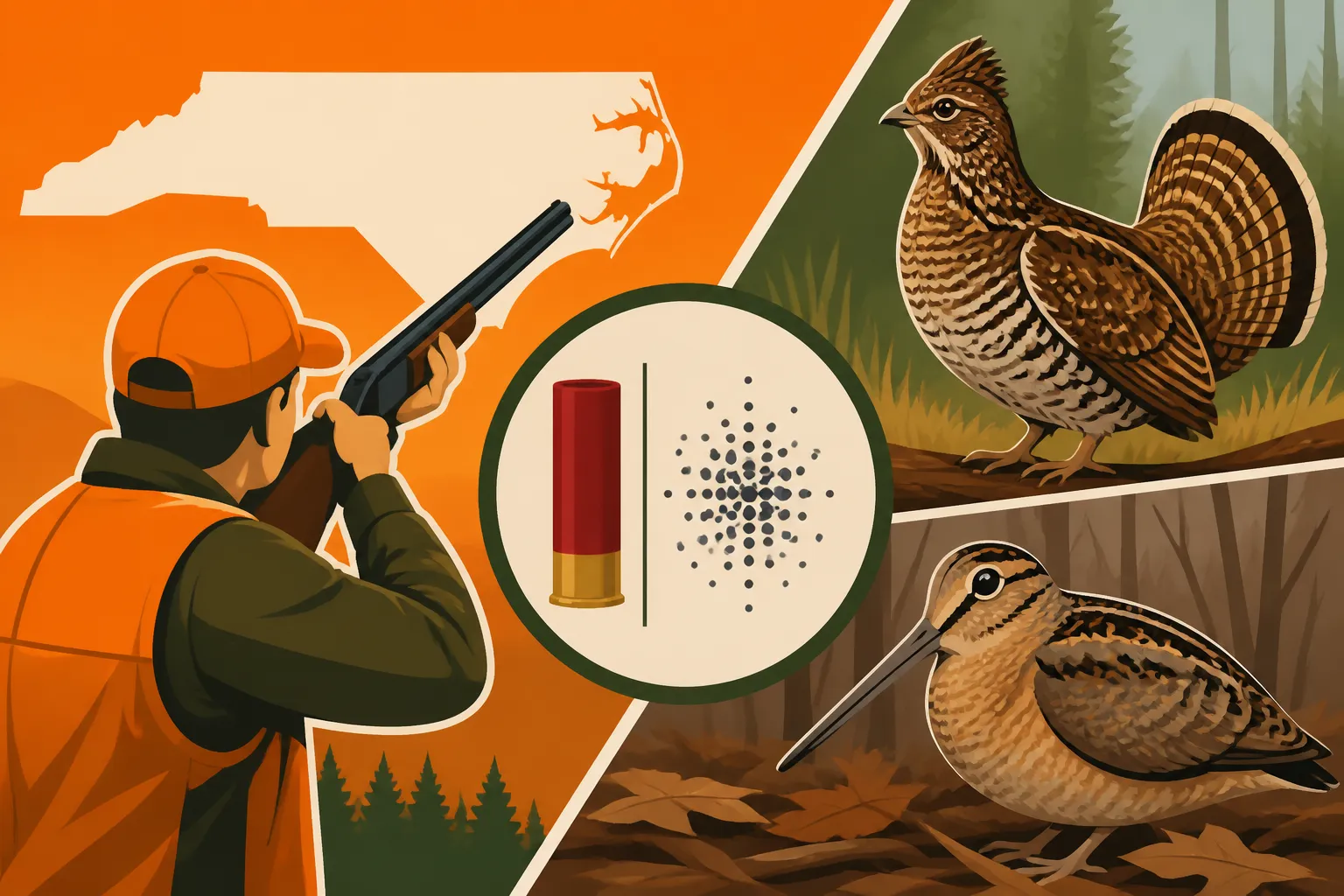
Shot Size for Grouse and Woodcock
Choosing the right shot size for upland birds like grouse and woodcock in North Carolina can feel like a guessing game. With dense cover in the mountains and soggy bottoms along the coast, a hunter faces a myriad of scenarios where pellet count and energy really matter. This guide is here to untangle the complexities of ammunition selection, helping you make informed decisions for more successful and ethical hunts across our diverse landscapes.
Understanding the Challenges of North Carolina Upland Birds
North Carolina offers unique, challenging hunting experiences for both ruffed grouse and American woodcock. These aren't your typical field birds; they demand specific tactics and, yes, specific shot considerations due to their habitats and flight patterns. Understanding these birds and their environments is the first step toward choosing the perfect load.
The Elusive Ruffed Grouse in Mountain Cover
Ruffed grouse are truly special, and often considered the pinnacle of upland hunting in North Carolina's western mountains. These birds thrive in the thick, regenerating clear-cuts, mountain laurel slicks, and rhododendron tangles of places like Pisgah and Nantahala National Forests. When a grouse flushes, it's usually explosive, loud, and incredibly fast, often with trees and dense vegetation between you and the bird. You're rarely getting a long-range shot. More often, it’s a blur of wings bursting from ten to twenty yards away, disappearing into the next thicket in a heartbeat.
The challenge with grouse isn't usually hitting them with a powerful enough pellet, but rather putting enough pellets through the dense cover to connect. A spread-out, dense pattern is often more critical than brute force. They aren't particularly large birds, but their flight path makes them tricky. You need a load that can deliver a sufficient number of pellets to the target quickly and efficiently, even if many are deflected by twigs and leaves. Many hunters spend years trying to figure out the best approach to these birds, finding that every flush is a new puzzle. For more insights into their habitat, check out Ruffed Grouse in the North Carolina Mountains.
Woodcock: The Timberdoodle's Unique Flight
American woodcock, affectionately known as timberdoodles, present an entirely different set of challenges. These migratory birds prefer wet, boggy, early successional habitats—think alder thickets, creek bottoms with dense saplings, and overgrown fields, often found in the Piedmont and Coastal Plain. Unlike grouse, woodcock are typically slower fliers, but their flight is incredibly erratic, a twisting, turning, almost corkscrew-like ascent before they level out and zip away. This unpredictable pattern can throw off even experienced shooters.
Shots at woodcock are almost always close-range, often within 15 to 25 yards, as they burst from the cover. Their bodies are relatively delicate compared to other upland birds, meaning you don't need a huge, hard-hitting pellet to bring them down ethically. What you do need is a very dense pattern to account for their erratic flight path and the narrow windows of opportunity in thick cover. If you can get a few pellets on them, that's usually enough. Understanding their migration and preferred habitat can be aided by resources that track migratory bird movements, or by checking out North Carolina's Place on the Woodcock Flight.
Deciphering Shot Sizes for Upland Hunting
Now that we've touched on the nature of these magnificent birds and their environments, let's dive into the core of the matter: shot size. It's not just about what sounds powerful; it's about what works effectively and ethically for these specific game animals. Getting this right is paramount for a successful outing.
The Role of Pellet Count and Energy
When you look at different shot sizes, remember this simple rule: the smaller the number, the larger the pellet. Conversely, a larger number means a smaller pellet. For example, #7.5 shot is larger than #9 shot. This difference directly impacts two critical factors: pellet count and individual pellet energy.
Smaller shot, like #9, means you get a lot more pellets in each shell. This creates a denser pattern, increasing the statistical chance of hitting a fast-moving or erratically flying bird, especially in thick cover where many pellets might be deflected. The trade-off is that each individual #9 pellet carries less kinetic energy. For smaller birds like woodcock, this is usually perfectly adequate. However, for a tougher bird like a grouse, or at slightly longer ranges, a single #9 pellet might not always deliver enough knockdown power for an instant, humane kill. This is why it’s a balancing act: density versus individual punch.
Larger shot, such as #7.5 or #6, has fewer pellets per shell. This means a more open pattern, but each pellet carries significantly more energy. This extra energy helps penetrate feathers and tissue more effectively, increasing the chances of a clean kill on birds that might be tougher or encountered at the outer limits of typical upland range. The challenge is that with fewer pellets, your margin for error on a rapidly flushing or twisting bird is reduced. You need to be more precise. Many North Carolina hunters leverage mapping tools like GoHunt to scout areas that might present more open shots, where that extra pellet energy might come in handy. It’s all about understanding the probabilities and adjusting to the conditions.
Common Shot Sizes for Grouse and Woodcock
For grouse and woodcock, hunters generally gravitate towards smaller shot sizes to maximize pattern density. Here’s a look at the most common choices and why they're favored:
- #7.5 Shot: This is often considered a versatile choice, especially for grouse. It offers a good balance of pellet count and individual pellet energy. It's robust enough for a clean kill on a grouse at reasonable distances, while still providing a decent pattern density for breaking through some light cover. Many hunters running a 12-gauge or a 20-gauge for grouse in the mountains will start with #7.5.
- #8 Shot: A popular choice for both species, particularly in situations where shots are expected to be close and cover is dense. You get more pellets than with #7.5, leading to a denser pattern, which is great for the erratic flight of woodcock. For grouse, it's still effective at close ranges, but some hunters prefer a bit more punch if shots might extend past 25 yards.
- #9 Shot: Often the preferred choice for woodcock, and an excellent option for grouse in extremely thick cover where shots are almost always under 20 yards. The sheer pellet count of #9 shot dramatically increases your chances of connecting with a small, erratically flying woodcock. While individual pellets have less energy, for woodcock, the high pellet count ensures enough hits for a clean kill. For grouse, it’s best reserved for very close, tight flushes.
Here's a quick comparison to help visualize the differences:
| Shot Size | Pellets per Ounce (approx.) | Individual Pellet Energy (Relative) | Ideal Range (yards) | Primary Target | Notes |
|---|---|---|---|---|---|
| #7.5 | 345 | Medium-High | 20-35 | Grouse, Woodcock | Good all-around, better for grouse |
| #8 | 410 | Medium | 15-30 | Woodcock, Grouse | Versatile, excellent pattern density |
| #9 | 585 | Low-Medium | 10-25 | Woodcock, Grouse | Maximum pellet count, ideal for woodcock |
When considering these options, a lot of seasoned hunters lean on resources like GoHunt to analyze game bird distribution and habitat types specific to their hunting areas, which can influence whether they favor more pellets or more punch.
Matching Shot Size to North Carolina's Hunting Scenarios
North Carolina's varied terrain means that a "one-size-fits-all" approach to shot selection rarely works. What's perfect for a grouse flush in a mountain laurel tangle isn't necessarily ideal for a woodcock in a coastal plain bog. Let's break down how to best match your ammunition to the environment you'll be hunting.
Dense Mountain Laurel for Grouse
Hunting ruffed grouse in the mountains of North Carolina, particularly in the vastness of the Blue Ridge Escarpment, often means navigating incredibly dense cover. Think about those notorious rhododendron and mountain laurel thickets where visibility is minimal and a flushing bird appears and vanishes in milliseconds. In these scenarios, your shots are almost always at very close range—often under 20 yards, sometimes even closer. The primary challenge isn't the bird's toughness, but simply getting enough pellets through the vegetation to make a connection.
For these tight quarters, pattern density is king. Many experienced grouse hunters will opt for #8 or even #9 shot, paired with a very open choke like Skeet or Improved Cylinder. The goal is to create a wide, forgiving pattern that can encompass the bird quickly, even if a significant portion of the shot stream gets hung up in the branches. While #7.5 shot can also work, the increased pellet count of #8 or #9 gives you a better chance of scoring multiple hits on a rapidly disappearing target. It's a game of fractions in these environments, and every pellet counts. Consider reading up on Grouse Hunting Blue Ridge Cover to get a better feel for the terrain you'll encounter.
Swampy Bottomlands for Woodcock
Shift gears from the mountains to the low-lying, often swampy creek bottoms and regenerating clearings found in the Piedmont and Coastal Plain, and you're squarely in woodcock country. Here, the cover is typically dense with small trees, alders, and vines, but it's not the impenetrable wall of mountain laurel. Woodcock flushes are distinct: a fluttering, erratic ascent, often topping out just above the tree line before darting away. Shots are consistently close, rarely exceeding 25 yards, and often much closer.
Given the woodcock's smaller size and relatively delicate build, along with their erratic flight, maximizing pellet count is almost always the priority. #8 and #9 shot shine here. The dense pattern they produce is incredibly effective at intercepting the bird's unpredictable movements. You don't need excessive pellet energy; a few #8 or #9 pellets will humanely dispatch a woodcock at these ranges. Coupling these smaller shot sizes with an Improved Cylinder or Skeet choke will ensure a broad, effective pattern for quick, instinctive shots. It's a high-probability strategy for a high-excitement bird. Understanding Woodcock Singing Ground Surveys can also give you insight into their preferred local habitats.
Considering Your Choke and Shotgun Gauge
Shot size isn't an island; it works in concert with your choke and shotgun gauge to create the overall pattern. Your choke dictates how tightly or openly your shot string spreads after leaving the barrel. For grouse and woodcock, you're almost universally looking for a more open choke.
- Choke Selection: Improved Cylinder (IC) and Skeet chokes are prime choices. They allow the shot pattern to open up quickly, which is exactly what you need for close-range, fast-flushing birds in thick cover. A Modified choke might be acceptable for more open grouse cover, but generally, anything tighter is going to be too constricting, leading to blown patterns at typical upland ranges and missed birds. If you're running an over/under or side-by-side, consider an even more open choke in the first barrel (e.g., Skeet) for the initial close shot, and a slightly tighter one (e.g., IC) in the second barrel for a follow-up if the bird manages to put a little distance on you.
- Shotgun Gauge: While 12-gauge shotguns are common, many upland enthusiasts prefer lighter, faster-swinging guns like 20-gauge or even 28-gauge. A 20-gauge is a fantastic all-around choice for North Carolina grouse and woodcock. It's light to carry through tough cover, offers less recoil for faster follow-up shots, and still delivers a perfectly adequate payload of #7.5, #8, or #9 shot for these birds. If you're specifically thinking about a more traditional upland setup, delve into 20 Gauge Doubles for Grouse Cover. Even the smaller 28-gauge, with its elegant handling and surprising pattern density, can be incredibly effective for woodcock and close-quarters grouse when loaded with #8 or #9 shot. The key is to find a gauge that you can shoot comfortably and effectively in dynamic situations.
Practical Tips and Field Considerations
Beyond the numbers and theories, real-world application is what truly matters in the field. North Carolina’s diverse hunting grounds, from the high elevations to the dense coastal swamps, present unique challenges. Here are some practical tips to help you finalize your shot size decision and ensure ethical, enjoyable hunting.
Patterning Your Shotgun
This cannot be stressed enough: pattern your shotgun with your chosen loads and chokes. There's no substitute for seeing how your specific firearm, choke, and ammunition combination performs on paper. Every shotgun is an individual, and what patterns perfectly in one might be mediocre in another. A load that produces a fantastic, dense pattern in your buddy's 20-gauge with an Improved Cylinder choke might throw a patchy, inconsistent pattern in yours.
Head to the range with large sheets of paper (30-inch by 30-inch is a good start) and shoot at typical grouse and woodcock ranges—say, 20, 25, and 30 yards. Pay close attention to the density of the pattern, looking for any holes or gaps that a bird could slip through. Also, note the distribution of pellets, ensuring a consistent spread across the target. This exercise will give you invaluable confidence in your setup, allowing you to focus on the hunt itself rather than second-guessing your gear. It’s an essential step that often gets overlooked but can drastically improve your success rate and, more importantly, ensure cleaner kills. GoHunt offers resources and articles detailing how to properly pattern shotguns, which can be quite helpful.
Carrying Mixed Loads
For hunters using an over/under or side-by-side shotgun, carrying mixed loads is a fantastic strategy to adapt to varying situations. While not always common for upland, it offers incredible versatility. Imagine this scenario: you're walking through a thicket known for both grouse and woodcock. You could load your first barrel (often choked more openly) with a #9 shot for a close, erratic woodcock flush, and your second barrel (perhaps with an Improved Cylinder choke) with a #7.5 shot, ready for a longer, tougher grouse shot if it busts out further.
This method allows you to be prepared for the highest probability shot first, while having a slightly different option immediately available. It minimizes the need to carry multiple boxes of shells and makes quick adjustments seamless. Just be sure you know which barrel is loaded with which shot size! For those long walks through challenging terrain, especially if you're exploring deep into public lands like Pisgah National Forest, every ounce of efficiency in your gear counts. You might even consider how Barrel Length for Walking Thick Cover affects your swing with different loads.
Ethical Harvesting and Clean Kills
Ultimately, the goal of any hunter is an ethical, clean kill. Choosing the right shot size and choke combination plays a crucial role in achieving this. An underpowered load or a too-sparse pattern leads to wounded birds, which is something every responsible hunter wants to avoid. Conversely, an overpowered load at close range might damage too much meat, though this is less of a concern with grouse and woodcock than with larger game.
By dedicating time to understanding pellet dynamics, patterning your shotgun, and matching your ammunition to the specific bird and habitat, you significantly increase your chances of a humane harvest. This respect for the game and the act of hunting is a cornerstone of our tradition. Always strive for that clean shot, ensuring the bird expires quickly. A good Upland Vests With Water Capacity is also key, especially on warm early season days, for you and any bird dogs you might be running. Remember, you're traversing sometimes brutal terrain, so proper apparel like Brush Pants for North Carolina Mountain Laurel and sturdy Boots for Walking North Carolina Ridges are just as important as your ammunition choice.
This article is for general informational purposes only and does not constitute professional advice. Laws, prices and regulations vary by location and change over time. Consult a qualified professional for guidance on your specific situation.