Choke Choice for Fast Flushes
We've all been there: that heart-stopping moment when a grouse explodes from a rhododendron thicket, a rabbit rockets out of a briar patch, or a covey of quail flushes like a feathered grenade. In these blink-and-you'll-miss-it scenarios, having the right choke in your shotgun can be the difference between a clean harvest and a frustrating miss. This guide will walk you through the nuances of choke tube selection, helping you optimize your shotgun for those lightning-fast flushes common in North Carolina's diverse hunting landscapes.
Understanding Choke Constriction and What it Means for Fast Flushes
Before we dive into specific hunting scenarios, it's crucial to understand what a choke tube actually does and why it's so important for those quick, close-range shots. It's not just about spraying pellets; it's about controlling them precisely.
The Science Behind Choke Tubes: How They Work
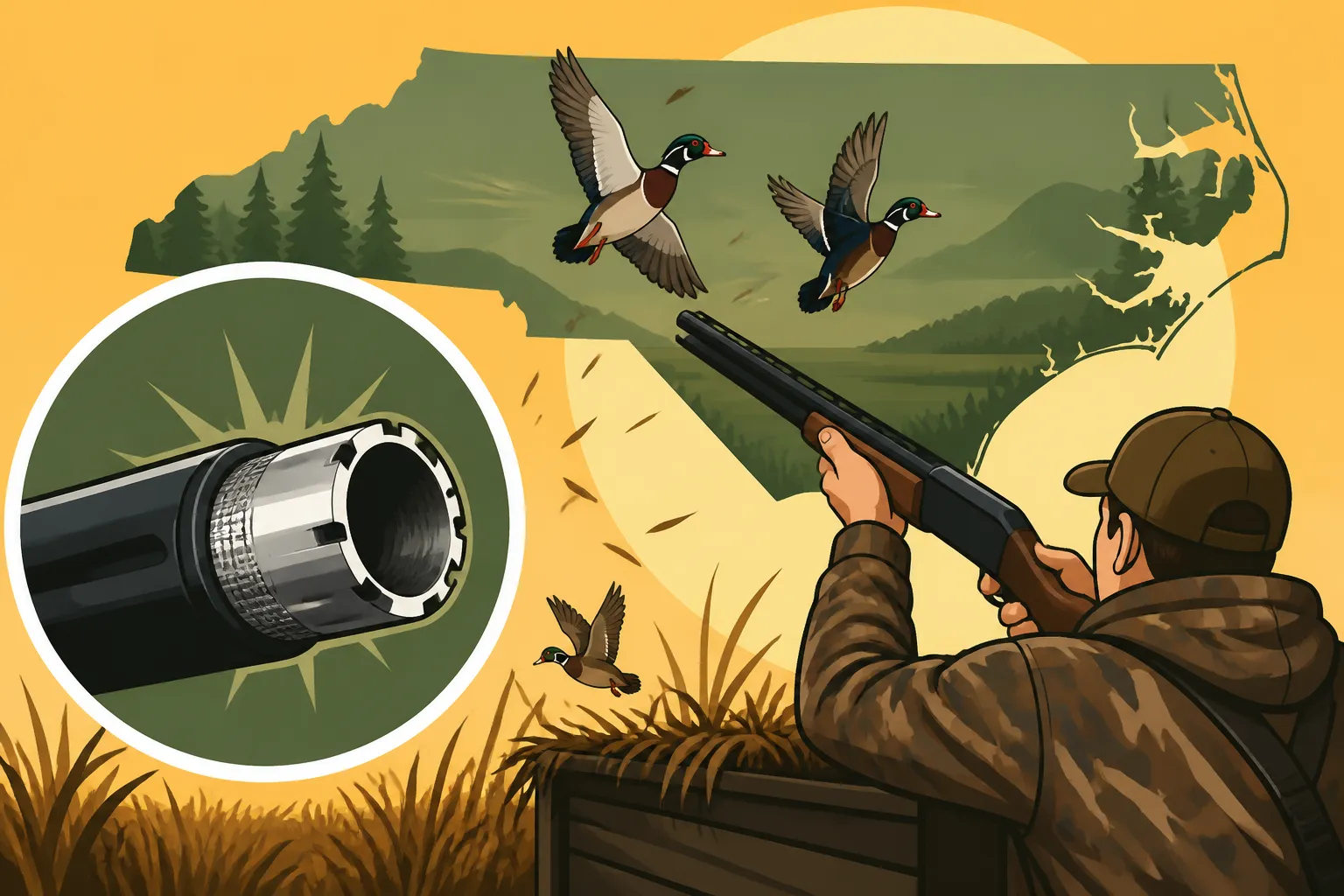
At its core, a choke tube is simply a constriction at the muzzle end of your shotgun barrel. This slight narrowing forces the shot pellets closer together as they exit, creating a denser pattern downrange. Think of it like putting your thumb over a garden hose – the water sprays out faster and in a tighter stream. Without any choke, pellets would spread very rapidly, leading to a thin, ineffective pattern at even short distances, with many gaps a bird could easily fly through.
The goal of this constriction is to deliver a consistent, effective pattern size at a particular distance. For fast-flushing game, which often presents extremely close shots, you're not looking for a super-tight pattern that might be ideal for geese at 50 yards. Instead, you need a pattern that spreads quickly enough to cover a broad area, increasing your chances of connecting with a rapidly moving, close-range target, but still dense enough to ensure a clean kill. It's a fine balance, and choosing the right choke helps you achieve it, allowing the pellets to exit and achieve their optimal spread for those immediate reactions.
It's also worth noting that different shot sizes and loads will interact with chokes differently. A very light target load of small shot might pattern differently than a heavy upland load of larger shot through the same choke. The way the shot column compresses and releases can be subtle, but it impacts your pattern on paper. That's why patterning your specific setup is always the best advice.
Standard Choke Designations and Their Applications
Choke tubes are categorized by their degree of constriction, from very open to very tight. Understanding these standard designations is your first step to making an informed decision for fast-flush situations.
| Choke Designation | Constriction | Typical Pattern Density (at 40 yards) | Ideal Effective Range | Best for North Carolina Fast Flushes |
|---|---|---|---|---|
| Cylinder (CYL) | Minimal | 40% | 15-25 yards | Very close, dense cover, brush |
| Skeet (SK) | Light | 50% | 20-30 yards | Close-range, fast-moving, open areas |
| Improved Cylinder (IC) | Light-Moderate | 60% | 25-35 yards | All-around upland, varied cover |
| Modified (MOD) | Moderate | 70% | 30-40 yards | Longer upland shots, ducks |
| Improved Modified (IM) | Moderate-Tight | 75% | 35-45 yards | Longer shots, geese |
| Full (F) | Tight | 80% | 40-50+ yards | Long-range waterfowl, turkeys |
| Extra Full (XF) | Very Tight | 85%+ | 50+ yards | Turkey hunting exclusively |
For those truly fast flushes where the bird seems to appear out of nowhere at your feet, you want a choke that allows your shot pattern to open up quickly. This generally means looking at Cylinder, Skeet, or Improved Cylinder. These chokes provide a wider cone of pellets at closer ranges, giving you a larger "strike zone" to hit a fast-moving target without having to be surgically precise with your lead. A tighter choke, like a Full or Modified, will keep the pattern too dense at close range, making it easier to miss entirely because the pattern hasn't had time to spread, often leading to either a clean miss or obliterating a bird.
It's important to remember that these are general guidelines. Every shotgun is a bit different, and the exact pattern a choke produces can vary slightly from one manufacturer to another, or even between two seemingly identical barrels. The "effective range" also depends on the payload and shot size you're using. A critical aspect of successful hunting is knowing your specific gun and choke combination.
Common North Carolina Fast-Flush Scenarios and Optimal Chokes
North Carolina offers a fantastic variety of hunting experiences, each with its own typical terrain and bird behavior. Matching your choke choice to these specific environments will significantly improve your success rate on fast-flushing game.
Grouse and Woodcock in Mountain Cover
Hunting ruffed grouse and American woodcock in the North Carolina mountains is often described as a test of nerves and reflexes. These birds inhabit incredibly dense cover, like thick rhododendron thickets, mountain laurel, and young timber stands. When they flush, it's typically a sudden, explosive burst of wings, often with the bird weaving through branches for a few fleeting seconds before disappearing. You're usually looking at shots that are extremely close, often under 20 yards, and sometimes even within 10-15 feet.
For these situations, a very open choke is your best friend. An Improved Cylinder (IC) is a solid all-around choice for many upland hunters, providing a decent spread without being too wide. However, for truly dense cover and the closest possible shots, a Skeet (SK) or even a Cylinder (CYL) choke might be even better. These chokes allow the pattern to open up almost immediately, giving you the largest possible spread to connect with a bird that's gone from zero to sixty in an instant. Trying to hit a grouse bursting from a thicket with a Modified or Full choke is like trying to swat a fly with a needle – possible, but highly improbable. The expansive pattern of an open choke helps compensate for the minuscule window of opportunity you have. Grouse Hunting the Blue Ridge Escarpment describes these conditions perfectly.
The nature of grouse and woodcock hunting means you're almost always walking, and you rarely have time to shoulder your gun properly before the shot. A wide pattern gives you a fighting chance even with less-than-perfect form. Many dedicated grouse hunters even opt for double barrels with an IC in the first barrel and a Light Modified in the second, to account for the rare longer shot if the bird breaks clear. Tools like GoHunt can provide detailed topographical maps and satellite imagery, which can be invaluable for identifying prime dense cover areas where these birds love to hide, helping you anticipate those sudden flushes.
Rabbit and Squirrel in Thick Bottomlands and Fencerows
The pursuit of rabbits and squirrels in North Carolina's thick bottomlands, creek beds, and overgrown fencerows presents another classic fast-flush scenario. Rabbits often bolt from underfoot or out of dense briars, zig-zagging through cover. Squirrels, especially fox squirrels in mature hardwoods, might scurry up a tree faster than you can blink if startled on the ground, or flush from a brush pile. These shots, while perhaps not always as frantic as a grouse, are still typically close-range and demand a quick reaction.
For cottontails bursting from a honeysuckle tangle or a brush pile, an Improved Cylinder (IC) or even a Light Modified choke is usually ideal. These chokes offer a good balance: enough pattern spread for the 15-25 yard shots typical of a fleeing rabbit, but still dense enough to ensure a clean kill. A Skeet choke could also work if you know you'll be primarily hunting extremely thick cover where shots are consistently under 15 yards. For squirrels, particularly if they're on the move or in slightly more open woods where a 25-30 yard shot might occur, a Modified choke might also be a viable option, ensuring a denser pattern for a smaller target. Rabbit Hunting North Carolina Fencerows and Squirrel Hunting North Carolina Bottomland Hardwoods highlight these hunting environments.
When hunting these areas, you're often walking slowly, eyes peeled for movement. The ability to make a quick, instinctive shot is key. Choosing a choke that provides a forgiving pattern at the average distances you expect to encounter is paramount. Remember to consider your shot size as well; larger shot like 5s or 6s with an IC can be very effective on rabbits and squirrels, providing good energy transfer without over-penetrating.
Dove Fields and Early Season Quail
While dove hunting might not always fit the traditional "fast flush" definition like a covey exploding from cover, opening day in a busy North Carolina dove field certainly involves fast-flying, agile birds that require quick target acquisition. And when it comes to true fast flushes, early season bobwhite quail are the quintessential example, bursting from short cover in a sudden, noisy eruption.
For dove hunting, many hunters gravitate towards Improved Cylinder (IC) or Modified chokes. Doves can present shots at various ranges, from 20 yards to 40 yards or more, especially when pass shooting. An IC offers a good balance for closer, decoying birds, while a Modified provides a denser pattern for those longer shots. Some hunters even start with an IC and switch to a Modified later in the day if the birds are flying higher. The speed and erratic flight patterns of doves mean you need a choke that offers a good pattern density without being so tight that you can't get on the bird quickly. GoHunt often provides insights into optimal field setups and flight patterns, which can inform your choke choice for a particular day. Working a Dove Field on Opening Day touches on these strategies.
For quail, however, you absolutely want a very open choke. A classic covey flush typically happens at close range, often within 10-20 yards, with multiple birds scattering in every direction. A Skeet or Improved Cylinder choke is perfect for this. The wide pattern ensures that even if your lead isn't perfect, you have a good chance of putting enough pellets on one or two birds for a clean kill. Trying to shoot quail with a Modified or Full choke often results in missing completely or destroying the bird due to an overly dense pattern at close range. Always prioritize a wider pattern for these explosive, close-quarter encounters to maximize your chances of success.
Choke Tube Materials, Maintenance, and Advanced Considerations
Choosing the right choke isn't just about constriction; it also involves understanding material compatibility, the importance of patterning your setup, and considering modern advancements that offer greater flexibility.
Material Matters: Steel Shot and Choke Compatibility
The type of shot material you're using can significantly impact your choke choice and, more importantly, the safety of your shotgun. Traditional lead shot is soft and relatively malleable, allowing it to compress and pass through even tight chokes without causing damage. However, many hunting areas, especially for waterfowl and some public lands, require the use of non-toxic shot like steel, bismuth, or tungsten-alloy.
Steel shot, in particular, is much harder than lead. If you use a choke that is too tight with steel shot, there's a serious risk of damaging your choke tube or even bulging your barrel. Steel shot cannot compress like lead, so forcing it through a tight constriction can create excessive pressure and friction. Always check the manufacturer's recommendations for your choke tubes; most will clearly indicate if they are rated for steel shot and up to what constriction (e.g., "Steel Shot Approved up to Modified"). Generally, it's safer to stick to more open chokes like Cylinder, Skeet, Improved Cylinder, or Modified when using steel shot. Avoid using Full or Extra Full chokes with steel shot unless explicitly stated by the manufacturer.
For hunters who frequently use steel shot for waterfowl, having a dedicated set of steel-rated chokes is crucial. If you're heading to a game land where non-toxic shot is required for upland birds, ensure your chosen choke is compatible. Ignoring this can lead to costly damage to your firearm. North Carolina Waterfowl Zones and Seasons and Where Nontoxic Shot Is Required in North Carolina are excellent resources for understanding where these rules apply.
Practice, Patterning, and Personalizing Your Setup
You can read all the articles in the world, but nothing replaces hands-on experience with your specific shotgun and choke combination. Patterning your gun is the single most important step in personalizing your setup for fast flushes. This means taking your shotgun, your chosen choke, and the specific ammunition you plan to hunt with to a shooting range.
Use large sheets of paper (at least 3×3 feet) and shoot at typical fast-flush distances, generally 15, 20, and 25 yards. After each shot, examine the pattern. Are there any large holes a bird could slip through? Is the pattern evenly distributed? Is it too dense, or too sparse? What's the effective diameter of the pattern where it's dense enough for a clean kill? This exercise will reveal exactly how your particular gun/choke/load combination performs. You might be surprised to find that an Improved Cylinder in one gun patterns like a Skeet in another, or that a particular brand of shell performs better through your choke.
This data is gold. It helps you understand your maximum ethical range for a given setup on a fast-flushing bird. Many members of the GoHunt community share their patterning results and tips, which can be a valuable resource. Beyond patterning, regular practice with fast mounts and swings is essential. The ability to quickly and smoothly bring your gun to your shoulder, find the target, and pull the trigger is paramount when a bird flushes quickly. Start with clay targets at close range and gradually increase your speed. Consistent practice builds muscle memory, which is critical when your brain has only a fraction of a second to react.
Quick-Change Chokes and Field Adaptability
Modern shotguns, especially those designed for hunting, almost universally feature interchangeable screw-in choke tubes. This innovation provides incredible flexibility, allowing hunters to adapt their shotgun to various hunting scenarios and species without needing multiple barrels or firearms. For fast-flush hunting in North Carolina, this means you can theoretically change your choke to match the specific cover you're entering.
For example, if you start your day walking thick creek bottoms for rabbits, you might begin with an Improved Cylinder. Later, if you transition to hunting the edge of a standing cornfield where longer shots at flushing pheasants (if you're traveling out of state) or doves might occur, you could easily switch to a Modified choke. While it's generally not practical to change chokes in the middle of a hot flush, having the ability to adapt between different sections of your hunting property or different types of hunts is a huge advantage. Rifle Setups for North Carolina Deer Hunting might talk about adaptability for rifles, but the principle applies to shotguns too.
Carrying a small choke tube wrench and a few different chokes in your vest pocket is a common practice for many upland hunters. Just remember to properly seat and tighten your choke tube before hunting, and always ensure it's clean and lightly lubricated to prevent seizing. The convenience of quick-change chokes eliminates the need to compromise, allowing you to optimize your pattern for the conditions and the specific fast-flushing game you're after. This adaptability is part of what makes shotgun hunting so versatile and rewarding in a state like North Carolina.
Disclaimer
This article is for general informational purposes only and does not constitute professional advice. Laws, prices and regulations vary by location and change over time. Consult a qualified professional for guidance on your specific situation.