Bow Sights for Timber Shots
For bowhunters across North Carolina, few things are as thrilling – or as frustrating – as a deer appearing suddenly in thick timber. That perfect shot window can vanish in a blink, often because your bow sight isn't optimized for the quick, close-range, and often low-light shots that dense woods demand. This guide is all about helping you choose and set up the ideal bow sight to conquer those challenging timber shots, ensuring you're ready when that elusive buck steps out from behind a stand of oaks.
The Unique Challenges of Timber Shots in North Carolina
North Carolina's diverse landscapes, from the thick mountain laurel and rhododendron in the west to the dense pine plantations and pocosin swamps of the Coastal Plain, present specific hurdles for bowhunters. Unlike open field edges where you might have time to range and settle, timber hunting demands a sight that can perform under pressure, often with little warning.
Why North Carolina Timber is Different
Hunting in the deep woods of North Carolina isn't like shooting targets on a wide-open range. We're talking about extremely dense cover, broken sightlines, and terrain that can shift dramatically underfoot. Imagine you're patiently waiting on a Treestand Setups in Pisgah National Forest stand, nestled in a mature oak flat. Suddenly, a deer ghosts through the underbrush, offering only a brief, 25-yard window between two thick pines. Your sight needs to be able to pick up quickly, maintain clarity, and give you confidence in that fleeting moment. The sheer volume of branches, saplings, and briars can obscure even a large animal, making pin visibility and alignment absolutely critical. This isn't just about deer; turkeys, too, can appear and disappear like phantoms in thick timber.
The varied topography adds another layer of complexity. In the mountains, you're dealing with steep slopes, deep hollows, and dense hardwood stands where sunlight struggles to penetrate. On the Coastal Plain, it might be a swampy bottomland, choked with cane and cypress knees, where every step is a calculation and visibility is often measured in scant yards. These environments often mean shooting at odd angles – uphill, downhill, or through a tight lane you wouldn't even consider in an open setting. A sight that is cumbersome or difficult to adjust quickly simply won't cut it when the moment of truth arrives. You need equipment that disappears, allowing you to focus solely on the shot.
The Importance of Quick Target Acquisition
Deer in timber country are often on high alert, especially on public land that sees significant Hunting Pressure on North Carolina Public Land. They move deliberately, sometimes pausing for only a few seconds before melting back into the shadows. This means your bow sight needs to facilitate immediate target acquisition. You can't be fiddling with dials or searching for the right pin when a mature buck stops for a split second at 30 yards. That's the kind of opportunity that North Carolina bowhunters dream of, and it demands a sight that's intuitively fast. Think about a buck following a scrape line along a logging road; he's not likely to stand broadside and pose for you.
A sight with fewer, brighter pins can often be a huge advantage here. While multiple pins might seem versatile, in a tight timber scenario, a cluttered sight picture can actually slow you down, making you hesitate as you try to distinguish between them. This is where simplicity often reigns supreme. Your muscle memory needs to be so ingrained that drawing back and putting a pin on target feels like one fluid motion, not a multi-step process. Every fraction of a second counts, and a sight that naturally guides your eye to the correct range will vastly improve your chances. It’s about minimizing thought and maximizing instinctive action when that deer finally steps out.
Dealing with Shifting Light Conditions
One of the biggest headaches for timber bowhunters is the constantly changing light. Deep within the woods, especially during early morning or late evening hunts, light can be incredibly dim. Then, as the sun rises higher, you get dappled light, with bright patches intermingling with dark shadows. These conditions make pin visibility a real challenge. A pin that looks perfectly bright in open sunlight might be all but invisible in a shaded creek bottom.
This problem is compounded by the fact that deer often move most actively during these low-light periods. Imagine a frosty morning during North Carolina Archery Season Opening Day, the woods still shrouded in fog, and a deer materializes at 20 yards. If your pins aren't glowing vibrantly, you could lose precious seconds, or worse, make an inaccurate shot because you can't clearly see your aiming point. You need a sight that can gather and amplify ambient light effectively, or one that has a reliable, discreet light source to ensure your pins are always crisp. Many hunters also find that the quality of the sight glass (if applicable) and the overall housing's ability to minimize glare are just as important as the pin brightness itself.
Key Features to Look for in a Timber Bow Sight
When you're out there chasing whitetails in North Carolina's dense forests, your bow sight needs to be a tool you trust implicitly. It’s not about having the most gadgets, but the right features for the environment you're hunting in.
Pin Configuration and Brightness
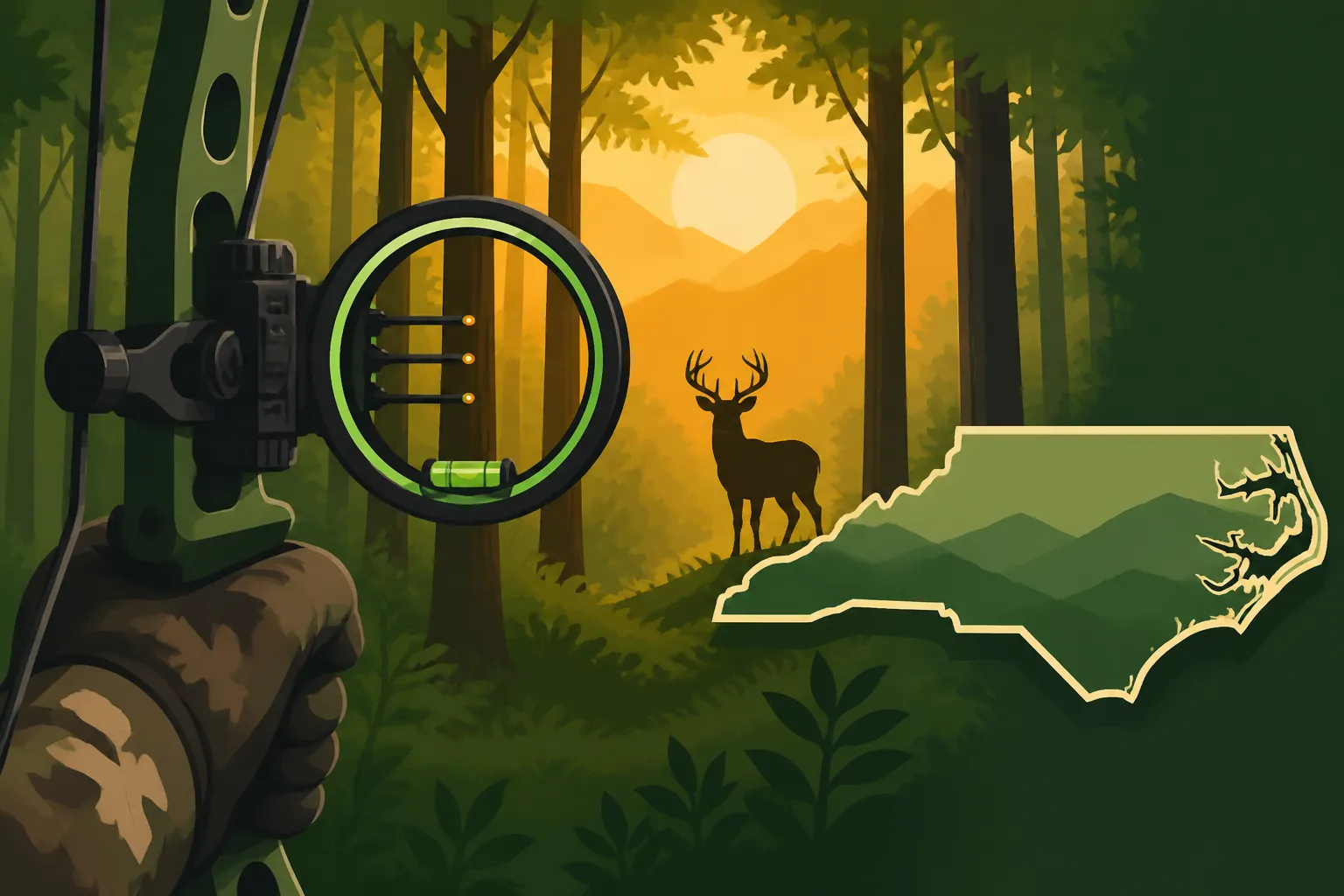
For timber hunting, less can often be more when it comes to pins. Many experienced timber hunters opt for 3 or 4 pins, rather than 5 or 7. Why? Because in those quick, tight shooting lanes, a simpler sight picture reduces clutter and allows for faster target acquisition. You'll likely be shooting within 40 yards, so pins set at 20, 30, and 40 yards cover most timber scenarios. Some even prefer just two pins: a 20-yard pin and a 30-yard pin, relying on a holdover for anything in between. The cleaner your sight picture, the quicker you can get on target when a deer appears suddenly.
Fiber optic brightness is paramount. Look for sights with long, well-protected fiber optics that gather maximum light. Some sights feature a wrapped fiber optic design, which means more fiber is exposed to ambient light, making the pins glow brighter even in low-light conditions. Green and yellow pins tend to be the most visible in deep timber settings for many hunters, though personal preference varies. Micro-adjustments for your pins are also a huge plus, allowing you to fine-tune your yardage settings with precision, which is critical for those slightly longer "timber" shots that might stretch to 40 yards. Having a crisp, visible pin, especially when combined with a reliable Fixed Versus Mechanical Broadheads choice, gives you the confidence you need for ethical shot placement.
Adjustability and Durability
Your bow sight will take a beating in North Carolina's woods. Whether you're climbing into a stand, navigating thick briar patches, or simply leaning your bow against a tree, your sight needs to withstand bumps and scrapes without losing its zero. Look for sights constructed from robust, aircraft-grade aluminum or similar tough materials. Flimsy plastic components are a recipe for disaster when you're deep in the Pisgah National Forest Hunting. Consider how well the fiber optics are protected; exposed fibers can easily break, rendering a pin useless.
Tool-less adjustments are a game-changer for timber hunting. Imagine you're on a Packs for a Pisgah Forest Day Hunt and realize your 30-yard pin is slightly off after an accidental bump. Having the ability to make quick, silent adjustments in the field without fumbling for an Allen wrench is incredibly valuable. Many modern sights, like those you might see recommended on a site like GoHunt, offer tool-less windage and elevation adjustments, along with individual pin adjustments. This means you can react to field conditions, or even just tighten up your groups after a practice session without having to go back to the truck for tools. It’s about minimizing hassle and maximizing your time actually hunting.
Integrating with Your Hunting Style
The "best" sight for timber hunting really depends on your personal hunting style. Are you a minimalist Saddle Hunting in North Carolina Hardwoods hunter who values lightweight gear and simplicity? Then a fixed-pin sight with 3-4 bright pins might be perfect. These sights are generally lighter, more robust, and have fewer moving parts to break or snag. They offer instant yardage reference without any extra movement, which is crucial when a deer is moving quickly.
Perhaps you prefer the versatility of a single-pin slider sight, which is excellent for Bow Draw Weight for North Carolina Whitetails and longer shots, but can be slower in rapid timber encounters. However, some advanced single-pin sights can be incredibly quick to adjust, especially if you're proficient with a rangefinder and practice extensively. For timber, you'd likely preset your slider to a common timber distance, say 25 or 30 yards, and only adjust for longer shots if time permits. Whether you prioritize ultimate simplicity, quick-draw capability, or a blend of both, GoHunt's resources often highlight a range of sights to fit different needs, emphasizing how important it is to match the gear to your specific hunting environment and preferences. Think about how you primarily hunt and choose a sight that complements that approach.
Practical Application and Setup for Timber Hunting
Having the right sight is only half the battle. Knowing how to set it up and practice with it specifically for North Carolina's timber conditions will give you a significant edge when hunting season rolls around.
Pin Gapping for Close-Range Accuracy
For bowhunting in dense timber, most shots will fall within 20 to 40 yards. This makes precise pin gapping for these closer distances absolutely vital. Start by accurately sighting in your 20-yard pin. This is your anchor, your most used pin in tight cover. Once that's dialed in, move back to 30 yards and adjust your next pin. Pay close attention to the gap between these two pins. Often, hunters will then set a 40-yard pin, completing their primary timber setup.
Many hunters find that having a dedicated 20-yard pin prevents them from "pinning" a deer too high on close shots, which is a common mistake when only using a 30-yard pin as their closest reference. If your sight has micro-adjustments, use them! Don't just get it "close enough." A small adjustment can mean the difference between a clean pass-through and a marginal hit. The goal is to make those 20, 30, and 40-yard shots feel like second nature. It's also wise to check your pins from an elevated position, simulating a treestand, to account for any slight changes in aiming point due to angle, especially if you plan to hunt areas like a Reading a Ridge for Mountain Zone Deer.
Optimizing Light Gathering for Low-Light Shots
As discussed, North Carolina's deep woods can get dark, fast. To optimize your sight for low-light conditions, first and foremost, ensure your fiber optics are clean and unobstructed. Any dirt or debris can drastically reduce their light-gathering capability. Many quality sights come with a small light, often called a rheostat light, that illuminates the fiber optics. If your sight has one, learn how to use it effectively and discreetly.
The key with a sight light is subtlety. You don't want a blinding glow that spooks game or gives away your position. Most lights have adjustable brightness settings; dial it down to just enough so you can clearly see your pins without creating a halo effect. Some hunters even apply a small piece of electrical tape over part of the fiber optic to dim overly bright pins, especially on sunny days. You can also strategically position your body or bow to block direct sunlight from hitting your fiber optics, which can cause excessive glare and make pins appear washed out. Practicing in dusk and dawn conditions is the best way to understand how your sight performs and how to best utilize its light-gathering capabilities, whether natural or assisted.
Pre-Season Practice in Realistic Scenarios
The shooting range is great for dialing in your pins, but it rarely replicates the realities of timber hunting. To truly prepare, you need to practice in conditions that mirror your actual hunting environment. This means shooting from your treestand or ground blind, wearing your full hunting gear, and practicing quick draw-and-shoot scenarios. Set up targets at various, unmarked distances, forcing yourself to quickly estimate yardage and pick the correct pin.
Try shooting through small openings between trees or brush, simulating those tight lanes you'll encounter when Hunting a Funnel Between Two Pocosins. Practice shooting at odd angles – uphill, downhill – as you would on a mountain slope or in a creek bottom. The goal is to build muscle memory and confidence so that when a deer steps out, your aim is instinctive. Consider using an app like GoHunt to log your practice sessions and note how your sight performs under different light and angle conditions. This kind of focused, realistic practice will pay dividends when Bowhunting North Carolina's Statewide Archery Season finally opens. It will also help you identify any issues with your sight before you're out in the field facing a real-life opportunity.
| Sight Feature | Advantage for Timber Hunting | Consideration |
|---|---|---|
| Fewer Pins (3-4) | Less clutter, faster target acquisition | Limited range for open-field shots |
| Bright Fiber Optics | Excellent visibility in low light and shadows | Can be overly bright in direct sunlight (manageable) |
| Tool-less Adjustments | Quick, silent field adjustments | May have slightly more moving parts to potentially fail |
| Durable Construction | Withstands bumps and scrapes in thick cover | Can be heavier |
| Compact Design | Less likely to snag on brush, lighter overall | Might have smaller sight window |
| Rheostat Light | Adjustable pin brightness for various light conditions | Requires batteries, potential for excessive light |
Choosing and setting up the right bow sight for timber hunting in North Carolina is a critical step in becoming a more successful and confident archer. By focusing on pin clarity, quick acquisition, durability, and practicing in realistic scenarios, you'll be well-prepared when that next whitetail ghosts through the woods. Don't let your sight be the weak link in your hunting setup; equip yourself for the challenges and rewards of North Carolina's diverse timber.
Disclaimer
This article is for general informational purposes only and does not constitute professional advice. Laws, prices and regulations vary by location and change over time. Consult a qualified professional for guidance on your specific situation.