Two-Way Radios on a Deer Drive
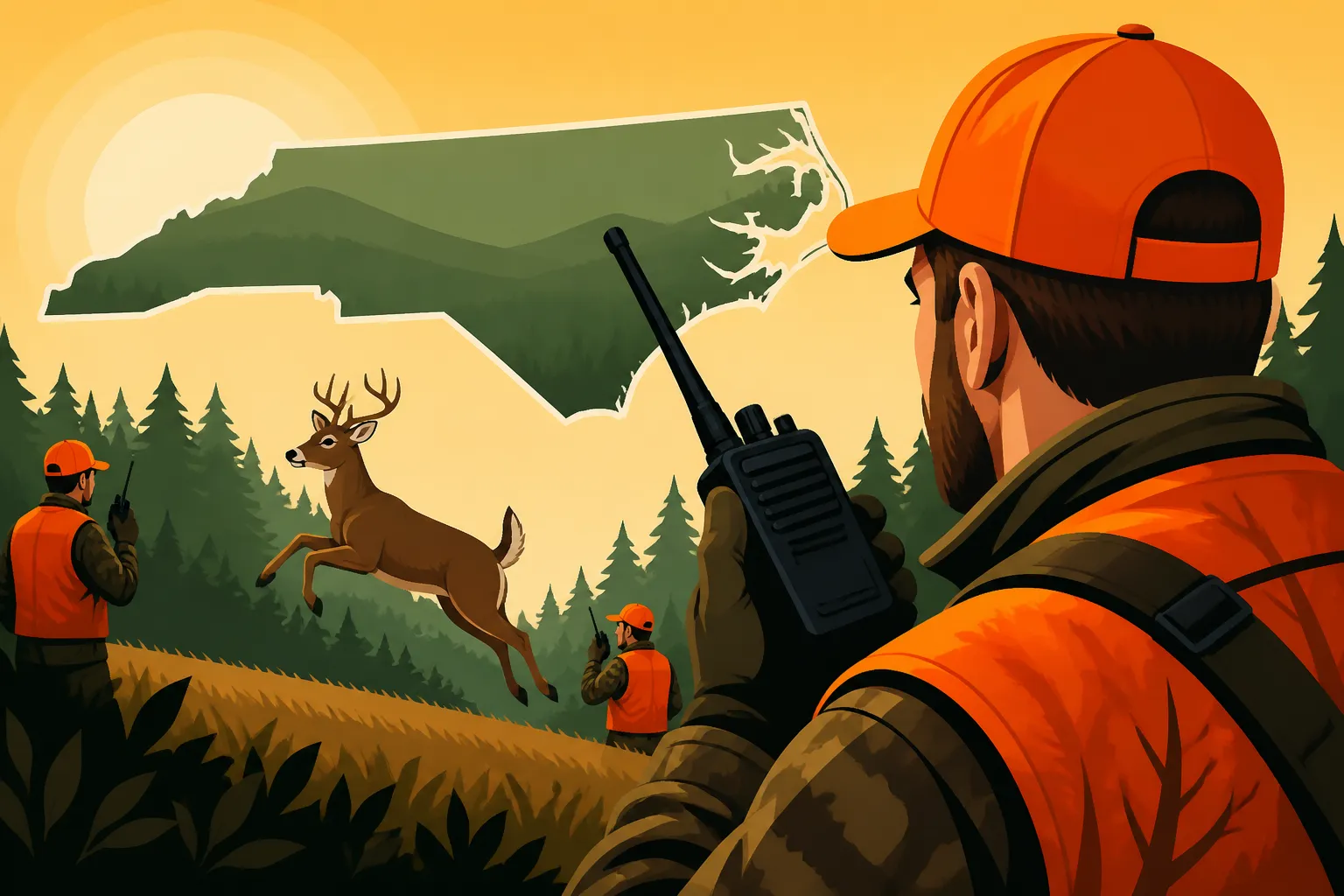
Anyone who's ever tried to organize a deer drive in North Carolina knows the feeling: the woods are thick, the hunters are spread out, and suddenly, silence descends. You're trying to coordinate movements, keep everyone safe, and ideally, put a deer on the ground, but shouting is out, and cell service is a cruel joke. That's where two-way radios become an indispensable piece of gear, transforming chaotic pushes into coordinated, safer, and ultimately more successful hunting experiences. This guide will walk you through why radios are critical, how to choose the right ones, and best practices for integrating them into your deer drive strategy across North Carolina's diverse landscapes.
Why Reliable Communication is Non-Negotiable on a Deer Drive
Deer drives, by their very nature, involve multiple people moving through the woods, often in challenging terrain. Without a consistent and clear way to communicate, you're not just inefficient; you're putting safety at risk. In North Carolina, where cover can range from dense mountain laurel thickets to vast coastal pocosins, maintaining situational awareness is paramount.
The Inherent Dangers of Disconnected Hunters
Picture this: you've got a couple of pushers moving slowly through a dense Piedmont woodlot, trying to bump deer towards standers positioned on a field edge. Suddenly, one of the standers spots movement and, needing to adjust their position for a clearer shot, moves 50 yards down the line without being able to tell anyone. Meanwhile, a pusher, unaware of the shift, continues to move along what they thought was a safe line. This scenario, or countless variations of it, highlights the critical safety implications of poor communication. Without two-way radios, it's incredibly difficult to know exactly where every hunter is at all times, especially when the landscape offers limited visibility. Hunters can inadvertently move into unsafe zones, cross firing lanes, or even be mistaken for game, leading to genuinely dangerous situations. Radios allow for constant updates: "Stander three, I'm moving 50 yards east," or "Pusher one, hold your position, deer just broke your side." This real-time information can be the difference between a successful, safe hunt and a regrettable incident.
Beyond knowing exactly where everyone is, radios become vital for other safety needs. What if someone twists an ankle in a creek bottom or gets disoriented in unfamiliar timber? A quick radio call can alert the group, providing crucial assistance much faster than trying to shout or find cell service. When you're out there, deep in the woods, whether it's the Nantahala National Forest Hunting or a private tract in the Eastern Zone, a direct line of communication is a lifeline. It’s not just about getting the deer; it’s about getting everyone home safely at the end of the day.
Coordinating Tactics Across Varied North Carolina Terrain
North Carolina's varied topography presents unique challenges for deer drives, and effective communication is the key to overcoming them. Consider a drive in the Appalachian Mountains, where steep ridges and deep hollows can create natural funnels, but also make it incredibly difficult for pushers to maintain a straight line or for standers to anticipate exactly where deer will emerge. Radios allow pushers to report the direction deer are heading, which standers can then use to quickly adjust their positions or prepare for a shot. "Deer just crossed the logging road headed towards stander two," can be a game-changer. In the thick, often disorienting environment of a Hunting Coastal Plain Pocosin Swamps, where visibility might be measured in feet rather than yards, radios help pushers stay oriented and maintain their spacing, preventing gaps that deer could slip through. They can also coordinate turns, signal when a drive is nearing its end, or even direct a dog handler if you're Running Hounds Where North Carolina Allows It.
Furthermore, radios enable quick tactical changes. Maybe the initial plan was to push a certain block of woods, but a pusher discovers an unexpected bedding area or realizes the deer are holding tight. With radios, they can communicate this information immediately to the entire group, allowing the drive leader to call an audible, adjust the line, or even call off the drive for that section if it's not productive. This adaptability is crucial for maximizing success, especially when you're dealing with wily North Carolina whitetails that know their home turf intimately. Without radios, such mid-drive adjustments are nearly impossible, often leading to wasted effort or missed opportunities. The ability to communicate on the fly is what elevates a disorganized scattershot effort into a precise, collaborative hunting operation.
Choosing the Right Two-Way Radios for North Carolina Hunting
Not all two-way radios are created equal, and for the specific demands of a North Carolina deer drive, you'll want to consider several factors to ensure you have reliable communication when it matters most.
Understanding FRS vs. GMRS for Range and Power
When you start looking at two-way radios, you'll quickly encounter the terms FRS (Family Radio Service) and GMRS (General Mobile Radio Service). Understanding the difference is crucial for North Carolina hunters.
- FRS Radios: These are typically what you find in multi-packs at sporting goods stores. They operate on lower power (up to 2 watts) and are license-free. The range on FRS radios is generally shorter, especially in dense woods or hilly terrain. They are great for short-range communication, say, between two hunters within visual sight or a few hundred yards apart on relatively flat land. However, for sprawling deer drives across varied North Carolina landscapes, their limited range might leave some hunters out of communication, especially if you're trying to coordinate Deer Drives With Three or Four Hunters across a large block of land.
- GMRS Radios: These radios can operate at higher power levels (up to 50 watts for base stations, but handhelds are usually 5-10 watts). This increased power translates to significantly better range and penetration through foliage and over terrain. However, GMRS radios do require a license from the Federal Communications Commission (FCC) to operate legally. This license covers your entire immediate family for ten years and is a relatively straightforward process. For a hunting party that frequently does drives or operates over larger areas, the investment in GMRS radios and the license is often well worth it for the enhanced reliability and safety it provides. When scouting public lands like the Pisgah National Forest, tools found on sites like GoHunt can sometimes offer topographical insights that help predict radio range, making the FRS/GMRS decision even more informed.
The choice really depends on your hunting group's needs and the terrain you typically hunt. If you're consistently hunting small, flat tracts or keeping hunters very close, FRS might suffice. But for covering significant ground in the North Carolina mountains or across wide coastal plains, GMRS offers a much more robust and dependable communication solution.
Essential Features: Battery Life, Durability, and Weatherproofing
Imagine being deep in a thicket, a deer is moving, and your radio dies. Or you slip crossing a stream, and your radio is submerged. These scenarios highlight the importance of specific features beyond just range.
- Battery Life: Deer drives can last for hours, sometimes extending from before dawn to late afternoon. Your radio needs to last as long as you do, often in cold weather that drains batteries faster. Look for radios with extended battery life or, even better, models that use rechargeable lithium-ion packs and can also run on standard AA/AAA batteries as a backup. Carrying spare, charged battery packs is a non-negotiable best practice. There's nothing worse than losing communication mid-drive because a battery decided to quit on you.
- Durability: Hunting gear takes a beating. Radios will be dropped, bumped, and potentially exposed to dirt and debris. Choose models known for their robust construction, often with a rubberized or reinforced casing. A fragile radio is useless in the field. Reading reviews from other hunters often provides insight into how a particular model stands up to real-world abuse.
- Weatherproofing: North Carolina weather can be unpredictable. A warm, sunny morning can quickly turn into a cold, driving rain. Your radio needs to be able to withstand moisture. Look for radios with an IP (Ingress Protection) rating, such as IPX4 (splash resistant) or IPX7 (submersible). An IPX4 rating is usually sufficient for rain and splashes, but if you're regularly crossing creeks or hunting in very wet environments like Hunting Coastal Plain Pocosin Swamps, a higher rating offers greater peace of mind. A radio that gets waterlogged and stops working is a critical failure on a deer drive.
Practical Considerations: VOX, Privacy Codes, and Accessories
Beyond the core functions, several practical features and accessories can greatly enhance your radio experience.
- VOX (Voice-Activated Transmission): This feature allows the radio to transmit automatically when it detects your voice, eliminating the need to press a "push-to-talk" (PTT) button. While it sounds convenient, VOX can be tricky in a hunting scenario. Unwanted background noise (wind, rustling leaves, even your own breathing) can trigger transmissions, tying up the channel. Many hunters prefer to use the PTT button for precise control over when they speak. However, if you are a driver with a rifle in your hands, the ability to communicate without reaching for your radio might be appealing, so test this feature extensively before relying on it during a hunt.
- Privacy Codes (or Sub-Channels): These aren't truly "private" in the sense of encryption, but rather filter out chatter from other radio users on the same main channel. They work by only opening your receiver when another radio transmitting on the same main channel also uses the same privacy code. This can be incredibly useful on public land where other hunting parties might be using the same frequencies. Setting a unique main channel and privacy code for your group ensures you only hear your team, minimizing confusion and unnecessary noise.
- Accessories: Don't overlook accessories. A good earpiece with a boom mic or a speaker mic can make a huge difference. An earpiece allows you to hear communications clearly without disturbing game, while a speaker mic keeps the radio clipped to your pack and allows for easier PTT access than fumbling with the radio itself. For those long walks through rugged terrain, a secure holster or clip to keep the radio accessible but out of the way is also invaluable. When you're Packs for a Pisgah Forest Day Hunt, every piece of gear needs to be thoughtfully considered for comfort and utility.
Maximizing Radio Effectiveness on Your Next North Carolina Deer Drive
Having the best radios is only half the battle; knowing how to use them effectively and integrating them into your hunting plan is where the real advantage comes in.
Pre-Drive Planning and Communication Protocols
Successful deer drives aren't spontaneous; they're meticulously planned. Your radio communication should be a central part of that plan. Before stepping foot in the woods, gather your team and establish clear protocols.
First, assign specific roles (drive leader, pushers, standers, flanks) and clarify each person's position and intended movement. This helps everyone understand who needs to communicate with whom and when. Second, check all radio batteries and ensure spares are packed. Nothing disrupts a drive like a dead battery. Third, agree on a main channel and privacy code that your group will use. Test it right there on the spot to make sure everyone's radios are set correctly and working. Fourth, establish clear, concise communication phrases or codes. For instance, instead of "Hey, I think I see a deer, kind of moving in my direction, but I'm not sure," train everyone to say, "Deer movement, Grid B7, headed East, over." Keep messages short and to the point. This prevents confusion and keeps the airwaves clear for urgent messages. Using tools like the Scouting North Carolina Public Land Before Season can also help identify optimal communication points and potential dead zones based on terrain.
Here’s a simple table to illustrate basic communication protocols:
| Role | Message Type | Example Phrase | Purpose |
|---|---|---|---|
| Drive Leader | Instructions/Coordination | "Pushers, advance 50 yards. Standers, hold." | Directing movement |
| Pusher | Deer Sighting/Movement | "Deer, 10 o'clock, moving towards Stander 3." | Alerting standers to game |
| Pusher | Location Update | "Pusher 2, crossing old logging road, on course." | Maintaining spacing and line |
| Stander | Location Adjustment | "Stander 4, moving 20 yards to the West." | Preventing unsafe overlaps |
| Stander | Shot Fired | "Shot fired, Stander 1, target down." | Notifying group, initiating recovery |
| Any Hunter | Safety/Emergency | "Safety alert! Hunter down, needs assistance, my location." | Critical emergency notification |
| Any Hunter | All Clear | "All clear, drive complete." | Signaling end of drive, safe to move |
Practicing these calls beforehand, even just verbally, can significantly improve coordination and safety once you're in the field.
Dealing with North Carolina's Unique Signal Challenges
North Carolina's diverse topography, from the Blue Ridge Mountains to the Coastal Plain, presents varying challenges to two-way radio signals. What works perfectly in a flat cornfield might fail completely in a deep mountain hollow.
In the mountains, signal can be severely hampered by terrain. Ridgelines can block signals, and deep valleys or hollows can create "dead zones" where communication is impossible. If you're Reading a Ridge for Mountain Zone Deer, remember that line-of-sight is king for radio waves. Your best bet is to try to maintain as much line-of-sight as possible, even if it means moving to slightly higher ground or a clearing to transmit. Keep in mind that heavy timber, especially dense pine plantations, can also absorb and scatter radio waves, reducing effective range even on relatively flat ground. For optimal performance, always aim for the clearest possible path between radios. Websites and apps like GoHunt can provide detailed topographic maps which are invaluable for identifying potential signal issues before you even leave home. This allows you to plan your drive routes and stander placements with radio range in mind, avoiding frustrating communication blackouts.
In the Coastal Plain, while the terrain is generally flatter, the dense pocosin swamps, thick river bottoms, and extensive pine forests can still create challenges. The sheer volume of vegetation can significantly degrade signals. Here, having higher-power GMRS radios becomes even more beneficial for punching through the thick cover. Again, try to avoid deep, low-lying areas if possible, or at least be prepared for reduced range in those environments. Constant, concise check-ins are vital in these challenging signal areas to ensure everyone remains connected.
Integrating Radios into Overall Drive Strategy
Radios are more than just emergency tools; they are tactical assets that can make your deer drives far more effective.
During the drive itself, real-time updates are invaluable. Pushers can communicate if they've jumped deer, how many, and in what direction they're heading. This allows standers to anticipate deer movement, adjust their focus, and prepare for a shot. Conversely, standers can alert pushers if deer are trying to slip back through the drive line, allowing the pushers to adapt and tighten up. If someone shoots, radios allow for immediate notification, confirming the shot was safe and allowing the group to coordinate the next steps, whether it's waiting for a tracker or beginning the recovery process. This is especially helpful if you're Tracking a Deer Through North Carolina Leaf Litter or need to coordinate a full group effort to recover game.
Beyond the immediate drive, radios can aid in post-hunt logistics. Imagine a successful hunt where a deer is down in a remote, difficult-to-access area. Radios allow you to coordinate precisely where to meet, which routes are clear for a deer cart or sled, and how many people are needed for assistance. If you're using Sleds and Drags for Mountain Country, radios can direct the best path out. They can even facilitate sharing information on late-season food sources or areas where deer are holding, making your subsequent hunts more productive. From beginning to end, two-way radios elevate deer drives from a hopeful endeavor to a well-orchestrated, safe, and efficient hunting strategy in North Carolina.
Disclaimer
This article is for general informational purposes only and does not constitute professional advice. Laws, prices and regulations vary by location and change over time. Consult a qualified professional for guidance on your specific situation.