Sleds and Drags for Mountain Country
There’s nothing quite like the thrill of harvesting a deer, turkey, or even a bear in the breathtaking mountains of North Carolina. But let's be honest, the adrenaline rush quickly gives way to a daunting reality once you realize you’re miles deep in rugged terrain with a heavy animal on the ground. Dragging an animal out of a steep cove or off a remote ridge can feel like a herculean task, making you question every life choice you’ve ever made. This guide is here to walk you through the various sleds and drags available, helping you choose the right tools and tactics to make mountain game recovery a whole lot less painful.
Why Mountain Game Recovery is a Different Beast
Hunting in North Carolina's mountain regions, like the vast expanses of Pisgah National Forest or Nantahala National Forest, offers incredible opportunities, but it also presents unique challenges when it comes to game recovery. This isn't your flatland deer drag across a cut cornfield. Here, every foot gained often feels like a mile.
The Challenge of Steep Terrain
The slopes in the Blue Ridge Mountains are no joke. What looks like a gentle incline on a topo map can be a near-vertical climb with 100+ pounds of deer meat to contend with. Imagine trying to haul a mature buck up a 45-degree slope, scrambling over rocks and through thick rhododendron. It’s an exhausting, often dangerous endeavor. The ground can be uneven, littered with loose rock, slick with mud or wet leaves, and tangled with blowdowns. Gravity is your biggest enemy, and without the right equipment, you can quickly find yourself exhausted, frustrated, and questioning your choices. I remember one season trying to drag a decent 8-pointer out of a hollow near Grandfather Mountain without a sled – it took four of us hours, and we were all toast. Don't be those guys.
Navigating Dense Cover and Obstacles
Beyond the sheer steepness, mountain country is often choked with dense vegetation. Think mountain laurel thickets, rhododendron hells, and tangled briar patches. Even after the leaves fall, the undergrowth can be incredibly tough to push through. You might have to climb over fallen trees, navigate around massive boulders, or push through areas where visibility is only a few feet. A simple drag rope can snag on every branch, making forward progress agonizingly slow. This is where a well-designed sled or drag system truly shines, allowing the animal to glide over many of these smaller obstacles rather than getting hung up on every twig. Effective navigation, often planned using detailed maps from tools like GoHunt, is critical to avoid the densest sections.
Understanding Your Options: Sleds Versus Drags
When it comes to getting a downed animal out of the mountains, you essentially have two main categories of tools: game sleds and drag systems. Each has its own strengths and weaknesses, and the best choice often depends on the specific terrain, the size of your animal, and whether you're working alone or with a partner.
Rigid Plastic Game Sleds
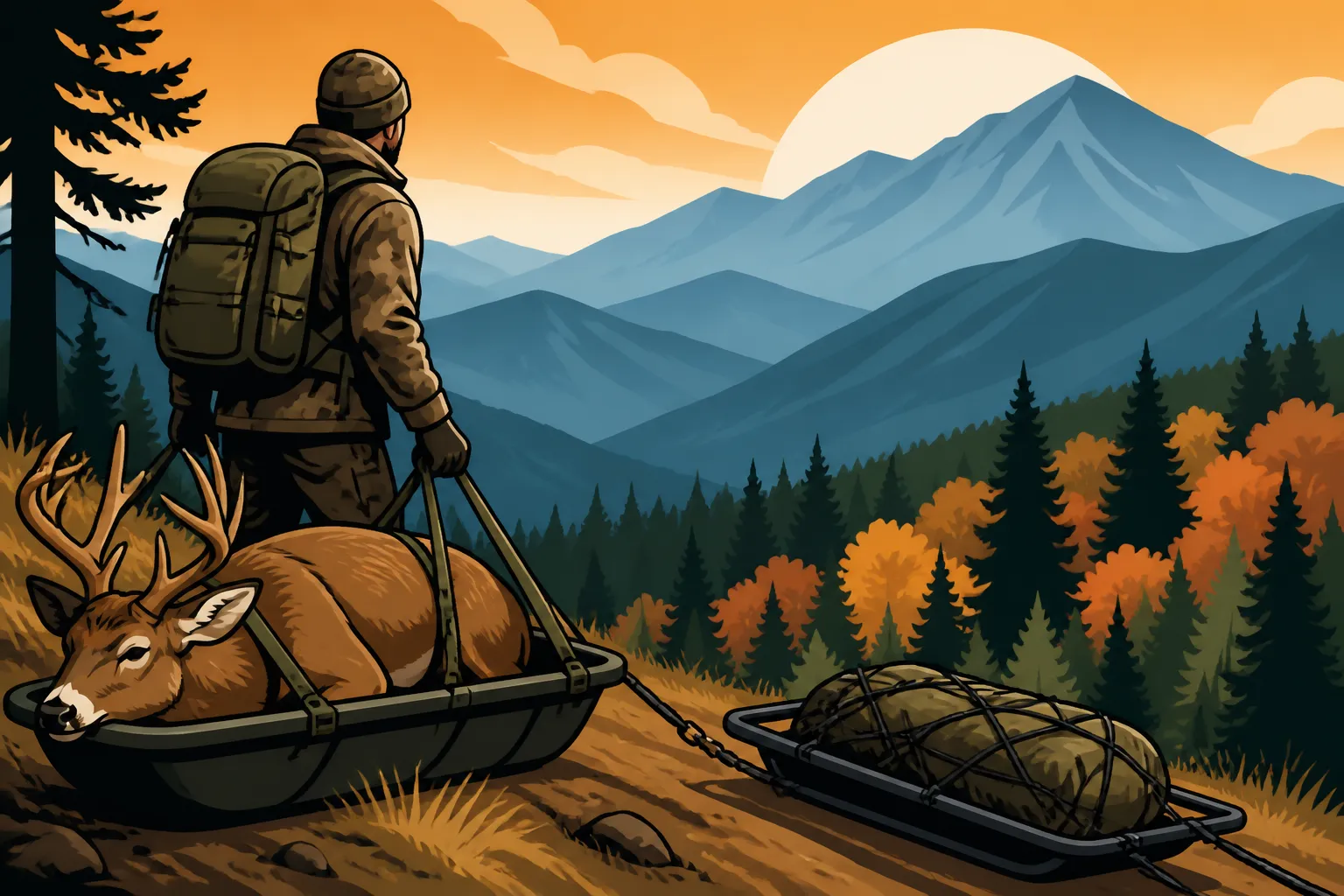
Rigid plastic game sleds are essentially heavy-duty plastic tubs or sheets designed to slide easily over varied terrain. They usually have a tough, slick bottom that minimizes friction, making it significantly easier to pull a heavy load. These are incredibly popular for a reason: they work.
-
Advantages:
- Reduced Friction: The slick plastic bottom glides over leaves, snow, mud, and even smaller rocks, dramatically reducing the effort needed to move a heavy animal. It can feel like you've cut the weight in half compared to a bare-ground drag.
- Protection for Meat: The sled keeps the animal elevated off the ground, protecting the hide and meat from dirt, debris, and punctures from sticks or sharp rocks. This is especially valuable in areas with a lot of loose scree or when you're dragging over downed timber.
- Ease of Cleaning: Most plastic sleds clean up easily with a hose, making post-hunt cleanup less of a chore.
- Versatility: Many larger sleds can also be used to haul gear into camp, transport firewood, or even move other heavy items around the property.
-
Disadvantages:
- Bulk and Weight: While they make the drag easier, rigid sleds can be bulky and somewhat heavy to carry into your hunting spot, especially on long hikes or steep climbs. You might find yourself debating whether the carry-in justifies the easier drag-out.
- Maneuverability in Tight Spots: Larger, more rigid sleds can be difficult to maneuver around tight trees, through thick brush, or over large boulders. They don't flex, so if the path is narrow, you might get stuck.
- Noise: Depending on the surface, a rigid plastic sled can make some noise as it scrapes along, which might be a minor concern if you're trying to stay quiet on a late-season stalk with it strapped to your pack.
Imagine harvesting a hefty black bear in the high country. Trying to drag that bruiser over broken rock and through thick mountain laurel would be a nightmare without a sled. A heavy-duty plastic sled, however, could distribute the weight and allow it to slide relatively smoothly, protecting the valuable hide and meat from damage. You'd still be working hard, but it would be possible.
Flexible/Soft-Sided Drags and Tarps
These options include heavy-duty tarps, canvas game bags, or specialized flexible sleds made from durable fabrics. They offer a different set of pros and cons, often favoring portability.
-
Advantages:
- Portability: This is their biggest selling point. They fold or roll up small and are incredibly lightweight, making them easy to carry in your pack without adding significant bulk or weight. You'll barely notice it until you need it.
- Conformability: They conform to the shape of the animal and can be pulled through tighter spaces than rigid sleds. They can bend and flex around obstacles, which can be a huge benefit in dense, uneven mountain terrain.
- Versatility: A heavy-duty tarp can double as a shelter, a ground cloth, or a place to lay out your gear.
- Cost-Effective: Often, these options are more budget-friendly than their rigid counterparts.
-
Disadvantages:
- Less Protection: While they keep the animal off the dirt, they offer less rigid protection from sharp sticks or rocks that might poke through the fabric, especially with repeated use on abrasive terrain.
- More Friction: While better than bare-ground dragging, flexible materials generally create more friction than slick plastic, meaning you'll still be exerting more effort than with a rigid sled.
- Durability Concerns: Repeated dragging over sharp rocks and rough terrain can wear out or tear thinner fabrics more quickly. Investing in a truly heavy-duty version is crucial for mountain use.
Consider a spring turkey hunt in the Piedmont, where you might only need to drag a gobbler a short distance across relatively open woods to your truck. A flexible drag or a simple tarp would be perfect – lightweight, easy to carry, and more than sufficient for the task. However, imagine recovering a deer from a steep, rocky ravine in the Nantahala. While portable, a flexible drag might not hold up as well or make the job as efficient as a rigid sled would. Packs for a Pisgah Forest Day Hunt might also highlight the importance of light, packable gear, where a flexible drag would definitely win out.
Here’s a quick comparison of the main recovery tools:
| Feature | Rigid Plastic Sleds | Flexible Drags/Tarps | Drag Ropes Only |
|---|---|---|---|
| Portability | Bulky, heavier to carry in | Lightweight, folds small, easy to pack | Minimal bulk, fits in a pocket |
| Friction | Very low friction, slides easily | Moderate friction, better than bare ground | High friction, animal catches on everything |
| Meat/Hide Protection | Excellent, keeps animal off ground & debris | Good, keeps animal off dirt, some puncture risk | None, animal scrapes directly on ground |
| Maneuverability | Can be difficult in tight spaces | Conforms to animal/terrain, good in tight spots | Excellent, only limited by animal's body |
| Durability | Very durable, resists punctures (good quality) | Varies by material, can wear/tear on sharp objects | Excellent (rope itself), but animal is damaged |
| Effort Required | Significantly reduced | Moderately reduced | Very high |
| Best Use Case | Larger animals, rough/rocky terrain, snow, mud | Smaller/medium game, short drags, when portability is key | Very short distances, emergency only, or with a team |
Choosing the Right Gear for North Carolina Terrain
The "best" sled or drag isn't a one-size-fits-all answer. It truly depends on where you hunt, what you hunt, and how you hunt. For North Carolina's diverse terrain, you might even consider different options for different trips.
Material Matters: Durability and Glide
When picking a sled, the material is paramount, especially for mountain hunting where you'll encounter everything from slick leaves to abrasive rocks. Look for high-density polyethylene (HDPE) in rigid sleds. This plastic is known for its durability, flexibility in cold weather (preventing cracking), and excellent glide properties. Some sleds feature molded-in ridges or channels on the bottom which can help with tracking in snow and provide structural integrity without adding excessive weight.
For flexible drags, canvas or heavy-duty ballistic nylon are excellent choices. They offer a good balance of durability and tear resistance. Some also incorporate a slicker, reinforced bottom panel to reduce friction. Always check the stitching and grommets – these are often the first points of failure under heavy loads and constant dragging. You want reinforced pull points that won't rip out after a couple of uses.
Handle and Harness Systems
This is where the rubber meets the road, or rather, where the rope meets your hands (or shoulders!). A good handle or harness system can make all the difference in comfort and efficiency.
- Ropes and Handles: Most sleds come with a simple rope handle. While functional, pulling a heavy animal with just a thin rope can quickly cut into your hands and cause fatigue. Look for sleds with wider, padded handles or a loop that allows for a two-handed grip. You can also easily modify most sleds by adding a section of garden hose over the rope to create a more comfortable handle.
- Shoulder Harnesses: For truly heavy loads or long hauls, especially alone, a dedicated shoulder harness is a game-changer. These distribute the weight across your shoulders and back, engaging your core and larger muscle groups, rather than just your arms and hands. Many hunters will create their own harness system using heavy-duty webbing and carabiners that attach to the sled's pull rope. Some sleds are even designed with attachment points for such a system. A good harness will allow you to lean into the pull, using your body weight to your advantage, which is crucial when tackling steep inclines or traversing long distances in the mountains.
I can't stress enough how much a good harness helps. My shoulders used to ache for days after a mountain recovery. Now, with a proper harness, I might still be tired, but I'm not crippled. It's an investment in your physical well-being. When you're Tracking a Deer Through North Carolina Leaf Litter and then trying to get it out, a harness will be your best friend.
Considering Game Carts for Rolling Terrain
While the primary focus here is sleds and drags for mountain country, it's worth a quick mention that game carts exist. These have wheels and are fantastic for flatter, more open terrain like logging roads, field edges in the Piedmont, or relatively level trails. However, in true mountain environments with steep grades, large rocks, and thick brush, wheels quickly become a liability. They get snagged, tipped over, or simply can't handle the uneven ground. A game cart usually requires a fairly clear path, something that's rare deep in Pisgah or Nantahala. So, while great for some hunting scenarios, they're generally not the go-to for steep North Carolina mountain recovery.
Tactics for Efficient Mountain Retrieval
Having the right gear is only half the battle. Knowing how to use it effectively in challenging mountain terrain is just as important. A little bit of strategy can save you a lot of sweat and tears.
Solo Versus Team Retrieval
The number of hands you have available dramatically impacts your strategy.
- Solo Hunter: When you're alone, weight distribution and leveraging your body are key. A shoulder harness becomes almost essential. When dealing with steep descents, you might need to zig-zag down the slope, guiding the sled to prevent it from gaining too much momentum and getting away from you. On ascents, taking frequent, short breaks and pacing yourself is vital. Don't try to power through; consistent, steady effort wins the race. Use trees or large rocks for anchor points if you need to rest on an incline and prevent the sled from sliding back down.
- Team Effort: With a partner or two, the dynamics change entirely. You can have one person pulling from the front and another pushing or guiding from the rear, especially valuable on steep sections. When going downhill, one person can pull while the other acts as a "brake" with a rope tied to the back of the sled, ensuring a controlled descent. On uphill sections, multiple pullers can combine their strength. Communication is critical: call out obstacles, coordinate your pulls, and signal when you need a break. This is also where Deer Drives With Three or Four Hunters often become a recovery team as well.
Dealing with Steep Inclines and Declines
This is often the most dreaded part of mountain game recovery.
- Ascents: Don't try to pull straight up the steepest part. Look for natural contours, old logging roads, or gentler slopes. Zig-zagging up the mountain, even if it adds distance, will save you immense energy by reducing the effective grade. If you have a partner, one can pull while the other pushes from behind. Use natural handholds like sturdy trees or rocks to pull yourself and the sled up. Take short, frequent breaks.
- Descents: Control is paramount. A heavy sled on a steep decline can quickly get out of control, damaging the animal or injuring you. If alone, use your body as a brake, letting the sled slide slowly while you maintain tension. With a team, one person can lead and guide, while another person at the back uses a separate rope to slow the sled down, preventing it from crashing into the person in front or going off course. Choose your path carefully, avoiding sheer drops or areas with unstable footing. Looking at your Reading a Ridge for Mountain Zone Deer insights might help you choose the best routes for both hunting and recovery.
Utilizing Natural Features
The mountains are full of assets if you know how to use them.
- Game Trails and Old Roads: These are your best friends. Even faint game trails offer a slightly clearer, often less steep, path. Old logging roads, though sometimes overgrown, can be lifesavers for long hauls, allowing for more consistent progress. Always scout for these during your pre-season trips, perhaps using a mapping application like GoHunt to mark potential recovery routes.
- Water Crossings: Small creeks or streams can be surprisingly helpful. The water reduces friction, allowing the sled to glide more easily. Just be mindful of slick rocks and deeper sections, and ensure your animal is securely fastened to the sled to prevent it from floating away or getting damaged. For larger creeks, a teamwork approach is key, with one person steadying the sled from the front and another from the back.
Preparation and Safety First
A successful recovery isn't just about the gear; it's about being prepared and prioritizing safety, especially when you're far from the truck in rugged country.
Packing Smart for Potential Recovery
Your day pack should always be recovery-ready, even if you’re just going out for a morning hunt.
- Essentials to Carry: Beyond your basic hunting gear, always have sturdy rope (at least 20-30 feet), a sharp, heavy-duty knife for field dressing, and possibly a small saw or hatchet for clearing minor obstacles. A first-aid kit is non-negotiable, especially when dealing with heavy lifting and sharp tools. Headlamps with extra batteries are crucial, as a recovery often extends into darkness. Don't forget water and high-energy snacks; you'll burn a lot of calories.
- Layered Clothing: North Carolina mountain weather can change on a dime. Pack layers of clothing that can be easily added or removed. You'll be sweating during the drag, even in cold weather, but then you'll cool down rapidly when you stop. Merino wool or synthetic base layers are ideal for wicking moisture. Having a dry layer to put on after the strenuous work can prevent chilling. When you're doing Field Dressing a Deer in Cold Weather, you'll appreciate having those extra warm layers ready to go.
Safety Considerations
Never let the excitement of a kill override common sense.
- Know Your Limits: Don't be a hero. If you’re alone and facing an impossibly steep or long drag, consider quartering the animal. This significantly reduces the weight you need to move at one time. It might mean more trips, but it's safer and often faster than attempting to drag a whole animal beyond your capabilities.
- Communicate Your Plans: Always let someone know where you're hunting and when you expect to be back. If you have a partner, establish clear communication signals, especially when working on a team in thick cover or on steep ground. Cell service can be spotty in the mountains, so don't rely solely on your phone.
- Blaze Orange: Even after a shot, keep your blaze orange on, especially if you're going to be moving around a downed animal or traversing the woods with a sled. Other hunters might still be in the area, and visibility is critical. Even during archery season, having some orange is a smart move when moving through public lands. Your North Carolina Blaze Orange Requirements will guide you on the legal minimums.
Maintenance and Longevity of Your Gear
Your sled or drag is an investment, and like any good hunting tool, it deserves proper care to ensure it lasts for many seasons of rugged mountain use.
Cleaning and Storage
After every use, especially after dragging a field-dressed animal, give your gear a good cleaning.
- Sleds: Rinse rigid plastic sleds thoroughly with a hose. A stiff brush and some mild soap can help remove stubborn blood, dirt, and hair. Make sure it's completely dry before storing to prevent mildew and odors. Store it in a cool, dry place, ideally out of direct sunlight, which can degrade plastic over time. Hanging larger sleds can save floor space and prevent warping.
- Flexible Drags/Tarps: Shake out any loose debris. If it’s muddy or bloody, a good hose-down is in order. For fabric items, you might even consider a gentle wash with a scent-free detergent if it's heavily soiled. Again, ensure it's completely dry before folding or rolling for storage. Damp fabric will quickly grow mildew and develop unpleasant smells.
Inspecting for Wear and Tear
Before and after each season, take some time to inspect your sled or drag for damage.
- Rigid Sleds: Look for cracks, deep gouges, or worn-through spots on the bottom. Small cracks can sometimes be repaired with plastic welding kits, but significant damage might mean it's time for a replacement. Pay attention to the attachment points for ropes or harnesses, ensuring they're not stressed or cracked.
- Flexible Drags: Check for tears, holes, frayed edges, and especially worn stitching at the pull points. Small tears in canvas or nylon can often be patched with heavy-duty repair tape or a sewing kit. If the pull straps or handles are severely frayed, replace them before they break under load. A compromised drag system can turn a challenging recovery into an impossible one.
By taking care of your gear, you ensure it's ready for the next time you hear that distinct "thwack" or "bang" echo through the North Carolina mountains, signaling the start of another memorable, albeit strenuous, game recovery. And trust me, investing a little time in maintenance means less headache when you're staring down a big buck at the bottom of a steep ravine.
Disclaimer
This article is for general informational purposes only and does not constitute professional advice. Laws, prices and regulations vary by location and change over time. Consult a qualified professional for guidance on your specific situation.