Spot-and-Stalk Tactics for Mountain Bears
Hunting black bears in North Carolina's rugged mountain terrain is an experience unlike any other, but it comes with unique challenges. The dense cover, steep slopes, and the sheer elusiveness of these intelligent animals can make traditional still-hunting or stand hunting feel like searching for a needle in a vast, wild haystack. This guide is designed to cut through that frustration, offering deeply practical, on-the-ground advice for successfully employing spot-and-stalk tactics to pursue mountain bears across the Old North State's western reaches.
Understanding the Mountain Bear Habitat and Behavior
Before you can even think about glassing a distant ridge for a black bear, you need to understand their world. North Carolina's mountain bears aren't just roaming aimlessly; they are incredibly attuned to their environment, especially when it comes to food, cover, and escape routes. Dissecting their habitat and predictable behaviors is the first critical step toward a successful spot-and-stalk hunt.
Key Foraging Areas and Food Sources
Bears are opportunistic omnivores, meaning their diet shifts with the seasons, making them constantly on the move for the richest food sources. In the fall, particularly during hunting season, natural mast is king. We're talking acorns, hickory nuts, beechnuts, and even wild berries like elderberries or blackberries that might still be clinging to bushes in early fall. If you can locate a heavy mast crop, you've found a potential bear hotspot. Look for oak ridges with a good mix of species – white oaks often drop first, followed by red oaks. Bear sign will be abundant here: flipped-over rocks and logs where they've searched for grubs, fresh scat full of berry seeds or nut fragments, and even claw marks on trees where they've climbed for nuts. Don't overlook the edges of clearcuts or recent timber harvests, where new growth can offer an unexpected buffet of succulent plants and berries. Understanding where these seasonal foods are likely to be found is paramount, as bears will follow the food. If you're looking for more in-depth knowledge on this, our article on Hunting Bears Over Natural Mast in the Mountains might be helpful.
Bear Movement Patterns and Bedding Areas
Bears are creatures of habit, moving between feeding grounds, water sources, and secure bedding areas. In the mountains, these patterns are heavily influenced by topography. They often utilize thick, nasty cover for bedding, places human hunters tend to avoid. Think dense rhododendron and laurel thickets, steep north-facing slopes that stay cooler, or deep hollows with ample blowdowns. When bears move, they'll use the path of least resistance where possible, but they're also masters of concealment. Look for "bear trails" – less defined than deer trails, but noticeable paths through dense undergrowth, often leading from known food sources to thick bedding cover. Saddles, benches, and creek bottoms can act as natural funnels for bear movement, especially if they connect different foraging areas. A bear might bed high on a ridge, then drop down to a more sheltered bench or hollow to feed, before climbing back up to bed. Predicting these movements requires a keen eye for terrain and an understanding of how bears use it to their advantage.
Essential Gear and Scouting for Spot-and-Stalk Success
Spot-and-stalk hunting for mountain bears isn't something you just wander into. It demands meticulous preparation, the right tools, and an intimate knowledge of your hunting grounds. The mountains are unforgiving, and being underprepared can turn an exciting hunt into a miserable, even dangerous, experience.
Optics and Observation Tools
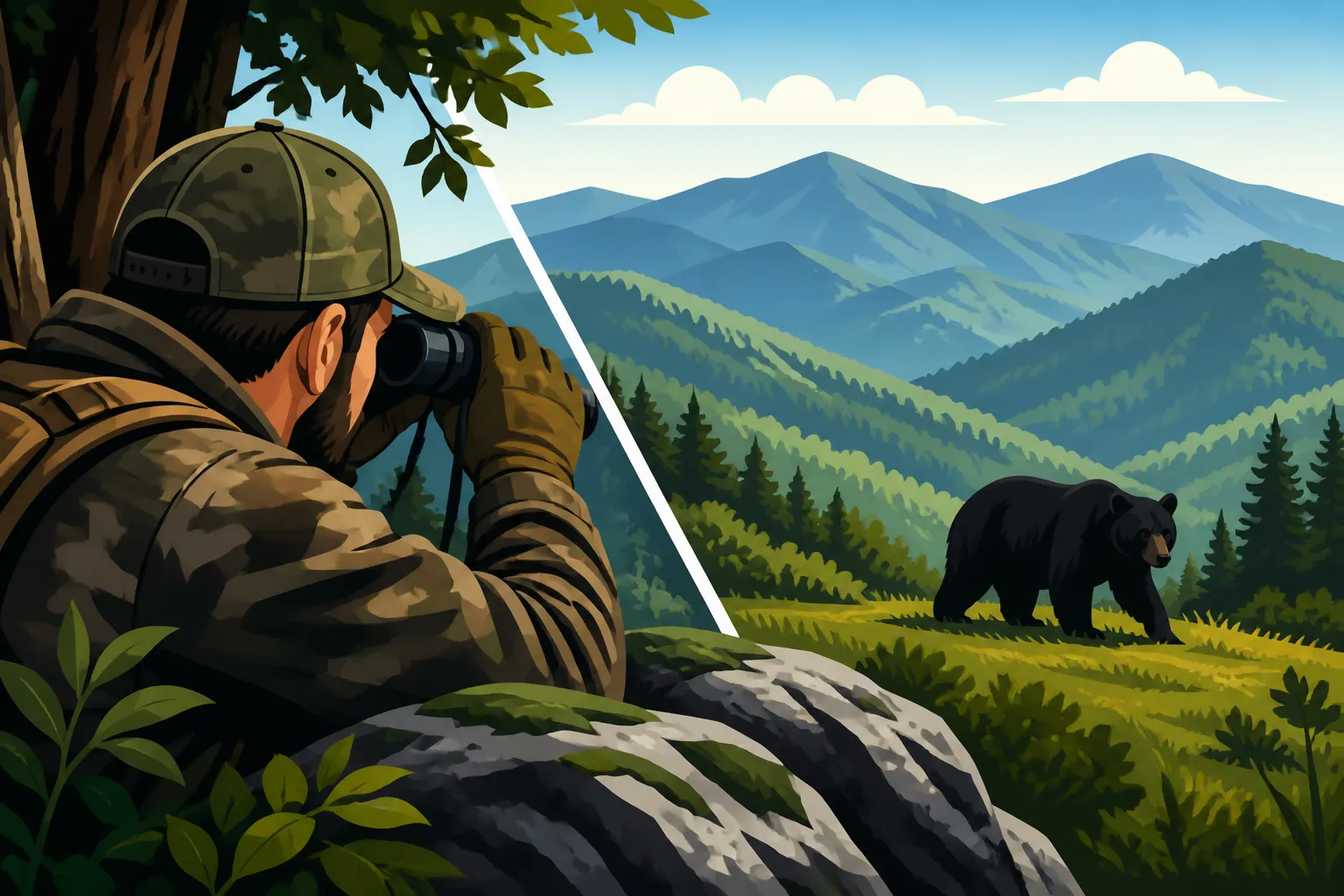
This is where your budget should shine. When you’re trying to pick a black bear out of a dark, shadowed cove or a distant laurel thicket from a mile away, cheap optics just won't cut it. A high-quality pair of 10x or 12x binoculars are your primary scouting tool for Spot-and-Stalk Tactics for Mountain Bears. You'll be spending hours glassing, so comfort and clarity are crucial. Don't skimp. Pair these with a spotting scope, especially if you plan on glassing really vast areas. A 60-80mm objective lens with 20-60x magnification will allow you to discern details at extreme distances – that dark blob might just be a rock, or it could be the shoulder of a big bear. The real secret weapon for mountain glassing, however, is a sturdy tripod. Handholding binoculars for extended periods is impossible if you want to eliminate shake and truly pick apart the landscape. A tripod allows you to lock in on a specific area and systematically scan, slowly and deliberately. When considering the ideal magnification, remember that too much can narrow your field of view too much; our guide on Binocular Power for Mountain Hunting offers excellent insights into balancing power and practicality.
Pre-Season Scouting and Digital Mapping
Effective spot-and-stalk starts long before you ever step foot in the woods with your rifle. Pre-season scouting, both physically and digitally, is non-negotiable. Begin with detailed mapping applications, like those found on GoHunt, to identify potential glassing knobs, likely travel corridors, and those dense bedding areas bears prefer. Look for areas with a mosaic of different timber types, south-facing slopes (which warm up first in the morning, attracting early forage), and steep, broken country where bears feel secure. Identify natural funnels, saddles between ridges, and benches along steep hillsides. These are high-percentage spots where bears are likely to travel.
Key Mapping Features for Bear Scouting
| Feature | Importance for Spot-and-Stalk Bear Hunting |
|---|---|
| Topographic Lines | Essential for identifying high points for glassing, steepness of terrain, and natural benches/saddles. |
| Satellite Imagery | Helps visualize different habitat types, clearcuts, dense thickets, and open timber. |
| Public Land Layers | Crucial for ensuring you are on huntable land and understanding boundaries. |
| Elevation Shading | Provides a quick visual of terrain relief, making it easier to spot potential bear havens. |
| Wind & Thermal Tools | Some advanced apps offer predictions, vital for planning your approach and avoiding detection. |
Physical scouting on the ground should confirm what your maps show you. Hike the highest ridges, identify the best vantage points for glassing, and look for actual bear sign: tracks, scat, rubbed trees, and torn-up logs. Pay close attention to how the wind and thermals behave in different parts of the terrain. This intimate knowledge, gained through hours of scouting, is invaluable for planning a successful stalk. For a broader approach to pre-season preparation, check out our piece on Scouting North Carolina Public Land Before Season.
Executing the Spot-and-Stalk
This is where the rubber meets the road. Spot-and-stalk hunting is a game of patience, stealth, and calculated aggression. The moment you spot a bear, the real work begins.
Locating Bears and Planning the Stalk
Your day will start on a high knob, usually before first light, so you can be set up and ready to glass as the sun hits the hillsides. Be patient. Don't rush your glassing. Systematically pick apart every shadowed draw, every patch of thick timber, every open hillside. Bears can blend in incredibly well. A good technique is to "grid" your area, scanning slowly from left to right, then dropping your field of view slightly and scanning back from right to left. Look for anything that looks "out of place" – a darker patch in the shadows, a specific shape, or movement.
Once you spot a bear, the very next thing you do is not rush. Observe the bear. Is it feeding? Moving? Bedded? How many bears are there? What's the wind doing? In the mountains, thermals play a huge role. Early in the morning, cold air sinks, pulling your scent down into the valleys. As the day warms, the thermals reverse, carrying your scent uphill. You must use these to your advantage. A sudden shift in wind or thermals can blow your stalk instantly. The GoHunt platform can be a valuable asset here, with its detailed maps allowing you to visualize terrain and anticipate thermal shifts, which are particularly dynamic in steep country. Our article on Wind and Thermals on a Blue Ridge Slope offers crucial advice for this exact challenge.
Next, plan your approach. Identify landmarks that will keep you concealed. Look for thick timber, rock outcroppings, or folds in the terrain. Visualize your entire route to the animal. There might be multiple "stalking lanes" – choose the one that offers the most cover, the best wind advantage, and the safest approach.
Cover, Movement, and Shot Opportunity
The stalk itself is an exercise in extreme patience and quiet movement. Every step matters. Keep your eyes peeled not just for the bear, but for broken branches, loose rocks, and anything that could give away your position. Walk slowly, lifting your feet and placing them down heel-to-toe. Use every bit of available cover. Stay in the shadows, behind ridges, and in thick timber.
As you get closer, reassess. Is the bear still there? Has its position changed? Is the wind still in your favor? You want to get as close as comfortably possible for a clean, ethical shot. For a bear, that's often within 100-150 yards, sometimes even closer in dense timber. When the opportunity arises, you'll need to be ready. Bears are built tough, and their vitals are slightly different from a deer. Aim for the crease behind the shoulder, slightly lower than you might for a deer, to penetrate the lungs and heart. If the bear is quartering away, aim to exit through the opposite shoulder. Take your time, get steady, and make a good shot. Our guide on Shot Placement on a North Carolina Black Bear provides essential diagrams and advice for this critical moment.
Post-Shot Strategy and Recovery
You've made the shot – now what? The work isn't over. Recovering a bear in North Carolina's mountains can be one of the most challenging aspects of the hunt.
Tracking and Recovery in Tough Terrain
The absolute most important thing to do after the shot is to wait. Bears, especially when hit, can travel significant distances, often into the nastiest, thickest cover imaginable. Unless you saw the bear go down and it didn't move, give it at least 30 minutes, or even a couple of hours if the shot wasn't perfect. Mark the exact spot the bear was standing when you shot and the last place you saw it.
When you begin tracking, go slowly. Look for blood, broken branches, disturbed leaves, and tracks. Bears leave a substantial blood trail if hit well, but it can quickly get lost in dense rhododendron or thick leaf litter. If you lose the trail, spread out and grid search the area in ever-widening circles. Don't be afraid to back out and come back later with more help if the trail is sparse or conditions are tough. A fresh pair of eyes can make all the difference. Sometimes, it might even require an overnight wait, especially if you're tracking late in the day, but always prioritize the ethical recovery of the animal. If you need a refresher on tracking fundamentals, our article on Tracking a Deer Through North Carolina Leaf Litter offers some universally applicable tips.
Field Dressing and Packing Out
Once you find your bear, congratulations! But don't celebrate too long. Bears are big animals, and in North Carolina's often warm early bear seasons, cooling the meat quickly is crucial. Field dress the bear immediately. Remove the entrails to allow the carcass to cool. If possible, consider skinning the bear and quartering it in the field, especially if you're deep in the backcountry and facing a long, arduous pack out. Bear meat spoils quickly if not handled properly.
Packing out a bear from the mountains is a monumental task. A mature boar can weigh upwards of 300-500 pounds, sometimes even more. You absolutely need a good frame pack and game bags. This is where the gutless method often shines, allowing you to bone out the meat and leave the heavy hide and skeleton behind if legal and practical for your situation. Having a hunting partner or two makes this process infinitely easier and safer. Make sure your Packs for a Pisgah Forest Day Hunt are up to the task of hauling serious weight, and that your Boots for North Carolina Swamps and Ridges provide the ankle support and traction needed for steep, uneven terrain. This will save you a lot of grief. For more specific advice on meat care, our guide on Field Dressing a Deer in Cold Weather provides a good foundation, which can be adapted for bear.
Disclaimer
Hunting bears in North Carolina's mountains is a physically demanding and potentially dangerous activity. This guide provides general information and tactics. Always consult the latest North Carolina Wildlife Resources Commission regulations, wear appropriate safety gear, and hunt ethically and responsibly. Ensure you have the proper licenses and stamps before heading afield.