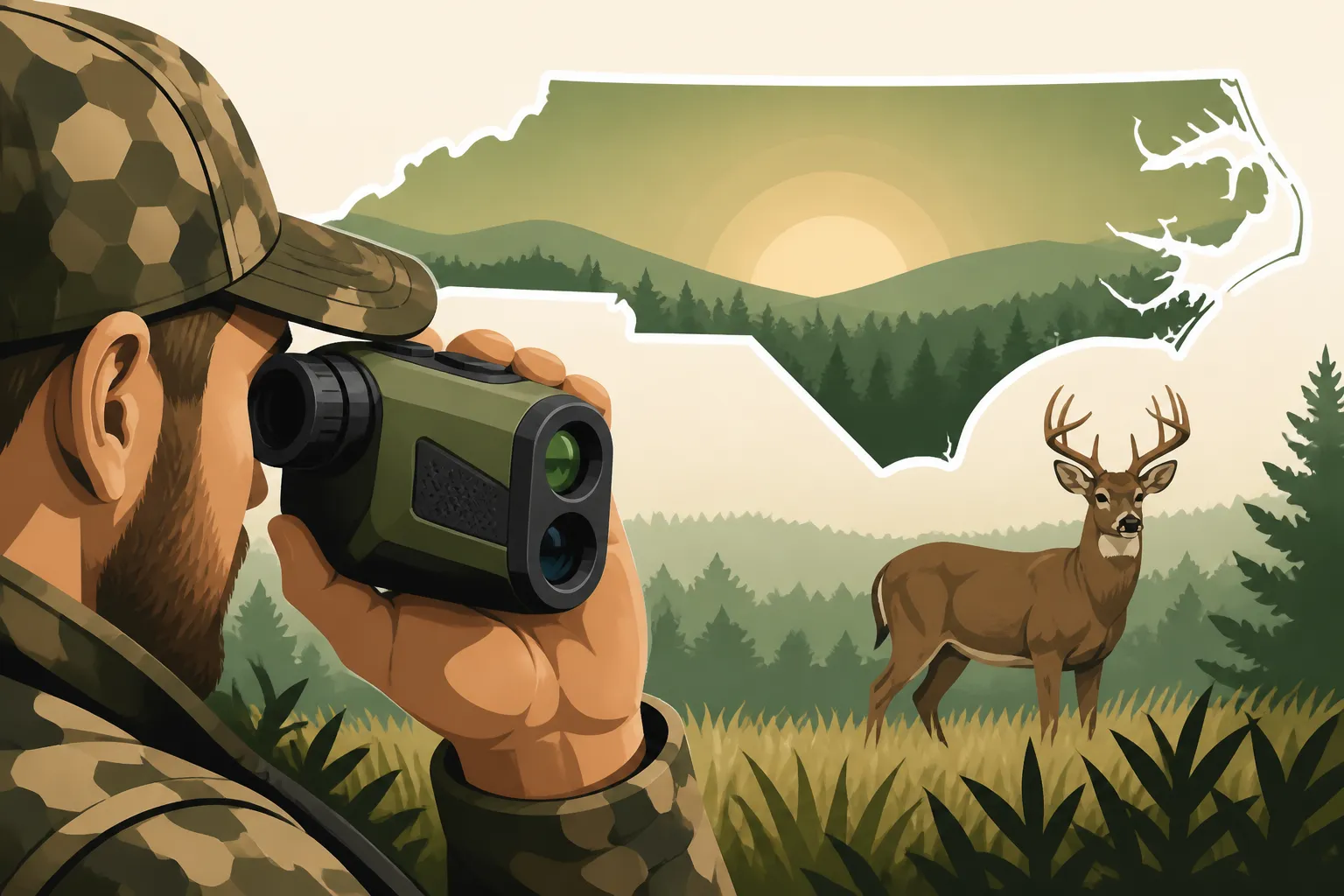
Rangefinders Under 100 Yards
It’s a common misconception that if a deer is "close," you don’t need to range it. You’re standing in your North Carolina treestand, a beautiful buck slips through the hardwoods at 30 yards, and your brain just screams, "Shoot!" But how many times have we all misjudged that distance, leading to a poor shot or a missed opportunity? This guide is all about helping you nail those crucial close-range shots by finding the perfect rangefinder that won't break the bank, ensuring you're precise even when a deer is practically under your stand.
Why Worry About Close-Range Ranging?
Many hunters, especially those new to archery or still-hunting in thick cover, might think that anything within, say, 40 yards is an "easy" shot that doesn't require a rangefinder. After all, if you practice at 20, 30, and 40, you should have it dialed, right? The reality of North Carolina's diverse terrain, from the steep, rolling hills of the Piedmont to the dense coastal pocosins, often throws a wrench into that idea. Your eye can play tricks on you, especially when the adrenaline is pumping.
The Myth of "Point Blank"
The term "point blank" often gives us a false sense of security. It suggests a range where you simply can't miss, or where a slight miscalculation won't matter. While it's true that at very close distances, the arrow's trajectory is flatter, those few yards can make a huge difference in arrow placement on a deer's vitals. Imagine you're hunting in a thick patch of pines, similar to what you might find in some of the gamelands near Hoffman. A buck steps out at what feels like 25 yards, but in reality, he's 32. If you've been practicing for 20 and 30, that extra 2 yards might not seem like much, but it could mean the difference between a clean pass-through and a gut shot, especially if you're holding your 20-yard pin a little low, expecting him to be closer. The slightest elevation difference, a small dip in the terrain, or even just the optical illusion of thick cover can throw your natural estimation off significantly. Don't fall for the "point blank" myth – every yard matters.
Angles and Obstructions in North Carolina Terrain
North Carolina is a state of incredible topographical variety, and this directly impacts how we range game. You might be Hanging a Stand on a Pisgah Ridge, looking down into a steep hollow. That deer at 40 yards downhill isn't a true 40-yard shot; gravity affects your arrow's flight, meaning you should aim for a shorter horizontal distance. This is where angle compensation becomes critical. Similarly, in the dense, tangled cover of a coastal swamp or an old clear-cut, a deer might be partially obscured by brush or a cluster of loblolly pines. Your rangefinder needs to be able to pick up the target cleanly, ignoring foreground clutter, even at those shorter distances. If you're on a flat field edge in the Piedmont, ranging might seem straightforward, but a small ditch or a rise can still throw off your perception. A good, affordable rangefinder helps you cut through the visual noise and get the actual, compensated distance.
What to Look For in an Affordable, Short-Range Rangefinder
When you're looking for a rangefinder under $100, you might feel like you have to sacrifice a lot of features. And while it's true you won't get the same bells and whistles as a top-tier model, there are still excellent options that provide reliable performance for the distances most North Carolina hunters will encounter, especially for bowhunting or still-hunting in dense woods. Focus on the core necessities that make a difference in the field, rather than getting distracted by marketing jargon for features you don't truly need at short range.
Magnification and Optics Clarity
For ranging under 100 yards, you don't need a powerful 8x or 10x magnification. A 4x or 6x magnification is usually more than sufficient. In fact, lower magnification can sometimes be better in thick timber because it provides a wider field of view, making it easier to acquire your target quickly. What's more important than sheer power is the clarity of the optics. Even on a budget, look for lenses that offer a bright, clear image with good contrast. You want to be able to see your target dot or crosshair clearly against the background, even in the dim light of dawn or dusk when North Carolina deer are most active. A fuzzy or dark image will only frustrate you and slow down your shot. A clear optic can also help you identify small shooting lanes in dense cover, helping you make a precise shot with your Bow Sights for Timber Shots.
Speed and Simplicity
When that buck steps out, you don't have time to fiddle with complicated menus or wait for a slow reading. A good rangefinder under $100 should be quick to power on and provide an instant, accurate reading. Look for models with a single-button operation: press once to activate, press again to range. The display should be uncluttered and easy to read, even if it's just a basic LCD screen. You don't need fancy color displays or complex targeting modes for short-range work; you need a fast, reliable number. Simplicity often means fewer things can go wrong, which is a huge benefit when you're relying on your gear in the field.
Durability and Weather Resistance
North Carolina weather can be unpredictable. One minute it's sunny, the next you're in a driving rain. Your gear needs to hold up. While most budget rangefinders aren't fully submersible, look for models that are advertised as water-resistant or weatherproof. This usually means they can handle light rain, mist, or an accidental splash. Also, consider the construction. A rubberized housing will provide better grip, reduce noise if it bumps against your stand, and offer some protection against minor drops. You don't need military-grade ruggedness, but it shouldn't feel like a toy that will fall apart after a season of use. A sturdy loop for a lanyard is also a great feature, preventing drops from a treestand or while scrambling over logs in a swamp.
Top Features for North Carolina Hunters on a Budget
When you're shopping for an affordable rangefinder, it's easy to get overwhelmed by the sheer number of options. My advice? Don't chase every fancy feature. Instead, focus on a few key capabilities that genuinely enhance your hunting experience in North Carolina's diverse environments, especially for those closer shots where precision is paramount. Think about the real-world scenarios you face.
Angle Compensation: A Must-Have
This is arguably the most important feature for any rangefinder used in the hilly or mountainous parts of North Carolina, but it's also highly useful even in the rolling Piedmont. Wind and Thermals on a Blue Ridge Slope are complex, and so is ranging on uneven ground. When you shoot uphill or downhill, gravity causes your arrow or bullet to strike higher than it would on flat ground at the same linear distance. Angle compensation (sometimes called "horizontal distance" or "true ballistic range") calculates the effective horizontal distance to the target, which is the distance you should actually use for your shot. Even a subtle incline in a creek bottom or a raised treestand can affect your shot. Missing this feature on a budget model would be a critical oversight, as it directly impacts your accuracy on those challenging angled shots. Make sure it's present, as it can be the difference between a clean kill and a frustrating miss when that buck is 30 yards directly below your stand.
Scan Mode for Moving Game
Imagine a scenario: you're Still-Hunting Nantahala Forest Ridges, slowly making your way through the timber. You spot a deer moving through the trees, stopping briefly, then moving again. Instead of trying to get a single, precise read on a momentarily stationary animal, a "scan mode" allows you to continuously range as you pan across the area or follow a moving target. This is incredibly useful for getting a quick average distance or confirming distances to multiple potential shooting lanes as an animal approaches or passes. For under $100, you might not get ultra-fast, multi-target scanning, but a basic scan mode that updates the distance as you hold down the button is invaluable for hunting active game in North Carolina's dynamic environments. It helps you prepare for the shot before the animal even stops.
Compact Size and Ergonomics
A bulky, heavy rangefinder is a pain to carry, especially if you're hiking into remote public land or trying to keep your gear light for Saddle Hunting in North Carolina Hardwoods. Look for a compact, lightweight design that fits comfortably in your hand or a bino harness. Ergonomics are key: can you operate it easily with one hand? Is the button placement intuitive? A lanyard or small carabiner attachment point is also a big plus, allowing you to secure it to your pack, harness, or even a belt loop, keeping it easily accessible without fumbling. While less critical for pure functionality, a comfortable and convenient rangefinder means you'll actually use it more often, and that's the whole point. Consider how it will integrate with your other gear, like your Packs for a Pisgah Forest Day Hunt, ensuring it doesn't add unnecessary bulk.
| Feature Priority | Description | Why it matters for under $100 |
|---|---|---|
| Angle Compensation | Provides "true horizontal distance" for uphill/downhill shots, crucial for accurate projectile drop. | Often found in budget models now. Essential for North Carolina's varied terrain to prevent high/low shots. |
| Optics Clarity | A clear, bright view through the viewfinder, even in low light, for easy target acquisition. | More important than high magnification for short range. Fuzzy views lead to frustration and missed opportunities, especially at dawn/dusk. |
| Scan Mode | Allows continuous ranging by holding the button, useful for tracking moving animals or surveying an area. | Helps get quick, average distances on moving game, or check multiple lanes quickly without multiple button presses. |
| Speed & Simplicity | Fast target acquisition and distance readout with minimal button presses and an uncluttered display. | Critical for reactive hunting scenarios. You need a number now, not after navigating menus. |
| Weather Resistance | Ability to withstand light rain, mist, and splashes without damage. | North Carolina weather is unpredictable. Protects your investment and ensures reliability in damp hunting conditions. |
| Compact Size | Lightweight and small enough to carry comfortably without adding bulk to your gear. | Encourages frequent use. Easier to deploy quickly from a pocket or harness, especially when still-hunting or in a treestand. |
Getting the Most Out of Your Under-$100 Rangefinder
Buying an affordable rangefinder is only the first step. To truly make it a valuable tool in your North Carolina hunting arsenal, you need to incorporate it into your routine, understand its limitations, and maintain it properly. Just like a Zeroing at 100 Yards for Woods Hunting regimen, consistent practice with your rangefinder will build confidence and make it second nature in the field. Don't let a great piece of gear sit unused or underutilized because you haven't taken the time to truly master it.
Practice, Practice, Practice
Like any piece of hunting equipment, a rangefinder is only as good as the hunter using it. Don't wait until opening day to pull it out of the box. Take it with you on scouting trips, even if you're just looking for Scrape Lines Along a Logging Road or Reading North Carolina Mud for Fresh Deer Movement. Range trees, bushes, and landmarks at various distances from different positions – from the ground, kneeling, and even from mock treestands. Pay attention to how angle compensation works on hills and valleys. The more you use it in non-pressure situations, the more intuitive it will become when that moment of truth arrives. Practice ranging from your actual treestand setup, knowing exactly how far the old oak is, or that brush pile, or the creek crossing. This familiarity makes all the difference when you're focusing on making a clean shot with your chosen Fixed Versus Mechanical Broadheads.
Mount it Right
While you won't be "mounting" a rangefinder in the traditional sense like a scope, how you carry and deploy it matters immensely. Many hunters opt for a binocular harness that has a dedicated pouch or pocket for their rangefinder, keeping it secure and easily accessible on their chest. Others prefer a small belt pouch or simply a pocket in their hunting jacket or pack. The key is consistency. Always put it in the same spot so you can retrieve it without looking. Consider adding a small lanyard to it, especially if you're in a treestand, to prevent accidental drops. Even the best rangefinder is useless if you can't get to it quickly and quietly when a deer appears. For those who use a mapping app like GoHunt for scouting and navigation, consider having your rangefinder on the opposite side of your binos or phone so you can fluidly switch between them.
Battery Life and Maintenance
Most rangefinders under $100 use common AAA or CR2 batteries. Always carry a spare, especially if you're heading out for a multi-day trip or hunting in cold weather, which can drain batteries faster. Check your battery before each season, and if it's been sitting for a while, just swap it out. It's a cheap insurance policy. Keep the lenses clean with a soft microfiber cloth; dirt and smudges will severely degrade image clarity and ranging performance. Store your rangefinder in a dry place when not in use. While these budget models are generally robust, a little care goes a long way in ensuring it's ready to perform when you need it most. And if you’re planning a long hike through somewhere like Pisgah National Forest Hunting, consider a small, dry bag for your electronics, including your rangefinder, just to be extra safe from unexpected downpours.
Disclaimer
This article is for general informational purposes only and does not constitute professional advice. Laws, prices and regulations vary by location and change over time. Consult a qualified professional for guidance on your specific situation.