Illuminated Reticles for Dark Timber
Hunting in North Carolina's dense forests and mountains often means facing incredibly challenging low-light conditions. Whether you're tracking a deer through a thick mountain laurel hell in Pisgah National Forest or waiting for a gobbler to fly down from a dark river bottom roost on the Coastal Plain, visibility can drop fast. This guide will help you understand how illuminated reticles in your rifle scope can be a game-changer, helping you make ethical, confident shots when legal shooting light is fading or cover is exceptionally dark.
Why Illuminated Reticles are a Game-Changer in North Carolina's Dark Timber
North Carolina offers an incredible diversity of hunting environments, from the vast, rugged mountains with their deep coves and thick rhododendron to the swampy, dense pocosins of the Coastal Plain. In both extremes, hunters often find themselves in what we affectionately call "dark timber"—areas where the canopy is so thick, or the undergrowth so dense, that ambient light struggles to penetrate. This is especially true during the early morning hours, late afternoon, or on heavily overcast days.
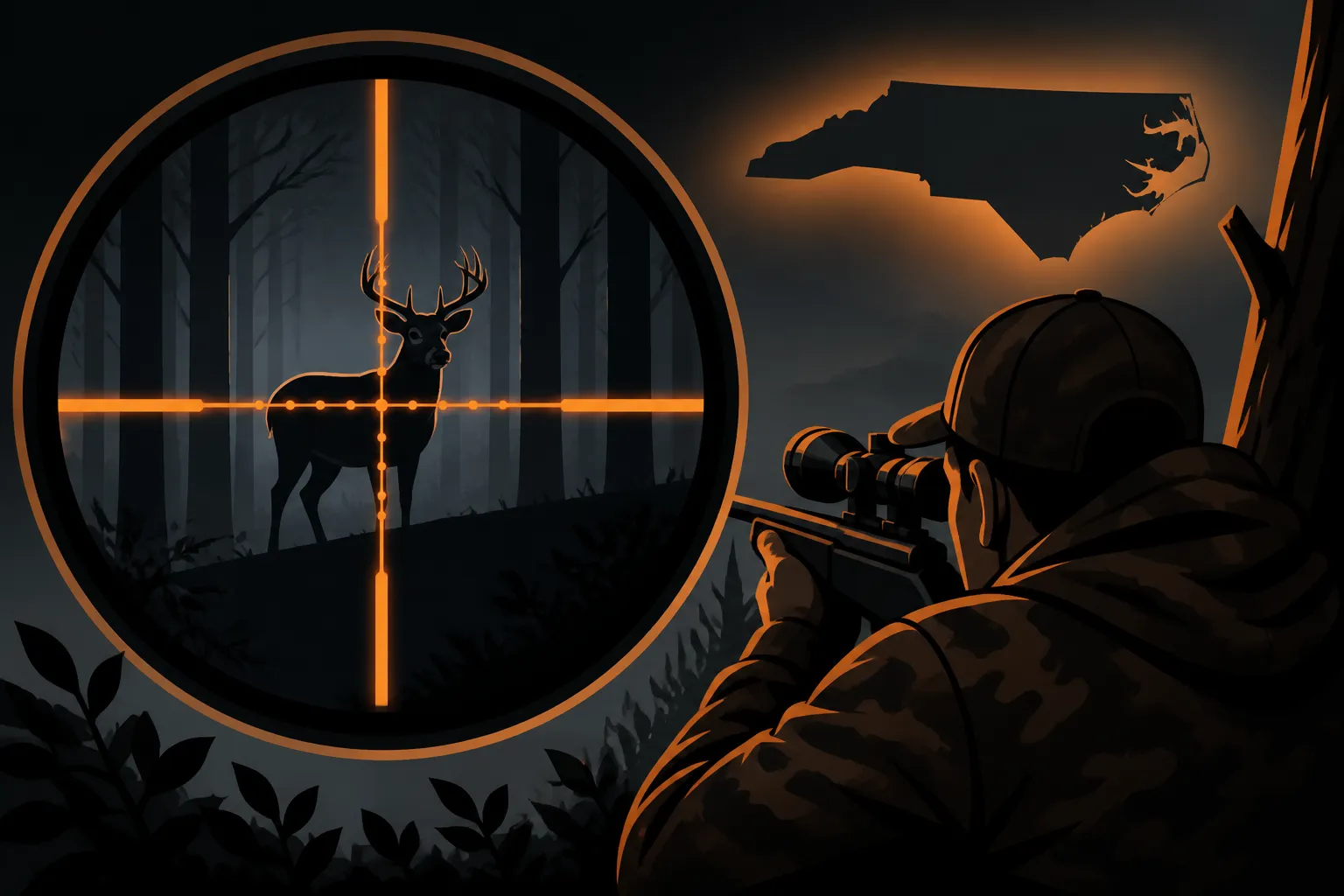
Imagine you've been working a ridge in the Nantahala National Forest all morning, and finally, a nice buck steps out into a small clearing in a stand of thick hemlocks. The light is dim, shadows are long, and your plain black crosshairs simply disappear into the animal's dark hide against the even darker timber background. This isn't just frustrating; it can lead to missed opportunities or, worse, an unethical shot. That's where an illuminated reticle shines, literally. It provides a visible aiming point that contrasts sharply with the target and background, giving you the confidence to place your shot precisely, even in conditions where a traditional reticle would fail you completely. It's about ensuring clarity and precision when every second and every ounce of visibility counts.
The frustration of losing your reticle is a common one, and it's not just a mountain problem. Even in the Piedmont, a big buck slipping through a thick briar patch along a creek bottom at last light can be nearly impossible to aim at with a standard reticle. The ability to quickly acquire your target and confidently place a shot becomes paramount, particularly as legal shooting light dwindles to its absolute limit. Having that glowing dot or crosshair means you're not guessing where the center of your aim truly is. This is especially important for hunters who spend a lot of time still-hunting or using treestands in areas known for their dense cover, where deer often appear abruptly and offer only a small window of opportunity. Treestand Setups in Pisgah National Forest and Still-Hunting Nantahala Forest Ridges are prime examples of scenarios where this technology truly earns its keep.
Understanding Illuminated Reticle Technology
Modern rifle scopes offer a wide array of reticle options, and illuminated reticles have become increasingly popular for good reason. They integrate a small LED light source that projects light onto a portion of the reticle, typically a central dot, crosshairs, or a specific aiming point. This illumination can be adjusted in brightness and often in color, giving the hunter control over how the reticle appears in various lighting conditions.
Types of Illumination and Reticle Patterns
There are generally two main types of illumination: red and green. Red is by far the most common, as it tends to be less disruptive to your natural night vision. However, some hunters prefer green, finding it more visible in certain environments or for specific types of color blindness. Beyond color, the reticle patterns themselves vary wildly. You might find a simple illuminated dot at the center of a traditional duplex reticle, or a more complex reticle with illuminated hash marks for bullet drop compensation or windage. Some high-end scopes, like those you might read about on GoHunt's gear reviews, offer reticles that illuminate only a small, precise center point, while others might light up a larger portion of the reticle, such as a Christmas tree style reticle for long-range precision.
The key is to have a reticle that offers a balance of precision and visibility. A tiny, glowing dot might be perfect for precision shots on open powerline cuts, but in thick brush, a slightly bolder illuminated crosshair might be easier to pick up quickly. For hunting in North Carolina's diverse environments, having options in both color and pattern can make a significant difference. It’s not just about turning on a light; it’s about having the right light for the situation.
Battery Life and Power Management
Since illuminated reticles rely on a battery, power management is a crucial consideration. Most scopes use small, coin-style lithium batteries (like a CR2032 or CR2025), which are generally long-lasting. However, leaving the illumination on constantly, especially at higher brightness settings, will drain the battery much faster. Many scopes include an auto-shutoff feature after a period of inactivity, which is a fantastic battery-saving design. Others have multiple brightness settings, allowing you to dial down the intensity to conserve power while still providing enough visibility for dim conditions.
It’s always a good practice to carry spare batteries, especially if you're heading deep into a remote area like the Linville Gorge Wilderness or for an extended hunt. Imagine finally getting that shot opportunity on a trophy buck in a dark bottom, only to find your reticle battery is dead. Keeping fresh batteries and checking them regularly is as important as checking your rifle's zero. You can find many discussions on hunting forums, or even on sites like GoHunt, about battery longevity for different scope brands, providing real-world insights from other hunters.
| Reticle Illumination Feature | Pros | Cons | Best Use Case in NC |
|---|---|---|---|
| Red Dot/Crosshair | Excellent for low light, preserves night vision. High contrast against dark backgrounds. | Can be too bright if not adjustable; may cause halo effect. | Dense timber, deep coves, late evening in Eastern NC swamps. |
| Green Dot/Crosshair | Highly visible to some eyes, stands out against red/brown targets. | Can be harsher on night vision for some; less common. | Hunters with specific vision needs, contrasting with heavy green foliage. |
| Variable Brightness | Adaptable to all light conditions, battery saving. | More complex controls, potential for accidental adjustment. | Any hunting scenario where light changes frequently. |
| Auto-Shutoff | Prevents battery drain if forgotten on. | May shut off unexpectedly during long waits. | Set-and-wait scenarios, hunting from a blind or stand. |
| Simple Center Dot | Clean, precise aiming point. | Can get lost easily if not illuminated. | Precision shots, medium to long range in timber openings. |
| Complex BDC/Holdovers | Aids in ranging and holdover at longer distances. | Can be cluttered at closer ranges in dark timber. | Open clear-cuts, longer shots across valleys in the mountains. |
Choosing the Right Illuminated Reticle for North Carolina's Dark Timber
When it comes to selecting a scope with an illuminated reticle for hunting North Carolina's dark timber, there are a few key factors to consider. This isn't a one-size-fits-all situation; what works for an open-country elk hunter might not be ideal for chasing whitetails in the dense woods of Uwharrie National Forest.
Brightness Settings and Color Choice
The ability to adjust the brightness of your reticle is paramount. You don't want a blazing-bright red dot in truly dark conditions; it can flare, create a "halo" effect, and obscure your target. Conversely, a reticle that's too dim won't be visible in twilight. Look for scopes that offer a wide range of illumination settings, from very subtle, barely-there glows for deep shadows to brighter settings for overcast days or when you're transitioning between shaded and open areas. Many quality scopes have multiple levels, often 7-10 or more, giving you fine-tuned control. As for color, most hunters gravitate towards red for its low impact on night vision and good contrast against dark game. However, if you find red hard to pick up, a green option might be worth exploring. Test both if you can, perhaps by borrowing a friend's scope or visiting a local sporting goods store.
Consider the ambient light conditions you typically hunt in. If you're often in areas like Hunting Coastal Plain Pocosin Swamps, where the canopy is dense and the air can be perpetually dim, a reticle with very low-end brightness settings will be crucial. For those who hunt more varied terrain, a wider range of settings ensures versatility.
Reticle Pattern for Quick Acquisition
The actual design of the illuminated portion of the reticle matters significantly. For quick, close-range shots in thick cover, a simple illuminated dot or a small illuminated crosshair is often preferred. These patterns are less distracting and allow for rapid target acquisition. More complex reticles with multiple holdover points can be great for longer shots across fields or clear-cuts, but in dark timber, they can appear cluttered and actually make it harder to find your exact aiming point quickly.
Think about the maximum ethical range you typically shoot in North Carolina's woods. For most timber hunting, shots are rarely beyond 150-200 yards. A clean, uncluttered illuminated center point will serve you far better than a busy long-range reticle in these scenarios. Ultimately, the best reticle pattern is one that you can quickly acquire and confidently use under pressure in low light. This is an area where personalized preference is key, so don't just go with what someone else recommends; try different options to see what feels most natural to your eye. When researching, check out hunter reviews on platforms like GoHunt, as they often detail personal experiences with various reticle styles in different hunting conditions.
Practical Tips for Hunting with an Illuminated Reticle in North Carolina
Having an illuminated reticle is just one part of the equation; knowing how to use it effectively and maintain it is what truly makes the difference in the field.
Zeroing and Testing in Varied Light
Just like any scope, your illuminated reticle needs to be properly zeroed. However, it's crucial to test your zero not just in bright daylight, but also in twilight conditions, perhaps during the first or last legal shooting hour. This allows you to confirm that the illumination doesn't cause any parallax shift or point-of-impact change at different brightness settings. While rare in quality scopes, it's always best to verify. Also, practice acquiring targets with the reticle illuminated. Can you pick it up quickly? Does it obscure too much of your target?
Consider setting up targets in shaded areas of your range or even just at the edge of the woods to simulate dark timber conditions. Shoot a few groups with the reticle on low power, then on medium. Pay attention to how your eye perceives the dot in relation to the target. This kind of testing goes beyond simply putting holes in paper; it builds muscle memory and confidence for those critical moments in the field. When Zeroing a Rifle for Mixed Distances in North Carolina, always include some low-light scenarios.
Battery Management and Field Preparedness
Never underestimate the importance of fresh batteries. Before every hunting trip, especially extended ones, replace your reticle battery or at least carry a spare. It's cheap insurance. Store spares in a small, waterproof container in your hunting pack, away from extreme temperatures. Many hunters keep a spare in a small pocket on their rifle sling or stock pack for easy access.
In the field, make it a habit to only turn on the illumination when you anticipate a shot opportunity or when actively scanning for game in truly dim light. Otherwise, keep it off to conserve battery life. If your scope has an auto-shutoff feature, familiarize yourself with its timing. You don't want it turning off mid-stalk. Always double-check your illumination setting before entering a prime hunting area. It's easy to accidentally bump the dial, so a quick visual check can save you a world of frustration. It's a small detail, but in the challenging environment of North Carolina's dark timber, these small details often make the biggest difference between success and a frustrating "what if."
Adapting to Environmental Factors
North Carolina weather can be notoriously unpredictable. Fog, drizzle, heavy rain, or even just high humidity can impact optical performance. While an illuminated reticle helps with target acquisition, it won't fix a fogged objective lens. Ensure your scope is well-maintained, with clean lenses and proper lens caps to protect them from the elements.
On cold mornings in the mountains, condensation can be an issue. Let your scope acclimate to the ambient temperature before hunting to minimize fogging. If you're hunting in particularly wet conditions, especially along the coast in a place like Hunting Croatan Forest Pocosin Edges, moisture can potentially get into the battery compartment if seals are compromised. Always ensure battery caps are tightly secured. Being prepared for the environment means your gear will perform when you need it most, helping you take advantage of those fleeting opportunities when a buck steps out of the shadows.
Disclaimer
This article is for general informational purposes only and does not constitute professional advice. Laws, prices and regulations vary by location and change over time. Consult a qualified professional for guidance on your specific situation.