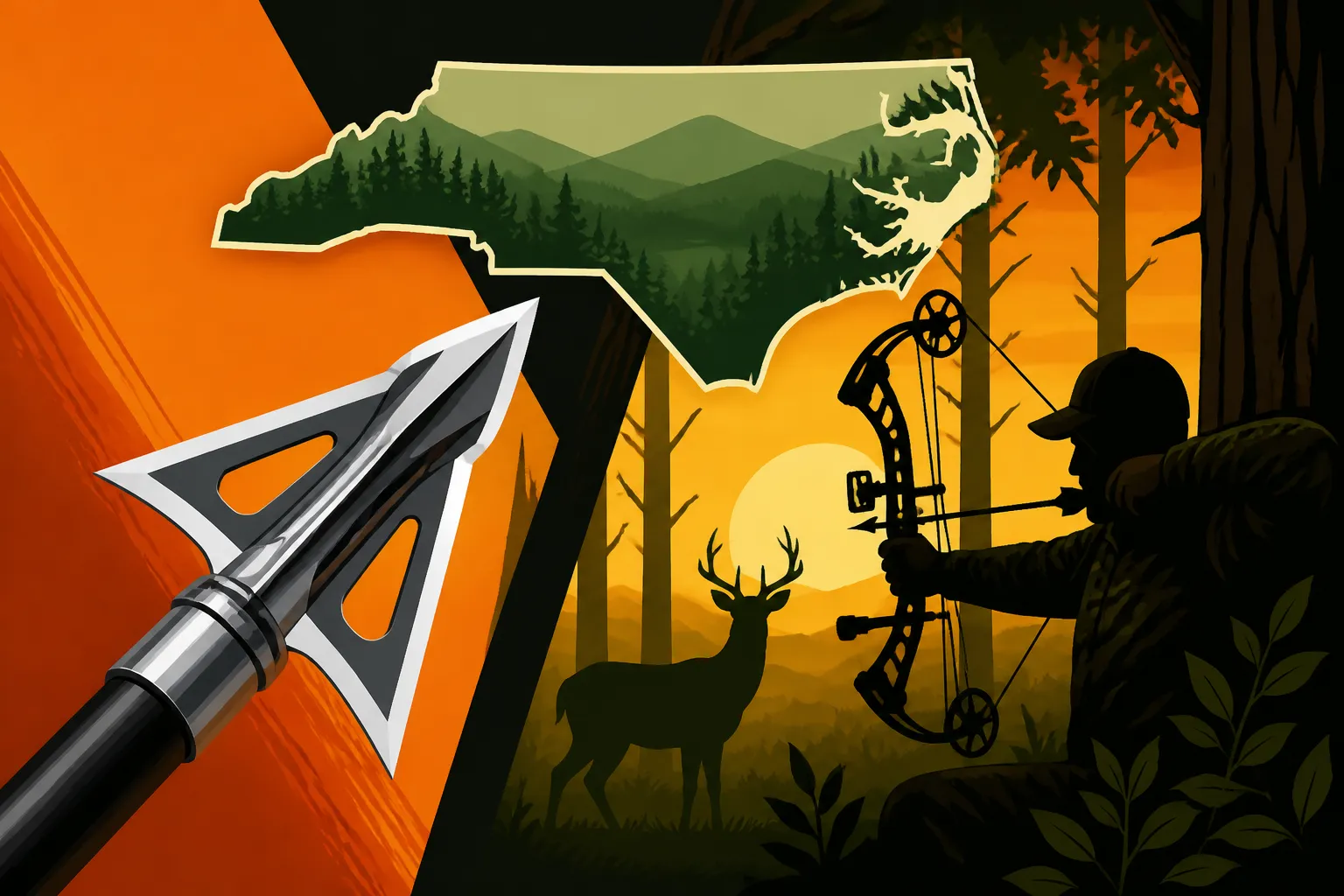
Broadheads for Timber Shots
One of the biggest head-scratchers for any North Carolina bowhunter, especially those of us who spend our time deep in the woods, is choosing the right broadhead. You’re often not looking at those wide-open field shots you see on TV. Instead, you're navigating dense pines, thick river bottom hardwoods, or gnarly rhododendron thickets in the mountains. This guide is all about helping you understand the different broadhead options and how to pick the perfect one to ensure clean, ethical kills when your shot window is tight and the cover is thick.
The Unique Challenges of Timber Hunting in North Carolina
Hunting deer in North Carolina's diverse landscapes means we're often dealing with terrain that demands specific gear choices. It’s a far cry from the wide-open prairie hunts some folks experience out West. Our timber presents a unique set of challenges that directly impact broadhead performance.
Thick Cover and Close Shots
Let's be real: when you’re hunting the hardwoods of the Piedmont, the vast pine plantations of the Sandhills, or those incredible, yet incredibly dense, pocosin swamps on the Coastal Plain, your shots are rarely going to be at extreme distances. We’re talking 30 yards and under, often much closer. In these scenarios, a deer might step out of a thicket, give you a brief window, and then be gone. You don't have time for a broadhead that might deviate its flight path even slightly. The focus shifts from pinpoint accuracy at 60 yards to guaranteed reliability and deep penetration at 20.
Imagine you're tucked away in a ground blind next to a cutover, or perched in a Treestand Setups in Pisgah National Forest looking into a laurel patch. A buck steps out at 15 yards, quartering away slightly, and suddenly you have a shot. You need a broadhead that will fly true at that short range, punch through whatever it encounters, and keep going to give you that crucial exit wound. This is the reality for many of us, and it’s why understanding broadhead design for these conditions is so vital.
Encountering Obstructions and Angled Shots
North Carolina timber isn't just about distance; it's about what’s between you and the deer. A small twig, a stray branch, or even a leaf can wreak havoc on an arrow's flight, especially with certain broadhead designs. Deer, being deer, rarely stand perfectly broadside in a clear shooting lane for long. You’ll often find them weaving through saplings, browsing with their vitals partially obscured, or quartering hard as they move through the undergrowth. This means you might get an angled shot that requires the broadhead to cut through ribs or shoulder bone.
A broadhead that folds up, breaks, or deflects on bone can turn a promising shot into a nightmare scenario. We’ve all heard the stories, or worse, experienced it ourselves – a solid hit that just didn’t penetrate enough, leading to a long, frustrating blood trail, or no trail at all. The gnarly cover of a Hunting Coastal Plain Pocosin Swamps or the dense rhododendron thickets in the mountains are unforgiving. You need a broadhead that holds its integrity when it hits something solid, maintaining its cutting action and driving deep.
Understanding Broadhead Types and Their Mechanics
When it comes to broadheads, the market offers a dizzying array of options. It's easy to get lost in the marketing hype, but for timber hunting, understanding the fundamental differences in design is key. Let’s break down the main categories.
Fixed-Blade Broadheads: The Tried and True
Fixed-blade broadheads are, as the name suggests, broadheads where the blades are fixed in place and do not move. These are the original, classic designs that have put game on the table for centuries. They typically come in two main styles: one-piece designs where the ferrule and blades are milled from a single piece of steel (like a G5 Montec or an Iron Will), or designs with replaceable blades that are screwed or locked into a sturdy ferrule (like a Muzzy or Wasp).
The beauty of fixed-blade broadheads, especially for timber hunting, lies in their durability and reliability. Because the blades are always deployed, there's no mechanism to fail. You get a consistent cutting surface from the moment of impact. This translates to deep penetration, which is absolutely critical for achieving pass-throughs and good blood trails in thick cover. They are often incredibly robust, capable of busting through bone without significant damage to the broadhead itself. While some argue they can be less forgiving to bow tuning and might "plane" more in flight, a well-tuned bow, as outlined in Bowhunting North Carolina's Statewide Archery Season, will send them exactly where you aim, even at those crucial short distances. They might not boast the massive cutting diameters of some mechanicals, but their dependable, consistent cut is hard to beat for deep woods hunting.
Mechanical Broadheads: Expanding Your Options
Mechanical broadheads, sometimes called expandable broadheads, operate differently. Their blades are tucked in during flight, making them similar in profile to a field point. Upon impact with the target, the blades deploy, opening up to create a much larger cutting diameter. Popular examples include Rage, NAP Spitfire, and Swat broadheads. The primary draw of mechanicals is often their field-point accuracy, as their compact design in flight theoretically reduces wind drag and planing issues.
For open-field hunting, where shots might be longer and obstructions minimal, mechanicals can be very effective, creating massive wound channels. However, for the dense North Carolina timber, they come with a few considerations. The deployment mechanism, while highly reliable in many modern designs, still represents a potential point of failure. If a blade doesn't deploy fully, or if it deploys prematurely due to a glancing blow off a twig, you can lose penetration and cutting surface. Moreover, the act of deployment can absorb a small amount of kinetic energy, which might be a concern on tougher bone hits or with lower poundage bows. While many hunters swear by them, especially with modern designs that have improved significantly, it’s worth weighing these factors carefully when your hunting environment is unforgiving. If you're a crossbow hunter, you'll find similar considerations, but Crossbow Rules During North Carolina Archery Season might require you to be even more mindful of broadhead performance given the typically higher speeds.
Hybrid Broadheads: A Blend of Both Worlds
As broadhead technology evolves, so do the designs. Hybrid broadheads are an interesting response to the "fixed vs. mechanical" debate, attempting to combine the best aspects of both. These broadheads typically feature one or more fixed blades that are always exposed, providing a solid cutting surface and reliable penetration similar to a traditional fixed blade. In addition, they incorporate smaller, mechanical "bleeder" blades that deploy on impact, adding to the total cutting diameter.
The idea behind hybrids is to offer the penetration and reliability of a fixed blade with some of the larger wound channel benefits of a mechanical. They can be a good compromise for hunters who want a bit more cutting diameter but don't want to completely sacrifice the integrity of a fixed-blade design. While they still have mechanical components, the primary cutting is often handled by the fixed blades, reducing the risk of a complete failure if the mechanical blades don't deploy perfectly. For a broad range of hunting scenarios across North Carolina, from Piedmont hardwoods to mountain fringes, a well-designed hybrid can be a versatile choice.
Key Factors for Choosing Broadheads in Timber
When you're out there chasing whitetails in North Carolina's timber, whether you're up in a stand or still-hunting through a pine thicket, your broadhead choice isn't just about personal preference; it's about performance under pressure. Several factors become paramount.
Penetration Power: Getting Through the Deer
In the close-quarters combat of timber hunting, penetration is king. You absolutely need your arrow to pass through the animal to create two holes: an entry wound and an exit wound. Why two holes? Because two holes mean a better, more consistent blood trail, which is crucial for recovering a deer that runs into thick cover after the shot. Recovering a deer from a Dragging a Deer Out of a Coastal Swamp or a dense rhododendron thicket is tough enough with a good blood trail; without one, it becomes a needle-in-a-haystack endeavor.
Factors influencing penetration include the broadhead's design (e.g., a steep, chisel-tip fixed blade generally penetrates better than a large, multi-blade mechanical on a tough angle), the sharpness of its blades, and your arrow's kinetic energy and momentum. Heavier arrows, for example, tend to carry more momentum, aiding in deeper penetration, especially important for Arrow Weight for Short Shots. A strong ferrule that doesn't bend or break on impact also contributes significantly. You want a broadhead that uses its energy to drive forward, not just to cut a massive surface area on entry.
Durability and Reliability in Tough Situations
Imagine this: you've made a perfect shot at a nice buck in a tight funnel, only to hear the dreaded thwack of your broadhead hitting a rib on the far side. What happens next depends heavily on your broadhead’s durability. A flimsy broadhead might bend, break, or have its blades snap, drastically reducing its ability to continue penetrating and creating a sufficient wound channel. A robust broadhead, however, will hold its integrity, continue cutting, and drive through, maximizing the chances of a clean pass-through.
This is where the strength of the broadhead's ferrule and the quality of its blades truly shine. Fixed-blade designs, especially those with one-piece construction or very thick, replaceable blades, often excel in this department. They are built to withstand abuse. When you're making a quartering-away shot through the shoulder blade, or even glancing a small twig before impact (which, let's face it, happens), you need confidence that your broadhead will perform. GoHunt, a great resource, offers extensive reviews and user feedback on various broadhead models, often including real-world experiences with durability and reliability, which can be invaluable when making your choice.
Flight Characteristics and Bow Tuning
Even though timber shots are generally close, broadhead flight characteristics are still incredibly important. A broadhead that flies erratically, even at 20 yards, can mean the difference between a clean kill and a frustrating miss or wound. Fixed-blade broadheads, with their exposed blades, can sometimes be more susceptible to "planing" or wind drift if your bow isn't perfectly tuned. This is why proper bow tuning is absolutely non-negotiable.
You need to ensure your arrow leaves the string cleanly and flies straight. This involves processes like paper tuning and walk-back tuning, which we’ll discuss shortly. The goal is for your broadheads to fly exactly like your field points. While mechanical broadheads often boast "field point accuracy" due to their compact in-flight profile, this doesn't excuse a poorly tuned bow. Even a mechanical broadhead will suffer from erratic flight if your arrow is coming off the bow with nock travel issues or fletching contact. Regardless of your broadhead choice, putting in the time to tune your bow to perfection is an investment that pays off in confidence and accuracy. When you're Hanging a Stand on a Pisgah Ridge and anticipating a close shot, knowing your arrow will fly true is paramount.
Matching Broadheads to North Carolina's Diverse Timber
North Carolina is a hunter’s paradise, but its diverse topography means what works well in one region might be less ideal in another. Understanding the nuances of each timber type can help you fine-tune your broadhead selection.
Mountain Hunting: Steep Terrain and Dense Undergrowth
Hunting in the mountains of North Carolina, particularly in areas like Pisgah and Nantahala National Forests, presents some of the most challenging conditions. You’re dealing with steep inclines, deep hollows, and incredibly dense undergrowth like rhododendron and mountain laurel. Shots are almost always close, often under 25 yards, and frequently at steep up or downhill angles.
In these environments, absolute dependability and maximum penetration are non-negotiable. A broadhead that can drive through a deer and potentially a bit of brush without deflecting or failing is paramount. Many seasoned mountain hunters lean heavily towards durable, fixed-blade broadheads with sturdy ferrules and strong, thick blades. Their reliability in punching through bone and maintaining a straight flight path, even after a glancing blow on a twig, makes them a favorite. You’re not looking for massive cutting diameter as much as you are for guaranteed two-hole penetration.
Piedmont Woods: Mixed Hardwoods and Farm Edges
The Piedmont region offers a mix of rolling hills, mature hardwoods, and agricultural fields. Here, you might encounter situations ranging from dense oak bottoms to more open timber stands, and certainly plenty of field edges. Shots can vary more than in the mountains or deep swamps, but typically still fall within the 20-40 yard range for most bowhunters.
In these mixed environments, versatility can be a benefit. Well-tuned fixed blades still perform exceptionally, offering consistent penetration. However, if your bow is impeccably tuned, and you prioritize a larger wound channel, some of the more robust hybrid broadheads or even certain mechanicals (especially those designed for high-energy bows and with a strong deployment mechanism) might be considered. The key here is consistent performance across varying cover types. Hunters often find themselves Hunting Piedmont Farmland Deer where a funnel between two woodlots or a thick patch of cover might lead to a quick shot. Your broadhead needs to perform regardless of whether the deer steps out from sparse timber or heavy brush.
Coastal Plain and Swamps: Thick Pocosins and River Bottoms
The Coastal Plain, with its vast pocosin swamps, river bottoms, and dense pine plantations, is arguably the toughest environment for timber hunting in North Carolina. This is where "thick" takes on a whole new meaning. Shots are often point-blank, sometimes as close as 5-10 yards, and deer are typically on the move through incredibly dense vegetation.
Here, broadhead selection should heavily favor maximum penetration and extreme durability. Fixed-blade broadheads that are designed for deep cutting and bone-shattering strength truly shine. The risk of hitting unexpected obstacles, or having a deer turn suddenly in the thick stuff, makes reliability key. Forget about delicate broadheads; you need a tool that will carve its way through the animal. The absolute best way to ensure you can recover a deer after a shot in this unforgiving landscape, especially when you might be Dragging a Deer Out of a Coastal Swamp, is to have a broadhead that delivers a complete pass-through and a gushing blood trail. When Hunting a Funnel Between Two Pocosins, the encounter will be fast and furious, demanding confidence in your setup.
Tuning Your Bow and Broadheads for Optimal Performance
No matter what type of broadhead you choose, or which part of North Carolina you’re hunting, proper bow tuning is the bedrock of consistent accuracy and ethical hunting. You can have the most expensive, most highly-rated broadhead on the market, but if your bow isn't tuned, it's all for naught.
Paper Tuning and Walk-Back Tuning
These two tuning methods are foundational for ensuring your broadheads fly true.
-
Paper Tuning: This involves shooting an arrow through a piece of paper suspended a few yards in front of you. The tear in the paper tells you how the arrow is leaving your bowstring. A perfect tear is a small, clean hole made by the arrow shaft, with three small cuts from the fletching. If you see horizontal tears (left or right), it indicates a nock travel issue (too much or too little pressure on the string side or cable side of the arrow). Vertical tears (up or down) suggest issues with nock point height. Adjusting your arrow rest, nock point, or even cam timing (for compound bows) can correct these tears. Achieving a perfect paper tune is the first step to making broadheads fly well.
-
Walk-Back Tuning: Once you’re paper tuned, walk-back tuning refines broadhead flight over distance. Start by shooting a field point at a target from about 5-10 yards, aiming for the center. Then, without adjusting your aim point, walk back to 20, 30, and 40 yards, shooting another field point at the exact same aiming spot. If your bow is tuned, the arrows should form a straight vertical line below your aim point as you move further back. If the arrows drift left or right, it indicates further tuning is needed, usually by micro-adjustments to your arrow rest. This method is excellent for confirming that your arrow is leaving the bow perfectly straight.
After achieving good field point flight, attach your broadheads and repeat the process (or at least shoot them at varying distances). Broadheads, especially fixed blades, can sometimes reveal tuning issues that field points don’t. This isn't the broadhead's fault; it's a symptom of a bow that isn't perfectly sending the arrow. Take the time, even if it feels tedious, to get it right. Your success and the ethical treatment of game depend on it.
Practicing with Broadheads
This might seem obvious, but it’s often overlooked. Many hunters practice extensively with field points, which is great for building form and muscle memory. However, broadheads, particularly fixed blades, have a different aerodynamic profile than field points. They can behave slightly differently in flight.
Therefore, it is absolutely critical to practice with your actual broadheads, or at least a set of broadhead-tipped practice arrows, before hunting season. Don't just assume they’ll fly like your field points. Shoot them at various distances you expect to encounter in your hunting area – 10, 20, 30 yards. Pay attention to how they group. Do they hit the same spot as your field points? If not, more tuning might be needed, or you might need to make small sight adjustments. Regular practice builds confidence, and confidence is a huge factor when that moment of truth arrives in the deer woods. Using a tool like Scouting With the NC Wildlife App or Using the NC Wildlife Map Tool to understand the typical terrain and expected shot distances in your chosen hunting area can help you tailor your broadhead practice to realistic scenarios.
My Personal Take on Broadheads for North Carolina Timber
As someone who has spent countless hours navigating North Carolina’s varied timber, from the deep woods around Uwharrie to the coastal swamps of the Croatan, I've had my share of broadhead experiences, both good and bad. My perspective is rooted in the practical realities of hunting here.
Fixed Blades: My Go-To for Reliability
When I'm heading into the really thick stuff – those dense pine stands, gnarly clear-cuts, or river bottom swamps – I almost always reach for a sturdy fixed-blade broadhead. For me, the peace of mind that comes with knowing there's no mechanism to fail, no blades to not deploy, is incredibly valuable. I've seen too many situations where a deer shifts at the last second, or a small twig gets in the way, and the sheer robustness of a fixed blade makes all the difference.
My confidence in fixed blades stems from their consistent penetration. In these close-range, high-stress situations, I need that arrow to drive through, creating a clear entry and exit hole. A good blood trail simplifies everything, especially when you're Reading North Carolina Mud for Fresh Deer Movement to track a deer through dense vegetation. While tuning might take a little more effort initially, once a fixed-blade broadhead is flying true, it's incredibly reliable.
Considering Mechanicals for Specific Scenarios
Now, I'm not saying mechanicals have no place in a North Carolina hunter's quiver. They absolutely do, and technology keeps making them better. For hunting over more open food plots, sitting on a wider field edge where shots might stretch a bit further, or if you're using a lower draw weight bow and need every bit of cutting diameter you can get, a well-designed, sturdy mechanical broadhead can certainly be effective. The larger cutting diameter often means a very impressive blood trail, assuming a clean pass-through.
However, for the true timber challenges – the close, tight, potentially obstructed shots – I still err on the side of fixed-blade dependability. If I do opt for a mechanical in a timber-adjacent scenario, I choose one known for its robust ferrule, strong blades, and reliable deployment mechanism, even if it means sacrificing a tiny bit of cutting diameter for integrity. It’s always a trade-off, and you have to decide what gives you the most confidence in your specific hunting situation. Checking out broadhead reviews on platforms like GoHunt can help you understand the nuances of different models and how they perform for other hunters in similar conditions.
Broadhead Comparison for North Carolina Timber
Here’s a quick overview of how fixed and mechanical broadheads typically stack up for our common North Carolina timber hunting scenarios:
| Feature | Fixed-Blade Broadheads | Mechanical Broadheads |
|---|---|---|
| Reliability | Extremely high, no moving parts to fail | High, but with inherent risk of deployment issues |
| Penetration | Generally excellent, especially on bone hits | Good, but deployment can absorb some energy |
| Durability | Very high, especially one-piece designs | Varies greatly by model; some vulnerable to blade damage |
| Flight Accuracy | Excellent with well-tuned bow; can plane if untuned | Often "field point accurate"; less susceptible to planing |
| Cutting Diameter | Typically smaller (1"-1.25") | Often larger (1.5"-2" or more) |
| Blood Trails | Good to excellent, especially with pass-throughs | Often very impressive due to larger cut |
| Timber Suitability | Highly recommended for dense cover, close shots | Potentially useful for more open timber/field edges |
| Obstruction Tolerance | High, less likely to deflect or fail on small twigs | Lower, risk of premature deployment or deflection |
| Maintenance | Sharpening required after practice/use | Often replaceable blades, less sharpening |
Ultimately, the best broadhead is the one you have absolute confidence in, that you've practiced with, and that is flying true from your bow. Whether you're Saddle Hunting in North Carolina Hardwoods or patiently waiting in a ground blind, that confidence is what helps you make a clean, ethical shot. Remember that things like Scent Control Gear for Humid Coastal Hunts and proper scouting are also critical, but none of it matters if your arrow doesn't perform.
Disclaimer
This article is for general informational purposes only and does not constitute professional advice. Laws, prices and regulations vary by location and change over time. Consult a qualified professional for guidance on your specific situation.