Turkey Chokes and Patterning
One of the most disheartening feelings for a North Carolina turkey hunter is a missed bird. You've done everything right: scouted, called, and drawn a gobbler into range, only for your shot to go awry. Often, the culprit isn't your aim or the call, but a mismatched choke tube or an unpatterned shotgun. This guide will walk you through everything you need to know about understanding turkey chokes and the non-negotiable process of patterning your gun, ensuring you're ready for that moment of truth when a big tom steps out.
Understanding Turkey Chokes: The Heart of Your Pattern
Let's be honest, trying to decipher all the different choke options out there can feel like learning a foreign language. But when it comes to turkey hunting, your choke tube isn't just an accessory; it's absolutely critical for delivering a dense, lethal pattern where it counts. Without the right choke, even the best turkey loads can spread too wide, too soon, leaving you with a clean miss or, worse, a wounded bird.
The Role of Constriction in Turkey Shotguns
At its core, a choke tube's job is to constrict the barrel of your shotgun, tightening the shot column as it leaves the muzzle. Imagine trying to throw a handful of marbles as far and as tightly as possible; you'd cup your hand around them. That's essentially what a choke does for your shotgun pellets. For turkey hunting, we're not just looking for a "tight" pattern; we're looking for a consistently dense pattern within the vitals of a turkey's head and neck at your chosen ethical range.
Standard chokes range from Cylinder (no constriction) to Full. But for turkeys, we're almost always talking about "Extra Full" or even more specialized "Turkey Specific" chokes. These chokes have significantly more constriction than a standard full choke. The goal is to keep as many pellets as possible within a critical 10-inch circle, which is roughly the size of a gobbler's head and neck area, out to 30, 40, or even 50 yards. Too little constriction, and your pattern opens up too fast, leaving gaps. Too much, and you can actually blow the pattern, creating inconsistencies or "holes" that a turkey's head can slip through. Finding that sweet spot is key to cleanly harvesting a North Carolina gobbler.
Fixed vs. Interchangeable Chokes for North Carolina Hunters
Back in the day, many shotguns came with fixed chokes, meaning the choke was permanently part of the barrel. You got what you got, and if you wanted a different pattern, you had to get a different barrel or a different gun. While some older guns still in use have fixed full chokes that can be decent for turkeys, the vast majority of modern turkey hunters rely on interchangeable choke tubes. And for good reason!
Interchangeable chokes offer incredible versatility, which is invaluable for a North Carolina hunter. One day you might be calling a bird across an open Piedmont field, needing maximum range and pattern density. The next, you could be hunting dense pine thickets or Hunting Coastal Plain Pocosin Swamps, where shots are often much closer. With an interchangeable system, you can swap out a super-tight turkey choke for something a little more open if you anticipate closer shots or even if you decide to go Squirrel and Small Game Hunting in North Carolina later in the season with the same shotgun. This flexibility saves you from needing multiple specialized shotguns and allows you to truly dial in your pattern for various hunting conditions and target distances. Just make sure you're always using the correct choke for your ammunition, especially if you're using steel shot for waterfowl, as some turkey chokes are not rated for it.
Specialized Turkey Chokes: What Makes Them Different?
So, what exactly makes a "turkey choke" different from a regular Extra Full choke? Well, manufacturers of specialized turkey chokes have gone above and beyond simple constriction. These chokes are often designed with unique internal geometries. You might see terms like "extra-extra full," "super full," or even specific designations like "Gobbler Getter" or "Deadly Dozen."
Many specialized turkey chokes feature a longer parallel section, meaning the bore stays consistently constricted for a longer distance before exiting the barrel. This helps stabilize the shot charge, theoretically leading to tighter, more uniform patterns. Some chokes are also ported, which means they have small holes near the muzzle. The idea behind porting is to reduce muzzle jump and felt recoil, allowing for faster follow-up shots (though with turkeys, you rarely need one if the first shot is placed well) and making the patterning process a bit more comfortable. Furthermore, many are optimized for specific shot sizes or types, such as the denser tungsten-based loads we'll discuss shortly. While a standard Extra Full choke can certainly kill a turkey, these specialized options are designed to wring every last bit of performance out of modern turkey loads, giving you the tightest, most consistent pattern possible.
The Art and Science of Patterning Your Turkey Gun
You've got your fancy new turkey choke, maybe even some high-octane turkey loads. You screw it in, load up, and head to the woods, confident you're ready for opening day. Stop right there! If you haven't patterned your specific gun, with that specific choke, and that specific load, you're essentially guessing. And when it comes to an ethical kill, "guessing" isn't in a responsible hunter's vocabulary.
Why Patterning is Non-Negotiable for North Carolina Turkeys
Patterning isn't just a suggestion; it's a fundamental step that every North Carolina turkey hunter needs to take. Think about it: you spend hours scouting, learning North Carolina Turkey Roost Tree Preferences, perfecting your calls, and enduring early mornings in the spring woods. All that effort hinges on one moment. If your pattern isn't hitting where you expect it, or if it's too sparse at 40 yards, all that hard work can be for nothing. The frustration of a clean miss or, even worse, a wounded bird that gets away, is something no hunter wants to experience.
Each shotgun, even two of the exact same model, can shoot a given choke and load combination differently. What patterns perfectly in your buddy's Mossberg might be a wide mess in your Remington. The only way to truly know your effective range and the spread of your shot is to put it on paper. This isn't just about knowing if you can hit a turkey; it's about knowing if you will hit it cleanly and ethically. An ethical kill means a dense enough pattern to ensure quick incapacitation, and patterning is the only way to confirm you have that capability at various distances, whether you're Setting Up Against a Big Oak or trying to get a gobbler to commit across a field.
Setting Up Your Patterning Station (or "Turkey Range")
Before you start flinging lead (or tungsten), you need a safe and effective patterning station. First and foremost, safety is paramount. You need a safe backstop – a substantial earthen berm is ideal, but whatever you use, make sure it can safely stop all rounds. Never shoot at anything that could cause a ricochet or allow a round to travel beyond your safe zone.
Next, you'll want to set up your targets. Large sheets of paper are essential, preferably 30×30 inches or larger. Some hunters use specific turkey head and neck targets, which are fantastic because they give you a realistic idea of what your pattern will do on a live bird's vitals. You'll want to mark off specific distances: 20, 30, 40, and possibly 50 yards. For most North Carolina turkey hunters, shots are usually within 40 yards, but knowing your gun's capability at 50 yards can be good for confidence, even if you never take that shot. Use a stable rest – a shooting bench with sandbags or even a bipod will work. The goal is to eliminate as much human error as possible, so you can evaluate the true performance of your gun, choke, and load combination. Consistency in your setup, just like consistency in your hunting setup, will give you the most accurate results.
The Patterning Process: Step-by-Step
Alright, gear's ready, range is safe. Now, let's talk about the actual process of Patterning a Turkey Gun at 40 Yards (and other distances).
- Start Close: Begin at 20 yards. This might seem too close, but it serves two crucial purposes: first, it confirms your gun is shooting relatively close to your point of aim, and second, it prevents you from wasting expensive turkey loads if your point of impact is wildly off. Aim directly at the center of your target.
- Move to Hunting Ranges: Once you're confident at 20 yards, move your target back to 30 yards, then 40 yards. If you're considering extending your ethical range, you might even try 50 yards, but always understand the limitations of your setup and yourself.
- Shoot Multiple Times: Don't just shoot once and call it good. Pellet distribution can vary slightly from shot to shot. Fire at least three, preferably five, shots at each critical distance with your chosen choke and load combination. This gives you an average and helps you identify any inconsistencies in your pattern.
- Try Different Combinations: This is where the "science" comes in. If your pattern isn't up to snuff, don't be afraid to try a different choke tube or a different brand/type of turkey load. Sometimes, a subtle change can make a huge difference. You might even find that a less expensive lead load performs better than a premium tungsten one in your particular shotgun. Keep notes on what works and what doesn't. A tool like the GoHunt app could be helpful here, allowing you to log your specific gun, choke, load, and the results from each patterning session, giving you a digital record of what performs best for your setup.
- Simulate Hunting Conditions: When you're patterning, try to shoot from positions you might encounter in the field. This could mean shooting from a comfortable seated position, just like you would on a turkey vest cushion, or even off your knee if you anticipate that scenario. The more realistic your patterning, the more confident you'll be when that North Carolina gobbler struts into range.
Analyzing Your Pattern: What to Look For
Once you've shot your targets, the real analysis begins. Don't just glance at the paper and assume it's good enough. This is where you determine your ethical maximum range.
- Identify the Point of Impact: First, find the densest part of your pattern. Does it align with your point of aim? Sometimes, shotguns can pattern slightly high, low, left, or right, even when shooting perfectly. Knowing this offset is critical, as you'll adjust your aim slightly in the field.
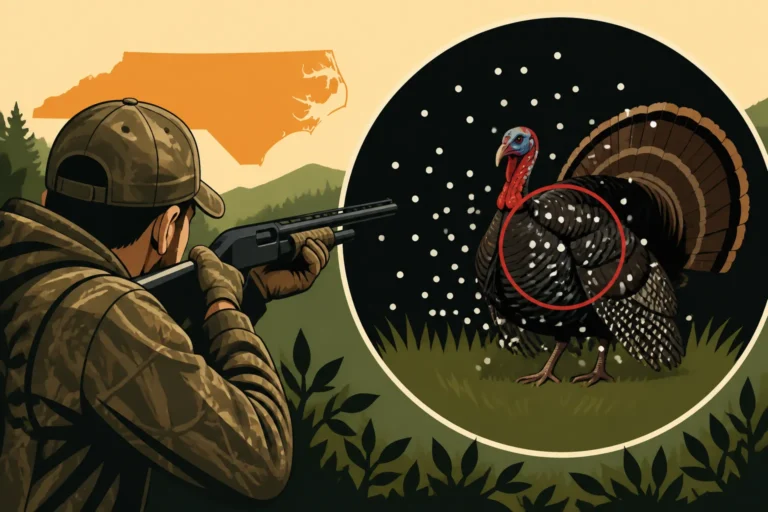
- Count the Pellets: This is the most important step. Draw a 10-inch circle around the densest part of your pattern on the turkey's head/neck area of the target. Now, count every pellet within that circle. What's considered an "ethical kill pattern"? Most experienced turkey hunters agree that you want at least 10-15 pellets within that 10-inch circle, especially in the brain/spine area, to ensure a swift, humane kill. Some will even push for 20+ pellets, particularly with modern super-dense loads.
- Check for Uniformity: Beyond pellet count, look at the distribution. Are there any big "holes" or voids in your pattern where a turkey's head could slip through? You want a consistent, even spread of pellets within that critical 10-inch circle, and a good density of pellets immediately surrounding it. A hot spot right in the center with a sparse periphery isn't ideal, nor is a pattern with significant gaps.
- Determine Your Max Effective Range: Based on your pellet count and uniformity analysis, you can now definitively say your shotgun, choke, and load combination is effective out to X yards. If your 40-yard pattern only yields 5-7 pellets, then 40 yards is not your ethical range, no matter what the box says. Stick to 30 yards or even 25, or go back to the drawing board with different components. This might mean trying a new load like Tungsten Turkey Loads Worth the Price, or a different choke altogether.
Pairing Loads with Chokes for Optimal Performance
The relationship between your choke tube and your chosen ammunition is like a finely tuned orchestra – each component has to play together to create a harmonious and deadly pattern. Ignoring one aspect means the whole performance suffers.
Heavy Lead vs. High-Density Tungsten: North Carolina Considerations
For years, lead shot was the only real option for turkey hunters. And good, heavy lead loads can still be incredibly effective, especially within 30-35 yards. They are generally more affordable, allowing you to do more patterning without breaking the bank. However, lead is inherently less dense than newer materials, which limits its energy retention and penetration at longer ranges. For hunters primarily focused on closer, woods-hunting scenarios, perhaps calling birds in tight in the Pisgah National Forest, a quality lead load might be perfectly adequate.
Enter high-density tungsten, bismuth, and other alloy shots. These materials are significantly denser than lead, meaning a smaller pellet retains more energy and penetrates deeper. This translates directly to more lethal patterns at longer distances and greater confidence when a gobbler hangs up at 45 yards. Brands like Federal (with their TSS), Apex Ammunition, and others have revolutionized turkey hunting with these loads. While they come with a higher price tag, they can dramatically extend your effective range and create patterns so dense they almost look like a rifle slug at 40 yards. Many North Carolina hunters, especially those hunting more open Piedmont farmlands or wider clear-cuts, find the investment in tungsten-based loads well worth it for the increased performance and ethical range. When you're trying to make the most of your North Carolina Turkey Daily Bag Limit, you want every advantage you can get.
Shot Size and Pellet Count: Finding the Balance
Beyond the material, shot size plays a critical role in your pattern. Common turkey shot sizes range from No. 4 down to No. 9, with No. 5 and No. 6 being traditional favorites for lead, and No. 7, 8, or 9 being popular for the denser tungsten.
Here's the basic trade-off:
- Larger Shot (e.g., No. 4): Fewer pellets per shell, but each pellet carries more individual energy and momentum, theoretically hitting harder.
- Smaller Shot (e.g., No. 9 Tungsten): Many more pellets per shell. While each pellet is lighter, the sheer volume of pellets significantly increases the probability of hitting vital areas. Because tungsten is so dense, even a small No. 9 pellet penetrates exceptionally well.
The key is to find the balance that works with your choke to put the most pellets into that 10-inch kill zone. Some choke tubes are designed with specific shot sizes in mind. For example, a choke optimized for No. 6 lead might actually perform poorly with tiny No. 9 tungsten shot, and vice-versa. This is why experimentation is so critical. Don't assume that because a choke says "turkey," it will perform optimally with any turkey load. It's about finding that specific pairing.
Experimentation is Key: The North Carolina Hunter's Approach
I can't stress this enough: your shotgun is a unique system. What works perfectly for one hunter's setup might be a dismal failure for yours. You simply must experiment. This often means buying a few different choke tubes and several different boxes of turkey loads from various manufacturers and with different shot sizes. Yes, it can get expensive, but consider it an investment in ethical hunting and increased success rates.
Think of it this way: you wouldn't head out on a Bowhunting North Carolina's Statewide Archery Season hunt without carefully sighting in your bow, would you? The same meticulous approach is needed for your turkey shotgun. Spend a morning at the range trying different combinations. Take detailed notes, measure your patterns, and celebrate when you find that magic combination that puts a consistent, dense swarm of pellets precisely where you want them. Using an organized system, maybe even an app like GoHunt, to track your different load and choke combinations can simplify this process immensely. It helps you quickly compare results and make informed decisions, whether you're chasing longbeards on public land or a private farm.
| Choke Constriction | Typical Pattern Density | Effective Range (Approx.) | Best For | Considerations |
|---|---|---|---|---|
| Full | Good, but can be open | 25-35 yards | Budget hunters, closer shots | Less dense than dedicated turkey chokes, can be hit-or-miss with modern loads. |
| Extra Full | Very Good | 30-40 yards | General purpose turkey hunting | A solid choice, especially with quality lead loads. |
| Turkey Specific | Excellent, very tight | 35-50+ yards | Maximizing range and pattern density | Often designed for specific shot sizes/materials. Can be too tight for very close shots. |
| Tungsten-Specific | Exceptional, extremely dense | 40-60 yards (with Tungsten loads) | Ultimate performance, longer range | Requires expensive tungsten loads. May blow patterns with lead. |
Common Choke and Patterning Mistakes to Avoid
Even experienced hunters can fall prey to common mistakes when it comes to chokes and patterning. Avoiding these pitfalls can save you frustration, money, and ensure you're as prepared as possible for your next Spring Turkey Hunting in North Carolina adventure.
Over-Choking Your Shotgun
It's a common misconception that "tighter is always better." While turkey hunting does demand a tight pattern, there's such a thing as too much constriction, or "over-choking." What happens then? Instead of creating a perfectly dense, uniform swarm, an overly tight choke can actually deform the shot pellets as they're forced through the narrow opening. This deformation can cause pellets to fly erratically, leading to inconsistent patterns with large holes or "blown" areas where the pattern spreads wildly.
Imagine pushing too much toothpaste through too small an opening; it squirts out everywhere, rather than a neat line. The same can happen with shot. You might find that a super-tight, specialized choke actually performs worse with your particular load than a slightly less constricted "Extra Full" choke. This is especially true with traditional lead shot. When analyzing your patterns, if you see an inconsistent spread, large voids, or flyers, an overly tight choke might be the culprit. Sometimes, backing off just a hair on the constriction can actually improve your pattern density and uniformity.
Not Patterning at Realistic Hunting Distances
I've seen it countless times: a hunter patterns their gun at 20 or 25 yards, sees a tight group, and assumes they're good to go for 40 or 50 yards. This is a recipe for disappointment. While your pattern might be incredibly dense at 20 yards, it can quickly open up and become dangerously sparse at extended ranges. The difference in pellet count and distribution between 20 and 40 yards can be dramatic.
Most North Carolina turkeys are typically harvested between 20 and 40 yards. Therefore, your patterning absolutely must include shots at 30 and 40 yards, at a minimum. If you're confident in your calling abilities and prefer to bring birds in close, fantastic! But you still need to know what your gun does if that gobbler hangs up at the 35-yard mark. Neglecting to test at these realistic distances means you're guessing, and as we discussed, guessing isn't acceptable when an ethical harvest is on the line.
Neglecting Recoil and Form During Patterning
Let's be real, shooting heavy turkey loads through a lightweight shotgun can be a jarring experience. Recoil is significant, and it's easy to develop a flinch or poor shooting habits during a patterning session. However, neglecting proper shooting form during patterning will skew your results. If you're flinching, closing your eyes, or not consistently shouldering the gun, your point of impact will be inconsistent, and you won't get an accurate representation of your gun's capabilities.
To combat this, wear plenty of padding – a thick recoil pad, a padded vest, or even multiple layers of clothing. Take breaks between shots to recover. If the recoil is truly unbearable, consider adding weight to your shotgun for patterning sessions (temporarily, of course) or investing in a dedicated recoil reduction system for your stock. Consistent, deliberate shooting form during patterning is just as important as the choke and load selection. You want to see what the gun can do, not what you do when anticipating a heavy kick.
Assuming Manufacturer Claims Translate to Your Gun
It's natural to trust what the box says. A choke package might boldly proclaim "Deadly at 60 Yards!" or a box of shells might promise "Ultimate Turkey Performance!" While these claims aren't necessarily false, they represent the best-case scenario for a particular test gun. They don't guarantee that the choke or load will perform identically in your specific shotgun.
Every shotgun has its own unique barrel characteristics, bore diameter, and harmonics. This is why two identical shotguns can perform differently with the same choke and load. Hunters often express frustration when they buy an expensive "guaranteed" turkey choke or premium load, only to find their patterns are mediocre. This isn't necessarily a fault of the product; it's just a reminder that your gun is the final arbiter of performance. Always, always, always pattern your specific setup. Take those manufacturer claims as a starting point, but let the paper tell you the definitive truth about what your shotgun is truly capable of delivering downrange.
Disclaimer
This article is for general informational purposes only and does not constitute professional advice. Laws, prices and regulations vary by location and change over time. Consult a qualified professional for guidance on your specific situation.