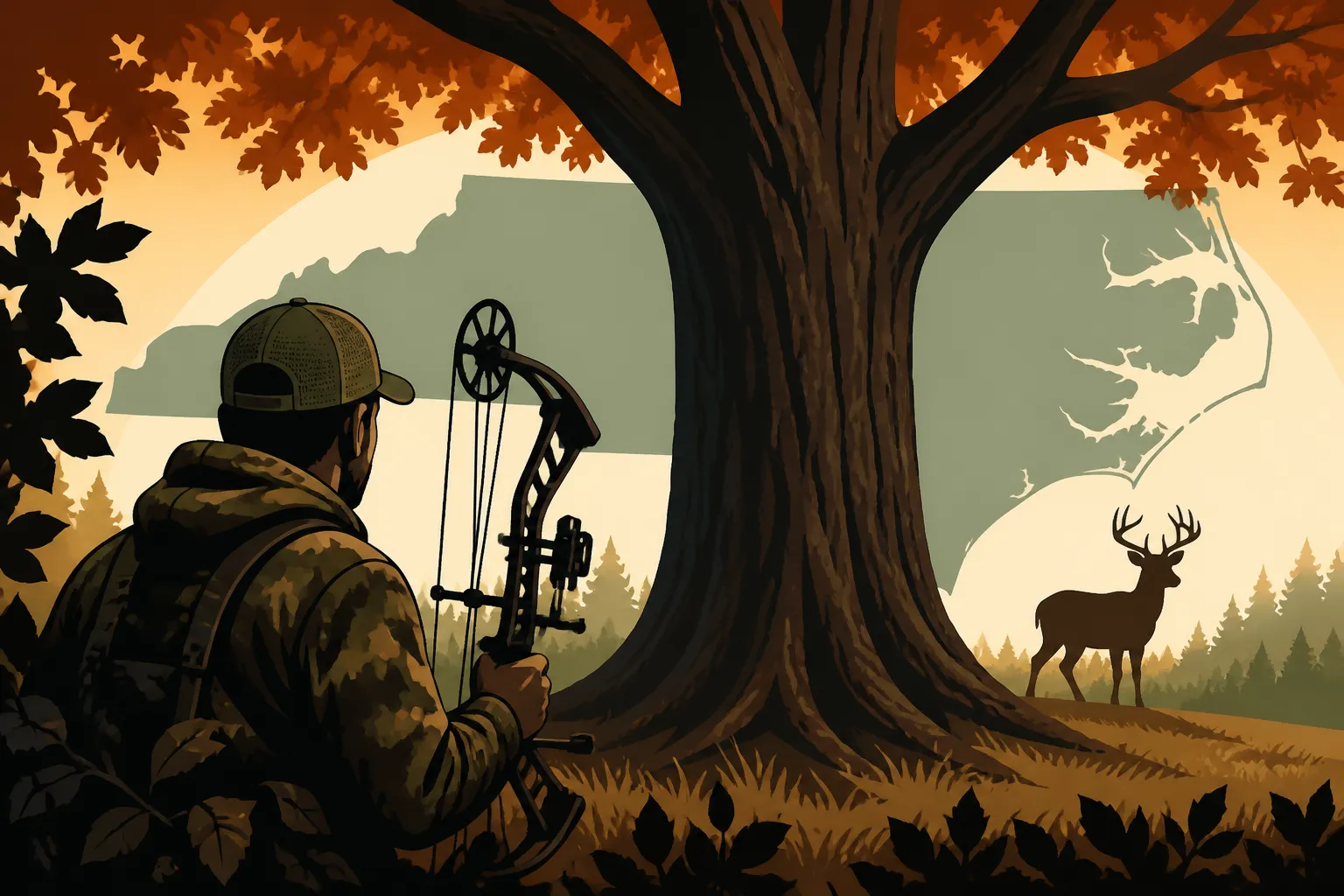
Setting Up Against a Big Oak
There’s a unique frustration that comes with hunting North Carolina’s sprawling woodlands: you know the deer are somewhere, but pinpointing exactly where they’ll show up can feel like pure guesswork. All that dense timber, those endless ridges – it’s easy to get lost in the sheer scale of it all. But for those of us who’ve spent years chasing whitetails in this beautiful state, we’ve learned one undeniable truth: a big, mature oak tree, especially one dropping acorns, is often the absolute best place to hang a stand. This guide will break down why these trees are magnets for deer and how you can successfully set up on them.
The Irresistible Pull of North Carolina's Big Oaks
When it comes to deer in North Carolina, food is king. And few food sources are as universally loved and actively sought out as acorns. While other mast crops come and go, oaks are a consistent draw, year after year, offering a reliable, high-energy meal for deer across all our diverse terrains, from the Coastal Plain to the Blue Ridge Mountains. Understanding this fundamental draw is the first step to hunting these majestic trees effectively.
Acorn Production and Deer Preference
Not all acorns are created equal in the eyes of a whitetail. North Carolina is home to a wide variety of oak species, broadly categorized into white oaks and red oaks. White oak acorns, which include species like true white oak, post oak, and chestnut oak, are generally sweeter and have a lower tannin content. This makes them highly palatable to deer, and they’ll typically be devoured almost as soon as they hit the ground. White oak acorns also mature in a single growing season, dropping in late summer and early fall, which aligns perfectly with the early archery and muzzleloader seasons.
Red oak acorns, from species like northern red oak, scarlet oak, and water oak, contain more tannins, giving them a bitter taste. Deer will still eat them, especially if white oak acorns are scarce, but they’re usually a secondary choice. The crucial difference is that red oak acorns take two years to mature. This means that even in a poor white oak year, there’s a good chance some red oak acorns will be available, often dropping later in the fall and into early winter. This extended availability can make red oaks valuable during the late season when other food sources have dwindled, providing essential energy for deer preparing for or recovering from the rut. Knowing which type of oak you’re hunting can drastically change your strategy, allowing you to anticipate deer movement based on the seasonal availability of their preferred food.
| Oak Type | Acorn Taste | Tannin Content | Maturation Time | Drop Period (NC) | Deer Preference |
|---|---|---|---|---|---|
| White Oak | Sweeter | Low | 1 growing season | Late Summer – Early Fall | High |
| Red Oak | More Bitter | High | 2 growing seasons | Mid-Fall – Early Winter | Medium (late season high) |
Cover and Sanctuary Value
Beyond just providing food, big oak trees, particularly those in mature stands, offer significant cover and a sense of security for deer. In areas like the Uwharrie National Forest or remote parts of Pisgah National Forest, these large trees often form parts of expansive canopies, creating shaded, secluded areas where deer feel comfortable bedding down close to their food source. The sheer size of these trees and the mature timber around them can obscure deer movement from predators, including hunters.
Mature oak stands often have less undergrowth compared to younger, regenerating forests, which can create clearer travel lanes for deer moving between bedding and feeding areas. However, this also means deer are more exposed, so they often approach these areas cautiously, especially during daylight hours. Finding a big oak that's surrounded by thick briars, a dense cedar thicket, or a secluded river bottom can be a goldmine, as it combines a prime food source with excellent security cover. Deer will naturally gravitate towards locations where they can feed without feeling overly vulnerable, making these combined cover and food spots absolutely vital to locate.
Scouting Big Oaks for the Perfect Stand Location
You can't just pick any big oak and expect success. Effective scouting is paramount. It involves more than just identifying an oak tree; it's about understanding the subtle nuances of deer behavior around that specific tree, taking into account prevailing winds, thermals, and how deer will likely approach and depart the area. The goal is to set your stand where you'll have the best chance for a shot without being detected.
Identifying Active Feeding Areas
The first step in scouting is to confirm that deer are actively feeding on the acorns. This means getting on the ground and looking for fresh sign. The most obvious indicator is acorn cuttings. Deer will often bite off the cap of the acorn and leave the rest of the shell on the ground. The fresher the cuttings, the more recent the activity. Also, look for disturbed leaf litter, fresh tracks, and droppings. Tracks will tell you where deer are entering and exiting the area, while droppings indicate how long they're spending there.
Don't just look at the base of the tree. Deer will often spread out to feed, so examine a wider radius. If you're on public land, like some of the vast tracts within Pisgah National Forest, you might have to walk quite a bit to find these hotspots. Pay attention to how deer are utilizing the terrain. Are they feeding on a ridge-top saddle, a gentle slope, or down in a bottomland? Use mapping applications, like GoHunt, to help visualize the terrain and identify potential travel corridors that lead to the oak stands. These tools can highlight subtle terrain features that might concentrate deer movement towards a specific feeding tree. Remember, fresh sign is king, and a big oak with a carpet of fresh cuttings is practically screaming, "Hang your stand here!"
Understanding Wind and Thermals on a Blue Ridge Slope
When hunting big oaks, especially in the undulating terrain of the North Carolina Mountains, understanding wind and thermals is non-negotiable. Thermals are air currents driven by temperature changes. In the mornings, as the sun warms the earth, air rises, creating an uphill thermal. In the evenings, as the earth cools, air descends, creating a downhill thermal. This means that if you're hunting a big oak on a slope, your scent will likely travel uphill in the morning and downhill in the evening, regardless of the prevailing wind direction. Ignoring these thermal shifts is a surefire way to get busted.
Combining this with the prevailing wind is crucial. For example, if you're on a Blue Ridge slope and the wind is generally from the west, but it's morning, your scent might still travel uphill (north, if the slope faces north) due to the thermal lift, then be pushed east by the westerly wind. You need to position your stand so that both the prevailing wind and the thermal currents carry your scent away from where you expect deer to approach or pass through. This often means scouting specific trees that offer coverage for multiple wind directions or having a few different stand locations for varying conditions. Overlooking these subtle air movements is one of the most common mistakes hunters make, and it will quickly educate the deer in your area.
Planning Your Entry and Exit Routes
An often-overlooked aspect of stand placement around a big oak is your entry and exit. It doesn't matter how perfect your stand is if you spook every deer in the county getting to or from it. Your routes need to be as quiet and scent-free as possible. Look for natural cover, thickets, or terrain features that can conceal your approach. Creeks, logging roads, or property lines can often serve as good entry/exit points, as long as they don't funnel deer directly past your path.
Consider the time of day and how deer typically move. If you're hunting an evening feed, try to approach from a direction that puts the wind in your face as you walk in, moving away from known bedding areas. For a morning hunt, plan your approach to avoid spooking deer that might still be feeding from the night before or bedding nearby. Your exit is just as important. If you climb down and immediately spook deer, they'll associate that oak with danger. Sometimes, this means waiting a bit after dark to climb down, or taking a much longer, more circuitous route out to avoid crossing prime deer trails. The goal is to be a ghost, leaving no trace of your presence. This meticulous planning is key to keeping your hunting spots productive for longer.
Tactical Considerations for Hunting Big Oaks
Once you’ve identified your prime big oak and planned your approach, the real work begins: setting up your stand and executing your hunt. This isn’t just about climbing a tree; it’s about strategic placement, maximizing your concealment, and knowing when and how to interact with the environment around you.
Choosing Your Specific Tree and Stand Height
The "big oak" might be your target, but you still need to choose the right tree to hang your stand in relation to it. Sometimes the big oak itself is the perfect tree, but often it's a neighboring tree that offers better cover, a more favorable wind direction, or a clearer shot angle. Look for trees that allow you to cover the most active feeding areas, as indicated by your scouting. Consider multiple angles – if deer consistently approach from a particular thicket, your stand should be positioned to intercept them effectively.
Stand height is another critical factor. While some hunters swear by extreme heights for scent control, a good rule of thumb is to get high enough to be above the deer's primary line of sight, typically 15-25 feet. However, equally important is having good background cover. A higher stand in a lone tree with no backdrop can silhouette you, making you incredibly visible. A slightly lower stand with a dense canopy or evergreen behind you will offer far better concealment. When you're Hanging a Stand on a Pisgah Ridge, for example, you might find yourself with fewer options for dense cover, making careful tree selection even more crucial. Ensure your chosen tree is healthy, sturdy, and offers good climbing opportunities with your chosen method, be it climbing sticks or a climbing stand.
Maximizing Concealment and Shot Lanes
Once your stand is hung, take the time to brush it in. Use natural vegetation – branches, leaves, small saplings – to break up your outline. The goal is to blend seamlessly into the tree, becoming part of the natural canopy. Pay attention to how the sun will hit your stand throughout the day; direct sunlight can reveal your position or create glare. Concealment isn't just about hiding from a deer's eyes; it's about minimizing movement. Even small, subtle motions can spook a deer if your outline isn't broken up.
Before you even step foot in the stand on opening day, clear your shooting lanes. Use a small hand saw or pruners to remove any branches that might deflect an arrow or bullet. Remember, even a tiny twig can send an arrow off course. Clear enough lanes to cover all the areas where you expect deer to travel or feed, but don't overdo it and create a giant hole in the canopy that draws attention. Think about the distances: practice shooting from your stand height to various points around the big oak to familiarize yourself with the angles and distances. Knowing your effective range in these specific scenarios is key to a clean, ethical harvest.
Using Calls and Scents Effectively
While a big oak might be a natural deer magnet, sometimes a little extra persuasion doesn't hurt. Calls and scents can be incredibly effective, especially during the rut when bucks are actively searching for does. A soft doe bleat or a few tending grunts can pique a buck's curiosity if he's passing by just out of range. When you're Grunt Calls in Mature North Carolina Timber, remember that volume matters; you don't want to overdo it and sound unnatural. During the peak of the rut in the Eastern Zones, a more aggressive rattling sequence might even draw in a territorial buck.
As for scents, stick to natural, subtle deer urine or estrus scents. Place them downwind of your stand or along likely travel corridors leading to the oak. Be cautious with synthetic attractants, as deer in heavily hunted areas can become wary of anything that seems out of place. The key is subtlety; you're trying to replicate natural deer behavior, not create a carnival. During periods of high deer activity, especially around a hot food source, sometimes the best strategy is simply to be still, silent, and let the natural draw of the big oak do all the work.
Avoiding Common Pitfalls When Hunting Big Oaks
Hunting around these prime food sources can be incredibly productive, but it's not without its challenges. There are common mistakes that hunters make which can quickly turn a promising spot into a dead zone. Being aware of these pitfalls and actively working to avoid them will greatly increase your long-term success.
Over-Hunting a Hot Spot
This is perhaps the biggest mistake hunters make around productive big oaks. It’s easy to get excited when you find fresh sign, and the temptation to hunt that spot every day is strong. However, deer are incredibly sensitive to pressure. Every time you enter and exit, every piece of scent you leave, every sound you make – it all adds up. Over-hunting a single oak, even a smoking hot one, will quickly educate the deer, turning them nocturnal or forcing them to abandon the area altogether.
The best strategy is to have multiple stand locations, perhaps targeting several big oaks in a given area, and rotate them. Think of your hunting spots like a chess game, not a sprint. Only hunt a particular oak when the wind, thermals, and deer activity are absolutely perfect. If the conditions aren't ideal, or if you've hunted it a few times without success, give it a rest. Let the deer feel safe returning to that food source. Sometimes, the most disciplined hunter is the one who chooses not to hunt, opting instead to wait for the opportune moment. Remember, a refreshed hunting spot is a productive hunting spot.
Ignoring Wind Direction and Thermals
We touched on this earlier, but it's worth reiterating: ignoring the wind and thermals will get you busted, plain and simple. It's the most common reason deer detect hunters. Even if the forecast calls for a perfect northwest wind, you need to understand how local terrain, especially around a big oak in a draw or on a ridge, will influence that air movement. Subtle swirls, updrafts, and downdrafts are constant.
Always carry a wind checker, like a small bottle of powder or a milkweed pod. Use it constantly, especially when you first get to your stand and throughout your sit. Pay attention to how your scent is drifting. If it's blowing towards a known bedding area or a popular travel corridor, you need to either adjust your setup or bail on the hunt. There's no such thing as "good enough" when it comes to scent control. Deer rely heavily on their sense of smell for survival, and if they catch a whiff of you, your hunt is effectively over, and you've just taught them to avoid that specific big oak. For a deeper dive into these environmental factors, check out our guide on Wind and Thermals on a Blue Ridge Slope.
Overlooking Secondary Sign and Travel Corridors
While the big oak and its fresh acorn cuttings are the primary draw, don't tunnel-vision on just the tree itself. Deer don't just materialize at the base of the oak; they travel to get there. It's crucial to identify the travel corridors, pinch points, and secondary food sources or cover that lead to and from your target oak. Look for old rub lines, scrape lines, and well-worn trails in the vicinity. These are often the paths deer are using to access the feeding area.
Sometimes, the best stand isn't directly over the oak, but 50-100 yards away, along one of these primary travel routes. This allows you to intercept deer before they reach the main feeding area, often when they are less wary, or as they leave. It also provides a buffer zone, minimizing the chances of spooking deer directly under the oak. For instance, if a thick Hunting Coastal Plain Pocosin Swamps is nearby, deer might use the edge of it as a low-impact travel lane to get to the oak. Think about the entire ecosystem around the oak, not just the tree in isolation. By understanding the bigger picture of deer movement, you can strategically place your stand for maximum success and minimize pressure directly on the primary food source. For comprehensive information on how the deer season is structured, our guide on North Carolina Deer Season Structure Explained offers valuable insights for planning your hunts.
Final Thoughts on Hunting North Carolina's Big Oaks
Hunting around big oak trees in North Carolina is a timeless and often highly effective strategy. Whether you're targeting early-season deer gorging on white oak acorns or pursuing late-season bucks browsing red oak remnants, these trees offer a consistent draw that you can capitalize on. Remember, success isn't just about finding the tree; it's about meticulous scouting, understanding the local conditions, patient planning, and disciplined execution.
By combining the natural attraction of a mature oak with careful consideration of wind, thermals, entry/exit routes, and minimizing pressure, you significantly increase your odds. Use modern tools like mapping applications from brands like GoHunt to analyze the terrain and historical data, but never substitute time on the ground for digital scouting. Spend your preseason Scouting North Carolina Public Land Before Season, look for those telling signs, and respect the incredible resource that these ancient oaks provide.
Disclaimer
Hunting involves inherent risks, including injury and death. Always prioritize safety, follow all local and state regulations, and ensure you have the necessary training and permits. The information provided here is for educational purposes only and should not replace professional advice or official hunting guidelines.