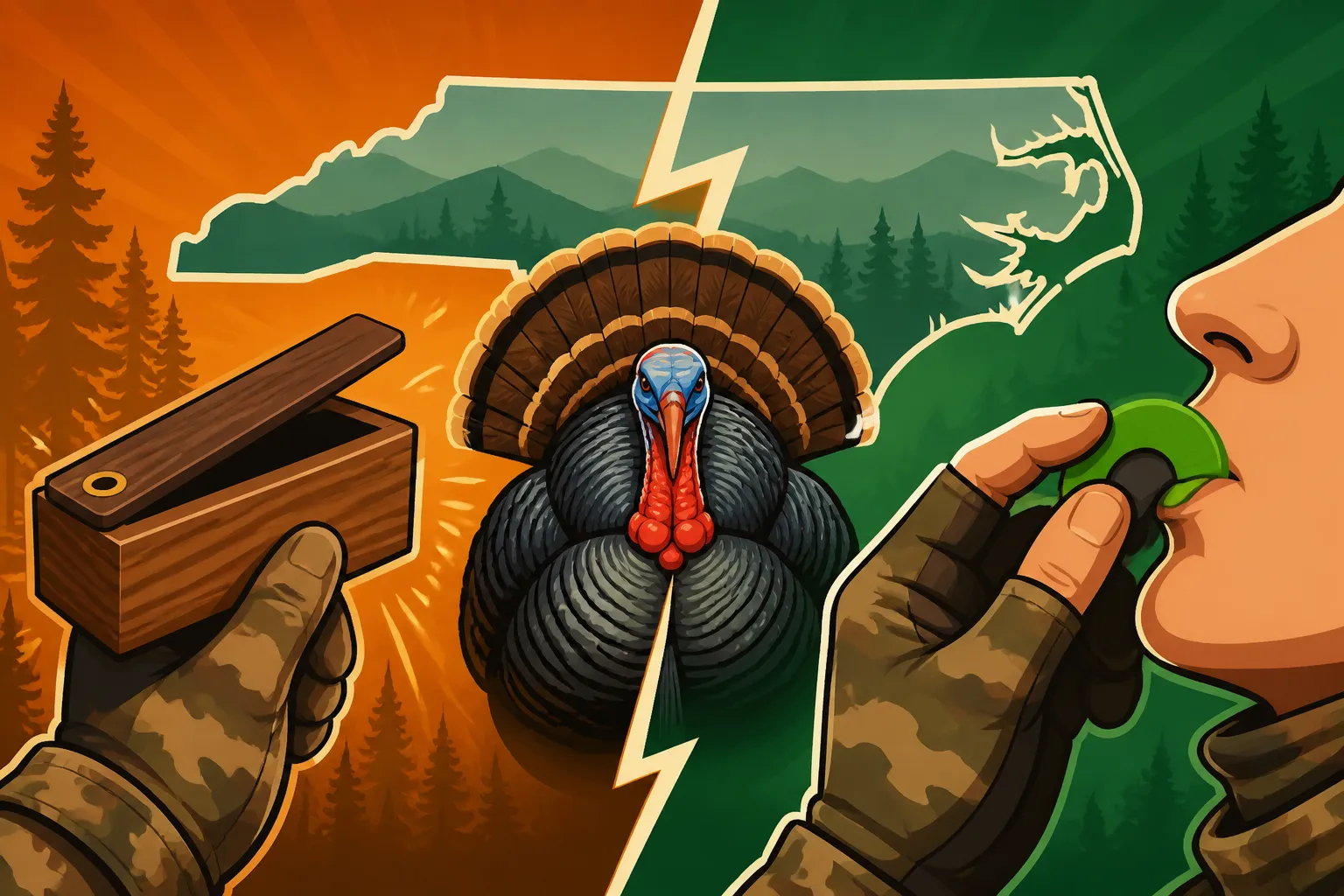
Box Calls Versus Mouth Calls
There's a special kind of frustration that bubbles up when you're deep in the North Carolina woods, trying to coax a wary gobbler into range, and your chosen turkey call just isn't cutting it. Maybe it's too loud, too soft, too clunky, or simply not producing the realistic sounds you need to seal the deal. This guide is here to help you navigate the age-old debate between box calls and mouth calls, exploring the strengths and weaknesses of each so you can make an informed decision and enhance your spring turkey hunting success.
The Perennial Question: Box Call or Mouth Call for North Carolina Turkeys?
For decades, North Carolina turkey hunters have deliberated over which call reigns supreme in the spring woods: the classic box call or the versatile mouth call. Both have their loyal adherents, and for good reason. Each offers distinct advantages and drawbacks, shaping the way a hunter interacts with the environment and, crucially, with the turkeys themselves. Understanding these fundamental differences is the first step in building a calling strategy that truly works for you, whether you're working a field edge in the Piedmont or navigating the dense rhododendron thickets of the mountains.
The Enduring Allure of the Box Call
There's something deeply satisfying about the rich, resonant tones produced by a well-crafted box call. It's often the first call many hunters learn, and for good reason: it’s relatively easy to master the basic yelp, cluck, and purr. The sheer volume a box call can produce is a massive asset when you're trying to locate a distant bird across a wide-open field or down a long ridge. Imagine trying to cut through a stiff morning breeze that's carrying your locator calls away – a box call often has the raw power to project those calls far and wide, getting a distant gobbler to shock gobble.
The sound profile of a box call is inherently realistic, mimicking the deep, raspy cadence of a mature hen. This authenticity is a huge confidence booster, both for the hunter and, hopefully, for the gobbler. When you're trying to strike a bird in a new piece of public land or a large private tract, the ability to make a lot of noise that sounds incredibly natural can often be the key to getting a response. Many experienced hunters will start their morning by letting out a few booming yelps from a box call, hoping to pinpoint a bird still on the roost. This is often the initial phase of Roost Hunting North Carolina Gobblers.
Furthermore, box calls are generally very durable, capable of withstanding the bumps and scrapes of a long season in the woods. They don't require delicate handling or intricate positioning in your mouth, making them less prone to human error when trying to make a quick, clean sound. For hunters who might have issues with dentures, gag reflexes, or simply prefer a tactile, hands-on calling experience, the box call is an absolute godsend. It's a reliable workhorse that, when used correctly, can put birds in front of your barrel time and time again.
The Subtle Art of the Mouth Call
On the other end of the spectrum is the mouth call, or diaphragm call, a small, unassuming device that belies its incredible versatility. The primary advantage of a mouth call is its hands-free operation. This is a game-changer when a gobbler is finally in close, strutting his stuff, and you need to keep your hands on your shotgun or bow, ready for the shot. Fumbling with a box call at 20 yards when a longbeard is staring a hole through you is a quick way to spook your target, but a mouth call allows you to make soft, reassuring clucks and purrs right up until the moment of truth.
Mouth calls excel at producing a vast array of realistic turkey sounds, from soft tree yelps and contented clucks to aggressive cuts and fly-down cackles. A skilled caller can even mimic multiple hens, adding incredible realism to their setup. This versatility allows for nuanced communication with a gobbler, adapting your calling strategy based on his response. If he's hot, you can get aggressive; if he's wary, you can soften your tone to a more seductive purr. This level of dynamic interaction is harder to achieve with the more rigid sound profile of a box call.
The stealth factor of a mouth call cannot be overstated. When a bird is coming in tight, perhaps circling around your setup, you can make extremely subtle calls without any visible movement. Imagine a wary old gobbler hung up just out of sight behind a thick stand of pines. A soft whine or a delicate series of purrs from a mouth call might be just enough to tip him over the edge and into your shooting lane, whereas any movement to operate a box call would instantly give you away. This precision and hands-free capability are essential for successful Run-and-Gun Turkey Tactics on Public Land.
Diving Deep into How Each Call Works and Sounds
To truly appreciate the differences between box calls and mouth calls, we need to understand the mechanics behind their sound production and the sonic palette each can offer. It's not just about "loud" or "soft"; it's about the texture, pitch, and emotion you can infuse into your calling, crucial elements for convincing a North Carolina gobbler that a real hen is nearby.
Box Call Mechanics and Tones
A box call typically consists of a wooden box with a lid that slides or pivots across the lips of the box. The friction created by this movement generates vibrations, producing sound. The magic truly happens when you vary the pressure, speed, and angle of the lid against the box. A light, slow stroke can produce soft purrs or clucks, while a quicker, firmer stroke creates sharp cuts and excited yelps. The size and shape of the box, as well as the types of wood used (like mahogany, cedar, or walnut), all contribute to the unique timbre and pitch of the call. Some box calls are designed with a single side for calling, while others offer two different sides, often made from different woods, allowing for varied tones.
Consider a situation where you're set up on a logging road, scanning a distant clear-cut for signs of a gobbler. A simple, consistent yelp from your box call, perhaps repeated every 15-20 seconds, serves as an excellent locator call. As the morning progresses and you hear a distant gobble, you can then switch to more excited, rapid yelps and cuts, mimicking a hen that’s eager to breed. The distinct break-over note—that slight hiccup in the yelp that sounds like a real hen—is often effortless to achieve on a box call, adding a layer of realism that can be hard to replicate for a beginner on a mouth call. Many hunters find these calls less frustrating initially, making them great for building confidence.
Different box calls will have different characteristics. Some are designed for higher pitches, ideal for mimicking younger hens or for getting an immediate, sharp response. Others are deeper and raspier, perfect for sounding like a seasoned old hen who's seen a few springs. Experimenting with a few different box calls can help you find one that resonates best with your natural calling rhythm and the specific types of sounds you want to emulate. The tactile feedback of the wood in your hand as you draw the paddle across the sound board is an experience many hunters cherish.
Decoding the Mouth Call: A Skill to Cultivate
Mouth calls, or diaphragm calls, are made from a small frame (usually plastic or aluminum) over which one to three (or more) latex or prophylactic reeds are stretched. A thin piece of tape or adhesive holds the reeds in place. You place the call against the roof of your mouth, with the open end facing out, and use air pressure from your lungs, combined with tongue pressure, to vibrate the reeds and produce sound. Different cuts in the reeds—like a batwing, V-cut, ghost cut, or combo cut—create varying levels of rasp, pitch, and break-over.
Mastering a mouth call can feel like trying to learn a new language, or even play a wind instrument, all with a small, floppy piece of latex in your mouth. The nuances come from how much air you push, how hard your tongue presses against the reeds, and the shape of your mouth and throat. A light, controlled puff of air with minimal tongue pressure might produce a soft purr or cluck, perfect for a gobbler that's just out of sight at the edge of a field. Increasing the air pressure and varying your tongue movement can produce the sharp, aggressive "cluck-and-cut" sequence that often excites a hung-up gobbler.
The beauty of a mouth call lies in its dynamic range and ability to transition seamlessly between different sounds. You can start with a soft tree yelp, then quickly shift to a fly-down cackle, and immediately follow with a series of excited yelps and cuts, all without moving your hands. This fluidity is incredible for painting a realistic vocal picture of a hen, moving and communicating naturally. Some hunters use specific brands or reed cuts for different parts of the season or different regions, finding that some calls simply perform better in certain conditions. This is where resources like those found on GoHunt might offer reviews or tutorials on different reed styles and their applications. The journey to becoming proficient with a mouth call is one of patience and consistent practice, but the payoff in the field is immeasurable.
Assessing the Field Performance: Pros and Cons for North Carolina Hunters
Every piece of gear has its ideal application, and turkey calls are no exception. The unique hunting environments of North Carolina, from the dense mountain forests to the sprawling coastal plains and the mixed hardwoods of the Piedmont, present diverse challenges that favor different calling tools. Let's break down when each call shines and when it might leave you wishing for something else.
Box Call Advantages in the Pines and Hardwoods
When you're hunting vast expanses of timber, like those found in Pisgah National Forest or the larger game lands, the ability to project sound over long distances is paramount. The powerful, far-reaching calls of a box call are incredibly effective for striking birds that are roosted high on a ridge or moving through a distant hollow. On a windy morning, a box call can cut through the environmental noise much more effectively than a subtle mouth call. This makes it an ideal choice for Calling a North Carolina Gobbler Off the Roost when you need to cover a lot of ground with your sound.
Box calls are also remarkably consistent. Once you learn the basic technique, you can reliably produce clear, resonant yelps and clucks with minimal effort. This consistency is a huge confidence booster, especially for newer hunters or those who might feel less coordinated with a mouth call. You don't have to worry about a "bad sound day" due to a dry mouth or fatigued tongue muscles. Just grab the call, find your rhythm, and let the sounds ring out. This reliability is why many seasoned hunters always keep a box call in their vest, even if they primarily use a mouth call.
Furthermore, box calls are less susceptible to certain environmental factors that can plague mouth calls. While extreme moisture can make them sound a bit dull, they generally perform well in a variety of conditions. They don't require saliva to function correctly, nor are they affected by the subtle shifts in mouth temperature or dryness that can impact reed performance. Their robust construction means they can take a beating and still perform, an important consideration when you're busting through thick briar patches or navigating uneven terrain.
Strengths of the Mouth Call in Tight Situations
When a gobbler is finally closing the distance, and every movement you make feels like it's amplified tenfold, the hands-free operation of a mouth call becomes invaluable. Imagine a longbeard strutting into a field edge where you've set up, slowly making his way toward your decoy. You need to keep your gun shouldered or your bow drawn, ready for the shot. A mouth call allows you to deliver those soft, enticing clucks and purrs that might be the final persuasion he needs, all while remaining perfectly still. This is particularly crucial in areas like Turkey Tactics for Piedmont Field Edges where birds are often visible from a distance but can hang up just out of range.
The precision and subtlety of a mouth call are also unmatched. You can produce incredibly quiet purrs, soft clucks, and delicate whines that sound exactly like a contented hen, without the risk of over-calling or making a sound that's too loud for the close range. This is especially useful for birds that are "hung up"—they're interested but won't commit to coming closer. A series of soft, seductive calls can often break their hesitation. When birds get quiet in late season, as often happens, When North Carolina Gobblers Go Quiet in May, these subtle calls become even more critical.
Finally, the vast range of sounds you can produce with a mouth call, including the ability to mimic multiple hens or even produce locator calls like an owl hoot or a crow caw, adds an incredible layer of realism to your setup. You can truly paint a vivid sonic picture for the gobbler, making him believe he's approaching a whole group of hens. This versatility allows you to adapt instantly to the bird's mood and responses, a dynamic capability that is a cornerstone of effective turkey hunting.
When a Box Call Might Let You Down
While box calls are excellent for many situations, they do have their drawbacks. The most significant is the need to use your hands, which can be a major disadvantage when a gobbler is within shooting range. The movement required to operate a box call can easily spook a wary bird, especially one that's intensely scrutinizing your setup. Picture a big gobbler strutting at 35 yards, fully fanned, and you reach for your box call to give him one last cluck. That movement could be the very thing that sends him bolting for the next county.
Another limitation is the volume control, particularly at close quarters. While great for distance, producing truly soft, subtle sounds with a box call can be challenging. A gentle purr or a soft tree yelp from a box call can still be louder than what you'd want when a bird is just a few yards away, potentially startling him. In dense cover, where birds might suddenly appear from unexpected angles, a loud call can instantly put them on high alert.
Box calls can also be somewhat sensitive to moisture. While they won't stop working entirely, excessive dampness from rain or high humidity can cause the paddle to stick or slide less smoothly, resulting in a squeaky or less realistic sound. Keeping them dry in adverse weather conditions can be a hassle, often requiring a protective pouch or careful placement inside your vest. This is a practical concern for North Carolina's often humid spring weather.
The Challenges of Relying Solely on a Mouth Call
The primary hurdle for many hunters with mouth calls is the steep learning curve. Producing consistently realistic sounds takes a significant amount of practice, often leading to frustration in the initial stages. Many beginners struggle with the proper tongue placement, air pressure, and reed vibration, resulting in squeaks, squawks, or sounds that simply don't resemble a turkey. This can be disheartening and lead some hunters to abandon mouth calls altogether. Online resources and tutorials, perhaps those offered by GoHunt as part of their educational content, can be incredibly helpful here, but nothing beats hands-on dedication.
Comfort can also be an issue. Some hunters find mouth calls uncomfortable to hold in their mouth for extended periods, especially those with multiple reeds. The constant pressure against the roof of the mouth can cause discomfort, and if the call doesn't fit properly, it can even cause a gag reflex. Finding the right size and reed cut that fits your mouth comfortably is crucial, and it often involves trying several different calls before settling on one.
Finally, while mouth calls are incredibly versatile in sound production, they generally lack the sheer volume of a box call. This can be a disadvantage when you're trying to locate distant birds, especially in windy conditions or across large, open landscapes. If you're relying solely on a mouth call for long-range locating, you might miss out on responses from birds that are just a little too far for your calls to reach effectively. This is where Locator Calls for North Carolina Gobblers can supplement, but a powerful call for yelping can't be beat for pure sound projection.
Strategic Integration: Making Both Calls Work for You
The truth is, most successful North Carolina turkey hunters don't choose one call over the other; they employ a combination of calls, leveraging the strengths of each for different phases of the hunt. Think of your calls as tools in a toolbox: you wouldn't use a hammer for every job, nor should you rely on a single turkey call.
The Power of a Combined Approach
The most effective strategy often involves using a loud, long-range call to locate a gobbler, then switching to a more subtle, hands-free call as he closes the distance. Many hunters start their morning with a series of loud yelps and cuts from a box call or even a pot call to pinpoint a bird. Once a gobbler has responded and you've established a setup, you can then transition to a mouth call for those critical final stages.
This combined approach allows you to maximize your chances of success. You get the benefit of the box call's volume for drawing distant attention, and the mouth call's stealth and precision for the close-quarters negotiation. Imagine you're hunting a deep hollow and you start with a box call, getting a gobble from across the ridge. You move to a good setup, perhaps Setting Up Against a Big Oak, then switch to a mouth call, offering soft clucks and purrs to bring that bird the rest of the way in without revealing your position. This creates a much more realistic and compelling scenario for the gobbler, making him believe a hen is genuinely moving toward him.
Another excellent tactic is to use both calls to create the illusion of multiple hens. A raspier box call could be one hen, while a higher-pitched mouth call could be another. This can be incredibly effective at exciting a gobbler, especially if he's been pressured and is wary of single-hen setups. The dynamic interplay of different voices can pique his interest and make him commit. Always remember to check North Carolina Spring Turkey Season Rules to ensure you're in compliance with any regulations regarding calling or decoys, especially on public lands.
Practice, Persistence, and Personal Preference
Regardless of which calls you choose to carry, consistent practice is absolutely vital. A poorly executed call, no matter the type, will do more harm than good. Spend time in the off-season practicing your yelps, clucks, purrs, and cuts. Record yourself and listen back critically. Compare your sounds to actual turkey vocalizations. The more realistic and consistent your calls are, the higher your chances of success. It’s not just about making the sound, but making the right sound at the right time.
Your personal preference also plays a huge role. Some hunters simply feel more comfortable and confident with a box call, while others prefer the freedom of a mouth call. Don't force yourself to use a call that feels awkward or produces sounds you're not happy with. The best call is the one you can operate effectively and confidently in the field. Many hunters develop a strong bond with a particular call, almost like a good luck charm, because it consistently performs for them.
Ultimately, the goal is to have a versatile calling arsenal that allows you to adapt to any situation North Carolina's spring woods throw at you. Having both a box call and a mouth call in your vest gives you the flexibility to locate distant birds, then work them quietly into range.
Here's a quick comparison of the two call types:
| Feature | Box Call | Mouth Call (Diaphragm) |
|---|---|---|
| Ease of Learning | Relatively easy for basic sounds | Steep learning curve; challenging |
| Volume | High; excellent for long-distance locating | Variable; can be very soft or moderately loud |
| Hands-Free | No; requires hand movement | Yes; completely hands-free |
| Versatility | Good range of basic turkey sounds | Excellent; wide range of nuanced sounds, including multiple hens |
| Stealth | Limited due to movement and volume | Excellent; perfect for close-range birds and subtle calls |
| Durability | Generally robust; wooden | Delicate reeds; can wear out or be affected by moisture/saliva |
| Best Use Case | Locating distant birds, windy days | Finishing birds, close-range work, stealthy setups |
Disclaimer
This article is for general informational purposes only and does not constitute professional advice. Laws, prices and regulations vary by location and change over time. Consult a qualified professional for guidance on your specific situation.