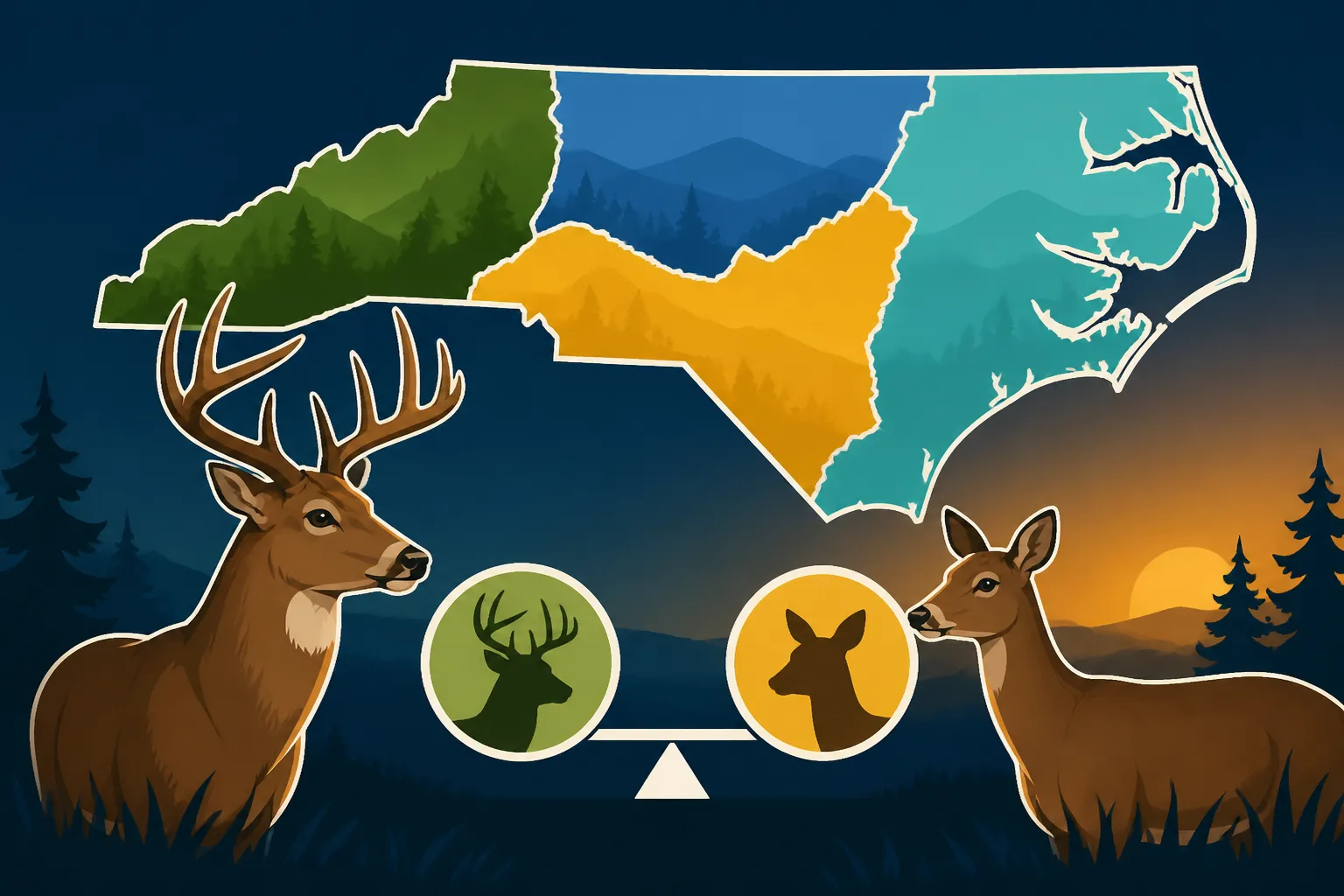
North Carolina Buck-to-Doe Ratio by Region
As North Carolina deer hunters, we often find ourselves wondering if the woods we hunt truly hold a balanced deer population. We've all had those seasons where we see doe after doe, perhaps even a button buck, but a mature shooter seems as rare as a unicorn sighting. It can be incredibly frustrating to put in countless hours scouting and sitting in a stand, only to feel like the odds are stacked against you because you're simply not seeing enough bucks. Understanding the buck-to-doe ratio in your specific hunting region is more than just a statistic; it's a vital piece of the puzzle that can dramatically influence your hunting strategy and success. This guide will dive deep into why these ratios differ across our beautiful state, what those differences mean for your hunt, and how you can use this knowledge to become a more effective and informed deer hunter.
Understanding the Buck-to-Doe Ratio in North Carolina
When we talk about the buck-to-doe ratio, we're really talking about the number of antlered bucks for every doe within a given deer population. It's often expressed as something like 1:3, meaning one buck for every three does. For hunters, this isn't just an abstract biological concept; it's the heartbeat of our deer season. A healthy, balanced ratio typically translates to better hunting opportunities, more active rut behavior, and ultimately, a more robust deer herd.
Why it Matters to Hunters
Imagine stepping into the woods during the peak of the rut, full of anticipation, only to find that all the bucks are chasing a seemingly endless supply of does. While that might sound good at first glance, a skewed ratio, say 1:7 or higher, actually means less competition among bucks. Less competition often translates to less daytime movement, fewer aggressive encounters, and shorter periods of chasing because the bucks don't have to work as hard to find receptive does. This can make for a very frustrating hunt where you're seeing deer, but they're not displaying the classic rut behaviors that we all dream about witnessing from our treestands.
On the flip side, a more balanced ratio, like 1:2 or even 1:1.5, means bucks have to compete much harder for breeding opportunities. This heightened competition fuels aggressive behavior, more scraping, rubbing, and most importantly for us hunters, more daylight movement. Bucks are up and cruising, challenging rivals, and scent checking every corner of their territory. This is when the woods truly come alive, offering those unforgettable encounters. For those using tools like GoHunt to analyze land features, knowing the expected ratio helps fine-tune strategies, making the insights even more powerful. It transforms your hunting from a game of chance into a more calculated pursuit.
How Ratios are Determined
Wildlife biologists don't just guess at these numbers; they employ a variety of methods to get the most accurate picture possible of North Carolina's deer herd. One of the primary ways is through harvest data. When hunters Report a Deer Through North Carolina's App or online, they provide crucial information about the age, sex, and sometimes even antler characteristics of the deer they harvest. This aggregate data, collected across the state, gives biologists a significant dataset to work with. Of course, this data is biased towards harvested animals, so it's not the only factor.
Beyond harvest data, biologists conduct spotlight surveys, trail camera studies, and even aerial surveys in certain areas to observe live deer and count bucks and does. These methods help to account for deer that aren't harvested and provide a more holistic view. They also examine fawn recruitment rates, which is the number of fawns that survive to adulthood, as this directly impacts future buck and doe populations. By combining these different data points, they can estimate the current buck-to-doe ratio for various regions and track trends over time. This continuous monitoring is essential for sound wildlife management and helps inform season structures and bag limits, as explained in North Carolina Deer Season Structure Explained.
Regional Differences Across North Carolina
North Carolina is a state of incredible diversity, from the towering peaks of the Appalachians to the sprawling coastal plains. This varied landscape, coupled with differing human populations, hunting traditions, and habitat types, leads to significant variations in buck-to-doe ratios across our state's distinct hunting regions. What you expect to see in the mountains is often vastly different from what you'll encounter along the coast.
The Mountain Zone Perspective
Up in the Western Zone, which includes the rugged Blue Ridge Mountains and surrounding foothills, the deer population often faces unique challenges. The terrain is steep, the timber is dense, and access can be difficult, leading to generally lower deer densities compared to other regions. While there are still plenty of deer, the sheer vastness and difficulty of the landscape can mean that hunting pressure is more dispersed. This can sometimes lead to slightly more balanced buck-to-doe ratios than in more accessible, heavily hunted areas, as bucks might have better chances to mature.
However, the mountain habitat also means less agricultural food sources and often poorer nutrition overall, which can impact antler development and deer body size. Bucks here might have a harder time packing on the pounds needed to survive tough winters and recover from the rut. If you're Hunting the Rut in the Western Zone, understanding that bucks might be more spread out and focused on survival, in addition to breeding, is key. Hunters in this region often prize any mature buck, recognizing the effort it takes for them to thrive in such an environment. The lower deer density in general also means that the overall number of deer observed might be lower, so even a balanced ratio can feel like seeing fewer deer.
Piedmont's Unique Challenges
The Piedmont region, stretching across the middle of the state, is truly a mixed bag. This area is characterized by rolling hills, a patchwork of agriculture and timber, and increasingly, suburban sprawl. It's also home to a significant portion of North Carolina's human population, which translates to higher hunting pressure on accessible lands. Here, you'll often find a less balanced buck-to-doe ratio, with does frequently outnumbering bucks significantly. This can be attributed to several factors, including the availability of abundant food sources from agriculture, which supports larger doe populations, and a tendency for hunters to be more selective about shooting does in areas where private land access is cherished.
The prevalence of smaller woodlots and fragmented habitat in the Piedmont means bucks might have smaller home ranges or be forced to move through more open country, increasing their vulnerability. Hunters might see a lot of deer, but many of them could be does or younger bucks. This skewed ratio can sometimes dampen rut activity, as discussed in Deer Density by North Carolina Zone, making it harder to consistently pattern mature bucks during daylight hours. Utilizing a platform like GoHunt for mapping and identifying potential low-pressure pockets or movement corridors becomes even more critical in such a dynamic landscape.
Coastal Plain's Prolific Herds
The Coastal Plain, covering the eastern part of North Carolina, is often considered a deer hunter's paradise, especially when it comes to sheer numbers. This region boasts vast expanses of timber, swamps, and agricultural fields, providing prime habitat and abundant food that allows deer populations to flourish. Does here often have high reproductive rates, leading to some of the highest deer densities in the state. Consequently, the buck-to-doe ratio in the Coastal Plain can be the most skewed, sometimes reaching numbers like 1:5 or even higher in localized areas.
While seeing numerous deer is exciting, this imbalance can lead to a less intense rut. Bucks might not need to travel far or fight as aggressively when there are plenty of does to go around. Hunters often experience a "trickle rut" rather than an intense, short breeding window. However, the sheer volume of deer still offers excellent hunting opportunities. Management strategies in these areas often emphasize antlerless harvest to help balance the herd, which is why understanding things like North Carolina deer management permits for farmers can be insightful. For those Hunting the Rut in the Eastern Zones, focusing on food sources and travel corridors might be more productive than relying solely on aggressive buck behavior.
Here's a simplified look at how buck-to-doe ratios can generally trend across North Carolina:
| Region | Typical Buck-to-Doe Ratio (Estimate) | Characteristics Impacting Ratio | Hunting Implications |
|---|---|---|---|
| Mountains | 1:2.5 to 1:3.5 | Lower deer density, rugged terrain, dispersed pressure | Bucks may have better age structure; harder to find deer due to density. |
| Piedmont | 1:3.5 to 1:5 | Mixed habitat, higher human population, fragmented land, varied pressure | Can be skewed; focus on pinch points, funnels, and understanding localized pressure. |
| Coastal Plain | 1:4 to 1:6+ | High deer density, abundant food, dense cover, high doe reproduction | Bucks don't need to compete as hard; "trickle rut" common; antlerless harvest important. |
Note: These are general estimates and local conditions can vary wildly within each region.
Factors Influencing the Ratio
Understanding the general trends is one thing, but truly grasping why these buck-to-doe ratios exist and how they fluctuate is another. It's a complex interplay of environmental, biological, and human-driven factors that shape the deer herds we pursue. Ignoring these underlying causes means missing a big part of the picture.
Hunting Pressure and Management
One of the most significant influences on the buck-to-doe ratio is human hunting pressure. Historically, deer management in many areas focused heavily on buck harvest. This selective pressure naturally leads to a reduction in the buck population relative to does, especially in accessible areas with high hunter numbers. If everyone is letting small does walk and waiting for a buck, but takes the first legal buck that walks by, regardless of age, the buck population quickly skews younger and scarcer. That's why North Carolina Deer Harvest Records are so carefully tracked by wildlife agencies.
However, modern deer management strategies in North Carolina, and across the country, have increasingly emphasized quality deer management (QDM) principles. This often involves encouraging hunters to harvest more does, particularly in areas with overpopulated herds, to bring the ratio closer to balance. Educating hunters on the benefits of balancing the herd, not just for buck quality but for overall herd health, is crucial. If you're on public land, especially a popular Game Land, you might find that bucks are simply harder to come by, not just because of the terrain, but because they're being selectively harvested by many hunters each season. This reality changes your approach to things like Deer Drives With Three or Four Hunters if your goal is to harvest an older-age-class buck.
Habitat Quality and Food Sources
The quality and availability of habitat and food directly impacts deer health, reproduction, and survival, which in turn affects the buck-to-doe ratio. In areas with abundant, high-quality forage – think agricultural fields mixed with diverse timber – does often have higher reproductive rates, giving birth to more fawns and raising them successfully. This can naturally lead to a higher number of does in the population. Conversely, in areas with poorer habitat or limited food, fawn survival might be lower, and deer densities might be reduced across the board.
For example, the rich agricultural lands of the Coastal Plain and parts of the Piedmont provide an almost year-round buffet for deer, enabling robust doe populations. In contrast, the more mature, less diverse forests of certain mountain areas might offer fewer nutritional options, impacting the overall carrying capacity of the land. Understanding these differences can help you target specific areas that might hold better buck potential. A wise hunter using tools like GoHunt to analyze satellite imagery can identify prime food sources and escape cover, knowing that better habitat often supports a healthier, more balanced herd. This kind of analysis is essential when Scouting North Carolina Public Land Before Season.
Predation and Disease
Nature also plays a significant role in shaping deer populations and their ratios. Predators, primarily coyotes in North Carolina, can have an impact on fawn survival, particularly in areas where deer density is already high or habitat provides less cover. If fawns are heavily preyed upon, it can affect the number of young bucks and does entering the breeding population in future years. While a certain level of predation is natural and healthy, an imbalance can certainly affect local herd dynamics. Predator Impact on Fawn Recruitment is a topic of ongoing study and concern for wildlife managers.
Diseases, such as Epizootic Hemorrhagic Disease (EHD) or the ever-present threat of Chronic Wasting Disease (CWD), can also drastically alter deer numbers and ratios. EHD, often spread by biting midges, can cause significant die-offs in localized areas, and bucks, due to their higher metabolism during the rut, can sometimes be more susceptible. CWD, while not yet widespread in North Carolina, has the potential to impact herd health and structure in affected zones. These natural challenges underscore the importance of ongoing monitoring by the NC Wildlife Resources Commission and the need for hunters to understand and comply with regulations to help manage disease spread.
Using Ratio Knowledge for Better Hunting
Knowing the buck-to-doe ratio isn't just about satisfying your curiosity; it's a powerful tool that can fundamentally change how you approach your deer season. By understanding the typical ratio in your hunting area, you can make more informed decisions about when, where, and how you hunt, ultimately increasing your chances of success. It's about working with the deer population, not against it.
Scouting with the Ratio in Mind
When you head out to scout, whether it's before the season or even during a lull, keep the buck-to-doe ratio in mind. If you know your area has a highly skewed ratio (many does per buck), your scouting efforts should focus heavily on finding prime doe bedding and feeding areas. During the rut, bucks will be constantly checking these areas for receptive does. Look for heavy doe sign – numerous tracks, browse lines, and well-used trails leading to food sources. Pinpointing these hotspots will give you a significant advantage, as bucks will inevitably cruise through these zones.
Conversely, if you're fortunate enough to hunt an area with a more balanced ratio, your scouting can expand to include more traditional buck sign like rubs and scrapes. In these areas, bucks are more likely to be competing and actively marking their territory, creating more visible sign that you can interpret. You might even find Scrape Lines Along a Logging Road or heavy rub lines indicating a mature buck's core area. Tools like GoHunt can layer property data with topographical maps, helping you pinpoint these features and understand deer movement patterns in relation to the local herd dynamic. It's about adapting your scouting to what the deer population is telling you.
Timing Your Rut Hunts
The buck-to-doe ratio has a direct impact on the timing and intensity of the rut. In areas with a heavily skewed ratio, the rut might feel prolonged and less intense, often described as a "trickle rut." Bucks have a wide selection of does, so they don't need to chase as hard or consolidate their breeding efforts into a short window. This means that while you might see some rut activity over a longer period, you might not experience those explosive few days of intense chasing. For these areas, hunting consistently through the traditional rut window and focusing on doe bedding areas can be effective. This is particularly true when considering When the North Carolina Rut Peaks by Zone.
In areas with a more balanced ratio, the rut tends to be shorter, more intense, and more predictable. Bucks are under pressure to find and breed does quickly, leading to more aggressive chasing, sparring, and daytime movement during the peak breeding window. If you know your area has a balanced ratio, timing your prime hunting days to coincide with the historical peak rut dates for your region – whether it's Hunting the Rut in the Eastern Zones or Hunting the Rut in the Western Zone – becomes paramount. Those few days of intense activity can offer some of the best hunting of the entire season, as bucks are far less cautious and far more visible.
Contributing to Healthy Herd Management
Finally, understanding the buck-to-doe ratio empowers you to be a more responsible and effective deer manager on your own hunting grounds, whether private or public. If you consistently observe a highly skewed ratio with many does and few mature bucks, consider adjusting your harvest strategy. Harvesting additional antlerless deer, within legal limits, can help bring the herd into better balance. This reduces pressure on the habitat, improves the overall health and nutrition of the remaining deer, and often leads to an increase in buck quality and more intense rut activity in subsequent seasons.
Many hunters are hesitant to shoot does, but it's often the most impactful thing you can do for the long-term health of your deer herd. For specific regulations and considerations, particularly regarding how many deer can be harvested, always refer to North Carolina Deer Bag Limit Rules. By taking an active role in managing the local deer population, you're not just thinking about your next hunt; you're contributing to a healthier, more vibrant White-Tailed Deer Across North Carolina population for years to come.
Disclaimer
This article is for general informational purposes only and does not constitute professional advice. Laws, prices and regulations vary by location and change over time. Consult a qualified professional for guidance on your specific situation.