Best North Carolina Counties for Grouse
It's no secret that hunting ruffed grouse in North Carolina can feel like chasing a ghost. For many, the thrill of a thunderous flush from dense cover is what upland hunting is all about, but finding consistent opportunities for these elusive birds in our state's limited prime habitat is a real challenge. If you’ve spent countless hours slogging through thick rhododendron hells and steep mountain slopes with little to show for it, you're not alone. This guide aims to pull back the curtain on where to focus your efforts, identifying the best North Carolina counties for grouse and offering insights into the habitat and tactics that give you the best chance at success.
The Elusive North Carolina Ruffed Grouse: A Mountain Dweller's Secret
Let's be honest, North Carolina isn't exactly renowned as a grouse hunting mecca like some of the northern states. Our grouse population is primarily found in the western reaches, clinging to the Appalachian Mountains. This isn't your grandfather's grouse hunting of easily accessible coverts and abundant flushes. Here, it’s a grueling, physically demanding pursuit, often rewarded with just a few heart-stopping moments. The frustration of walking for miles only to hear a distant flush or see a bird disappear into impenetrable cover is real, but that very difficulty is what makes a successful hunt so incredibly satisfying.
The ruffed grouse thrives in specific types of forest habitat – typically young, regenerating forests with a mix of dense understory for protection and open canopy for food. Think early successional growth, brushy clear-cuts, and areas with thick mountain laurel or rhododendron that provide vital escape cover from predators. Unfortunately, much of the mature forest that dominates our western mountains, while beautiful, doesn't always provide this ideal mix. This scarcity of prime habitat is a major reason why North Carolina Ruffed Grouse Decline has been a topic of concern for many years, making those pockets of good habitat even more precious and harder to find.
Understanding the Habitat Puzzle
Ruffed grouse are birds of the forest, but not just any forest. They need a mosaic of different age classes of timber. Older, mast-producing hardwoods like oaks provide acorns and other hard mast for food, especially in the late season. However, they also desperately need dense, young saplings and thickets – what we often call "grouse cover" – to protect them from avian predators like hawks and owls, and ground predators like coyotes. This is where you'll find them dusting, loafing, and escaping danger.
In North Carolina, this ideal mix is most prevalent in the higher elevations of the Appalachian Mountains. Think about areas where timber has been harvested or disturbed in the past 10-20 years, allowing for vigorous regrowth. These aren't always easy-to-access areas, often requiring extensive hiking into remote sections of national forests or game lands. The challenge lies in identifying these younger stands amidst vast stretches of mature timber. Utilizing tools like satellite imagery and topographical maps, perhaps even with a platform like GoHunt, can help you pinpoint potential clear-cuts or areas of recent logging activity before you ever set foot in the woods. These insights can significantly cut down on the fruitless miles you walk.
The Prime Grouse Counties of North Carolina
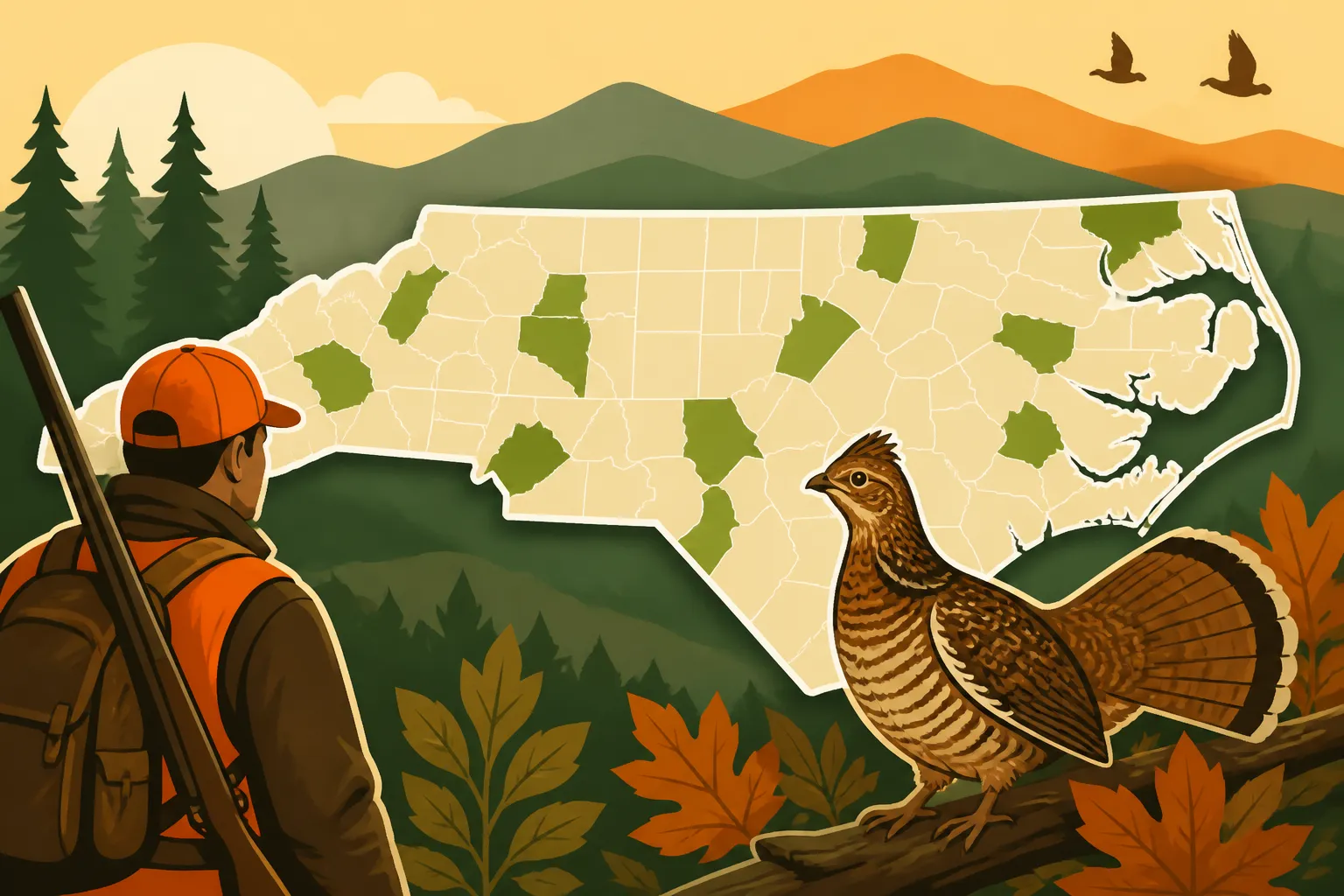
When we talk about the best North Carolina counties for grouse, we're talking about a select few that encompass the most suitable mountain habitat. These are the counties where you'll find the highest elevations, the most rugged terrain, and, critically, the highest concentrations of grouse-friendly cover. While you might find a lone bird in an outlying county, these are your best bets for consistent encounters.
| County | Primary Habitat Type | Key Characteristics | Proximity to Public Land |
|---|---|---|---|
| Haywood | Mixed hardwood, regenerating cuts | Steep slopes, thick rhododendron, good elevation | Nantahala National Forest, Pisgah National Forest |
| Transylvania | Mixed hardwood, stream bottoms | Rugged terrain, diverse forest, good moisture | Pisgah National Forest |
| Jackson | High elevation, dense thickets | Remote, challenging access, mature timber interspersed | Nantahala National Forest |
| Macon | Old growth, regenerating cuts | Appalachian Trail corridors, varied topography | Nantahala National Forest |
| Swain | Remote wilderness, creek bottoms | Deep hollers, less pressure in specific spots | Nantahala National Forest, Great Smoky Mountains NP (no hunting) |
| Graham | Rugged, remote, mature timber areas | Very wild, difficult access, but good pockets of cover | Nantahala National Forest |
Haywood and Transylvania Counties: A Great Starting Point
These two counties, nestled firmly within the Pisgah and Nantahala National Forests, often top the list for North Carolina grouse hunters. Haywood County, with its high elevations and significant portions of public land, offers classic mountain grouse hunting. You'll find yourself navigating steep slopes covered in dense rhododendron thickets and mountain laurel — the quintessential Grouse Hunting Blue Ridge Cover. Focus your scouting efforts on identifying clear-cuts from 10-20 years ago, or areas that have seen recent timber management for forest health. These disturbed areas will have the regenerating understory that grouse crave.
Transylvania County offers similar rugged terrain and diverse forest types. Here, you'll also find some stream bottoms and slightly less extreme slopes in certain areas, but the key is still seeking out those young, brushy pockets. Think about the transition zones between mature hardwoods and thick, younger growth. These "edge habitats" are where grouse often spend their time, moving between feeding grounds and protective cover. Many of these areas are publicly accessible within the vast expanses of the Pisgah National Forest Hunting. Remember, patience and persistence are your greatest assets when tackling these challenging landscapes.
Jackson, Macon, Swain, and Graham Counties: For the Dedicated Hunter
Further west and southwest, counties like Jackson, Macon, Swain, and Graham offer equally challenging but potentially rewarding opportunities for the dedicated grouse hunter. These are areas where the national forests stretch for miles, offering vast tracts of public land. The downside? Access can be incredibly difficult, often requiring long hikes away from established roads or trails. This can be a blessing in disguise, however, as it often means less hunting pressure.
In these counties, you'll be primarily hunting within the Nantahala National Forest Hunting. Look for areas with a history of logging, especially those that aren't immediately adjacent to popular hiking trails. Deep hollers and creek bottoms can also hold birds, particularly if there's a good mix of dense cover and food sources. The birds here are truly wild, and a flush is always hard-earned. These are the places where understanding Wind and Thermals on a Blue Ridge Slope can be critical, as grouse will often position themselves to take advantage of these natural air currents for escape or foraging. Tools like GoHunt can be invaluable in these remote areas, helping you overlay property lines, locate past timber cuts, and even identify potential travel corridors for birds based on topography and vegetation types.
Habitat Cues and Scouting for Grouse
Finding grouse in North Carolina isn't about aimlessly walking. It's about diligent scouting and understanding their specific needs. You’re looking for specific features on the landscape that scream "grouse habitat." These areas are often difficult to navigate, but that's precisely why the birds choose them. They offer unparalleled protection.
Identifying Key Habitat Features
Beyond the general forest type, look for these specific characteristics within your chosen counties:
- Young Regenerating Clear-cuts (5-20 years old): This is paramount. These areas provide dense cover, berries, and insects. Look for saplings, briars, and thick growth that’s almost impenetrable to humans.
- Mountain Laurel and Rhododendron Thickets: These evergreens offer year-round cover. Grouse will dive into these thickets at the first sign of danger. The denser, the better. You’ll often find these along creek beds, on north-facing slopes, and in shaded ravines.
- Old Logging Roads and Skidder Trails: While not habitat themselves, these can provide easier access into dense areas and often have successional growth along their edges, creating perfect strips of cover. They can also be great places to look for grit.
- Conifer Stands: Pockets of hemlock, spruce, or pine, especially if mixed with deciduous growth, offer thermal cover in winter and protection from predators.
- Mast-Producing Hardwoods: Areas with oaks, hickories, and beeches, particularly those bordering dense cover, provide essential food sources during fall and winter. Hunting After a Poor Acorn Year will significantly change grouse distribution, making them concentrate around other food sources like greenbriar berries or remnant wild grapes.
When scouting, don't just look for birds. Look for signs of birds. Dusting bowls (small depressions in soft earth), droppings (often found on logs or rocks), and discarded bud remnants (from eating tree buds in winter) can all indicate recent grouse activity. A good mapping app, such as one supported by GoHunt's data layers, can help you mark these spots and build a picture of grouse movement over time.
The Role of Elevation and Aspect
In the mountains, elevation and slope aspect (which way a slope faces) play a significant role. Grouse often prefer middle to higher elevations, away from intense human pressure. North-facing slopes tend to hold more moisture and can have denser evergreen cover, while south-facing slopes warm up faster, attracting insects and offering early green-up. Successful hunters often work these transition zones.
During different parts of the day or in varying weather conditions, grouse might shift their positions. A cold, frosty morning might find them on a sun-drenched, south-facing slope, while a warm afternoon might push them into a cool, shaded rhododendron thicket on a north slope. Understanding these microhabitats and how they change with the weather is a huge advantage. This detailed knowledge of terrain and how it influences game behavior is what separates casual strolls from effective hunting expeditions.
Tactics and Considerations for North Carolina Grouse Hunters
Hunting grouse in North Carolina is as much about physical endurance and mental fortitude as it is about shooting skill. The terrain is brutal, the cover is thick, and the birds are wily. You won't find many "easy" hunts here, but that's part of the appeal for true upland enthusiasts.
Gear Up for the Grind
Your gear needs to be robust and functional for this type of hunting. Forget your lightweight pheasant vest; you need something that can stand up to tearing through briars and thickets.
- Shotgun: A fast-handling, open-choked shotgun is key. Many hunters prefer a 20 gauge or 28 gauge, but a 12 gauge with a light load and improved cylinder choke works well too. Upland Guns for Mountain Grouse Cover should be chosen for their balance and ability to swing quickly in tight quarters. Shotguns for North Carolina Grouse and Dove typically require faster reflexes than open field hunting.
- Ammunition: Light loads of 7 1/2 or 8 shot are usually sufficient for grouse.
- Clothing: Brush Pants for North Carolina Mountain Laurel are a necessity. Think heavy-duty canvas or briar-proof material. Layers are crucial for dealing with fluctuating mountain temperatures and intense exertion.
- Boots: Waterproof, ankle-supporting boots with good traction are non-negotiable. You'll be climbing, descending, and crossing wet areas.
- Navigation: A reliable GPS or mapping app (like GoHunt, with its offline map capabilities) is absolutely essential. It's easy to get turned around in dense, unfamiliar mountain cover. Mark your truck, mark points of interest, and keep track of your progress.
- Safety: Always carry a first-aid kit, a whistle, and let someone know your hunting plan. Cell service is often nonexistent in remote mountain areas.
Hunting Strategies for Tough Birds
Grouse hunting in North Carolina is rarely a passive affair. You need to be proactive and aggressive.
- Walk, Pause, Walk: Grouse often hold tight, but a sudden pause can make them nervous enough to flush. Walk for a bit, stop for 10-15 seconds, then continue. This often triggers a flush.
- Work the Edges: Focus on the transition zones between dense cover and more open timber, or along the edges of old logging roads.
- Utilize a Dog: A well-trained bird dog, especially a pointing breed, is an incredible asset. They can locate birds you’d walk past and give you a precious few seconds to prepare for the shot. Even a flushing dog can be effective, provided it works close.
- Hunt into the Wind: Grouse often flush into the wind, which slows them down slightly and makes for a more predictable flight path. Pay attention to Wind and Thermals on a Blue Ridge Slope – understanding how these affect bird movement can be a game-changer.
- Don't Give Up on a Flush: If a bird flushes wildly and you don't get a shot, mark where it went. Grouse will often fly a short distance and re-pitch into new cover. Sometimes, they can be re-flushed.
- Be Patient: This isn't high-volume shooting. You might walk for hours for a single opportunity. Celebrate every flush, even if you miss. It’s about the experience, the challenge, and the beautiful places these birds call home.
Remember, the goal is not just to harvest a bird, but to immerse yourself in the wild, rugged beauty of North Carolina's mountains. The few ruffed grouse we have are a testament to the wildness that still exists, and pursuing them is an ancient, honorable pursuit.
Disclaimer
This article is for general informational purposes only and does not constitute professional advice. Laws, prices and regulations vary by location and change over time. Consult a qualified professional for guidance on your specific situation.