Wind and Thermals on a Blue Ridge Slope
Hunting the steep, rugged slopes of North Carolina's Blue Ridge Mountains can be incredibly rewarding, offering a solitude and challenge unlike anywhere else. But let's be honest, trying to predict deer movement when the wind seems to swirl in every direction, and the thermals play tricks on your scent, can feel like you're fighting an invisible battle. It's frustrating to put in the effort only to have a mature buck bust you from an unexpected angle. This guide is all about demystifying the complex dance of wind and thermals in mountain country, helping you understand these forces so you can use them to your advantage and stack the odds in your favor.
Understanding the Invisible Forces of Mountain Air
When you're out in the Blue Ridge, it's not just about the big gusts you feel on your face; there's a constant, often subtle, movement of air that dictates where deer feel safe and where they'll move. Overlooking these nuanced air currents is a surefire way to get busted, especially by wary mountain whitetails. Unlike flatland hunting where a prevailing wind might be fairly consistent, the mountains are a whole different beast. The terrain itself acts like a giant, irregular funnel and obstacle course for air, creating microclimates and unpredictable shifts that demand a keen understanding.
The Fundamental Difference: Wind Versus Thermals
It's crucial to distinguish between true wind and thermals because they operate on different principles and at different times of the day. Wind, as we generally understand it, is caused by atmospheric pressure differences across larger geographical areas. It's the prevailing breeze you might feel, often reported by weather forecasts, and it can come from any direction. It can be strong and steady, or gusty and swirling, especially when it interacts with mountainous terrain. A strong westerly wind hitting a ridgeline, for instance, might create a downdraft on the leeward side, pushing scent straight down into a hollow.
Thermals, on the other hand, are localized air currents driven by temperature changes throughout the day. Think of them as localized convection currents. As the sun rises and heats the earth, warm air expands and rises. As the sun sets and the earth cools, cool air contracts and sinks. This consistent, daily cycle creates predictable up-and-down air movements that are often far more influential in mountain hunting than the broader, atmospheric winds. Many hunters make the mistake of only paying attention to their wind checker while completely ignoring the thermal effect, leading to unexpected busts. For hunters navigating the complexities of public land like those covered in Hunting the North Carolina Mountains, understanding both is non-negotiable.
How Terrain Shapes Air Movement
The physical contours of the Blue Ridge play an enormous role in how both wind and thermals behave. Ridges, hollows, draws, and saddles all act as funnels, barriers, or accelerators for air. A prominent ridgeline, for example, can deflect wind over its top, creating a calm zone directly below it, or it can cause a swirling vortex where the wind wraps around its contours. Deep hollows, especially those with dense cover, can hold colder, denser air longer into the morning, causing thermals to start later and persist differently.
Imagine a deer bedded on a steep mountainside. During the day, as the sun warms the slope, the air will rise, carrying the deer's scent uphill. In the evening, as temperatures drop, that same scent will slide downhill. This means a deer can effectively "hunt" with its nose, using the terrain and the thermal currents to detect threats both above and below it. Your strategy for Reading a Ridge for Mountain Zone Deer absolutely needs to account for these subtle air movements. Neglecting this crucial aspect is like walking into the woods blindfolded.
Mastering the Daily Thermal Cycles
The most predictable and arguably most important air movements in mountain hunting are the daily thermal cycles. These are your allies if you understand them and your worst enemy if you don't. They operate like clockwork, driven by the sun, and are most pronounced during calm, clear weather when prevailing winds are light. When those big weather fronts roll through, wind might dominate, but on those classic, crisp mountain mornings and evenings, thermals are king.
Morning Thermals: Riding the Rise
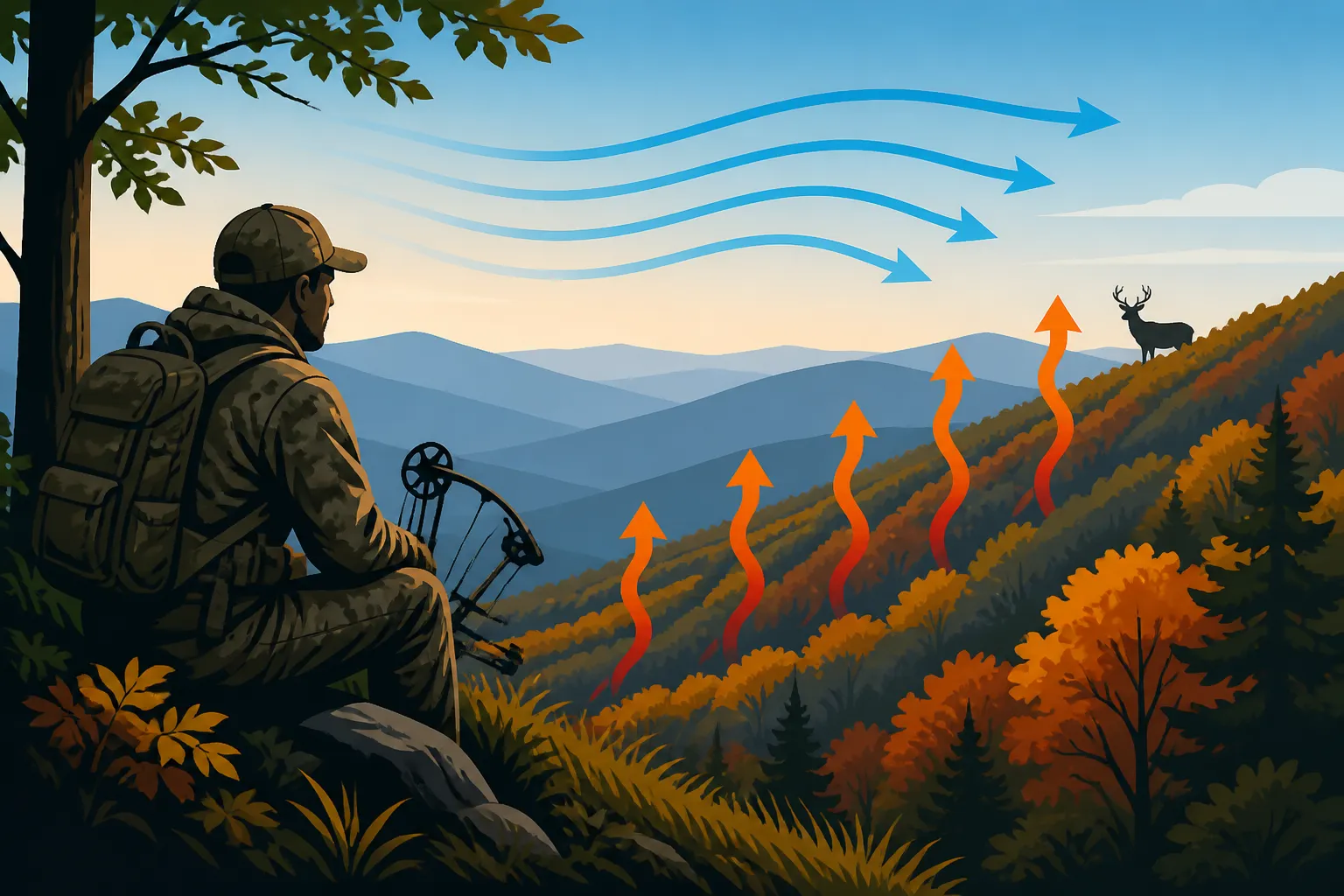
As the sun peeks over the eastern ridges of the Blue Ridge, its warmth begins to penetrate the forest floor. The ground and vegetation absorb this heat, which in turn warms the air directly above it. Warm air, being less dense, naturally begins to rise. This creates what we call "morning thermals" or "updrafts." From sunrise until roughly mid-morning, sometimes later depending on how quickly the air heats up and how steep the terrain is, the air on a mountainside will generally flow uphill.
This means your scent, and the scent of any deer moving below you, will be carried upwards along the contours of the mountain. For a hunter trying to slip into a morning feeding area or a bedding ridge, this is critical. You want to approach from below your intended hunting location, allowing your scent to rise harmlessly above any deer that might be bedded higher up. Conversely, if you're trying to hunt a deer bedded above you, approaching from below is a bad idea; your scent will go right to them. Instead, consider an approach from the side, or wait until the thermals have stabilized or a strong prevailing wind takes over. When setting up a stand, particularly for Treestand Setups in Pisgah National Forest, a morning thermal dictates that you avoid placing yourself directly in line with where deer might be bedded uphill.
| Thermal Cycle | Time of Day | Air Movement Direction | Scent Path (Hunter's Scent) | Ideal Approach |
|---|---|---|---|---|
| Morning | Sunrise – Mid-morning | Uphill | Travels Uphill | From Below |
| Evening | Mid-afternoon – Sunset | Downhill | Travels Downhill | From Above |
Evening Thermals: The Downward Drift
As the sun begins its descent towards the western horizon, the dynamic shifts. The ground starts to cool rapidly, especially in shaded areas and valleys. The air immediately above the cooling ground also cools, becoming denser and heavier. This cool, dense air then begins to sink, creating "evening thermals" or "downdrafts." From mid-afternoon until well after sunset, the air on a mountainside will generally flow downhill, settling into the hollows and creek bottoms.
This downward flow means that your scent will be carried downwards into the valleys and draws. If you're setting up for an evening hunt, perhaps to catch deer moving from bedding areas high on a ridge down to a food source in a bottom, you ideally want to approach from above your chosen stand location. This keeps your scent drifting away from where the deer will be coming from. If you try to hunt from a low stand hoping to catch deer coming down, your scent could easily pool in the bottom and bust any deer trying to enter. Conversely, if you're attempting to still-hunt up a draw in Still-Hunting Nantahala Forest Ridges during the evening, your scent will be pushed ahead of you, making it a very risky endeavor. A smart hunter uses a mapping tool like the one found on GoHunt, which often includes topo lines and prevailing wind overlays, to visualize these airflows.
Thermal Transition: The Midday Challenge
There's a period, usually around late morning to early afternoon, when the thermals are transitioning. The rising morning air currents begin to weaken, and the cooling evening currents haven't fully established themselves. During this time, the air can be incredibly unpredictable and swirling, especially if there's no strong prevailing wind. It's often referred to as "dead air" or "swirling hell" by frustrated mountain hunters.
This transition period is often when hunters get busted the most. Your scent might hang in one spot, then suddenly shift direction for a few seconds before returning, making it nearly impossible to predict. Many experienced mountain hunters use this period for moving between locations, grabbing lunch, or taking a break. If you absolutely must hunt during this transition, try to position yourself in areas where natural windbreaks or funnels might create a more stable air current, even if temporary. Or, focus on areas where deer are less likely to be relying on their nose, such as heavy cover where visibility is limited and their other senses are heightened. When considering a Packs for a Pisgah Forest Day Hunt, remember to account for this midday lull or transition period in your plans.
Advanced Wind Tactics and Micro-Thermals
While the general rules of thermals are incredibly helpful, the mountains are full of nuances. True mastery comes from understanding how smaller-scale features and even subtle temperature differences create localized air movements that can either confirm or confound the broader thermal patterns. This is where truly keen observation and experience come into play, allowing you to fine-tune your approach.
Identifying Micro-Thermals in Specific Features
Beyond the large-scale uphill and downhill thermals, smaller terrain features can create localized "micro-thermals." A steep rock face, for instance, heats up and cools down much faster than surrounding soil or vegetation. In the morning, that rock face might create a strong, localized updraft, pulling air straight up its surface. In the evening, it could create a concentrated downdraft. Even a small clearing in dense timber, or a particularly thick patch of rhododendron, can create subtle temperature differences that influence air flow.
Observing these micro-thermals is an art. It involves constantly checking your wind indicator, even in seemingly still air, and watching for leaves or grass movement. Pay attention to how the air moves around individual boulders, tree trunks, or small elevation changes. A good mapping application, such as the one offered by GoHunt, can help you identify subtle terrain features that might act as thermal generators or funnels. If you're Hanging a Stand on a Pisgah Ridge, consider how a dip in the ridge or a small rock outcrop might alter the air just enough to make a difference.
Using Prevailing Winds and Crosswinds
While thermals govern the up-and-down movement of air, prevailing winds still dictate the horizontal flow. The trick in mountain hunting is to combine your understanding of both. On a windy day, the prevailing wind might be strong enough to override the thermal effect, or at least temper it. If you have a strong westerly wind, even in the morning, that wind might push your scent horizontally across a slope rather than allowing it to rise directly uphill.
The ideal scenario often involves a crosswind combined with a thermal. For example, if you're hunting a morning thermal (air rising) but also have a light crosswind, your scent will not only rise but also drift slightly to the side. This can be your best friend when trying to sneak into a bedding area. Similarly, in the evening, if you have a downhill thermal and a crosswind, your scent will drop into the valley and then be pushed sideways. Always try to position yourself so that your scent is being carried away from where you expect deer to approach or be bedded, often along a contour line or a subtle ridge spur that allows a cross-wind to work with the thermal. For insights on where deer might be bedded, check out Where Nantahala Forest Bucks Bed.
The Importance of Scent Control in Mountain Hunting
Given the swirling, unpredictable nature of mountain air, impeccable scent control is paramount. While understanding thermals and wind helps you position yourself, good scent control acts as your ultimate backup. This means showering with scent-free soap, washing hunting clothes in scent-free detergent, and storing them in airtight containers. Using scent-eliminating sprays before heading into the woods is also a good practice, though they are not a substitute for proper wind awareness.
Furthermore, consider what you eat and drink before and during your hunt. Coffee, garlic, and other strong-smelling foods can seep through your pores and create a scent cone that even the best wind strategy can't entirely negate. For Cold-Weather Sitting Strategy in the Mountains, it’s tempting to bring hot food, but be mindful of its odor. Many hunters swear by ozone generators for their gear, or at the very least, hanging their clothes outside to air out regularly. The more you can minimize your scent, the larger your margin for error when the inevitable mountain wind shift occurs.
Putting It All Into Practice on a Blue Ridge Slope
Okay, so you understand the theory – great! But how do you actually apply this when you're standing on a steep mountainside at 5:30 AM, trying to decide where to hang your stand or which way to approach? It comes down to meticulous scouting, constant observation, and having a flexible plan. The Blue Ridge, whether you're in Pisgah National Forest Hunting or Nantahala National Forest Hunting, demands a dynamic approach.
Scouting and Planning Your Approach Routes
Before you ever step foot in the woods with your bow or rifle, spend time scouting. Use mapping tools like GoHunt to analyze the topography, identifying ridges, draws, saddles, and potential bedding or feeding areas. Visualize how the thermals will flow in the morning and evening. Identify multiple approach and exit routes for each stand location, always considering the thermal and prevailing wind. You want an approach that keeps your scent out of the deer's nose, and an exit that doesn't blow out another area.
When scouting, pay attention to the little details. Where does the sun hit first in the morning? Which slopes stay shaded longer? These seemingly minor details will directly influence when and where thermals initiate. Look for specific features like benches or small shelves on a ridge, which deer often use for bedding, and plan your approach accordingly. Often, a stealthy approach means taking a longer, more circuitous route that keeps you out of the critical wind zone. This is key for effective Scouting North Carolina Public Land Before Season.
Strategic Stand Placement and Flexibility
Once you've identified a promising area, your stand placement needs to be tactical, leveraging the wind and thermals. For a morning hunt, aim to set up below or to the side of where you expect deer to come from or be bedded, knowing your scent will rise. For an evening hunt, position yourself above your target area, allowing your scent to drop into the valley below. But don't just pick one spot and stick to it; be ready to move. Mountain hunting often requires being mobile.
Carry a small wind checker and use it constantly. Even if you've done your homework and the forecast says one thing, the air on the mountain might be doing something completely different. If the wind unexpectedly shifts or swirls, you need to be prepared to adjust. That might mean climbing down and moving to a new stand, or even just shifting your body in your stand to present a smaller profile to the shifting wind. Remember that even the best Boots for North Carolina Swamps and Ridges won't help if your scent gives you away. Having a few pre-scouted alternative stand locations for different wind directions will increase your chances significantly.
Hunting the Edges: Avoiding Direct Confrontation
Given the unpredictable nature of mountain air, sometimes the best strategy is to hunt the "edges" of expected deer movement, rather than directly in their travel corridors. This means setting up on a subtle ridge spur that provides a crosswind, or a bench just off a main trail, rather than right on top of a well-used run. This gives you a buffer zone for shifting winds and thermals. Deer often feel more secure in thicker cover and can surprise you.
Consider glassing from a distance during the early morning or late evening, using powerful Binocular Power for Mountain Hunting to spot deer movement from afar, then planning a stalk based on confirmed sightings and current wind conditions. When you do approach, do so deliberately and slowly. Incorporate natural pauses, using the terrain to break up your silhouette. The deer in the Blue Ridge are highly attuned to their environment, and any misstep with your scent or movement will be quickly punished. The goal isn't just to be in the woods, but to be an intelligent, adaptable hunter who respects the invisible forces at play.
Disclaimer
Please note that hunting regulations and conditions can change. Always consult the latest North Carolina Wildlife Resources Commission (NCWRC) regulations before heading into the field. This guide is for informational purposes only and does not supersede official regulations.