Where North Carolina Turkeys Are Densest
If you've spent frustrating mornings calling into a silent North Carolina spring wood, wondering if there are any gobblers left in the state, you're not alone. It can feel like finding a needle in a haystack, especially when the birds aren't talking. But the truth is, North Carolina is home to a fantastic wild turkey population, and knowing where they tend to concentrate their numbers can dramatically improve your odds. This guide is all about helping you understand the prime turkey territories across our diverse state and how to pinpoint those high-density areas.
Understanding North Carolina's Turkey Population Distribution
It’s easy to get discouraged when you’re not hearing gobblers, but it's important to remember that wild turkeys aren't evenly distributed across the landscape. Their presence, and especially their density, is heavily influenced by a mix of historical factors, habitat quality, and human impact. Understanding these elements is the first step in finding those spots where turkeys truly thrive.
Historical Context of Turkey Restoration
Believe it or not, there was a time when wild turkeys were nearly absent from North Carolina. Habitat destruction and unregulated hunting took a severe toll, pushing these magnificent birds to the brink in many areas. For those of us who appreciate the thunderous gobble of a spring longbeard, it's a testament to incredible conservation efforts that we have huntable populations today. Over several decades, through trap-and-transfer programs, turkeys were reintroduced into suitable habitats across the state. This means that areas that historically had robust turkey populations might still be prime, but also that newer, carefully managed release sites have become strongholds. The success of these programs, often driven by the North Carolina Wildlife Resources Commission and groups like the National Wild Turkey Federation, has allowed populations to flourish, but their spread hasn't been a perfectly uniform blanket. Some areas simply took better than others due to the underlying habitat. If you're curious about the journey, you can read more about How Turkeys Were Restored to North Carolina.
Factors Influencing Turkey Density
So, what makes a particular patch of North Carolina turkey heaven? It boils down to a few critical factors. First and foremost is habitat diversity. Turkeys need a mosaic of different cover types: mature hardwoods for roosting and mast crops (acorns, beechnuts), open woodlands or fields for feeding on insects and seeds, dense undergrowth for nesting and escape cover, and reliable water sources. A vast, unbroken pine plantation, while offering some cover, usually won't hold the same density of turkeys as a property with a mix of mature timber, agricultural fields, and brushy edges.
Food is another massive driver. Turkeys are omnivores, consuming everything from acorns and wild grapes to grasshoppers and beetles. Areas with a consistent, varied food supply throughout the year will naturally attract and hold more birds. This often means tracts that include good mast-producing trees, planted food plots, or agricultural fields (especially those left fallow or with waste grain). Finally, pressure plays a significant role. Areas that see heavy hunting pressure, whether from humans or an abundance of predators like coyotes, can exhibit lower turkey densities, or at least make the birds incredibly wary and hard to find. Finding those pockets of ideal habitat that are also relatively undisturbed is often the key to locating the highest concentrations.
Top Regions and Counties for Turkey Density
North Carolina is a state of incredible ecological diversity, and its turkey populations reflect that. While you can find turkeys in nearly every county, certain regions and specific types of terrain consistently produce higher densities. It's not always the "prettiest" or most remote land that holds the most birds; sometimes it's the perfect blend of food and cover, even in areas you might not expect.
The Piedmont's Hidden Gems
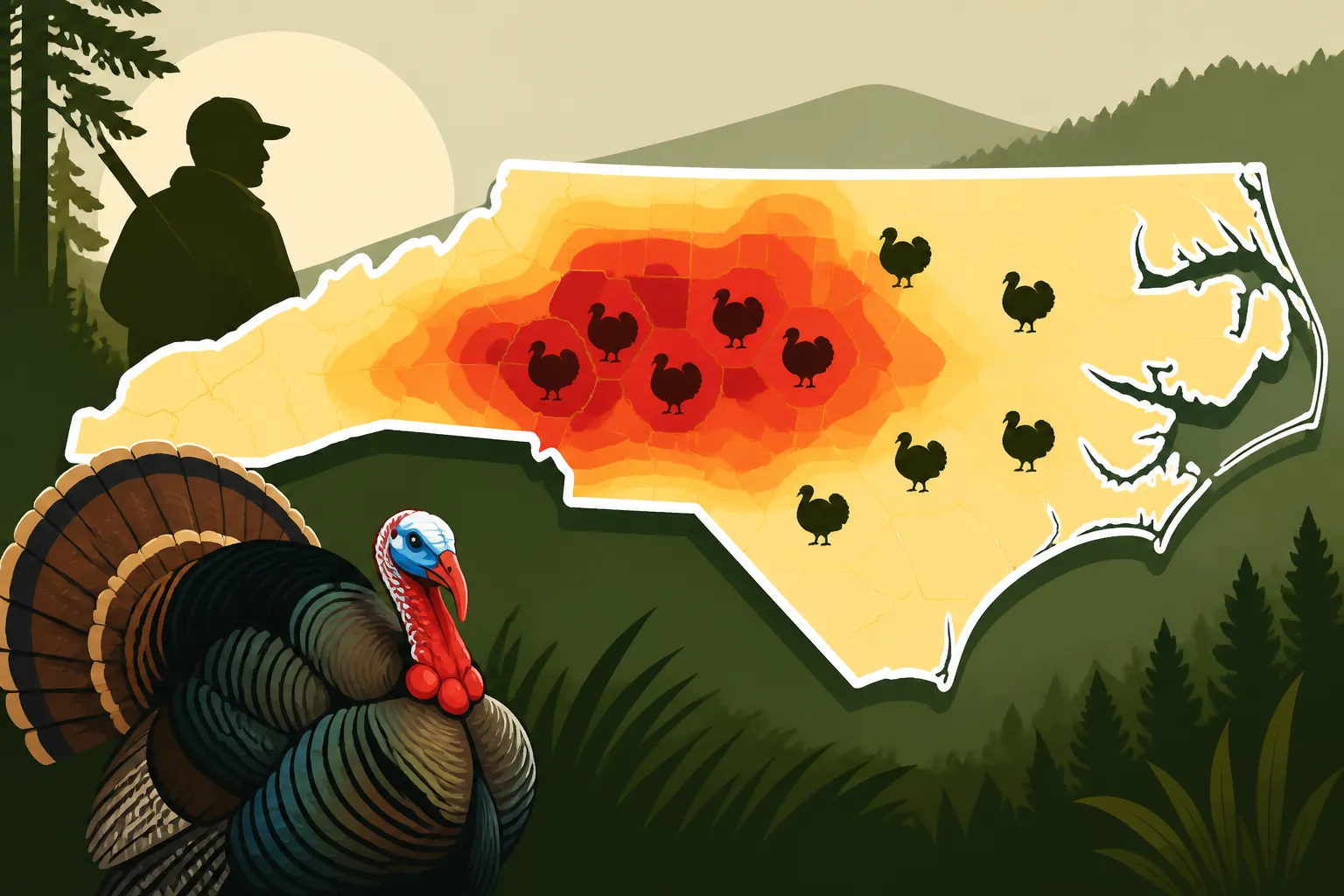
When many hunters think of North Carolina turkeys, they might immediately picture the mountains or the vast coastal swamps. But let me tell you, the Piedmont region, with its rolling hills, mixed forests, and agricultural patchwork, is a dark horse for turkey density. Counties like Randolph, Chatham, Montgomery, Moore, and Lee often boast excellent turkey numbers. Why? It’s a combination of factors. The Piedmont features extensive mature hardwood bottoms and ridges that provide critical roosting sites and abundant mast crops. These are often interspersed with active or fallow agricultural fields growing corn, soybeans, or wheat, which are absolute magnets for turkeys seeking easy meals.
Another benefit of the Piedmont is often slightly lower human population density in the rural areas compared to the immediate vicinity of major cities, yet still enough farming activity to create those beneficial field edges. This balance can lead to less pressure on the birds than some of the more intensely hunted public mountain lands. Scouting these areas, either by driving rural roads at dawn or dusk looking for birds in fields, or using satellite imagery on a platform like GoHunt to identify prime habitat mosaics, can reveal incredible opportunities. You'll want to look for those transition zones where hardwood forests meet crop fields or overgrown fencerows. These are often where turkeys spend their days. The same strategies that work for Hunting Piedmont Farmland Deer can often lead you to turkeys here too.
Mountain Foothills and Valleys
While the highest, steepest peaks of the Appalachians might be tough going for turkeys (and hunters!), the mountain foothills and lower river valleys offer fantastic turkey habitat and can hold very high densities. Counties like Wilkes, Surry, Yadkin, Burke, and Cleveland are often standouts in this region. Here, you'll find a mix of mature hardwood forests with abundant mast production, coupled with creek bottoms and river drainages that provide richer soil, more diverse plant life, and often small agricultural plots. These lower elevations also tend to be less snow-bound in late winter and early spring, giving turkeys a head start on green-up and insect foraging.
Turkeys in these mountain-adjacent areas often utilize the varied topography to their advantage, roosting high on ridges and then flying down to feed in bottomland fields or along sun-drenched slopes. The challenge here is the terrain itself – it can be rugged. However, if you're willing to put in the legwork, you can find incredibly productive areas. Focus your scouting on south-facing slopes in early spring where the sun hits first, melting snow and encouraging new growth, and always keep an eye on creek bottoms for signs of movement. These areas are also prime for Roost Hunting North Carolina Gobblers, as birds will often stick to predictable roosting trees along these natural corridors.
Coastal Plain's Productive River Bottoms
Moving eastward, the vast Coastal Plain offers a completely different, yet equally productive, turkey landscape, especially within its extensive river bottomlands and swamp edges. Counties such as Sampson, Bladen, Columbus, Duplin, and Lenoir often report strong turkey numbers. These areas feature mature bottomland hardwoods like oaks and cypress, which provide abundant mast and ideal roosting sites, especially in the towering trees found along major river systems like the Cape Fear, Black, and Lumber Rivers. The surrounding landscape often includes large agricultural operations, which provide endless feeding opportunities.
The density here isn't necessarily in open fields, but in the thick, often intimidating, cover that makes up these river corridors and pocosin edges. Turkeys in the Coastal Plain know how to disappear into the dense undergrowth, making them challenging but rewarding to hunt. The key is to focus on the transitions – where the mature hardwoods of a river swamp meet a pine plantation, a clear-cut, or an agricultural field. These interfaces create superhighways for turkeys. Using a mapping tool like GoHunt to pick out these distinctive habitat changes can reveal overlooked pockets. While it might seem counterintuitive, you can often find great turkey action in areas adjacent to where you'd be Hunting Coastal Plain Pocosin Swamps, as the edges of these dense areas often hold good birds.
Scouting Strategies for High-Density Turkey Areas
Finding areas with high turkey density isn't just about knowing which counties generally have good numbers; it's about pinpointing the specific woodlots, ridges, and creek bottoms where those birds are right now. This takes diligent scouting, both from your easy chair and with boots on the ground.
Pre-Season Reconnaissance
Long before the season opener, your scouting begins from home. This is where digital tools really shine. Start by poring over aerial maps and topographic maps. Services like GoHunt allow you to examine satellite imagery in incredible detail, revealing subtle changes in vegetation, potential food sources, and natural travel corridors. Look for the "turkey trifecta": mature hardwood forests (especially those with open understories), interspersed with clearings or fields, and a reliable water source. Look for long ridge lines with adjacent creek bottoms in the mountains, or intricate networks of logging roads and field edges in the Piedmont and Coastal Plain.
Pay close attention to changes in elevation, which can funnel turkey movement, and areas with different timber types. A mix of older, mature trees for roosting and younger, brushier areas for nesting and bugging is ideal. Pinpoint potential roost sites – usually the tallest trees along a water source or on a ridge. Identify south-facing slopes in colder regions, as these will warm up faster in spring, attracting early bugging activity. Don't forget to mark potential access points, parking spots, and any features that might act as a natural barrier or funnel. This map work is crucial for narrowing down your search before you even step foot in the woods. This initial work can be as important as actually Scouting North Carolina Public Land Before Season with your boots on the ground.
Reading the Landscape for Turkey Sign
Once you've identified promising areas on your maps, it's time to hit the woods. Turkeys leave plenty of clues, and learning to read these signs is vital for confirming density. One of the most obvious indicators is fresh droppings. Tom droppings are typically J-shaped, while hen droppings are more coiled. Abundant fresh droppings under large trees, especially near water or field edges, indicate a roost or heavy feeding area. Tracks are another clear sign, particularly along muddy creek banks, logging roads, or dusty field edges. Look for the distinctive three-toed print; larger tracks usually mean a gobbler.
Scratch marks in the leaf litter are unmistakable. Turkeys scratch forward with both feet, sweeping leaves aside to uncover insects, seeds, and acorns. Large, fresh scratchings covering a wide area suggest a feeding flock. Don't overlook dust bowls – shallow depressions in dry, dusty soil where turkeys will "dust bathe" to clean their feathers and deter parasites. Finding several dust bowls in an area is a strong indicator of consistent turkey presence. Finally, spend time listening at dawn or dusk near suspected roost sites. A gobble from the limb, or even the sound of turkeys flying down from their roost, is the ultimate confirmation of density. Understanding North Carolina Turkey Roost Tree Preferences can guide you to these prime locations.
Navigating Public vs. Private Land for Turkey Hunting
The age-old debate of public versus private land is particularly relevant when discussing turkey density. Both offer opportunities, but they come with different challenges and rewards, especially in North Carolina where hunting pressure can vary wildly.
Public Land Challenges and Opportunities
Hunting turkeys on North Carolina's extensive public lands, which include National Forests and various Game Lands, presents a unique set of challenges. The biggest one, inevitably, is pressure. Areas with easy access or known turkey populations will often see a lot of other hunters, especially during the opening weekends. This can make birds incredibly wary, silent, and difficult to approach, seemingly lowering their effective density even if the actual bird numbers are good. It can feel like you're constantly running into other hunters or calling to birds that have already been educated by a dozen other calls. If you're going into public ground, be prepared for Hunting Pressure on North Carolina Public Land.
However, public lands also offer tremendous opportunities for the dedicated hunter. To find higher turkey densities on public ground, you often need to go where others aren't willing to. This means walking further, penetrating deeper into dense cover, or exploring less accessible areas. Look for remote ridges, thick swamps, or hard-to-reach creek bottoms that might deter less persistent hunters. Many game lands are managed with diverse habitat in mind, and if you can find those overlooked pockets of mature timber, open fields, and water, you might discover relatively unpressured birds. The sheer amount of acreage available means that true density is out there, you just have to work harder to find it. Early season on public land, before the birds are fully educated, can also be a golden window.
Securing Private Land Access
For many North Carolina turkey hunters, private land is the holy grail for finding consistent, high-density turkey populations. On private ground, especially large tracts with minimal hunting pressure, turkeys tend to be more vocal, less wary, and often more numerous. The control over habitat management means landowners can create ideal conditions with food plots, timber management, and prescribed burns that directly benefit turkeys. This often results in significantly higher bird densities compared to average public land.
The challenge, of course, is gaining access. This requires building relationships, demonstrating respect for property, and sometimes offering to help with land management or other chores. It's not a quick fix, but the payoff can be substantial. Farming communities, particularly in the Piedmont and Coastal Plain, often have landowners dealing with turkey depredation on crops, which can be an "in" for hunters. If you're interested in pursuing this route, understanding the etiquette and strategies for Knocking on Doors in Piedmont Farm Country can be incredibly helpful, even if you're not specifically looking for deer. Always remember, once you gain access, treating the land and the landowner with the utmost respect is paramount to maintaining that privilege.
Here's a quick summary of general turkey densities across North Carolina:
| Region | Typical Habitat | General Density Trend | Hunting Pressure |
|---|---|---|---|
| Mountains | Steep, rugged hardwoods, some high elevation; river valleys | Moderate to High | Moderate to High |
| Piedmont | Mixed hardwoods, agricultural fields, rolling hills | High | Moderate |
| Coastal | Bottomland hardwoods, swamps, pine plantations, agriculture | High | Moderate |
| Sandhills | Longleaf pine, dry uplands, creek bottoms | Moderate | Moderate |
North Carolina's wild turkeys are a truly remarkable conservation success story, and the opportunity to hunt them across such diverse landscapes is a gift. While finding those high-density areas sometimes requires diligent scouting and persistence, the rewards of a thundering gobble in a silent spring wood are well worth the effort. By understanding where turkeys thrive – from the Piedmont's farmlands to the Coastal Plain's river bottoms – and by employing smart scouting techniques, you can significantly increase your chances of a successful hunt.
Disclaimer
This article is for general informational purposes only and does not constitute professional advice. Laws, prices and regulations vary by location and change over time. Consult a qualified professional for guidance on your specific situation.