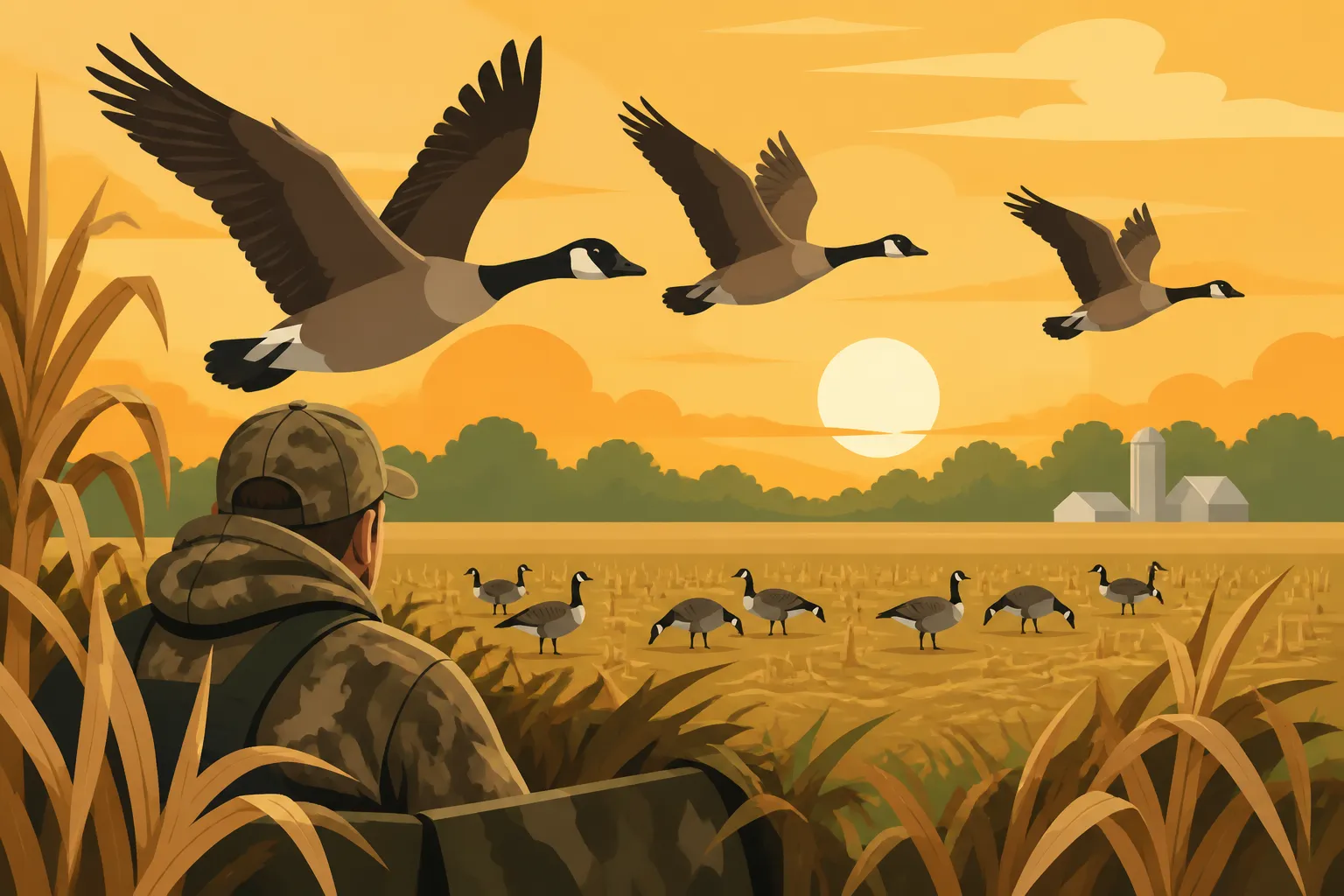
Canada Geese on North Carolina Farmland
The crisp fall air carries a sound that, for many of us, signals the true start of hunting season in North Carolina – the unmistakable honk of Canada geese. If you've ever driven through the sprawling farmlands of our state, particularly in the Piedmont and Coastal Plain, you've seen them: hundreds, sometimes thousands, congregated in cut cornfields or recently planted winter wheat. It's a breathtaking sight, but for hunters, it can also be incredibly frustrating trying to get close to these notoriously wary birds. This guide aims to help you understand these feathered farmland residents and develop effective strategies for hunting them across North Carolina's diverse agricultural landscape.
Understanding North Carolina's Farmland Goose Population
When we talk about Canada geese in North Carolina, it's easy to picture the massive V-formations honking high overhead during the migrations. But a significant portion of the geese you'll encounter on our state's farmlands aren't just passing through; many have made North Carolina their permanent home. This mix of resident and migratory populations means different challenges and opportunities for hunters throughout the season.
Resident Versus Migratory Geese in Agricultural Areas
North Carolina is home to a robust population of what we call "resident" Canada geese. These birds forego the epic journeys north and south, instead choosing to breed and raise their young right here in our state. You'll find them year-round in agricultural settings, around ponds, golf courses, and urban parks. They become particularly noticeable when they move into large farm fields after the nesting season, looking for easy calories.
Migratory geese, on the other hand, are the travelers. These are the birds that nest in the northern reaches of Canada and the United States, then push south along the Atlantic Flyway as winter approaches, with many stopping over or wintering in North Carolina. They often arrive in larger, more distinct flocks, and their behavior can be subtly different from their resident cousins. Migratory birds often seem a bit wilder, more skittish, and quicker to abandon a feeding field if they sense pressure. This makes them a unique challenge, but also offers the excitement of new birds constantly filtering into the area. For hunters, distinguishing between these groups isn't always obvious in the field, but understanding that both are present helps you anticipate their movements and reactions to pressure.
Why Farmland is So Attractive to Geese
It doesn't take a rocket scientist to figure out why geese are drawn to vast agricultural fields. Imagine a buffet spread out for miles, offering an incredible variety of high-energy foods that are relatively easy to access. That's what a cornfield, a soybean field, or a winter wheat planting represents to a goose. After crops are harvested, waste grain left behind provides a crucial food source, packed with carbohydrates and fats necessary for survival, especially during colder months. Even fields planted for winter cover or early spring crops offer tender shoots and roots that geese will happily graze upon.
Beyond food, farmland often provides expansive, open sightlines, which are vital for a bird that needs to spot predators from a distance. The lack of dense forest cover in many agricultural areas gives them a sense of security. Add in nearby water sources – whether it's a farm pond, a river, or even flooded depressions in fields – for drinking, roosting, and escape, and you have the perfect goose habitat. This combination of abundant food, open space for security, and accessible water makes North Carolina farmlands an undeniable magnet for these big birds.
Historical Trends and Current Numbers
The Canada goose story in North Carolina is actually one of significant success, particularly for the resident population. Decades ago, over-hunting and habitat loss severely impacted goose numbers. However, conservation efforts, including strict regulations, habitat restoration, and reintroduction programs, allowed populations to rebound dramatically. Today, both resident and migratory populations are healthy.
Resident goose numbers have grown to the point where they are managed not just as a game species, but also as a nuisance in some areas. The sheer volume of geese can cause significant crop damage for farmers, leading to situations where landowners are often eager to have hunters help manage the population. Migratory populations fluctuate annually based on nesting success in the north and weather patterns during migration, but North Carolina remains a key wintering ground along the Atlantic Flyway, offering consistent opportunities for hunters. The North Carolina Wildlife Resources Commission actively monitors these populations, adjusting season dates and bag limits to ensure sustainable hunting while addressing agricultural concerns. Understanding these population dynamics is key to appreciating the hunting opportunities we have.
The Seasonal Dance: Goose Movement Across North Carolina Farmland
Geese aren't static; their movements across farmland shift with the seasons, the availability of food, and increasing hunting pressure. Understanding these seasonal changes is paramount for consistent success in the field. What works in early September might be completely ineffective by late December.
Early Season Opportunities and Local Movements
When the early goose season opens in North Carolina, typically around September, the vast majority of birds you’ll encounter are our local resident Canada geese. These birds have spent the summer breeding, raising young, and loafing around local ponds and lakes. As soon as crops like corn and soybeans are harvested, these local flocks will often quickly shift their focus to feeding on waste grain in newly cut fields. Their movements at this time are largely localized, flying relatively short distances between roosting water bodies and feeding fields.
The early season presents a fantastic opportunity because these birds are often less pressured than later in the year. While still wary, they haven't endured weeks of hunting attempts, and their patterns are more predictable. This is a great time to focus on scouting immediate areas around known goose roosts, looking for fresh droppings and disturbed stubble in cut fields. Fields that are close to water and offer good visibility are often prime spots. However, even these early-season birds are smart. They'll quickly learn from pressure, so moving your spreads and adjusting your tactics after a successful hunt is important. The flexibility to adapt, even in the "easy" early season, is what separates a good hunt from a frustrating one. You can read more about specific tactics in our guide on Early Goose Season Tactics in North Carolina.
Mid-Season Migrations and Wintering Grounds
As autumn deepens into late October and November, the first pushes of truly migratory geese begin to arrive from the North. These are the birds that bred in the boreal forests and tundra, and they bring with them a new level of challenge and excitement. These migrants often arrive in larger flocks and have already encountered hunting pressure in states north of us. They are typically warier and more responsive to weather changes, which can dictate their movements more than local food availability.
During the mid-season, North Carolina's farmlands become critical wintering grounds. Key areas, particularly in the Coastal Plain and parts of the Piedmont, see concentrations of thousands of geese. These birds establish routines, flying between large bodies of water (like major rivers, sounds, or large reservoirs) where they roost, and extensive agricultural fields where they feed. Hunters must now contend with larger flocks that require more decoys and often more subtle calling. This is when paying close attention to weather forecasts, especially cold fronts and strong winds, becomes critical, as these conditions often trigger significant movements of birds into or across the state. Using scouting tools like GoHunt or local knowledge from other hunters can be invaluable for tracking these larger movements.
Late Season Pressures and Adaptations
By late December and into January, North Carolina's goose hunting reaches its most challenging phase. The birds that have wintered here have likely seen every trick in the book. They've been called at, shot at, and chased out of fields multiple times. This intense pressure makes them incredibly wary, often feeding only in the middle of massive fields, far from roads or tree lines where hunters might hide. They become masters of spotting anything out of place – a shiny blind, a poorly placed decoy, or a hunter shifting position.
Successful late-season hunting requires extreme attention to detail. This means meticulous blind concealment, sometimes moving blinds deep into fields well before daylight. Decoy spreads need to be absolutely convincing, often requiring larger numbers of full-body decoys to mimic a truly relaxed, feeding flock. Calling becomes less about loud hailing and more about soft, reassuring clucks and moans that suggest contentment. Hunters might need to adapt by employing strategies like Layout Blind Hunting Coastal Plain Fields to disappear completely into the stubble. Furthermore, late-season food sources can become scarcer, driving geese to feed on different crops or even graze on winter cover crops, requiring constant scouting to locate the "X" where they want to be.
Deciphering Goose Behavior on Agricultural Fields
Hunting geese on farmland is a bit like playing chess; you have to anticipate their moves, understand their motivations, and react to their signals. This means becoming a student of goose behavior, especially when they're feeding and resting in our wide-open fields.
Feeding Patterns and Crop Preferences
Canada geese are primarily herbivores, and they have definite preferences when it comes to their diet on North Carolina farmlands. Freshly cut cornfields are often their first choice after harvest. The waste grain offers a high-energy meal that's easily digestible. Following corn, soybean fields can also be attractive, as can fields of winter wheat, rye, or other cover crops, where they'll graze on the tender green shoots. Sometimes, especially in extremely cold weather or if other options are exhausted, they'll even scratch through standing stubble for any remaining seeds or roots.
Their feeding patterns are usually quite predictable once established. Geese will typically fly from their roost to a chosen feeding field shortly after sunrise, staying for several hours, then often returning to water to loaf and digest, only to come back to feed again in the late afternoon. This twice-a-day pattern is a strong indicator of their daily routine. However, factors like extreme cold, heavy rain, or severe hunting pressure can alter these routines, sometimes causing them to feed all day or choose entirely new fields. Successful hunters are constantly observing these patterns, noting not just where the geese are, but what they are eating, as this influences where they'll likely be tomorrow.
Roosting and Loafing Area Dynamics
While geese spend a good chunk of their day feeding on farmland, their time on water is equally critical. Roosting areas are typically large, open bodies of water – think major rivers, large ponds, reservoirs, or even coastal sounds like Currituck Sound. These locations offer safety from predators and a place to rest undisturbed. Geese will fly to these roosts in the evening and depart from them in the morning. Understanding these daily flights helps predict their general travel corridors.
Loafing areas are places where geese rest and digest during the mid-day hours. These can be the same roosting water bodies, but often they'll find smaller, safer ponds, or even quiet, undisturbed corners of large fields to simply sit, preen, and watch for danger. The key here is "undisturbed." If a loafing area is routinely disturbed by hunters or other activity, the geese will quickly abandon it for a more secure location. The GoHunt app can be a useful tool for identifying large bodies of water and potential loafing ponds in relation to feeding fields, helping you map out their daily circuits. By identifying these critical water features, you can better anticipate their movements to and from your chosen hunting spot.
Flock Intelligence and Pressure Response
Canada geese are incredibly intelligent birds, and this intelligence is magnified when they operate in large flocks. There's a reason they have a reputation for being difficult to hunt. Each bird in a flock acts as an extra set of eyes and ears, constantly scanning for threats. Their keen eyesight is legendary; they can spot a hunter's face, an unnatural outline, or a flicker of movement from hundreds of yards away. This collective vigilance means that fooling a single goose is hard enough, but fooling an entire flock requires near perfection.
When geese experience hunting pressure, they learn incredibly quickly. A field that was hot one day might be completely abandoned the next if hunters were visible or missed too many shots. They'll adjust their flight paths, fly higher, and become even more hesitant to commit to decoy spreads. This is particularly true for migratory birds that have already run a gauntlet of hunters on their way south. For hunters, this means you can't rely on the same setup or tactics day after day. You need to constantly scout, observe, and adapt. If a flock gets "educated" on your spot, sometimes the best move is to pack up and find a new location altogether, giving the pressured birds time to forget the negative association with that particular field.
Effective Hunting Strategies for Farmland Geese
Hunting Canada geese on North Carolina farmland is often a test of patience, meticulous planning, and adaptability. It's about more than just setting out decoys; it's about understanding the entire environment and making yourself as invisible and appealing as possible.
Field Scouting and Setup Selection
Scouting is, without a doubt, the most critical element of successful goose hunting. You can have the most expensive decoys and calls, but if you're not where the geese want to be, you're just birdwatching. Effective scouting starts days, even weeks, before the hunt. Drive slowly through agricultural areas, looking for geese in fields. Pay attention to specific fields where they land, the size of the flocks, and their entry and exit points. Look for fresh droppings, trampled stubble, and actual feathers – undeniable evidence of recent activity.
Once you've identified a "hot" field, the next step is choosing your setup location. You want to be on the "X" – the exact spot where the geese are feeding. Ideally, this means within the field itself, not on the edges. Consider wind direction, as geese almost always land and take off into the wind. Your blinds should be placed downwind of your decoy spread, allowing geese to finish their approach directly over your position. Also, think about sun angle; having the sun at your back can offer a significant advantage, making it harder for incoming birds to spot your blinds. For detailed guidance on finding these productive areas, you might find our article on Scouting North Carolina Public Land Before Season helpful, as many of the principles apply equally to private farmland.
Decoy Spreads and Calling Techniques
Decoys are your silent invitation to passing geese. For farmland hunting, larger spreads are generally more effective, mimicking the safety and abundance of a large, feeding flock. Full-body decoys are superior to silhouettes or shells, as their three-dimensional realism is harder to distinguish from live birds, especially from a distance. The spread itself should look natural. Avoid perfect geometric patterns; instead, create small family groups, feeding pairs, and some "sentry" decoys with raised heads to simulate alert birds. Leave a landing zone upwind of your blinds, directly in front of your shooting lanes. For an in-depth look at optimal decoy placement, consider how it differs from Decoy Placement for Pressured North Carolina Birds.
Calling is the sound that brings your decoy spread to life. It's a nuanced art that requires practice. Start with aggressive hailing calls to get the attention of distant birds. As they turn and approach, switch to more conversational clucks, murmurs, and feeding calls. These soft sounds convey contentment and security, reassuring wary geese that it's safe to land. Only use the aggressive "come back" call if birds are flaring and leaving. Always watch the birds' reactions; if they start to shy away, ease off the call. If they continue to work, keep calling softly. The goal is to sound like a natural, happy flock, not a desperate one. Brands like Zink Calls and Buck Gardner offer excellent quality goose calls that can replicate these various vocalizations.
Blind Concealment and Shot Presentation
Goose hunting, particularly on wide-open farmland, is a game of concealment. Geese have incredible eyesight, and if they spot you, the hunt is over before it begins. Layout blinds are arguably the most effective choice for field hunting. They allow you to lie completely flat, blending seamlessly into the stubble or cover. Crucially, they must be brushed in meticulously. Don't just throw a few handfuls of cornstalks on top; gather as much natural vegetation from the field as possible and weave it into the blind's stubble straps. The blind should disappear into the field, not stand out like a bump.
Shot presentation involves knowing when to call the shot and how to execute it effectively. Wait until the geese are within effective shooting range, typically 30-40 yards, with their landing gear down, committed to the spread. Call the shot clearly, sitting up quickly and smoothly. Aim for the head and neck, or the front half of the body. Use heavy shot sizes like BB, BBB, or T in non-toxic varieties, as required for migratory birds, to ensure clean kills on these large, tough birds. Practice at the range to understand your shotgun's pattern with your chosen ammunition, ensuring you know your effective kill range.
Navigating Regulations and Conservation for NC Goose Hunting
Understanding and adhering to North Carolina's hunting regulations isn't just about avoiding a fine; it's about respecting the resource and contributing to its conservation. Goose hunting comes with its own set of rules, particularly because they are migratory birds.
Specific Season Dates and Bag Limits
North Carolina's Canada goose season is typically split into several segments to manage both resident and migratory populations, and to offer diverse hunting opportunities. There's often an early September season focused solely on resident geese, followed by longer splits later in the fall and winter that include both resident and migratory birds. These dates can vary slightly year to year based on federal frameworks and state surveys, so it's absolutely critical to consult the most current North Carolina Inland Fishing, Hunting & Trapping Regulations Digest annually.
Bag limits also differ by season segment. For example, the early September resident goose season often has a more liberal daily bag limit (sometimes 15 birds per hunter per day), while the regular season has a much more conservative limit (often 3-5 birds per hunter per day). Exceeding these limits is a serious offense. Always double-check the regulations for the specific zone and season you plan to hunt. Information on these critical details can be found by reviewing North Carolina's North Carolina Duck and Goose Bag Limits and North Carolina Waterfowl Zones and Seasons guides.
Permits, Stamps, and Reporting Requirements
Hunting Canada geese in North Carolina requires more than just a basic hunting license. Because they are migratory game birds, you'll need several federal and state endorsements. First, you'll need a valid North Carolina hunting license. Beyond that, anyone 16 years or older who hunts migratory game birds must possess a valid Federal Duck Stamp. This stamp is an annual requirement and directly contributes to waterfowl habitat conservation.
Additionally, North Carolina requires hunters of migratory game birds to purchase a North Carolina Migratory Game Bird Hunting License, also known as the HIP (Harvest Information Program) certification. This certification ensures that hunters are included in surveys that help wildlife agencies estimate harvest numbers, which is crucial for setting future regulations. While there might not be a specific "goose tag," reporting requirements exist. You are generally required to report your migratory bird harvest if selected for a federal survey, and the HIP certification is part of that process. Always keep these permits and stamps on your person while hunting.
Conservation Efforts and Landowner Relations
The robust Canada goose population we enjoy today is a direct result of decades of conservation work. Hunters, through the purchase of licenses and stamps, are primary funders of these efforts. However, managing goose populations also involves working closely with landowners. As mentioned, resident geese can cause significant agricultural damage, leading to situations where farmers are eager to have hunters help control their numbers.
Building good relationships with landowners is crucial for accessing prime goose hunting property. This often starts with simply asking for permission – a courteous, respectful approach can open many doors. Being a responsible hunter means respecting property lines, leaving no trash, driving only on designated paths, and closing gates. Offering to share some of your harvest or even assisting with small chores on the farm can go a long way in maintaining these relationships. Remember that hunting on Hunting Small Private Tracts in North Carolina often means you're acting as a wildlife manager, and good landowner relations are at the heart of that.
Common Challenges and Solutions for Farmland Goose Hunters
Even with the best planning, goose hunting on North Carolina farmland comes with its share of challenges. These birds are resilient and adaptable, and so must hunters be to find consistent success.
Dealing with Hunting Pressure and Educated Birds
One of the biggest frustrations for goose hunters in North Carolina is dealing with hunting pressure, especially on public lands or easily accessible private tracts. Geese learn quickly. If they see hunters too often in a particular field, they'll avoid it. If they consistently get shot at when approaching a specific setup, they'll start flaring far out, sometimes flying right over the decoys without ever dropping low enough for a shot. These "educated" birds are the bane of many a hunter's existence.
The solution to pressure and educated birds often lies in innovation and perseverance. First, move your setup frequently. Don't hunt the same field, or even the same spot within a field, multiple times in a week. Second, focus on hyper-realistic spreads; this means more full-body decoys, motion decoys, and a fanatical attention to natural-looking placement. Third, become invisible. Your blind must disappear into the landscape. This might mean investing in top-quality layout blinds and brushing them in meticulously. Finally, consider hunting midweek if possible, when pressure is often lighter, or finding ground that other hunters overlook. Sometimes the toughest fields yield the most rewarding hunts precisely because the birds are so difficult to outsmart. You might also reconsider Hunting Pressure on North Carolina Public Land if public ground feels too crowded.
Weather Impacts and Adaptations
Weather plays a monumental role in goose hunting, sometimes to our advantage, sometimes making it incredibly tough. A clear, calm, bluebird day, while pleasant, often means geese are loafing, unmotivated to feed, and can spot everything from miles away. Conversely, truly miserable weather – cold, wind, rain, or even light snow – can create some of the best hunting opportunities. These conditions make geese more active, more eager to get into a feeding field for calories, and less likely to spot a well-camouflaged hunter through the gloom.
Adapting to weather means being prepared. For cold, windy days, layer your clothing appropriately to stay warm and dry. This often means wearing insulated and waterproof outerwear, like a good quality Gore-Tex jacket and pants, with wool or synthetic base layers. A good pair of waterproof boots is essential, especially in potentially muddy fields. In heavy wind, your decoys might get blown around, so ensure they are anchored well. Your calling needs to be adjusted too; loud hailing calls carry further in the wind. For foggy or rainy days, decoys can be less visible, so focusing on motion and loud calls becomes even more important. Learning to read the weather and adjusting your tactics accordingly is a skill that comes with experience but dramatically improves success.
Accessing Private Farmland for Goose Hunting
One of the most persistent challenges for goose hunters in North Carolina is gaining access to prime private farmland. Many of the best fields are privately owned, and without permission, they are off-limits. The frustration of watching hundreds of geese pour into a private field you can't access is a feeling every goose hunter knows well.
The solution starts with networking and building relationships. Don't be afraid to knock on doors, but do so respectfully and at appropriate times (not during dinner or early in the morning). Start by asking for permission to scout or observe, not immediately to hunt. Offer to help the farmer with goose problems, explaining how hunting can mitigate crop damage. Be polite, clean, and professional. Always leave the land better than you found it. Consider offering to share some of your harvest. Sometimes, simply asking if they know someone who might allow hunting can lead to a connection. The key is persistence and proving yourself to be a trustworthy and responsible hunter. For more insights on this crucial aspect, check out our guide on Asking a North Carolina Farmer for Permission and general rules about North Carolina Trespass and Permission Law. Utilizing resources like GoHunt to identify property boundaries can help you locate landowners to contact.
North Carolina Goose Season Overview
To help you keep track of the general framework for Canada goose hunting in North Carolina, here's a quick overview. Always consult the current year's NCWRC regulations for precise dates and details, as these can change.
| Season Segment | Typical Dates | Daily Bag Limit (General) | Target Population | Notes |
|---|---|---|---|---|
| Early Season | September (approx. 1-30) | 15 | Resident Canada Geese | Designed to reduce local populations causing agricultural damage. |
| Regular Season | Late Oct – Early Nov (split) | 3-5 | Migratory & Resident | First wave of migratory birds. Can be excellent. |
| Mid Dec – Jan/Feb (split) | 3-5 | Migratory & Resident | Often the coldest part of the season, high pressure. |
Note: This table provides general information. Specific dates, bag limits, and zone regulations are subject to change annually. Always verify with the latest NCWRC regulations.
Canada goose hunting on North Carolina farmland offers a challenging yet incredibly rewarding experience. By understanding their behavior, meticulously scouting, mastering your setup, and respecting the land and its rules, you'll greatly increase your chances of success. It's an opportunity to connect with nature, test your skills, and bring home some fantastic table fare.
Disclaimer
Please be aware that hunting regulations, season dates, and bag limits are subject to change. Always consult the latest North Carolina Wildlife Resources Commission (NCWRC) regulations digest or their official website before planning any hunting trip. This guide is for informational purposes only and should not be considered a substitute for official legal guidance.