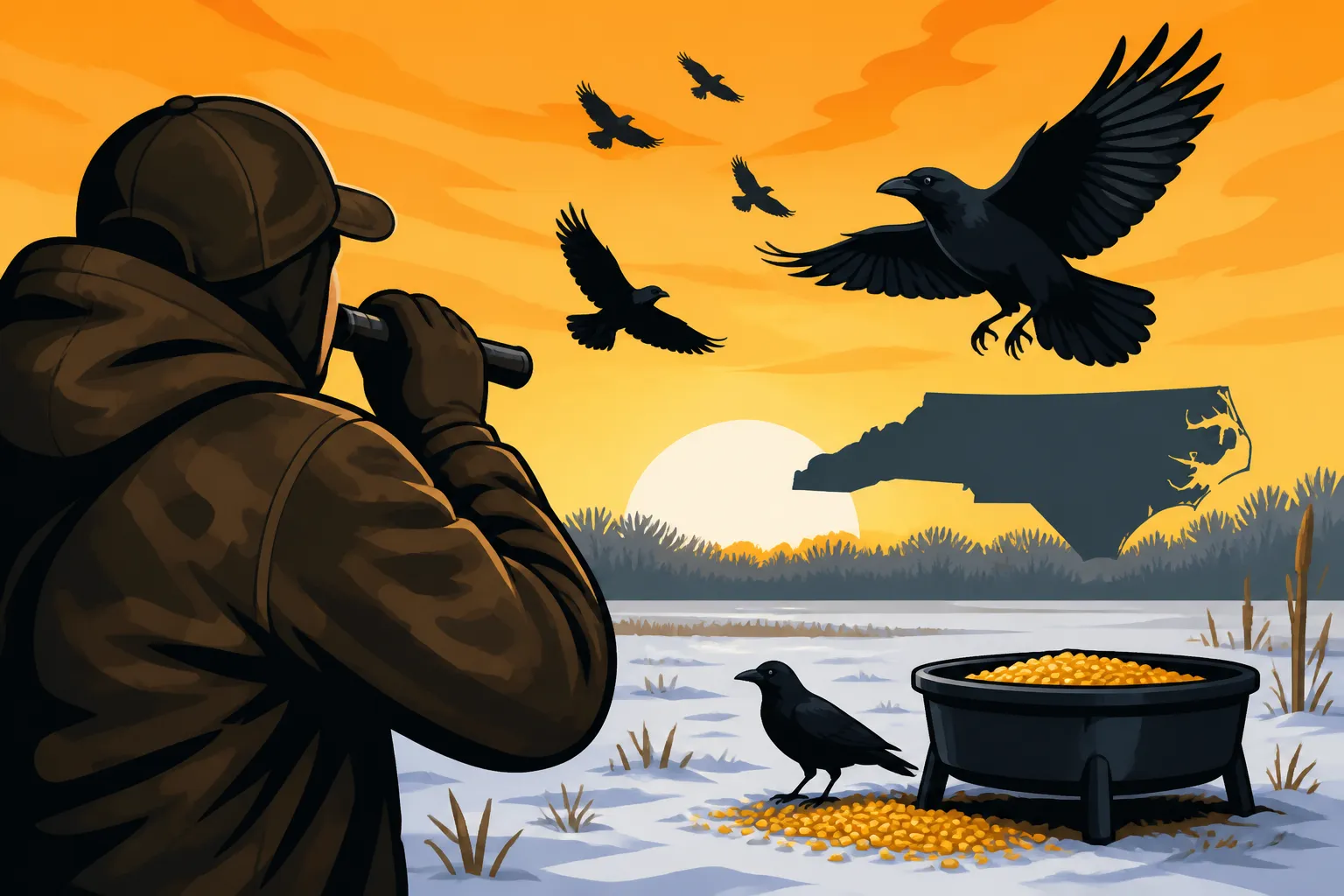
Calling Crows Over a Winter Feed Site
There’s a certain frustration that comes with hunting crows, especially once the leaves fall and winter sets in. They become incredibly wary, grouping up in massive numbers, and seem to possess an almost supernatural ability to spot you from a mile away. But don't let their cunning deter you. This comprehensive guide will walk you through the nuances of calling crows over a winter feed site in North Carolina, transforming your winter hunting challenges into thrilling successes.
Understanding Winter Crow Behavior and Feed Sites
The shift from autumn to winter brings a dramatic change in crow behavior, and understanding these changes is the first step toward a successful hunt. They don't just move around randomly; their patterns are driven by survival instinct, primarily centered on food and safety.
Why Winter Changes Crow Patterns
As the lush bounty of summer and fall vanishes, crows face increasing pressure to find reliable food sources. Gone are the days of easy pickings from diverse insect populations, garden scraps, and scattered berries. In North Carolina, this environmental shift forces crows to consolidate their efforts. They transition from smaller, more dispersed family groups to much larger, communal roosts, sometimes numbering in the thousands. This congregation is a defense mechanism; there's safety in numbers when predators like great-horned owls or bobcats are on the prowl, and more eyes means a better chance of spotting danger.
This communal living dictates their daily routine. Crows will fly miles from their nighttime roosts each morning, fanning out across the landscape in search of food. They’ll concentrate their feeding efforts in areas where resources are abundant and easily accessible, creating predictable flight paths and feeding patterns. Knowing these daily movements, especially how they navigate between their roosts and their breakfast table, is crucial. If you're wondering about other types of animals that contribute to population control, remember that a healthy population of predators in North Carolina helps keep various species in check.
Identifying Prime Winter Feed Sites
So, what exactly constitutes a prime winter feed site for crows in North Carolina? Think agriculture. While they'll still scavenge, their primary focus during the colder months shifts to areas with leftover grain, particularly corn and soybeans, in harvested fields. Peanut fields in the eastern Coastal Plain can also be massive attractants, as can large-scale poultry operations where spilled feed is a constant buffet. These sites offer a concentrated, calorie-rich food source that's hard to pass up when other options are scarce.
When scouting for these sites, you're looking for more than just a harvested field. You want evidence that crows are actively using it. Look for large concentrations of crow droppings, especially on power lines or prominent trees overlooking a field. Feather piles can indicate feeding or roosting activity, and well-worn trails in the snow or mud from their consistent landings and take-offs are dead giveaways. Using modern scouting tools, like the GoHunt app or other aerial mapping software, can be incredibly helpful. You can often spot the distinct patterns of harvested fields or identify potential roosting areas along dense creek bottoms or pine thickets that crows will use for cover. Imagine a vast cornfield near Goldsboro, recently harvested, with irrigation pivots still visible on an aerial map – that's a prime target. Or consider the peanut fields of Bertie County, where crows flock after the harvest. Even in the Piedmont, you might find significant crow activity in large tracts of standing corn that farmers have left through early winter.
Essential Calling Techniques for Winter Crows
Once you've located a promising winter feed site, the next step is to draw those wary birds into range. This is where your calling skills and decoy setups truly shine.
Mastering Your Crow Calls
Calling crows isn't just about making noise; it's about mimicking their language and understanding their reactions. There are generally two main types of calls: mouth calls and electronic calls. Mouth calls, like those made by Faulk's or Primos, offer versatility and direct control over volume and inflection, allowing for incredibly realistic vocalizations. Electronic calls, such as those from FoxPro, provide a wide array of pre-recorded crow sounds, offering consistency and the ability to project sound over long distances, which is invaluable on large agricultural fields.
The type of call you use depends on the situation. If crows are distant or you're trying to draw them in from their flyway, an assembly call – a series of rhythmic, confident "caw-caw-caw" notes – signals to other crows that there's a gathering, likely over food. As they get closer and show interest, you might switch to a distress call or fighting call. These are louder, more frantic, and often include rapid, agitated caws, sometimes mixed with squawks. This tells approaching crows there's trouble or a predator, triggering their inherent desire to mob or investigate. Baby crow distress calls can be particularly effective, often eliciting a strong, aggressive response from adult crows. Varying your cadence, volume, and the type of call is key. Don't just blast one call; listen to the crows' responses and adapt. Sometimes, less is more, especially with wary winter birds. If you're interested in calling other predators, mastering a diverse range of calls is important for activities like Coyote Calling in North Carolina Farm Country.
Decoy Setups for Winter Success
Crows, especially in winter, are highly suspicious. They won't just blindly fly into an area based on sound alone; they need visual confirmation that it's safe and that other crows are already there. This makes decoys absolutely crucial. Without them, even the most masterful calling might only bring them to an overhead flyby, just out of range.
You have several options for decoys. Full-body crow decoys are the most realistic, but silhouettes and even flying decoys that simulate a crow coming in for a landing can also be effective. The key is numbers. In winter, with larger crow flocks, you'll generally need more decoys than in other seasons. A dozen to two dozen can create the illusion of a bustling feed site. Placement is also critical: scatter them naturally, as if they are feeding, with some looking up as if on guard. Create a "kill hole" – an open shooting lane of about 20-30 yards where you expect the crows to commit. Don't place decoys directly in this lane, as you want the birds to land or hover there.
To add an extra layer of realism and elicit an aggressive response, consider adding an owl or hawk decoy among your crow spread. Crows despise raptors and will often dive-bomb them, presenting excellent shot opportunities. An old coyote or fox decoy placed on the ground a bit further out can also work wonders, signaling that a predator is present, which often incites crows to mob. Keep your decoy setup dynamic; adjust based on how crows are reacting. When you're dealing with other wary animals, like deer, a well-placed ground blind can make all the difference, similar to how you might use a blind while Using a Ground Blind on North Carolina Public Land.
Concealment and Strategy at the Feed Site
Once you've got your calling and decoy strategy in place, the final, and perhaps most critical, element is your concealment and overall hunting strategy at the chosen feed site. Crows are notoriously sharp-eyed, and the slightest glint or movement can send them soaring away.
Building an Effective Blind
Effective concealment is non-negotiable when hunting crows. Their eyesight is legendary, and in the stark landscape of winter, anything that looks out of place will be immediately flagged. Natural blinds are often the most effective. Look for dense hedgerows, thick tree lines, or substantial patches of brush along the edge of your chosen feed site. These offer natural breaks in your outline and blend seamlessly with the environment. If natural cover is sparse, a good quality portable pop-up blind becomes indispensable. Brands like Primos and Ameristep offer options that are relatively quick to set up and provide excellent concealment.
Regardless of whether you use a natural or manufactured blind, brushing in is paramount. This means using local vegetation – branches, corn stalks, dead weeds – to break up the hard lines of your blind and make it disappear into its surroundings. Think about what's around you and replicate it. If you're hunting a cut cornfield, weave corn stalks into your blind. If you're alongside a pine thicket, incorporate pine boughs. As an expert would advise for deer, learning how to effectively Brushing In a Blind on a Field Edge is a transferable skill across many types of hunting in North Carolina. Always consider the sun's position. Try to set up with the sun at your back or to your side, preventing glint off your gun or face and allowing you to see incoming crows without squinting. Most importantly, remain absolutely still. Crows pick up on movement far more easily than static shapes.
Shot Placement and Follow-Up Shots
When those crows finally commit and swoop into your kill hole, ethical and effective shot placement is key. For crow hunting, a 12-gauge shotgun is typically the most popular choice, though a 20-gauge can also be effective. Shot sizes ranging from 7.5 to 8 are generally ideal, offering a good pattern density to bring down fast-moving birds. For choke selection, a modified or full choke will give you the tight patterns needed for consistent kills at typical crow hunting distances, usually between 20 and 40 yards.
Aim for the head and neck area if possible, as this delivers a quick, humane kill. Body shots are effective, but a well-placed head or neck shot ensures the bird goes down quickly. Crow hunting can be fast and furious, especially when a large flock commits. It's crucial to be ready for follow-up shots on wounded birds to prevent them from flying off and suffering. If you're hunting with a partner, communicate your shots and work together. While one hunter might take the lead shot, the other should be ready to clean up any wounded birds or target new incoming crows. The chaos of a mobbing flock can offer multiple shot opportunities, so be prepared to reload quickly. Remember, effective shooting practice is just as vital for small game as it is for larger animals, like those practiced in Rifle Ranges Realistic in Piedmont Woods.
Here’s a quick reference for common crow calls and their uses:
| Call Type | Primary Use | Description | Best Time to Use |
|---|---|---|---|
| Assembly Call | Attracting distant crows, signaling a gathering | Series of clear, confident "caw-caw-caw" notes, varied rhythm | When crows are far off, to initiate interest |
| Distress Call | Simulating a crow in trouble, eliciting mobbing | Loud, frantic, irregular caws and squawks, often continuous | As crows get closer, to draw them into shooting range |
| Fighting Call | Mimicking a dispute, drawing aggressive response | Aggressive, sharp, rapid caws with varied tones, conveying agitation | When crows are wary, to challenge them or provoke attack |
| Baby Crow Distress | Strong emotional response from adults | High-pitched, desperate squawks and cries, mimicking a young bird in peril | When all else fails, to trigger strong parental instincts |
| Come-Here Call | Short, quick, inviting caws | A series of short, sharp "caw!" notes, often used by one crow to another | To get a crow to move a short distance, or confirm presence |
| Fly-Over Call | Alerting crows overhead | Long, drawn-out "caaaaaw" notes, usually just a few in succession | When crows are directly overhead but not committing |
Crow hunting in North Carolina during the winter months can be a challenging but incredibly rewarding experience. By understanding their seasonal patterns, perfecting your calling techniques, utilizing a convincing decoy spread, and maintaining absolute concealment, you'll be well on your way to intercepting these intelligent birds over their preferred winter feed sites. It’s a game of wits, and with these strategies, you’re setting yourself up for success. Plus, it's a great way to stay sharp during the off-season for other game. If you're interested in other forms of predator control or year-round hunting, you might find our guide on North Carolina's Year-Round Hog Rule on Private Land insightful, or learn more about general Predator Hunting in North Carolina.
Disclaimer
Hunting is an activity with inherent risks. Always prioritize safety, adhere to all North Carolina Wildlife Resources Commission regulations, and obtain proper licenses and permits before heading afield. Ensure you have permission to hunt on private land. This guide is for informational purposes only and does not substitute professional training or legal advice.