Rangefinders in Thick Coastal Plain Cover
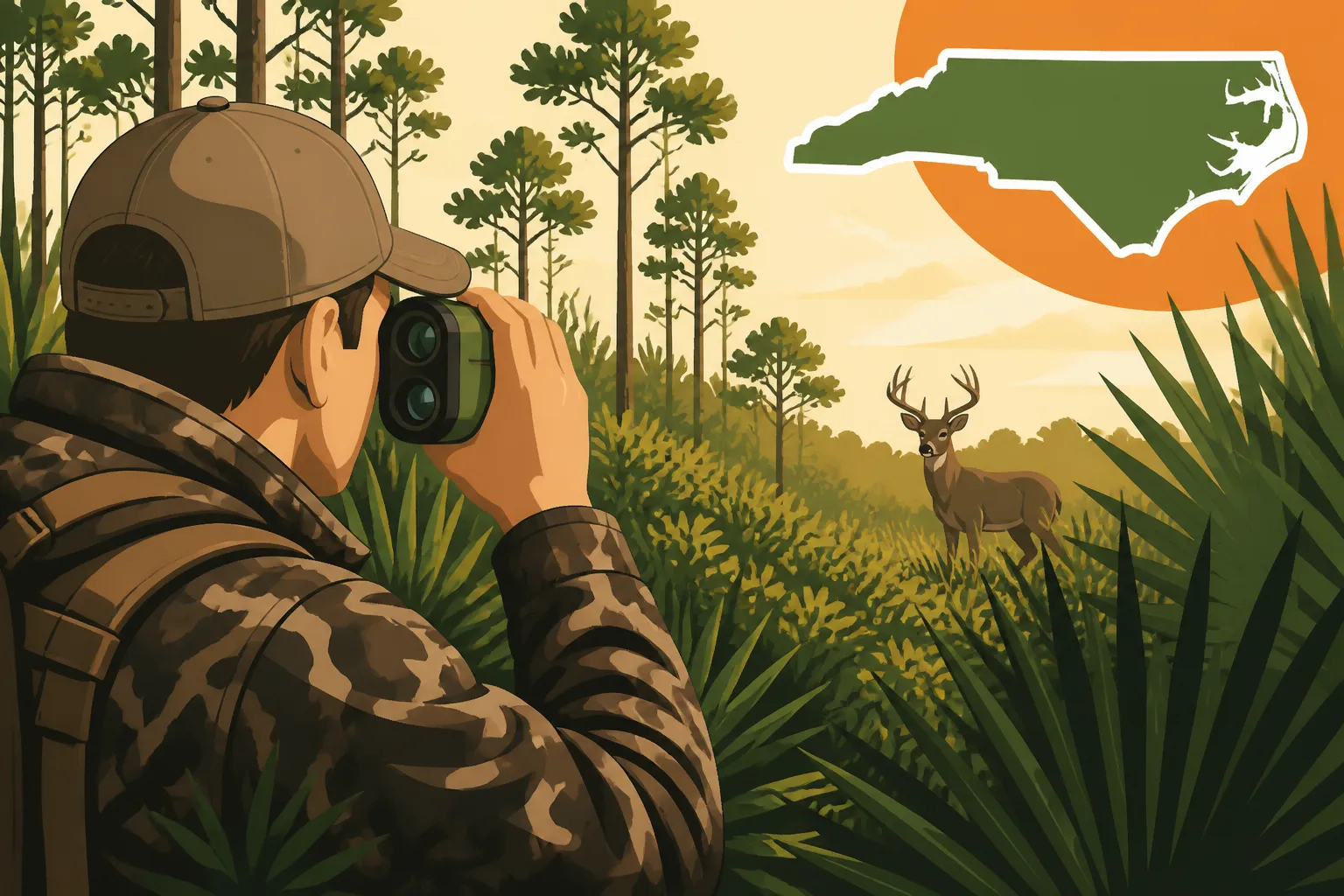
Navigating the thick, unforgiving cover of North Carolina's coastal plain for deer or bear can be a real headache. Those dense pocosins and pine thickets make judging distances feel like a wild guess, leading to missed opportunities or, worse, unethical shots. This guide will walk you through how a rangefinder becomes your absolute best friend in these challenging environments, helping you pinpoint exact distances and ensuring you're always ready when that game animal finally steps into your shooting lane.
The Unique Challenge of North Carolina's Coastal Plain Cover
Hunting the North Carolina Coastal Plain is an experience unlike any other. It’s a land defined by its expansive, low-lying terrain, often dominated by vast tracts of timber, thick pocosin swamps, and agricultural fields bordered by dense hedgerows and creek bottoms. While this landscape offers incredible habitat for game, it presents a unique set of challenges for hunters trying to accurately judge distances, which is absolutely critical for ethical shot placement.
Dense Vegetation and Limited Sightlines
The sheer density of the vegetation in the Coastal Plain is often the biggest hurdle. You're not typically looking at wide-open hardwoods with clear sightlines stretching for hundreds of yards. Instead, you're dealing with a jungle of young pines, saw palmetto, gallberry, and a myriad of other undergrowth that can reduce visibility to mere dozens of yards. What looks like a clear lane from your stand can quickly become a maze of branches and saplings just 20 or 30 yards out. This means that a deer or bear stepping out from a thicket might only be visible for a short window, and that window might be through a tiny gap. Estimating that distance by eye in such a compressed, obstructed environment is incredibly difficult, even for seasoned hunters. You might think a deer is at 40 yards, but in reality, it's 25, or even 50, and that miscalculation can lead to a less-than-ideal shot.
Compounding this, the terrain itself is often flat and featureless, offering few natural benchmarks to gauge distance against. There are no dramatic elevation changes, no towering rock formations, just miles of similar-looking trees and brush. This uniformity makes it hard for your brain to naturally calibrate distances, especially when your target is partially obscured. Hunters often find themselves in situations where they think they know the range to a particular patch of brush, only to find when the moment of truth arrives that their internal guesstimate was way off. This isn't a failing on their part; it's simply the nature of hunting in such a visually deceptive environment. This is where tools like Reading a Tidal Creek for Deer Movement can help you predict where deer might be, but a rangefinder confirms the exact distance.
Humidity, Fog, and Environmental Factors
Beyond the physical cover, the coastal plain throws in a few more environmental curveballs that can mess with your perception of distance. North Carolina’s coast is known for its high humidity, especially during the early archery and muzzleloader seasons. This moisture can hang heavy in the air, creating a hazy effect that literally blurs distant objects and makes them appear further away than they actually are. A seemingly clear morning can quickly turn foggy, reducing visibility significantly and rendering visual ranging almost impossible.
Think about those crisp, still mornings after a rain, when the air is thick and heavy. Distant tree lines can disappear into a soft blur. Now imagine trying to pick out a deer through that haze and estimate its range. It’s a recipe for uncertainty. Even without full-blown fog, the general atmospheric conditions can play tricks on your eyes, especially during low light conditions at dawn and dusk, which are prime hunting times. The flat light, coupled with the humidity, can make judging depth and distance feel incredibly unreliable. This environmental deception isn't something you can train your eyes to overcome easily; it requires a reliable tool to cut through the visual noise and give you an unassailable number.
Why a Rangefinder is Indispensable in Coastal Plain Hunting
Given the challenges of dense cover and deceptive atmospheric conditions, a rangefinder isn't just a nice-to-have gadget; it's a critical piece of gear for anyone hunting the North Carolina Coastal Plain. It transforms uncertainty into confidence, ensuring that every shot taken is as ethical and precise as possible.
Eliminating Guesswork for Ethical Shots
The primary benefit of a rangefinder is its ability to provide an exact, instantaneous distance measurement to your target. No more guessing, no more "he looks about 40 yards." With a rangefinder, you know for sure. This precision is absolutely vital for making ethical shots, especially on big game like deer and bear. When you're bowhunting, a difference of just 5 or 10 yards can mean the difference between a clean pass-through and a gut shot. Even with a rifle, understanding the precise range allows you to make the necessary holdover or dial adjustments, particularly at the outer limits of your comfort zone or when shooting through small openings.
Consider a scenario in a coastal swamp. You've spent hours wading through the cypress knees and thick undergrowth, carefully Hunting a Funnel Between Two Pocosins. Suddenly, a mature buck steps out, but he's partially obscured by a few saplings, just briefly in a lane. In the heat of the moment, your adrenaline is pumping. Without a rangefinder, you're relying on your eye, which is notoriously bad at judging distance in such chaotic environments. With a quick glance through your rangefinder, you get an immediate "32 yards." That exact number allows you to adjust your aiming point instantly, confidently, and make the shot you've practiced for. This accuracy doesn't just improve your success rate; it upholds your responsibility as a hunter to make a quick, clean kill.
Gaining Confidence in Your Setup and Shooting Lanes
Beyond the shot itself, a rangefinder significantly boosts your confidence in your entire hunting setup, particularly when it comes to preparing your stand location and clearing shooting lanes. Before a hunt, or even during a mid-day lull, you can systematically range various landmarks around your stand. Identify specific trees, stumps, openings, or even distinct clumps of palmetto and mark their distances. You might range a patch of thick cover at 28 yards, a fallen log at 45 yards, and the edge of a small clearing at 60 yards. This creates a mental map of your immediate hunting area, complete with precise yardage markers.
When that deer or bear finally appears, you don't have to scramble to range them in the last second. Instead, you can mentally (or even verbally, to yourself) cross-reference their position with your pre-ranged landmarks. "He's just past the big pine, maybe 35 yards." This kind of preparation reduces movement and noise, and most importantly, stress, allowing you to focus on the shot. This practice is especially valuable in dense areas like those found when Hunting Coastal Plain Pocosin Swamps, where every yard can be critical. Knowing your exact ranges helps you decide if a shot is truly clear and within your effective range, giving you the peace of mind to wait for the perfect moment or pass on a marginal shot without second-guessing yourself. This preparation is a foundational aspect of your hunting strategy, much like understanding North Carolina's Deer Season Structure Explained.
Key Features for a Coastal Plain Rangefinder
Not all rangefinders are created equal, especially when you're dealing with the specific demands of North Carolina’s coastal plain. Certain features become far more critical than others for consistent, accurate performance in dense, often obstructed, and humid conditions. Choosing the right tool for the job can make all the difference in the field.
Angle Compensation and Target Priority Modes
When you're hunting from a treestand, which is common even in the coastal plain for better visibility over dense undergrowth, angle compensation becomes a vital feature. Even slight elevation differences can significantly affect the true horizontal distance to your target, especially for bowhunters. A rangefinder with angle compensation (sometimes called "horizontal distance" or "true ballistic range") calculates and displays the compensated distance, which is the effective distance your arrow or bullet will travel, rather than the straight-line distance. This is crucial for precise aiming, preventing over- or under-shooting, particularly on steep angles that might occur when a deer is directly below your stand or far down a subtle slope.
Beyond angle compensation, look for rangefinders that offer different target priority modes. In thick cover, you’re constantly battling intervening brush, small branches, and dense foliage between you and your target. "First target priority" mode is your best friend here. This mode ranges the closest object in the beam's path, which is ideal when you want to make sure you're ranging the deer and not the branch in front of the deer. Conversely, some rangefinders also offer a "last target priority" mode, which is great for ranging targets behind obstructing elements like tall grass or light brush, ensuring you get the distance to the animal itself rather than the foreground clutter. For the coastal plain, however, prioritizing the closest target mode is often more beneficial due to the sheer amount of immediate, dense cover. This feature gives you a fighting chance to get an accurate reading through the toughest of screens.
Magnification, Lens Quality, and Ranging Speed
The magnification and lens quality of your rangefinder are more important than you might think in dense cover. While you're not usually ranging extreme distances, a little magnification (typically 6x or 7x) helps you pick out your target from the busy background. Good lens quality, often indicated by multi-coated optics, means brighter, clearer images, which is paramount in the low light conditions often encountered at dawn and dusk under the thick canopy of a coastal forest. A clear image reduces eye strain and helps you distinguish a deer’s antler tine from a small branch, allowing for more precise targeting of the rangefinder’s reticle.
Equally important is ranging speed. When that buck finally steps out into a small opening, you often have mere seconds to range, acquire your target, and make the shot. A rangefinder that takes several precious seconds to lock onto a target and display the distance can be the difference between a successful hunt and watching a tail wave goodbye. Look for models that boast fast, instantaneous readings. Some advanced models, like those you might find information on through hunting platforms like GoHunt, offer lightning-fast acquisition times, which are invaluable when every second counts. Furthermore, consider the maximum effective range. While you might only be taking shots under 100 yards, a rangefinder with a longer maximum range (say, 800-1000 yards) will often perform more consistently and accurately at shorter, obstructed distances because it has more power to penetrate light brush and foliage. It's like having a more powerful engine for a shorter trip—it performs the task with less effort and more reliability.
Durability and Weatherproofing
Let’s be honest, hunting in the coastal plain often means dealing with wet, humid, and sometimes outright muddy conditions. Your gear needs to be able to take a beating and keep on performing. Durability and weatherproofing are non-negotiable features for a rangefinder destined for these environments. Look for models with a rugged, rubber-armored housing. This not only protects against drops and bumps but also provides a non-slip grip, which is essential when your hands are cold, wet, or covered in mud.
Beyond physical toughness, ensure your rangefinder is fully waterproof and fog-proof. An IPX rating of 7 or 8 typically indicates true waterproofing, meaning it can be submerged for a short period without damage. Fog-proofing, usually achieved by nitrogen purging the optics, prevents internal lenses from fogging up due to sudden temperature changes or high humidity. Imagine trying to range a deer at first light, only to find your rangefinder’s optics are completely fogged over. That’s a frustrating situation that can ruin your morning. Investing in a truly weatherproof rangefinder means one less thing to worry about when the weather turns sour, allowing you to focus on the hunt.
| Feature | Coastal Plain Benefit | Ideal Specification |
|---|---|---|
| Angle Compensation | Accurate distances from elevated stands or uneven ground | Included |
| First Target Priority | Ranging through light brush to the animal, not obstructions | Included |
| Magnification | Helps identify targets in dense cover | 6x or 7x |
| Lens Quality | Brighter image in low light and thick canopy | Multi-coated |
| Ranging Speed | Quick acquisition for fleeting shot opportunities | Sub-second readings |
| Max Range Capability | Consistent performance even at shorter, obstructed distances | 800+ yards |
| Durability | Withstands drops, bumps, and rough handling | Rubber-armored |
| Weatherproofing | Prevents fogging and water damage in humid/wet conditions | Waterproof (IPX7/8), fog-proof |
Strategies for Using Your Rangefinder in Thick Cover
Having the right rangefinder is one thing; knowing how to effectively use it in the challenging environment of the North Carolina Coastal Plain is another. It’s not just about pointing and shooting a laser; it’s about strategic application to maximize your chances of success.
Pre-Ranging Your Shooting Lanes
This is arguably the most crucial strategy for hunting any dense environment. Before the hunt begins, or during a quiet moment in your stand, take the time to methodically range every potential shooting lane and key landmark around your position. Identify specific trees, stumps, openings in the brush, game trails, or even distinct clumps of palmetto that an animal might pass. Range them and commit those distances to memory. Some hunters even use small, discrete markers (like a piece of reflective tape tied to a branch, well out of sight) at known distances if private land rules allow, though most simply use natural features.
For instance, if you're sitting in a treestand overlooking a small clearing on the edge of a pocosin, you might range the big cypress tree on the far side at 47 yards, the patch of gallberry to your left at 30 yards, and the opening in the dense undergrowth where you expect a deer to enter at 22 yards. Write these down if you need to, or simply reinforce them in your mind. This pre-ranging process eliminates the need to fumble with your rangefinder when a deer or bear suddenly appears. Instead, you can quickly assess their position relative to your pre-determined markers and know their approximate distance instantly. This reduces movement, noise, and the critical time it takes to acquire and shoot, giving you a distinct advantage in those fleeting moments. It’s a habit that pays dividends, much like Scouting North Carolina Public Land Before Season is crucial for overall success.
Ranging Through Obstacles and to Specific Targets
One of the frustrating aspects of thick cover is the difficulty of getting a clean range. Often, there’s a small branch, a leaf, or some light brush between you and your target. This is where understanding your rangefinder’s capabilities and knowing how to manipulate it comes into play. If your rangefinder has a "first target priority" mode, engage it. This helps ensure that the device picks up the closest object in its beam, which could be the deer itself if there's only minor foreground clutter. If the cover is denser, you might need to try a few different angles or aim at a slightly different part of the animal to find a clear path for the laser.
Alternatively, if you're trying to range through very light, sparse cover that might give a false reading, some rangefinders with a "last target priority" mode can be useful. However, for the majority of coastal plain hunting where thick immediate cover is the norm, "first target priority" is usually your best bet. Another trick is to aim at a target just behind or just to the side of the animal if you can clearly identify a landmark there. Range that landmark, then estimate the slight difference. For example, if a deer is standing right next to a prominent tree you can range, you know the deer is essentially at the same distance. Practice this in the field before season opens. Don't be afraid to experiment with different aiming points to get a reliable reading.
Integrating Your Rangefinder with Mapping Tools
Modern hunting extends beyond just the moment of the shot, and your rangefinder can play a crucial role in broader strategy, especially when integrated with digital mapping tools. Platforms like GoHunt offer detailed satellite imagery, topo maps, and land ownership information. Before you even set foot in the woods, you can use these mapping tools to identify key terrain features, potential funnels, and natural pinch points in the coastal plain. For example, you might spot an old logging road that runs along the edge of a swamp, creating a natural travel corridor for deer.
Once in the field, use your rangefinder to verify distances to features identified on your map. You might range a bend in a creek you saw on your GoHunt map, or the far edge of a clear-cut. This ground-truthing helps you orient yourself and accurately mark specific waypoints on your digital map, creating a more precise understanding of your hunting area. If you're scouting for new stand locations or planning a Deer Drives With Three or Four Hunters strategy, using your rangefinder to measure distances between key points—like the entry and exit points of a drive, or the distance from a bedding area to a food source—can be invaluable for planning your approach and knowing your shooting capabilities within those specific zones. This synergy between physical ranging and digital mapping creates a much more informed and effective hunting plan.
Common Mistakes and Best Practices
Even with the best rangefinder, there are common pitfalls that hunters can fall into, especially when dealing with the unique environment of North Carolina’s Coastal Plain. Avoiding these mistakes and adopting some best practices can significantly enhance your effectiveness and confidence in the field.
Over-Relying on General Estimates
One of the biggest mistakes hunters make, even those carrying a rangefinder, is still falling back on general estimates. You've walked into your stand, done a quick sweep with the rangefinder, and maybe ranged a couple of major landmarks. But then, in the heat of the moment, a deer appears at an unexpected angle, or in a spot you didn't specifically range, and instead of taking that extra second to get a precise reading, you default to, "Looks about 30." This is exactly what a rangefinder is designed to prevent.
Remember, your eyes are easily deceived in dense, flat terrain with uniform cover. What looks like 30 yards might be 20, or 45. That difference can be critical for both bow and gun hunters, especially with varying bullet drop or arrow trajectories. The best practice is to make ranging a routine for every shot. Even if you've pre-ranged the area, if a target appears between your established markers, take that extra half-second to get a current reading. It builds a habit of precision and eliminates doubt. If time is too short for an accurate range, and you're unsure, it's always better to pass on the shot and wait for a clearer opportunity. This discipline is a hallmark of ethical hunting, much like understanding North Carolina Deer Bag Limit Rules.
Neglecting Regular Battery Checks
It sounds simple, but a dead battery can render your expensive, feature-packed rangefinder utterly useless. It’s an incredibly common and frustrating oversight. You hike miles into a remote section of Croatan National Forest Hunting, settle into your stand, and when that big coastal plain bear finally steps out, you press the button, and… nothing. Or worse, the display flickers weakly and gives an unreliable reading before dying.
Make it a habit to check your rangefinder's battery level before every single hunt, or at least before opening day of a major season like Bowhunting North Carolina's Statewide Archery Season. Many rangefinders have a battery indicator; pay attention to it. Keep a spare set of the correct batteries in your pack – whether it’s a CR2, a 9-volt, or a common AAA. Store them in a waterproof baggie to protect them from humidity and moisture. A small, inexpensive investment in spare batteries can save you a huge amount of heartache and potentially a missed opportunity when it matters most.
Practicing with Your Rangefinder in Real-World Scenarios
Just like you wouldn’t go hunting with a new bow or rifle without practicing, you shouldn’t expect to be an expert with your rangefinder without practicing its use. Don't just pull it out in your backyard; take it into the types of environments you actually hunt. Go to a local game land or even a woodlot near your home that mimics the dense cover of the coastal plain. Practice ranging objects at various distances, through light brush, and in different lighting conditions.
Set up a target and practice ranging it quickly, drawing your bow, or shouldering your rifle, and mentally noting the holdover. Practice ranging objects in low light, or on foggy mornings if possible. The goal is to make using your rangefinder a fluid, instinctive action. You want to be able to pull it out, get a reading, and put it away with minimal movement and thought, allowing your focus to remain primarily on the animal. The more you practice, the more confident and efficient you’ll become, turning your rangefinder into a truly integrated part of your hunting routine. This will help you feel more comfortable in situations like Hunting Coastal Plain Pocosin Swamps, where quick, confident decisions are essential.
Disclaimer
This article is for general informational purposes only and does not constitute professional advice. Laws, prices and regulations vary by location and change over time. Consult a qualified professional for guidance on your specific situation.