8×42 Versus 10×42 in the Woods
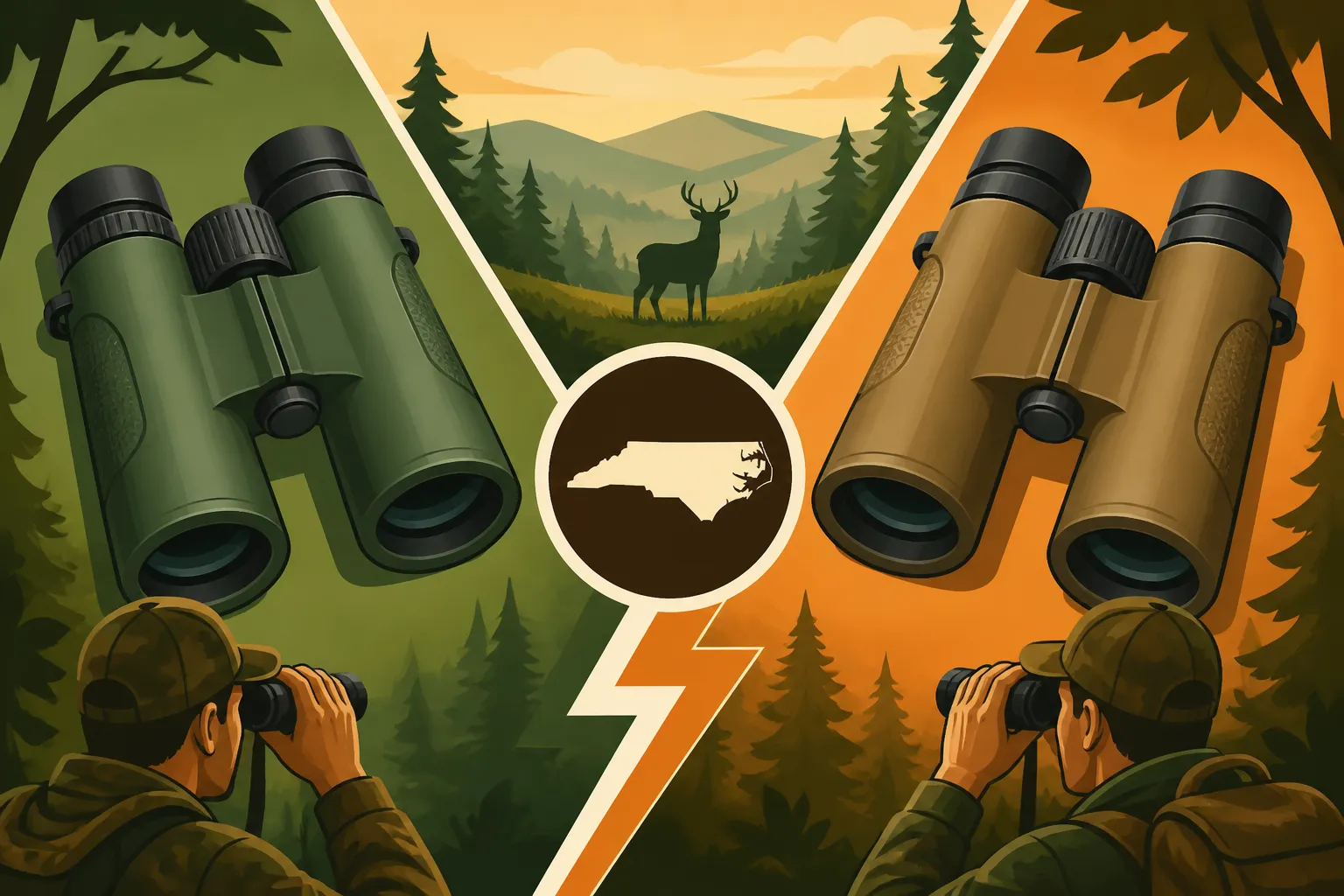
Choosing the right set of binoculars for your North Carolina hunting adventures can feel like a surprisingly complex decision. You’re often standing in an aisle, staring at two nearly identical options: an 8×42 and a 10×42. Many hunters just grab the 10x, thinking "more magnification must be better, right?" But for the varied and often dense terrain we hunt here in the Old North State, that extra "x" isn't always the advantage it seems. This guide will break down the real differences between 8×42 and 10×42 binoculars, helping you decide which optic truly suits your hunting style and the unique challenges of North Carolina's woods.
Understanding Binocular Magnification and Objective Lens Size
Before we dive into which magnification is best for your hunting, let's clarify what those numbers – 8×42 and 10×42 – actually mean. It's more than just simple math; it's about how light enters your eyes and how steady you can hold your glass.
What Do the Numbers Mean?
When you see "8×42" or "10×42" on a pair of binoculars, you're looking at two crucial pieces of information. The first number, "8x" or "10x," refers to the magnification. An 8x binocular makes an object appear eight times closer than it actually is. So, if a deer is 200 yards away, it will look like it's only 25 yards through an 8x binocular. Similarly, a 10x binocular will make that same 200-yard deer appear as if it's just 20 yards away. It seems like a small difference on paper, but in the field, it can dictate what you can actually discern.
The second number, "42" in both cases, refers to the diameter of the objective lens in millimeters. This is the large lens at the front of the binoculars, the one pointing away from your eyes. The objective lens's primary job is to gather light. A larger objective lens gathers more light, which translates to a brighter image, especially crucial during those low-light periods at dawn and dusk when game animals are most active. Since both options here have a 42mm objective lens, their light-gathering potential is the same, but how that light is delivered to your eye differs due to magnification.
The Trade-Offs of Magnification
While more magnification might seem like an obvious win, there are definite trade-offs to consider, particularly in North Carolina's diverse hunting landscapes. The biggest one is often the field of view (FOV). This is the width of the area you can see through your binoculars at a given distance. Generally, the higher the magnification, the narrower your field of view will be. Imagine trying to find a deer moving through thick pines; a wider field of view (like with an 8x) allows you to scan more ground quickly, increasing your chances of picking up movement or an obscure rack. With a 10x, you're zoomed in tighter, which means you see less "around" your target.
Another critical factor is stability. The more you magnify an image, the more noticeable any hand shake becomes. An 8x binocular is significantly easier to hold steady than a 10x, which means a clearer, less jumpy image in your hands. This is vital when you're trying to pick out a small detail, like the direction an ear is flicking or whether that dark spot is a branch or a bear's nose, especially after a long walk up a mountain ridge or when your adrenaline is pumping. The exit pupil—the little circle of light that comes out of the eyepiece and enters your eye—also plays a role. It's calculated by dividing the objective lens by the magnification (42mm / 8x = 5.25mm, 42mm / 10x = 4.2mm). A larger exit pupil (like the 8×42 offers) is more forgiving to align with your eye, making the image appear brighter, especially in low light when your own pupils are dilated, allowing more light to enter.
The Case for 8×42 Binoculars in North Carolina's Woods
For a significant portion of hunting scenarios in North Carolina, especially if you're spending most of your time in timber or dense undergrowth, an 8×42 binocular often proves to be the superior choice.
Navigating Dense Cover and Thick Timber
North Carolina is rich with varied habitats, but much of our hunting, from the eastern Hunting Coastal Plain Pocosin Swamps to the central Hunting Uwharrie Piedmont Hollows, involves navigating thick cover. Think about still-hunting through a stand of mature hardwoods in the Piedmont, or slipping through a pine plantation in the east. In these environments, shots are typically close, and the ability to quickly acquire a target is paramount. The wider field of view offered by an 8×42 binocular is an absolute game-changer here. Instead of looking through a narrow keyhole, you get a broader panorama, allowing you to sweep a wider area for flicking ears, a horizontal backline, or a tell-tale tail.
When a whitetail deer is threading its way through dense underbrush, or a wild turkey is strutting just out of easy sight behind a thicket, a wider field of view helps you keep track of the animal's movement and anticipate where it might emerge next. You can pick up a deer moving through the trees much faster with an 8x than trying to follow it with a higher-magnification 10x, which often feels like trying to look through a straw. This faster target acquisition and better situational awareness are invaluable in North Carolina's often close-quarters hunting.
Stability, Brightness, and Eye Strain
Another huge advantage of the 8×42 is its inherent stability. Even the steadiest hands will have a slight tremor, and that tremor is magnified along with your view. An 8x binocular provides a much more stable image, making it easier to hold steady for extended periods, reducing eye fatigue and allowing you to discern subtle details without the image jumping around. This is especially true when you're hunched over, leaning against a tree, or trying to glass from an awkward position in a treestand. Imagine trying to pick out a rub line from a slight tremor in your hands; it’s far less frustrating with an 8x.
The larger exit pupil of the 8×42 also contributes to a brighter image, particularly crucial during those first and last minutes of legal shooting light. As our eyes dilate in low light, they can take in more light. The 8×42 delivers a wider beam of light to your eye, making it easier to quickly get a full, bright picture. This superior low-light performance means you can often keep glassing a few minutes longer, or start a few minutes earlier, extending your effective scouting time. This can be critical when waiting for a buck to step out of a bedding area or trying to identify a Late-Season Food Sources for North Carolina Whitetails in the fading light. Over a full day of hunting, less eye strain from a brighter, more stable image means you're more comfortable and effective in the field.
When 10×42 Might Shine in North Carolina
While 8×42 often gets the nod for general North Carolina woods hunting, there are certainly specific scenarios where the increased magnification of a 10×42 binocular can be a distinct advantage. It's all about matching your gear to the specific conditions you anticipate.
Glassing Open Fields and Mountain Vistas
If your hunting primarily involves vast, open spaces, then the 10×42 begins to make a strong case for itself. Picture yourself sitting on the edge of a massive cut cornfield in the Coastal Plain, trying to spot deer hundreds of yards away, or Glassing a Powerline Cut at Last Light for hogs. The extra magnification helps resolve those distant details – is that a stump or a bedded deer? Is that branch a tine? The 10x provides that crucial additional reach. Similarly, when hunting the expansive vistas of our western mountains, like the Blue Ridge Escarpment, you might be scouting distant ridges or looking down into deep hollows from a vantage point. Here, an 8x might leave you wanting more power to truly identify what you’re seeing at a quarter-mile or more.
In scenarios like Hunting a Standing Cornfield in Farm Country or observing deer in a vast cut bean field, the ability to zoom in a bit further allows for better observation of subtle movements or the overall body size and antler development of a distant animal. This is particularly useful if you're trying to selectively harvest mature animals or differentiate between similar-sized deer. The increased magnification can help you count points more reliably or confirm characteristics that are otherwise ambiguous from afar.
The Compromise: Tripods and Steady Rests
One of the key considerations when opting for 10×42 binoculars is how you plan to stabilize them. While you can hand-hold a 10x, to truly get the most out of that extra magnification and to minimize image shake, a steady rest becomes almost essential. Many hunters who routinely use 10x binoculars for extended glassing will invest in a small, lightweight tripod adapter and tripod. This setup eliminates shake, allowing you to pick apart distant cover with impressive clarity. However, this also means added gear to carry into the woods, which might not be practical for every hunter, especially those covering a lot of ground or hunting in rugged mountain terrain.
Alternatively, you can utilize natural rests in the field. Leaning against a sturdy tree trunk, bracing your elbows on your knees, or using a shooting stick or bipod can all significantly improve stability for a 10x binocular. While these methods are effective, they still require conscious effort and might not always be available or convenient in every hunting situation. If you anticipate quick, on-the-go glassing without the luxury of a stable rest, the 10x might actually hinder more than help, as the shaky image will quickly cause fatigue and frustration. Many experienced hunters use resources like GoHunt to research the best lightweight tripod options that pair well with their 10x binoculars for efficient field use.
Making Your Choice: Factors Beyond Magnification
While the 8×42 versus 10×42 debate often focuses purely on magnification, there are several other critical factors that should weigh into your decision when choosing binoculars for North Carolina hunting. Ignoring these can lead to buyer's remorse, no matter the "x" factor.
Optical Quality and Construction
This is perhaps the most crucial, yet often overlooked, aspect. A top-tier 8×42 binocular with excellent glass and coatings will almost always outperform a budget 10×42. High-quality objective lenses, prisms, and lens coatings contribute to superior light transmission, sharper images, better color fidelity, and enhanced contrast. These elements combine to give you a clearer, brighter, and more detailed view, even with less magnification. Don't fall into the trap of thinking more magnification automatically means a better view; clarity and brightness are far more important than raw power, especially in the often dimly lit woods. When researching, platforms like GoHunt provide detailed reviews and specifications that highlight these crucial optical features across different brands, helping you understand what you're truly getting for your money.
Beyond the glass, consider the overall construction. Hunting binoculars need to be rugged. Look for models that are fully waterproof and fog proof, ideally purged with inert gas like nitrogen or argon to prevent internal fogging in our humid North Carolina climate or after an unexpected rain shower. The housing material, armor coating, and focusing mechanism all contribute to durability and ease of use in the field. A pair of binoculars that can withstand bumps, drops, and the elements is far more valuable than one with slightly more magnification but fragile construction.
Personal Preference and Intended Use
Ultimately, the "best" binocular for you comes down to a significant degree of personal preference and how you intend to use them most often. Do you spend 90% of your time still-hunting thick timber, making short-to-medium range observations? An 8×42 is likely your champion. Are you primarily hunting vast fields, open marsh, or distant mountain slopes, spending long periods glassing from a fixed position, perhaps from a comfortable ground blind you've meticulously brushed in on a field edge? Then the 10×42 might be more appropriate. Your physical comfort is also a factor. Do you find 10x binoculars too shaky to hold steady for more than a few seconds? Then save yourself the frustration and stick with an 8x.
It's also worth considering the weight and ergonomics. A lighter, more compact 8x binocular can be more comfortable to carry all day in a bino harness, especially if you're covering miles of ground, like when Scouting North Carolina Public Land Before Season or tracking a deer through dense forest. Try to get your hands on both options if possible. Feel the weight, how they fit your hands, and how easily you can operate the focus wheel. What feels right to you is a huge part of the equation.
Budget and Brand Considerations
Your budget will always play a role in this decision. As a general rule, higher quality optics cost more. However, that doesn't mean you can't find excellent performance at various price points. It's often better to buy a high-quality 8×42 than a mediocre 10×42. Investing in good glass from a reputable brand will pay dividends in clarity, durability, and overall hunting satisfaction for years to come. Brands like GoHunt often feature a wide array of optics, from entry-level to premium, with detailed specifications and user reviews that can help you compare performance within your budget.
When you're looking to purchase, consider the value proposition. Some brands offer exceptional performance for the money, while others command a premium for their top-tier offerings. Don't be afraid to research, read reviews, and perhaps even ask fellow hunters about their experiences. What works well for one person in a specific hunting scenario might not be the ideal choice for another. Being an informed consumer, particularly with an investment as important as your primary optic, ensures you get a tool that truly enhances your time afield.
Here’s a quick comparison of the general characteristics:
| Feature | 8×42 Binoculars | 10×42 Binoculars |
|---|---|---|
| Magnification | 8 times closer | 10 times closer |
| Field of View | Wider, easier to scan and find targets | Narrower, harder to scan, more zoomed in |
| Stability | Easier to hold steady, less hand shake | More susceptible to hand shake, often requires rest |
| Brightness | Brighter image, especially in low light (larger exit pupil) | Slightly dimmer in low light (smaller exit pupil) |
| Eye Relief | Often more forgiving | Can be more critical for proper eye placement |
| Weight | Generally lighter and more compact | Can be slightly heavier, though often similar |
| Best Use | Dense woods, quick target acquisition, general hunting | Open fields, long-range glassing, mountains |
| Eye Strain | Less eye strain over long periods of glassing | Can cause more eye strain due to magnified shake |
Ultimately, for the vast majority of deer, turkey, and bear hunting you'll do in North Carolina's diverse blend of timber, swamps, and rolling hills, the 8×42 is arguably the more versatile and user-friendly choice. Its wider field of view, increased stability, and better low-light performance often outweigh the marginal gain in magnification offered by a 10x, making you a more effective and less fatigued hunter in the varied conditions we encounter here.
Disclaimer
This article is for general informational purposes only and does not constitute professional advice. Laws, prices and regulations vary by location and change over time. Consult a qualified professional for guidance on your specific situation.