Hunting Longleaf Pine Savanna for Deer
Hunting deer in North Carolina's vast longleaf pine savannas can feel like you're searching for a needle in a haystack. The open understory and seemingly endless rows of pines can be intimidating, making it tough to pinpoint deer movement and set up effectively. But don't despair; this guide is here to walk you through the unique challenges and rewarding strategies for successfully hunting whitetails in these iconic North Carolina landscapes.
Understanding the Longleaf Pine Savanna and Its Deer
The longleaf pine ecosystem is one of North Carolina's most distinctive and historically significant natural habitats, especially prevalent in the Coastal Plain and Sandhills regions. Hunting these areas requires a different mindset than chasing deer in the thickets of the Piedmont or the steep terrain of the mountains. Many hunters get frustrated because the deer seem to vanish, or their usual tactics simply don't translate. It’s not you; it’s the landscape, and understanding it is your first step to success.
The Unique Ecology of Longleaf Pine
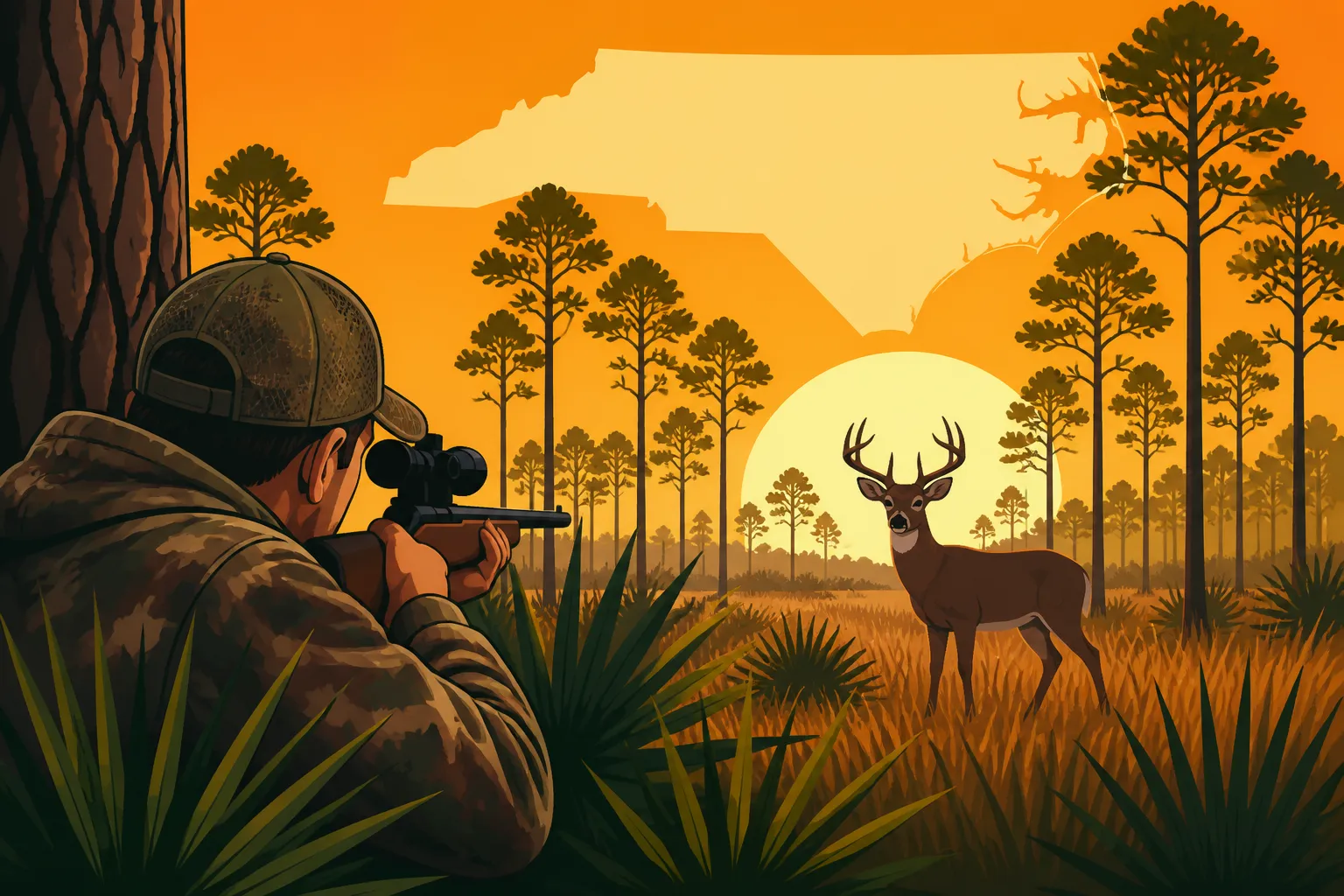
Imagine walking through a forest where the trees are tall and widely spaced, the ground beneath them often sandy, and the understory mostly open with grasses and scattered herbaceous plants. That's a classic longleaf pine savanna, often managed with prescribed fire to maintain this open, park-like appearance. These fires, which are essential to the health of the ecosystem, clear out dense brush and allow fire-adapted plants to thrive. This creates a very different environment for deer compared to the dense, brushy areas many hunters are accustomed to.
The food sources in a longleaf savanna might not be as obvious as a vast oak bottom full of acorns or a sprawling agricultural field. Deer here rely on a mix of tender forbs and grasses that sprout after fire, acorns from scattered oaks (often turkey oaks or other scrub oaks), and the tender new growth of woody browse plants. During certain times of the year, particularly after a recent burn, the new growth can be a major draw, acting as a natural food plot. However, without regular fire, these areas can become thick with palmetto or gallberry, creating dense cover patches that deer will certainly use. These areas can be incredibly difficult to penetrate, and deer use them to their advantage, disappearing into them like ghosts.
How Deer Utilize Longleaf Habitat
Deer in longleaf savannas are masters of using the available cover and food. While the overall landscape might seem open, they will gravitate towards areas that offer even the slightest bit of security or a concentrated food source. This means looking for transitions – where the longleaf meets a hardwood bottom, a planted field, a creek drainage, or even a denser patch of unburnt pine. These "edges" are high-traffic areas.
Their bedding areas are often subtle. Unlike a thick clear-cut, deer might bed down in relatively open areas if they feel secure, relying on their keen senses to detect danger. They'll choose slight rises in elevation, areas with dense gallberry or palmetto patches, or even just a tight cluster of young pines that offer a visual screen. When the wind is blowing, they might bed on the leeward side of a ridge or a cluster of trees, letting the wind carry scent to them while they watch downwind. Deer movement tends to be more purposeful here, often covering longer distances between bedding and feeding, or simply slipping through the open timber with incredible stealth. This makes understanding their travel corridors critical, even if they're not as well-defined as a trail through thick woods.
Strategic Scouting in Open Longleaf Areas
Scouting in longleaf pine savannas requires a sharp eye and a methodical approach. The sparse undergrowth means less visual obstruction, but the expansive nature can also spread deer sign thin, making it harder to interpret. This is where patience and attention to detail truly pay off. Don't fall into the trap of thinking "there's nothing here" just because you don't see thick trails everywhere.
Interpreting Ground Sign in Sandy Soils
One of the biggest challenges is reading sign in the often-sandy soil of longleaf regions. Tracks can be less defined, and rubs and scrapes might be less common or harder to spot than in areas with denser timber and richer soil. However, the sand can also work to your advantage. Fresh tracks stand out incredibly well in soft, damp sand after a rain, or in the drier, looser sand where deer have recently passed. Look for tracks that haven't been disturbed by wind or other small creatures.
When you do find sign, try to determine direction and frequency. Are there multiple sets of tracks moving in a similar direction, indicating a travel corridor? Are they heading towards an area of new growth or a water source? Scrapes in longleaf are often smaller and more subtly worked, sometimes just a pawed-out patch under an overhanging limb. Rubs might be on smaller pines or even on low-lying woody plants. Focus on finding clusters of sign, or areas where sign converges, as these indicate areas of consistent deer activity. Don't overlook old logging roads or fire breaks; deer frequently use these as easy travel routes through otherwise open country. For a deeper dive into pre-season work, check out Scouting North Carolina Public Land Before Season to hone your general scouting skills.
Leveraging Mapping Technology and Aerial Views
Given the vastness and often repetitive nature of longleaf savannas, mapping tools are your best friend. Services like GoHunt or other robust hunting apps allow you to pour over aerial imagery, marking potential hotspots long before you ever step foot in the woods. Look for changes in vegetation density, subtle elevation changes, scattered hardwood drains, or any anomalies in the otherwise uniform pine stands.
Identify potential travel corridors by looking for natural funnels – perhaps a narrow strip of pines between two larger, more open areas, or where a dense patch of palmetto forces deer into a constricted path. Pinpoint water sources, even small ephemeral puddles or damp depressions, especially during dry periods. These can be major attractants. Using the GoHunt app, you can drop pins on potential bedding areas, feeding zones, and travel routes, creating a digital roadmap for your hunt. Don't forget to look for historical burns. Newer burns, visible as darker patches on satellite imagery, often indicate areas that will produce fresh, palatable forage. Conversely, older, unburnt areas might offer denser cover that deer will use for security. Reviewing Reading Aerial Photos for Piedmont Deer can provide transferable skills, even if the terrain differs slightly.
Effective Hunting Approaches for Longleaf Whitetails
Hunting longleaf pine savannas demands a blend of stealth, patience, and adaptability. The traditional "sit on a food plot" approach might not yield results here. Instead, think about how deer move through and use this unique open country, and adapt your tactics accordingly.
The Art of Still-Hunting and Stalking
In longleaf country, still-hunting is an incredibly effective tactic, provided you can move quietly and patiently. The relatively open understory means you can often see further, but it also means deer can see you further. The key is to move at a snail's pace, pausing frequently to scan with your binoculars, looking for horizontal lines or patches of color that don't quite fit the vertical pines and brown grasses. Think about moving 10-20 yards in 10-15 minutes, not just walking.
Use the wind to your advantage, always trying to keep it in your face or quartering. The sandy soil can be quiet, but snapping a dry branch underfoot will carry. Wear quiet clothing, layer effectively, and choose boots appropriate for the sandy, often flat terrain, as discussed in Boots for North Carolina Swamps and Ridges. When still-hunting, focus on transition zones: where the longleaf meets a creek bottom, a clear-cut edge, or a patch of thicker, unburnt cover. These are the places deer are most likely to be moving or holding. The principles of Still-Hunting Nantahala Forest Ridges can be applied here, even if the habitat differs, by focusing on methodical movement and observation.
Setting Up Concealed Ambush Points
While still-hunting is powerful, there will be times when setting up an ambush point is the better strategy, especially if you've identified a consistent travel corridor or feeding area. Since many longleaf savannas lack tall, mature trees suitable for traditional treestands, ground blinds become a primary tool.
The open nature of the longleaf means you need to be exceptionally well-concealed. Don't just set a blind out in the open; brush it in meticulously with local vegetation – pine boughs, palmetto fronds, gallberry branches. Make it disappear into the landscape. Ideal locations include the edge of a small thicket, along a natural travel funnel, or overlooking a recently burned area with new growth. When using a ground blind on North Carolina public land, remember to position it for optimal wind advantage and shooting lanes. Consider the sun's position throughout the day to avoid being silhouetted. If you can find a suitable tree, a lightweight climbing stand or saddle can also be effective, offering a different vantage point over the relatively flat terrain.
Longleaf Pine Hunting Tactic Comparison
| Tactic | Best For | Pros | Cons | Gear Considerations |
|---|---|---|---|---|
| Still-Hunting | Covering ground, searching for deer, quiet days | Highly adaptable, allows for active searching, stealthy | Requires extreme patience and quiet movement, easily seen | Binoculars, quiet clothing, comfortable walking boots |
| Ground Blinds | Known travel corridors, feeding areas, security | Excellent concealment, scent containment, comfort | Less adaptable, requires pre-season setup, limited view | Camo blind, brushing material, comfy seat, rangefinder |
| Treestands | Specific bottlenecks, elevated view | Wide field of view, scent dispersal (some), stealthy | Limited suitable trees, challenging in open savannas | Lightweight stand, climbing sticks, safety harness |
| Deer Drives | Moving deer out of thick cover, group hunting | Can be very effective in dense pockets, covers ground | Requires multiple hunters, can push deer off public land | Blaze orange, communication, knowledge of escape routes |
Note: Deer drives are legal in North Carolina and can be effective in breaking deer out of dense pocosins or gallberry thickets within longleaf habitat, but require careful planning and coordination among hunters, as highlighted in Deer Drives With Three or Four Hunters.
Maximizing Your Success in Northleaf Pine Savannas
Beyond the specific tactics, there are broader considerations that can significantly impact your success when hunting longleaf pine savannas. These often come down to understanding hunter behavior and being prepared for the unique environment.
Navigating Hunting Pressure and Hunter Density
Public lands within North Carolina's longleaf regions, especially Game Lands in the Sandhills or Coastal Plain, can experience significant hunting pressure, particularly during opening weekends. This pressure can make deer even more wary and push them into the thickest, most overlooked corners of the savanna. For those hunting these areas, it’s vital to be aware of Hunting Pressure on North Carolina Public Land.
To counter this, consider hunting during weekdays or later in the season when crowds thin out. More importantly, be willing to walk further than most hunters. Use your mapping tools to identify remote pockets or areas that are difficult to access, perhaps requiring a longer hike or navigating a swampy drain. Deer will often gravitate to these sanctuaries. If you do encounter other hunters, always be courteous, maintain safe distances, and adjust your plans if necessary. Sometimes, other hunters inadvertently push deer towards you, so always be alert.
Essential Gear for the Longleaf Environment
Your gear choices can significantly impact your comfort and effectiveness in longleaf pine savannas. Since long walks are common, having a comfortable pack is crucial. A good day pack, similar to what you might use for Packs for a Pisgah Forest Day Hunt, is perfect for carrying essentials like water, snacks, extra layers, a first-aid kit, and game bags.
Footwear is another critical component. While the terrain is often flat, it can be sandy and occasionally damp or even wet near drains. Comfortable, supportive, and waterproof boots are ideal. Good quality binoculars are non-negotiable for still-hunting, allowing you to pick apart the open timber for subtle deer movement. A rangefinder is also extremely useful, as the open woods can make estimating distance tricky. Finally, don't forget the practicalities for handling your harvest; Coolers and Game Bags for Early Archery are crucial if you're hunting during warmer early-season periods often found in the longleaf regions. Even in cooler weather, having a plan for meat care is paramount, especially if you're deep in the woods. And of course, ensure you have your proper North Carolina hunting licenses and necessary big game privileges, as outlined in North Carolina Hunting Licenses and What They Cost.
Disclaimer
Hunting is an inherently dangerous activity. Always prioritize safety, understand and follow all North Carolina Wildlife Resources Commission regulations, and hunt ethically. Ensure you are familiar with your equipment, proficient with your chosen weapon, and respectful of wildlife and other outdoor enthusiasts. This guide provides general information and recommendations, but individual hunting situations can vary.