North Carolina Deer Record Book
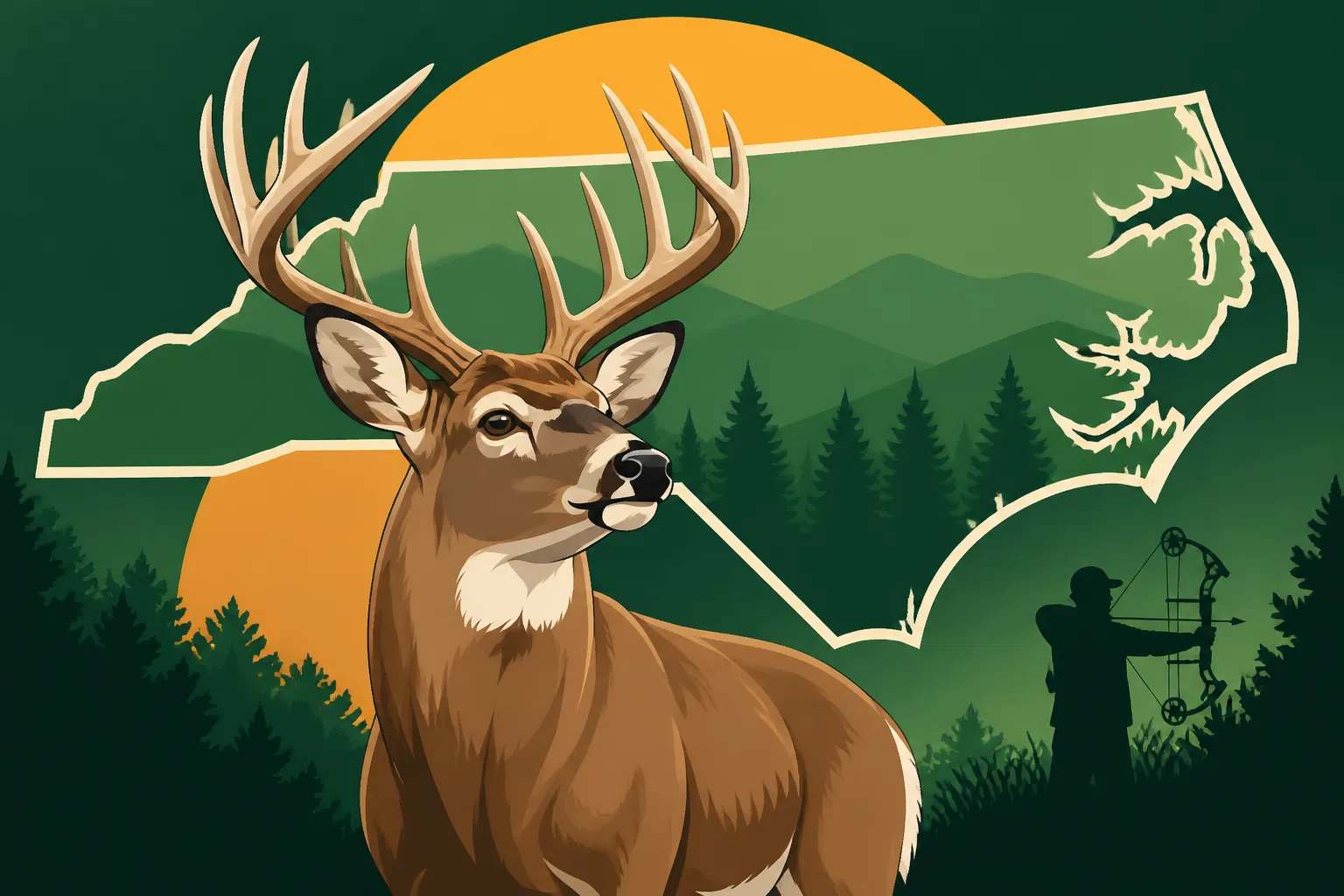
There's a special kind of thrill that comes from seeing a magnificent buck in the North Carolina woods, and an even greater one when that buck is on the ground. For many, the next thought isn't just about venison, but about how that deer stacks up—will it make the book? This guide aims to clear up the mystery and excitement around the North Carolina Deer Record Book, offering a straightforward look at what it is, how to measure your deer, and the steps to getting your trophy officially recognized.
Understanding the North Carolina Deer Record Book
For generations of North Carolina hunters, pursuing white-tailed deer has been a deep-rooted tradition, connecting us to the land and the wild. When you harvest a truly exceptional buck, whether it's the biggest you've ever seen or just a unique, gnarly rack, there's a natural curiosity: how does it compare to other deer taken across our beautiful state? The North Carolina Deer Record Book exists precisely to answer that question, providing a historical registry and a benchmark for the incredible deer that roam our varied landscapes.
What is the North Carolina Deer Record Book?
The North Carolina Deer Record Book isn't just a list of big antlers; it's a testament to the quality of our deer herd and the passion of our hunting community. Managed by the North Carolina Bowhunters Association (NCBA), it serves as the official state record-keeping system for whitetail deer harvested within North Carolina. It's dedicated to recognizing outstanding bucks taken by both archery and firearm hunters, providing a tangible way to honor these animals and the hunters who pursue them ethically. Unlike some record books that might focus on specific hunting methods, the North Carolina book embraces all legal means of harvest, reflecting the diverse hunting culture here. It's a place where a buck taken with a muzzleloader in the mountains can stand alongside one arrowed in a coastal plain pocosin, each respected for its unique journey to the record books.
Why Official Recognition Matters to Hunters
The allure of the record book goes beyond just bragging rights, although those are certainly a part of it! For many, it's about validating years of effort, early mornings, late evenings, countless scouting trips, and the patience required to harvest a mature deer. Having your buck officially measured and recognized provides a permanent place in the state's hunting history. It's a legacy you can share with your family, a story passed down, and a physical representation of a memorable hunt. Imagine showing your grandkids the official certificate years from now, recalling every detail of the hunt. This recognition also subtly validates the effectiveness of certain hunting strategies or the quality of a particular piece of land. It gives a sense of pride not just in the kill, but in the entire pursuit, from understanding North Carolina's deer season structure explained to meticulously planning your hunt. For those who invest heavily in their passion, an entry in the record book is a capstone achievement.
The Difference Between State and National Record Keeping
It's easy to get national and state record books confused, especially when terms like "Boone & Crockett" and "Pope & Young" are thrown around. Think of it this way: the North Carolina Deer Record Book is our local league, celebrating the best within our state's borders. It operates under slightly different minimum scores and administrative guidelines than the larger, more internationally recognized organizations.
- Boone & Crockett Club: This is the granddaddy of North American big game record keeping, focusing on fair chase ethics and wildlife conservation. Its records are typically for big game animals taken with firearms. Their minimum scores for entry are generally higher, making it a truly elite club.
- Pope & Young Club: Similar to Boone & Crockett in its conservation focus and ethical standards, Pope & Young specifically recognizes animals taken with archery equipment under fair chase principles. Their minimum scores are tailored to bowhunting harvests.
The North Carolina Deer Record Book often uses the same general scoring methodology (the Boone & Crockett system, which we'll discuss next) but adapts the minimum scores to reflect the typical size and age structure of North Carolina deer. This means a buck that might not quite make the national Boone & Crockett or Pope & Young book could still be a celebrated entry in our state record book. It’s important to understand these distinctions so you know which goal you're aiming for when you're dreaming of a trophy buck. You can find many impressive animals, some of which are North Carolina Boone and Crockett Whitetails, in our state, but a different level of achievement is recognized by the state book.
Scoring Your North Carolina Buck: The Basics
The moment you walk up to a fallen buck and see that rack, your mind instantly starts estimating. But how do you turn those antler points and beam lengths into an official score? It all comes down to a precise, standardized system that ensures every deer is measured fairly, whether it's from the mountains or the coast. This method, largely based on the Boone & Crockett system, accounts for every inch of antler, creating a numerical value that allows for comparison.
Antler Scoring Methods: Typical vs. Nontypical
The first, and perhaps most crucial, distinction in antler scoring is whether your buck is considered "typical" or "nontypical." This isn't just a subjective judgment; it's a structural classification that profoundly affects how the score is calculated.
- Typical Racks: These are the classic, symmetrical racks we often visualize: a main beam on each side, with tines (points) growing upward in a consistent, matching pattern. For a typical rack, symmetry is king. Any deviation from this symmetry, such as an extra point sticking off a main beam or a drop tine, is usually considered an "abnormal point" and is subtracted from the total score. The goal for a typical score is to achieve the highest possible symmetrical measurement.
- Nontypical Racks: This category is for the wild, unique, and often breathtaking racks with significant abnormal points. These might include numerous drop tines, sticker points, forks where they shouldn't be, or simply a lack of symmetry in the standard points. For nontypical racks, abnormal points are added to the score, after specific deductions for side-to-side differences in typical points. This method celebrates the unique character and mass of these distinctive racks.
It's common for a deer to have a few small abnormal points, making the decision between typical and nontypical tricky. A certified measurer will help you determine the best way to score your buck to maximize its entry, as a buck with a few small abnormal points might score higher as a typical deer with deductions, rather than a nontypical one with additions.
Key Measurements: Inside Spread, Main Beams, Tines, Circumferences
Scoring a deer is a meticulous process, requiring a special flexible steel tape and careful attention to detail. Here are the main components that contribute to a buck's score:
- Inside Spread of Main Beams: This is the widest point between the main beams, measured perpendicular to the skull. It's one of the few measurements that doesn't require tape to follow the curvature of the antler. While often a hunter's favorite "measurement" when bragging, it's actually just one component of the overall score.
- Length of Main Beams: Starting at the burr (the base of the antler where it meets the skull), the tape follows the outside curve of the main beam all the way to its tip. This measurement accounts for a significant portion of the total score.
- Length of All Tines (Points): Each point that is at least one inch long and longer than it is wide is measured from the nearest edge of the main beam to its tip. These are individually measured and then summed up for each side. This is where those extra long G2s and G3s really add up!
- Circumferences (Mass Measurements): These are perhaps the most overlooked but crucial components. Four circumference measurements are taken on each main beam, typically at the smallest point between the burr and the first point (G1), between the G1 and G2, between the G2 and G3, and between the G3 and the tip or last point. These measurements capture the "mass" of the antlers and can add considerable inches to the final score, especially on older, mature bucks.
All these individual measurements are added together, and then for typical racks, any deductions for asymmetry between corresponding points on each side, plus abnormal points, are subtracted to arrive at a net score. For nontypical racks, abnormal points are added after similar deductions for typical symmetry. It’s a complex system that ensures a fair and accurate representation of the antler’s size.
Provisional Scoring Versus Official Measurement
Before you even think about submitting your buck, it's helpful to understand the difference between a "green score" or provisional score, and an official measurement.
- Green Score (Provisional Score): This is the measurement taken soon after harvest, often by the hunter themselves, a hunting buddy, or a local taxidermist. It's a great way to get an immediate idea of your buck's potential. However, antlers are mostly bone and cartilage, and they contain moisture. As they dry, they can shrink slightly. Because of this, a green score is almost always higher than the final, official score will be. Think of it as an excited first estimate. Many hunters use tools like the GoHunt app or other scouting resources to find areas with a history of big deer, and then celebrate a good green score after a successful hunt.
- Official Measurement: This is the score that counts for the record book. It must be taken by a certified measurer after a mandatory 60-day drying period from the date of harvest. This drying period allows the antlers to stabilize, ensuring an accurate and consistent measurement that won't change over time. The measurer will meticulously go through each step of the scoring process, double-checking every measurement to ensure accuracy before calculating the final score. This official score is what determines if your buck makes the North Carolina Deer Record Book and, if it's large enough, potentially the national Pope & Young or Boone & Crockett records.
It’s crucial to respect that 60-day drying period. Patience is a virtue in hunting, and it's certainly one you'll need after the harvest if you're aiming for the record book.
| Measurement Category | Typical Racks | Nontypical Racks |
|---|---|---|
| Main Beams | Length measured along outer curve. | Length measured along outer curve. |
| Tines (Points) | All symmetrical points over 1" added. | All points over 1" (typical and abnormal) added. |
| Circumferences (Mass) | Four measurements per beam added. | Four measurements per beam added. |
| Inside Spread | Max width between main beams added. | Max width between main beams added. |
| Deductions | Symmetry differences between corresponding points AND abnormal points subtracted. | Symmetry differences between corresponding points subtracted. |
| Abnormal Points | Subtracted from gross score. | Added to gross score. |
| Goal | Highest possible symmetrical net score. | Highest possible overall mass and length net score. |
The Process of Getting Your Deer Entered
So, you've got a fantastic buck, it's dried for over 60 days, and you're pretty sure it has a shot at the record book. What next? The process is straightforward, but it does require a few specific steps to ensure your trophy is properly recognized and documented. It's not just about a score; it's about following the established protocols that maintain the integrity of the record book.
Finding a Certified Measurer
This is your first, and arguably most important, step after the drying period. Official scoring must be done by an individual certified by the North Carolina Bowhunters Association (NCBA) for the state book, or by a Boone & Crockett or Pope & Young measurer for national recognition. These individuals have undergone training to understand the intricate rules and nuances of the scoring system, ensuring accuracy and consistency.
You can usually find a list of certified measurers on the NCBA website, often broken down by region or county within North Carolina. Don't hesitate to reach out to them directly. When you contact a measurer, be prepared to discuss:
- The type of deer: Is it a typical or nontypical? Firearm or archery harvested?
- Its status: Has it dried for the full 60 days?
- Logistics: Where and when can you meet? Some measurers have specific offices or shops; others might be more flexible.
- Fees: There may be a small fee for the measurer's time and expertise, which is standard practice. Be sure to ask about this upfront.
Finding a good measurer is key to a smooth process. They often have a passion for big deer themselves and are happy to share their knowledge and congratulate you on your harvest. They can also provide invaluable advice if you're unsure if your buck is truly "book worthy" or if you need clarity on the scoring method.
The Waiting Period and Drying Time for Antlers
We mentioned it briefly, but it bears repeating: the 60-day drying period is non-negotiable for an official score. This period starts from the date of harvest. Why is it so critical? Antlers, while appearing solid, contain moisture when first shed or harvested. As this moisture evaporates, the antlers can shrink ever so slightly. A fractional reduction in length and circumference might seem insignificant, but when multiplied across numerous measurements, it can impact the final score. An official score is meant to be permanent, a true reflection of the antler's size once it has fully cured. Attempting to get an official score before this period is up will simply result in the measurer asking you to wait. During this time, ensure your antlers are stored in a cool, dry place, away from extreme heat or humidity, to prevent any damage or further shrinking. This waiting period also gives you time to reflect on your hunt and plan the next steps, perhaps reviewing tactics like Hunting the North Carolina Rut by Zone for next season, or scouting new areas.
Submitting Your Entry and Potential Fees
Once your deer has been officially measured by a certified scorer, they will typically help you with the submission paperwork. This usually involves:
- The official score sheet: Filled out by the measurer, detailing every measurement.
- Hunter information: Your name, contact details, hunting license number, and information about the hunt (date, county of harvest, method of take).
- Photographs: Often, good quality photos of the buck (especially on the hoof if available, and certainly the rack from multiple angles) are requested.
- Fees: There will likely be an entry fee to cover the administrative costs of maintaining the record book, compiling records, and issuing certificates. This is separate from any fee paid to the measurer.
The measurer will usually guide you through the process, but it's always good to be prepared. Once submitted, your entry will be reviewed, and if everything is in order, your buck will officially be added to the North Carolina Deer Record Book. You'll usually receive a certificate commemorating your achievement. This achievement is a testament to the health of our deer herd, which you can learn more about by looking at the North Carolina Deer Population Estimate.
Celebrating Your Achievement and What it Means for North Carolina Hunting
The moment you get that confirmation, that official certificate, it's a feeling of immense satisfaction. It's the culmination of everything we've talked about – the hunt, the ethics, the careful measurements, and the dedication to recognizing a truly magnificent animal. But entering the North Carolina Deer Record Book isn't just a personal win; it's a contribution to the broader hunting and conservation community in our state.
The Sense of Accomplishment
Few things in hunting can match the profound sense of accomplishment that comes with taking a record-book deer. It’s not just about the numbers on a score sheet, but the entire narrative that led to that moment. Think back to the countless hours spent scouting public lands, pouring over aerial maps, or maybe the specific tactics you used, like Rattling and Grunting in North Carolina, that finally drew that mature buck into range. This achievement validates your skills as a hunter, your patience, and your connection to the wild. It’s a memory etched in time, a story you'll tell for years to come, and a physical trophy that will serve as a constant reminder of an extraordinary day in the North Carolina woods. For many, it's a lifetime goal, and achieving it is a deeply personal and rewarding experience.
Contribution to North Carolina Deer Management Data
While the individual hunter celebrates their success, each entry into the North Carolina Deer Record Book also provides valuable data for wildlife biologists and game managers. These records, compiled over years, offer insights into:
- Deer age and genetics: Larger, older bucks with impressive racks indicate good nutrition, healthy genetics, and sufficient habitat.
- Regional potential: Patterns of record-book entries can highlight areas within the state that consistently produce mature deer, informing habitat management decisions and identifying regions where Why the Piedmont Grows Big Bucks is a clear reality.
- Overall herd health: A trend of increasing or decreasing average scores can be an indicator of herd health, hunting pressure, or environmental factors.
Every official score is more than just a number; it's a data point that helps paint a broader picture of the North Carolina deer herd. This information aids our wildlife agencies in making informed decisions about bag limits, season dates, and other regulations, all aimed at ensuring a sustainable and healthy deer population for future generations of hunters. It shows that responsible hunting, far from being just a recreational pursuit, plays a vital role in conservation and wildlife management.
Sharing Your Story and Inspiring Others
Once your buck is officially in the book, don't keep that story to yourself! Share it with fellow hunters, friends, and family. Your experience can inspire others, whether it's encouraging a new hunter to take their hunter education course or motivating a seasoned veteran to try new Scouting North Carolina Public Land Before Season tactics.
Consider reaching out to local hunting clubs, appearing at outdoor shows, or even submitting your story to hunting publications (like our blog right here!). Sharing the details of your hunt—the challenges, the decisions, and the ultimate success—can be a powerful way to promote ethical hunting practices, highlight the beauty of North Carolina's natural resources, and foster a sense of community among hunters. Whether it's the thrill of the chase, the respect for the animal, or the shared camaraderie, every record-book entry adds another rich chapter to North Carolina's proud hunting heritage.
Disclaimer
This article is for general informational purposes only and does not constitute professional advice. Laws, prices and regulations vary by location and change over time. Consult a qualified professional for guidance on your specific situation.