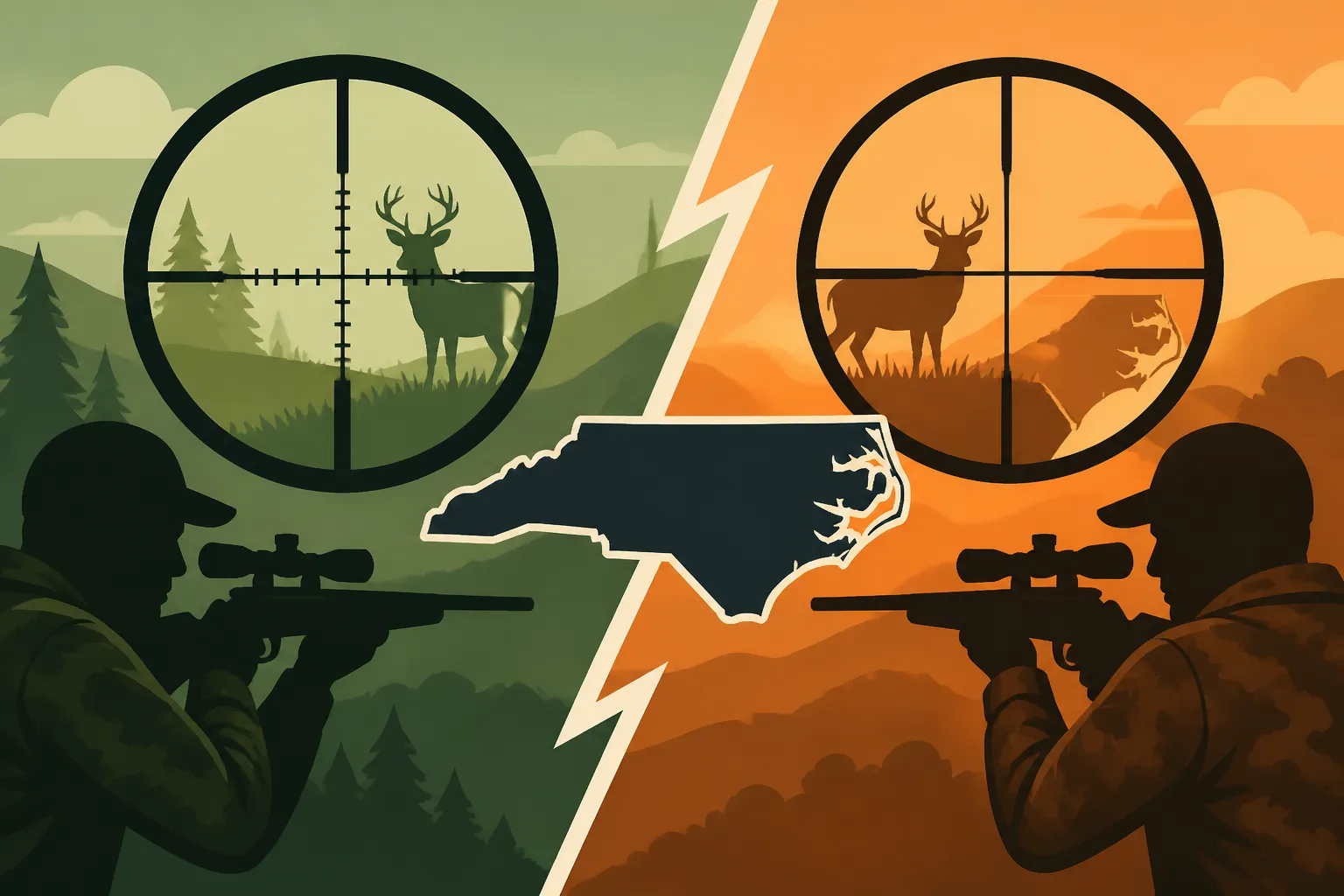
First Focal Plane Versus Second
Hunters are constantly seeking an edge, a clearer picture, or a more precise way to make that crucial shot. Yet, many of us find ourselves scratching our heads when it comes to the technical jargon of rifle scopes, particularly the distinction between first focal plane (FFP) and second focal plane (SFP) reticles. It’s not just a fancy term; it's a fundamental difference that dictates how your reticle behaves under magnification and, consequently, how you can confidently make holdover or windage adjustments in the field. This guide will meticulously unravel the mysteries of FFP and SFP, offering a practical breakdown for North Carolina hunters navigating everything from dense pocosin swamps to vast mountain ridges, helping you decide which reticle style truly suits your pursuit of game in the Old North State.
Understanding First Focal Plane FFP Reticles
When you hear "first focal plane," it essentially describes where the reticle, or crosshairs, is placed inside the scope. In an FFP scope, the reticle is positioned in front of the erector assembly – the mechanism that changes magnification. This placement has a very specific and impactful consequence on how your scope functions, especially in dynamic hunting situations.
How FFP Reticles Work in Practice
Imagine your reticle as a drawing on a piece of glass. In an FFP scope, this "drawing" physically grows and shrinks in apparent size as you adjust your magnification up or down. At low power, the reticle appears very fine, almost tiny, relative to the target image. Crank up the magnification, and that same reticle gets bolder, appearing much larger. What's happening is that the reticle is scaling proportionally with the target image. This proportional scaling means that any aiming points or hash marks on your reticle – often called subtensions – maintain their true subtension values at every single magnification setting. A 1 MOA hash mark will always represent 1 MOA, whether you're at 4x or 16x.
Let's put this into a real-world North Carolina hunting scenario. You're set up on a high knob in Pisgah National Forest, overlooking a distant clear-cut where deer often browse. You spot a nice buck at 300 yards. The light is dim, and the wind is swirling. With an FFP scope, you can range the deer, dial up your magnification for a better look, and confidently use the holdover marks on your reticle for bullet drop and windage, knowing that those marks are dead-on accurate for your cartridge at that precise distance, regardless of whether you're on 6x or 12x. You don't have to remember a specific magnification setting; the math stays constant. This consistent behavior is a huge advantage when you're making quick decisions, where every second counts and accuracy is paramount. Whether you’re considering 6.5 Creedmoor for Mountain Ridges or a classic .308, understanding your reticle’s behavior is key.
Advantages of FFP for Precision Shooters and Long-Range Hunting
The primary advantage of an FFP reticle is its unwavering consistency. For hunters who practice ethical long-range shooting, or those who find themselves in situations requiring precise holdovers for significant bullet drop and wind drift, FFP scopes simplify the equation immensely. You can range your target, consult your ballistic data, and apply the correct holdover or windage mark directly on your reticle without worrying about whether you're at the "correct" magnification power for the subtensions to be accurate. This is invaluable when hunting game like deer or bear where the shot might be across a wide-open field in the Piedmont or down a long logging road in the mountains.
This consistency also shines in dynamic hunting scenarios. Imagine you're hunting black bear in the coastal pocosins of Croatan National Forest. You might be still-hunting with your scope on a lower magnification for a wide field of view in thick cover, but then suddenly spot a bear at the edge of a small clearing 150 yards away. You zoom in to identify the animal and prepare for the shot. With an FFP reticle, those holdover points for elevation and windage remain true, allowing you to quickly acquire your target and make the shot without having to readjust your thinking or remember a specific magnification setting for your hold points. For those who map out their hunt with tools like GoHunt, understanding how your reticle works in conjunction with distance estimations is critical.
Potential Drawbacks and Learning Curve
While FFP scopes offer tremendous advantages, they aren't without their quirks. The most common complaint from hunters is the reticle's changing appearance. At low magnification, the reticle can become incredibly fine – sometimes almost disappearing against a dark background or in very low light conditions, especially if it's a busy, complex reticle. This can make quick target acquisition difficult in thick cover or at dawn and dusk. Conversely, at high magnification, the reticle can appear very thick, potentially obscuring small targets or fine details at longer ranges. This isn't usually an issue for larger game, but it's something to consider.
Another aspect is the learning curve. If you're accustomed to SFP scopes (which most traditional hunters are), the FFP's scaling reticle can take some getting used to. It might feel "different" or even slightly disorienting at first. You need to spend time on the range, experimenting with different magnifications and shot distances to truly understand how your specific reticle behaves. For hunters who typically make very short-range shots in dense cover and rarely use holdovers, the added complexity and often higher cost of an FFP scope might feel like overkill. It’s a trade-off between absolute precision at all magnifications and a consistent reticle appearance.
Deciphering Second Focal Plane SFP Reticles
The second focal plane (SFP) scope is, for many, the more traditional and familiar optic. Unlike FFP, the reticle in an SFP scope is placed behind the erector assembly, closer to your eye. This fundamental difference in placement leads to a distinct operational characteristic that has kept SFP scopes popular for decades, especially among a certain segment of hunters.
Understanding SFP Reticle Behavior
In an SFP scope, the reticle itself does not change in apparent size as you adjust the magnification. It always looks the same, maintaining its thickness and overall dimensions in your field of view. This can be very comforting and familiar to the eye. However, because the reticle stays constant while the target image magnifies and de-magnifies around it, the actual subtension values of any hash marks or aiming points on the reticle change with magnification. This means a 1 MOA hash mark might represent 1 MOA at 10x, but 2 MOA at 5x, and 0.5 MOA at 20x.
For the holdover and windage marks to be accurate, an SFP scope must be set to a specific magnification power, which is typically the highest power setting (e.g., 9x on a 3-9x scope, or 16x on a 4-16x scope). This specific magnification is where the reticle’s subtensions are calibrated to their stated values. If you use a different magnification, those holdover marks are no longer accurate for true ballistic compensation. For example, when Zeroing at 100 Yards for Woods Hunting with an SFP, you typically do so at maximum magnification if you plan to use any subtensions for holdovers beyond that.
Consider a classic Setting Up on a Piedmont Field Edge scenario. You're tucked into a ground blind overlooking a soybean field. You spot a deer in the distance, but you have your scope dialed down to 4x for a wider field of view. If that deer moves to 250 yards, and you intend to use your reticle's hash marks for a holdover, you must remember to crank your magnification up to the highest setting (e.g., 9x on a 3-9x scope) for those marks to be accurate. If you forget or don't have time, your holdover will be off. This requires a conscious action and understanding from the hunter.
The Enduring Appeal of SFP for Traditional Hunting
The consistent appearance of an SFP reticle is undoubtedly its biggest draw. For many hunters, especially those who predominantly hunt at shorter ranges (under 200-250 yards) or who prefer to dial their elevation adjustments rather than using holdovers, the SFP scope offers a simple, uncluttered, and predictable sight picture. The reticle never gets too fine to see in low light nor too thick to obscure a target, which can be a huge benefit when hunting in the dense cover often found across North Carolina. Whether you're chasing squirrels in Squirrel Hunting North Carolina Bottomland Hardwoods or waiting for a deer to step out into a small food plot, the SFP reticle just is.
Furthermore, SFP scopes are generally less complex to manufacture, which often translates to a more accessible price point. This makes them a fantastic value for many hunters who don't require the specialized features of an FFP design. If your typical deer hunt involves setting up on a Reading a Ridge for Mountain Zone Deer where shots are often within 150 yards, or watching a clear-cut edge in the eastern zones where you might simply hold high on the deer's back for a 200-yard shot, an SFP scope performs admirably without demanding extra mental calculations about reticle subtensions.
When SFP Might Not Be Your Best Friend
While SFP scopes are excellent for many applications, their reliance on a specific magnification for accurate holdover subtensions can become a liability in certain situations. If you're a hunter who frequently engages targets at varying distances beyond your zero, and you prefer to use holdovers for quick adjustments rather than dialing, an SFP scope introduces an additional layer of complexity. You must remember to be on the "correct" magnification power for your reticle's hash marks to be true. Failure to do so will result in an incorrect hold and a missed shot, or worse, a wounded animal. This can be especially frustrating when target range estimation, perhaps with the help of a tool like GoHunt, is precise, but your reticle isn't used correctly.
Imagine you're trying to make a shot on a deer across a wide river bottom, and you need to quickly compensate for both elevation and a tricky crosswind. If you're not on the exact magnification setting where your SFP reticle is calibrated, your windage and elevation hold marks will give you false information. This could be problematic in a high-pressure situation where time is of the essence. For hunters who venture into environments requiring more technical long-range shooting, or those who participate in precision shooting sports, the SFP's changing subtension values can be a significant drawback.
FFP vs. SFP: A North Carolina Hunter's Practical Comparison
The choice between FFP and SFP isn't just about optical theory; it's about practical application in the diverse hunting environments North Carolina offers. From the thick pine plantations of the Sandhills to the rugged peaks of the Blue Ridge, your reticle choice can impact your success and confidence.
Reticle Size, Visibility, and Speed of Engagement
One of the most noticeable differences in the field is how the reticle appears and its impact on target acquisition. With an FFP scope, the reticle scales. At low power, it can become almost hair-thin, which might make it difficult to pick up quickly against a busy background or in very low light conditions, such as during Cold-Weather Sitting Strategy in the Mountains at dawn. Conversely, at high power, it can become quite thick, potentially obscuring a small target at extreme ranges. This trade-off means you need to be mindful of your magnification setting relative to your environment.
SFP scopes, on the other hand, maintain a consistent reticle thickness. This means the reticle is generally always visible and easy to acquire, whether you're at 3x or 12x. For many North Carolina hunters, especially those whose shots are typically fast and within shorter ranges in dense cover – think Hunting a Funnel Between Two Pocosins or navigating thick brush for rabbits – the constant reticle size of an SFP can feel more natural and quicker for snap shots. It removes one variable from the equation, allowing for faster target engagement when a deer might only offer a small window of opportunity.
Subtension Accuracy for Holdovers and Windage
This is the absolute core functional difference and often the deciding factor for many hunters. With an FFP scope, the reticle's subtensions (those hash marks for bullet drop or wind drift) are always accurate at any magnification setting. If your reticle has a mark that represents 2 MOA of drop, it will be 2 MOA at 4x, 10x, or 16x. This simplifies long-range shooting immensely, as you only need to know the range and your ballistics; you don't need to consider your magnification setting. This is incredibly helpful when using a tool like GoHunt to estimate distances on complex terrain, as the range data can be directly applied to your reticle without additional mental gymnastics. Rangefinders in Thick Coastal Plain Cover become even more effective with an FFP scope.
For SFP scopes, those subtension marks are only accurate at a specific magnification, usually the highest power. If you plan to use those marks for holdovers, you must remember to be at that specific power. If you're set at 6x on a 3-12x SFP scope, and its holdovers are calibrated for 12x, your 2 MOA hash mark might actually be subtending 4 MOA in your field of view, leading to a significant miss. For hunters who typically make elevation adjustments by "dialing" the turret rather than using holdovers, this isn't an issue. However, for those who rely on quick holdovers, especially for windage, an SFP requires an extra step of verifying magnification or simply foregoing the use of those internal reticle references. When you're making a calculated shot on a deer in a large Hunting a Standing Cornfield in Farm Country, this accuracy difference could mean the difference between a clean kill and a frustrating miss.
Budget, Build Quality, and Learning Curve
Generally speaking, FFP scopes tend to be more expensive than their SFP counterparts within the same brand and quality tier. The manufacturing process for an FFP reticle, especially ensuring its precise scaling and robust performance, is more intricate. This higher cost can sometimes put FFP scopes out of reach for hunters on a tighter budget. SFP scopes, conversely, offer excellent value, providing reliable optical performance and features at a more accessible price point for the average hunter. For general Optics for Mountain and Piedmont Hunting, an SFP scope is a perfectly capable and often more economical choice.
The learning curve is also a factor. If you've been hunting for decades with SFP scopes, transitioning to FFP requires an adjustment period. You'll need to train your eye to the changing reticle size and learn to appreciate its consistency, rather than being distracted by its apparent growth or shrinkage. However, for newer hunters, or those coming from a precision shooting background, FFP can be intuitive from the start. Ultimately, both types of scopes, when chosen from reputable brands, offer excellent build quality. The choice often boils down to how much you're willing to invest and how willing you are to adapt your shooting habits.
| Feature | First Focal Plane (FFP) | Second Focal Plane (SFP) |
|---|---|---|
| Reticle Size | Changes with magnification (grows/shrinks) | Stays constant regardless of magnification |
| Subtension Values | Remain accurate at ALL magnifications | Accurate ONLY at a specific (usually highest) magnification |
| Visibility | Can be very fine at low power, thick at high power | Consistent visibility across all magnifications |
| Best For | Long-range shooting, precision holdovers, dynamic shooting, situations needing quick magnification changes | Mid-to-short range hunting, dialing adjustments, quick target acquisition, consistent reticle appearance |
| Complexity | Higher learning curve for traditional hunters, requires understanding scaling | Simpler, more intuitive for many hunters |
| Typical Cost | Generally higher | Generally lower |
| North Carolina Use | Open fields, mountain long shots, varied terrain | Dense woods, short-to-mid range, quick shots |
Making Your Choice for North Carolina Whitetails and Beyond
Deciding between an FFP and SFP reticle isn't about one being inherently "better" than the other. It's about matching the tool to the task, your personal hunting style, and the specific North Carolina environment you'll be in.
Match Your Scope to Your Hunting Style and Terrain
Consider the type of hunting you do most often in North Carolina. If you primarily hunt dense bottomland hardwoods or thick pine forests, where shots are typically under 100-150 yards and often quick, an SFP scope with its consistent reticle appearance might be more beneficial. The constant reticle size is easier to pick up fast, and if you’re not using holdovers, its main “disadvantage” isn't really a factor. For these types of hunts, like Still-Hunting Nantahala Forest Ridges or still-hunting through a thick Piedmont woodlot, quick target acquisition is often more important than precise subtension accuracy at extreme range.
However, if your hunting grounds involve more open spaces—large agricultural fields, powerline cuts, or vast mountain clear-cuts—where shots could stretch out to 300, 400 yards, or even further, an FFP scope truly shines. The ability to use accurate holdovers at any magnification is a massive advantage when you need to quickly compensate for bullet drop and wind without having to remember to crank your power ring. This is where a detailed scouting plan on GoHunt, combined with the precision of an FFP reticle, can truly optimize your chances on a distant deer in a Glassing a Powerline Cut at Last Light scenario.
Magnification Range and Intended Use
The magnification range of your scope should also play a role in your decision. For scopes with a low maximum magnification, say a 1-4x or 2-7x, the benefits of FFP are often less pronounced. The actual difference in subtension values between the lowest and highest magnification settings might not be significant enough to warrant the FFP's complexity or cost, especially if your effective hunting range with such a scope is limited.
Conversely, if you're looking at higher magnification scopes, such as 4-16x or 5-25x, which are designed for versatility across varying distances, an FFP reticle becomes much more valuable. The wider magnification range means a greater variance in subtension accuracy if it were SFP. With FFP, you gain the flexibility to use any magnification while maintaining reticle accuracy. So, if you're building a versatile rifle setup for various North Carolina terrains, considering a higher-magnification FFP scope could be a smart long-term investment.
Practice and Confidence are Key
No matter which reticle system you choose, the most critical factor is your familiarity and proficiency with your equipment. Spend ample time at the shooting range, practicing at various distances and magnification settings relevant to your hunting areas. If you choose an SFP scope, be disciplined about using it at its calibrated magnification when employing holdovers. If you go with an FFP, practice with the reticle at both low and high magnifications so you understand how its apparent size changes and how to still make accurate shots.
Get to know your rifle, your ammunition, and your scope intimately. Knowing your bullet’s trajectory and how it interacts with your reticle at different ranges is paramount for ethical hunting. Use ballistic calculators and practice holdovers and windage adjustments, whether you're dialing or using your reticle. Tools like GoHunt can help you visualize your hunting grounds and anticipate potential shot distances, allowing you to tailor your practice sessions. Ultimately, confidence in your gear comes from thorough preparation and understanding, ensuring that when the moment of truth arrives, you're ready. For any North Carolina hunter, mastering your optic, whether Practical Range in North Carolina Mountain Coves or wide-open fields, leads to more successful and ethical hunts.
Disclaimer
This article is for general informational purposes only and does not constitute professional advice. Laws, prices and regulations vary by location and change over time. Consult a qualified professional for guidance on your specific situation.