Is a .243 Enough for North Carolina Whitetails?
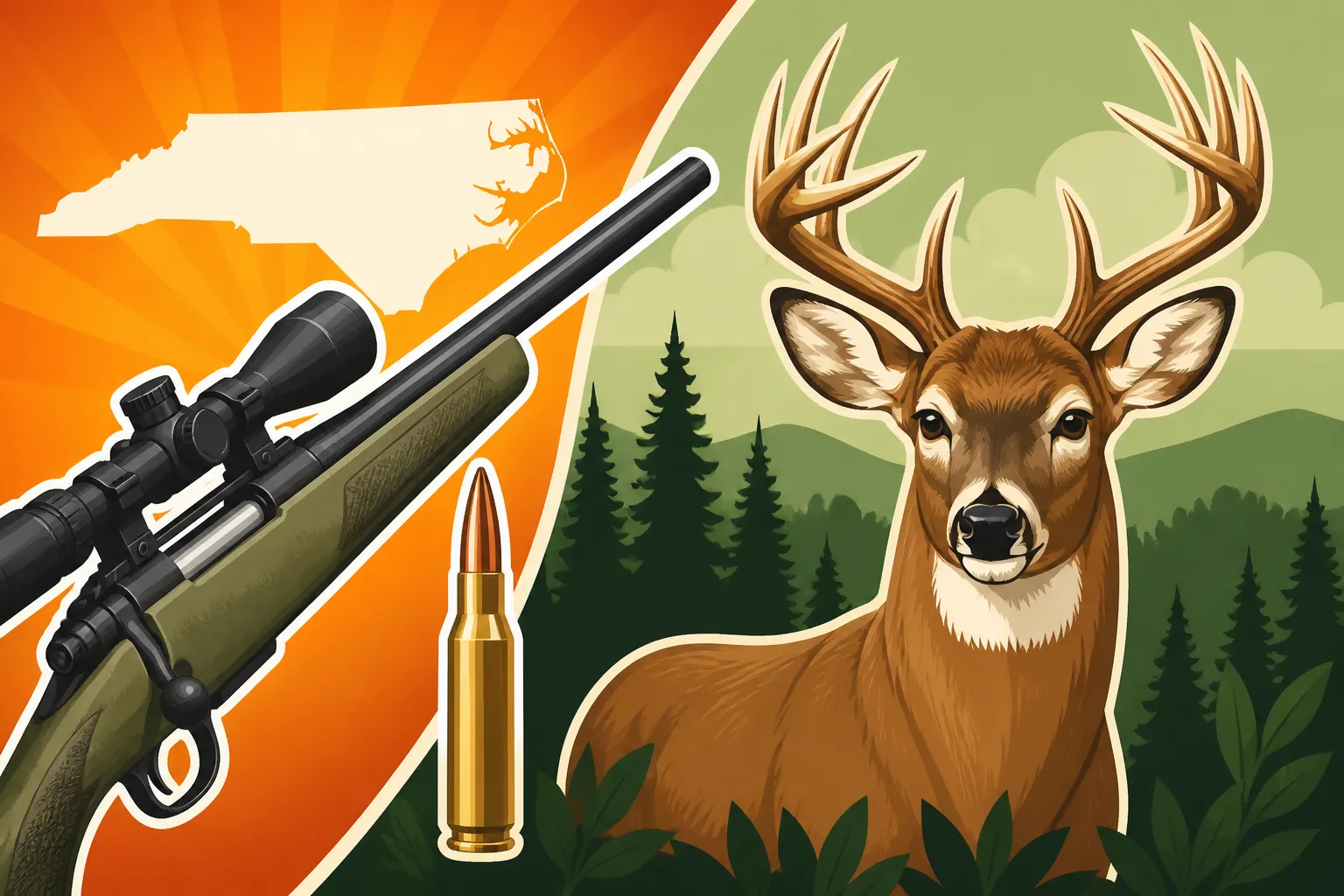
It’s a question that echoes through deer camps and hunting forums across North Carolina: "Is a .243 enough for North Carolina whitetails?" Hunters often grapple with choosing the right caliber, worried about insufficient knockdown power or excessive recoil, especially when facing the diverse terrain and varying deer sizes found across our state. This guide dives deep into the capabilities of the venerable .243 Winchester, exploring its effectiveness for deer hunting specifically within our diverse North Carolina landscapes, helping you make an informed decision for your next season.
Understanding the .243 Winchester Cartridge
The .243 Winchester has long been a popular choice for hunters, but its suitability for deer, particularly larger-bodied whitetails, is a frequent point of discussion. Let's break down what this cartridge brings to the table.
History and Ballistics
The .243 Winchester was first introduced by Winchester in 1955, derived from the .308 Winchester case. Its original intent was to be a versatile cartridge, suitable for both varmint hunting and smaller deer species. It quickly gained traction for its flat trajectory and mild recoil, making it a favorite for many shooters. When you look at its design, it's essentially a necked-down .308, meaning it pushes a smaller, lighter bullet at higher velocities.
Bullets for the .243 typically range from 55 grains for varmint hunting up to 105 grains for deer. For North Carolina whitetails, you'll almost exclusively want to focus on bullets in the 80 to 100-grain range. These heavier bullets are designed for better penetration and energy transfer on game. The cartridge is known for its high muzzle velocity, often exceeding 3,000 feet per second with lighter projectiles, which contributes to its incredibly flat shooting characteristics. This flat trajectory can be a real asset when taking shots across longer distances in open country or fields.
While the .243 isn't a powerhouse like some of its larger cousins, it delivers more than enough kinetic energy to humanely harvest a North Carolina whitetail when paired with the right bullet and, critically, proper shot placement. It might not create the massive wound channels of a .30-caliber magnum, but its speed helps with hydrostatic shock and its relatively small diameter means less resistance as it travels through tissue. Many seasoned hunters will tell you that it's more about where you hit than what you hit them with.
Ultimately, the .243 offers a blend of speed, accuracy, and relatively modest energy. It’s a cartridge that demands respect for its capabilities and limitations. It's often misunderstood as solely a "youth gun," but it's far more capable than many give it credit for, especially when modern bullet technology is factored in.
Recoil and Shooter Comfort
One of the most significant advantages of the .243 Winchester, and a primary reason for its enduring popularity, is its incredibly mild recoil. For many hunters, especially those new to the sport, young hunters, or anyone sensitive to the heavy kick of larger calibers, this is a huge benefit. A comfortable shooter is a more accurate shooter, plain and simple.
When you're not flinching or anticipating a heavy shoulder thump, you can concentrate on fundamental shooting skills: breath control, sight picture, and a smooth trigger squeeze. This translates directly to better accuracy in practice sessions and, most importantly, in the deer stand or field. Imagine being able to spend more time at the range, honing your skills, without ending the day with a sore shoulder or a developing flinch. That's what the .243 offers.
This comfort factor isn't just about avoiding pain; it's about building confidence. A young hunter who starts with a .243 and experiences success without being intimidated by recoil is far more likely to develop into a lifelong hunter. Similarly, experienced hunters who appreciate precision and a lighter rifle for long walks in the woods often gravitate back to the .243 for its user-friendly nature. It allows for quick follow-up shots if needed, as the rifle stays on target better than heavier recoiling options.
The choice of firearm should always align with the shooter's ability to handle it effectively. If a heavier caliber causes you to flinch, miss, or hesitate, then it's actually a less ethical choice, regardless of its raw power. The .243 excels in this regard, promoting better shooting habits and ensuring a more positive hunting experience overall.
North Carolina Whitetails: What You're Hunting
North Carolina's deer herd is robust and widespread, but the characteristics of the deer can vary significantly from the mountains to the coast. Understanding these differences is key to evaluating the .243's effectiveness.
Deer Size and Habitat
North Carolina whitetails, while healthy, generally aren't the same massive-bodied animals you might encounter in the agricultural heartland of the Midwest. A mature buck in the coastal plain might weigh 160-180 pounds, while a mountain buck in the Pisgah National Forest could be a bit smaller, often in the 130-150 pound range, though exceptions always exist. Does typically weigh less, often 80-120 pounds. When considering North Carolina Deer Population Estimate, these average sizes are generally consistent across the state, with local variations.
The diverse habitats across North Carolina also play a significant role in determining shot opportunities and distances. In the thick, swampy pocosins of the Coastal Plain or the dense cover found in river bottoms, shots are often up close and personal, rarely exceeding 50-75 yards. Conversely, hunting vast clear-cuts, powerline rights-of-way, or wide-open Piedmont farmlands can present longer shot opportunities, sometimes stretching beyond 200 yards. This habitat diversity means your rifle choice needs to be versatile or tailored to your specific hunting grounds.
For the vast majority of North Carolina hunting scenarios, where shots are typically inside 150 yards in relatively thick woods, the .243 is more than adequate, provided the hunter does their part. It's in those longer, open-field situations that some hunters start to question its reach, but with a well-zeroed rifle and appropriate bullet, it can still perform effectively. Knowing the specific terrain you'll be hunting and the likely shot distances is crucial when making your gear choices.
Population and Pressure
North Carolina boasts a healthy and thriving deer population. In many areas, especially the Piedmont and Coastal Plain, deer densities are quite high. You can often find strong numbers of deer in suburban fringe areas as well, where hunting pressure might be different. However, high deer populations often come with significant hunting pressure, particularly on public lands or easily accessible private tracts. This pressure can make deer more wary, nocturnal, and quicker to react to human presence, meaning shot windows can be brief.
The health and resilience of the deer herd can also vary. While typically robust, factors such as weather patterns or disease outbreaks, like EHD Die-Offs in North Carolina Deer, can impact individual deer's physical condition and their ability to withstand a less-than-perfect shot. A deer weakened by environmental stress might not travel as far after a hit, but conversely, a healthy, adrenalized animal can cover an astonishing amount of ground even with a lethal wound.
What does this mean for the .243? It reinforces the need for precision. When deer are jumpy due to pressure, you might only get a fleeting opportunity. The low recoil of the .243 can help you settle quickly and make that critical shot. However, it also means that if your shot placement isn't spot-on, a pressured deer is less likely to stand around, making tracking paramount. Hunters need to be prepared for the realities of deer behavior under pressure, which is something you often learn from years afield. Understanding the Deer Density by North Carolina Zone can also give you insight into where you might encounter more deer and thus, potentially more competition from other hunters.
Factors Beyond Caliber: Shot Placement and Bullet Choice
While caliber is important, it's truly only one piece of the puzzle when it comes to ethical hunting. Two other factors far outweigh it in importance for a humane harvest: where you hit the deer and what kind of bullet you're sending downrange.
The Importance of Shot Placement
You can shoot a deer with the most powerful rifle in the world, but if your shot placement isn't precise, you're likely to wound the animal and have a long, difficult, or even unsuccessful recovery. Conversely, a perfectly placed .243 bullet will be far more effective than a poorly placed shot from a .30-06. This truth cannot be overstated. We, as hunters, have an ethical obligation to ensure a swift and humane kill, and that begins with shot placement.
Understanding deer anatomy is paramount. The goal is always to hit the vital organs—the heart and lungs—which are located behind the shoulder in the chest cavity. This area offers a large target and, when struck, leads to rapid blood loss and incapacitation. Aiming for the shoulder bone itself is often a poor choice, as heavy bone can stop or deflect a bullet, especially from a smaller caliber, resulting in a superficial wound. A slightly forward and low shot, targeting the crease behind the shoulder, is generally the most effective.
This emphasis on accuracy means practice, practice, and more practice. Spend time at the shooting range, not just punching paper, but shooting from various positions you might encounter in the field—off-hand, kneeling, from a rest. Familiarize yourself with your rifle's point of impact at different ranges. Many hunting platforms, like GoHunt, offer detailed diagrams and educational content on deer anatomy and optimal shot placement, which can be invaluable tools for visual learners. Your commitment to marksmanship is the single greatest factor in a clean kill.
Ultimately, even with its modest recoil, the .243 demands the hunter’s full attention to making a perfect shot. It’s not a cartridge that forgives poor aim, but neither should any caliber. Our responsibility is to put in the work so that when the moment comes, we are ready to deliver a lethal and ethical shot.
Bullet Construction Matters
This is where the rubber meets the road for the .243. While the caliber itself is capable, the type of bullet you load into it makes a monumental difference in its performance on deer. You absolutely cannot treat all .243 bullets the same, especially when transitioning from varmint hunting to deer hunting.
For deer hunting, you need a bullet specifically designed for controlled expansion and adequate penetration. Forget about thin-jacketed, rapidly fragmenting varmint bullets; these are built to explode on impact, ideal for small pests but disastrous for deer, as they won't penetrate deeply enough to reach vital organs. Instead, look for premium hunting bullets with heavier jackets, bonded cores, or monolithic (all-copper) construction. Brands like Nosler Partition, Barnes TSX, Hornady Interlock, or Swift Scirocco are excellent examples in the 90-100 grain range that will retain their weight and penetrate reliably.
These specialized bullets are engineered to expand consistently, creating a larger wound channel while still driving deep into the animal. This combination of expansion and penetration is what truly delivers the terminal performance needed for a quick, humane harvest. Without it, even a perfectly placed shot from a .243 might not create enough damage to ensure a rapid kill. Think of it this way: the .243 generates enough energy, but the bullet needs to harness and transfer that energy efficiently into the target.
So, when you're choosing ammunition for your .243, don't skimp. Invest in high-quality hunting bullets. They might cost a little more, but the ethical peace of mind and increased effectiveness they provide are priceless. It's a critical component in making the .243 a fully capable North Carolina deer rifle, helping to ensure your hunt is both successful and responsible.
Range Limitations
While the .243 Winchester is known for its flat trajectory, every cartridge has its effective range limitations, and it's vital for hunters to understand these. For North Carolina deer hunting, where shots can vary from tight timber to open cutovers, knowing your rifle's capabilities and, more importantly, your own shooting skills at various distances is paramount. While the cartridge itself might be capable of hitting targets accurately at 300 yards or more, the ethical effective range on game is often much shorter.
Kinetic energy, which is the force a bullet delivers, decreases significantly with distance. Even with a flat-shooting .243, at longer ranges, the energy delivered to the target might drop below what's considered ideal for a quick, humane kill on a deer. While a 90-grain bullet might carry ample energy at 100 yards, that energy could be halved by the time it reaches 300 yards. This is why for ethical deer hunting, most seasoned hunters suggest limiting shots with a .243 to within 200-250 yards, especially on larger bucks, even though you might be able to hit a paper plate further out. Your skills will dictate a practical limit, as noted in considerations like Practical Range in North Carolina Mountain Coves.
Your rifle's zero also plays a role. While many hunters choose to zero their rifle at 100 yards (a good baseline for varied North Carolina hunting), understanding bullet drop beyond that point is essential for longer shots. Resources like GoHunt can help you generate ballistic tables specific to your bullet choice, allowing you to learn your holdovers for different distances. A simple Zeroing at 100 Yards for Woods Hunting approach is perfect for most close-to-medium range hunting, but if you expect longer shots, you need to practice them.
Ultimately, the ethical hunter knows their personal maximum effective range—the furthest distance at which they can consistently make a lethal shot under field conditions. This isn't just about the cartridge; it's about the shooter's confidence, the wind conditions, the angle of the shot, and the deer's behavior. Never attempt a shot at a distance you haven't thoroughly practiced and proven yourself capable of making. When it comes to North Carolina Minimum Rifle Caliber Rules, the .243 is perfectly legal, but legality doesn't override ethical responsibility.
Real-World Scenarios and Ethical Considerations
Putting theory into practice is what hunting is all about. Let's look at how the .243 performs in common North Carolina hunting scenarios and discuss the ethical framework that underpins its use.
Close Quarters vs. Open Fields
North Carolina offers such a diverse range of hunting environments, and the .243 shines in many of them. In the dense, often tangled woods of our national forests like Nantahala, or the thick creek bottoms of the Piedmont, shots are usually tight and fast. Here, the .243's quick handling, light weight, and mild recoil are distinct advantages. It allows hunters to maneuver easily through cover and get on target quickly without being burdened by a heavy, long-barreled magnum. The typically shorter distances mean the .243 delivers plenty of energy for a decisive harvest.
However, when you find yourself overlooking a sprawling cutover, a freshly planted green field, or a long powerline right-of-way, the dynamics change. These open areas can present opportunities for shots stretching to 200, 250, or even 300 yards. In these situations, the .243’s flat trajectory is beneficial, but you absolutely must know your rifle's ballistics and your own ability to shoot accurately at those distances. While it can certainly make those shots, any deviation in bullet performance or shooter error becomes amplified.
This is where advanced planning and scouting come in. Before the season, visualize your hunting spots. Will you primarily be hunting thick hardwoods, where a shot might be 60 yards? Or will you be sitting on the edge of a vast soybean field, hoping for a long shot? Your ammunition choice should align with these expectations. If long shots are a possibility, ensure you're using a premium, heavy-for-caliber bullet that retains energy well. Being prepared for both types of scenarios, perhaps by carrying a rangefinder and knowing your holdovers, is a smart move for any hunter, regardless of caliber.
Youth and Smaller Framed Hunters
The .243 Winchester holds a special place for introducing new hunters to the sport, particularly youth and smaller-framed individuals. Its low recoil is a game-changer, removing a significant barrier that often prevents aspiring hunters from fully embracing the experience. When a young hunter can shoot comfortably, they build confidence much faster, develop better shooting habits, and, crucially, enjoy their time in the field. This enjoyment is vital for fostering a lifelong love of hunting and conservation.
Many states, including North Carolina, have programs like the North Carolina Apprentice Hunter License Rules specifically designed to mentor new hunters. A .243 is an ideal rifle for these programs. It allows mentors to teach proper shooting fundamentals without the new hunter developing a flinch from heavy recoil. Imagine teaching a child to shoot a powerful magnum; the intimidation can be overwhelming. With a .243, they can focus on the target, the breath, and the trigger, not the impending punishment.
Even for adults who are new to hunting or have developed recoil sensitivity over the years, the .243 offers a refreshing alternative. There's no shame in choosing a caliber that you can shoot accurately and comfortably. In fact, it's the responsible choice. The effectiveness of any hunting rifle is directly tied to the shooter's ability to place the bullet where it needs to go. By making shooting less physically demanding, the .243 empowers more people to participate in deer hunting effectively and ethically.
For anyone concerned about recoil, or looking for a first deer rifle, the .243 should be at the top of the list. It proves that you don't need a cannon to humanely harvest a deer; you just need to be able to put the bullet in the right spot, and a .243 helps you do that consistently.
Responsible Hunting Practices
Ultimately, the question of "Is a .243 enough?" boils down to responsible hunting practices. It’s not just about the rifle, but the hunter operating it. An ethical hunter understands their equipment, practices their skills, and respects the game they pursue. This means making sound decisions before, during, and after the shot.
Before the hunt, ensure your rifle is sighted in correctly and you've practiced at various distances you might encounter. Familiarize yourself with the North Carolina Legal Firearms for Deer Hunting and any specific regulations for the area you're hunting. During the hunt, exercise patience. Wait for a broadside or quartering-away shot that presents a clear path to the vitals. Resist the urge to take a risky shot, especially if the deer is moving erratically or is at the very edge of your comfortable shooting range. Remember, a clean miss is always better than a wounded animal.
After the shot, the responsibility continues. Even with a seemingly perfect hit, always give the animal time before tracking, especially with a smaller caliber. This allows the animal to expire and reduces the chance of bumping it, making recovery more difficult. Learn effective tracking techniques, such as those for Tracking a Deer Through North Carolina Leaf Litter, and be prepared to follow a blood trail, even if it's sparse. Having good gear for Field Dressing a Deer in Cold Weather or warm weather is also essential.
| Caliber | Typical Bullet Weight (Deer) | Recoil (Relative) | Trajectory (Relative) | Typical Max Ethical Range on NC Deer | Primary Advantages (NC Deer) |
|---|---|---|---|---|---|
| .243 Winchester | 80-100 grains | Low | Very Flat | 200-250 yards | Low recoil, high accuracy, flat shooting |
| .30-30 Winchester | 150-170 grains | Moderate | Arched | 125-175 yards | Classic brush gun, good knockdown at close range |
| .308 Winchester | 150-180 grains | Moderate-High | Flat | 300-400+ yards | Versatile, powerful, excellent energy retention |
The .243 Winchester is absolutely "enough" for North Carolina whitetails, but it demands that the hunter holds up their end of the bargain. By understanding its capabilities, selecting the right ammunition, practicing diligently, and adhering to ethical hunting principles, you can confidently and humanely harvest deer with this excellent cartridge. It's a testament to the fact that responsible hunting is about skill and ethics, not just brute force.
Disclaimer
This article is for general informational purposes only and does not constitute professional advice. Laws, prices and regulations vary by location and change over time. Consult a qualified professional for guidance on your specific situation.