Haywood County Public Land for Deer
If you've ever dreamt of chasing whitetails through the majestic, rugged mountains of Western North Carolina, Haywood County probably pops onto your radar. But let's be real: hunting these steep slopes and vast timberlands is a completely different ballgame than sitting on a Piedmont field edge or navigating coastal pocosin swamps. It's a daunting task to pinpoint where the deer actually are, let alone how to get to them and hunt them effectively on public land. This guide is here to break down the specific challenges and equip you with the knowledge to make your Haywood County public land deer hunt a success, cutting through the confusion of vast forestlands and tricky terrain.
Understanding Haywood County's Public Hunting Landscape
Haywood County is a gem in the heart of the Appalachian Mountains, offering incredible beauty and a real challenge for deer hunters. Unlike the sprawling farmlands of the Piedmont or the dense, flat woods of the Coastal Plain, Haywood’s public hunting opportunities are almost exclusively defined by its national forests. This means you're dealing with vast tracts of contiguous land, but also incredibly steep and unforgiving terrain that can test even the most seasoned hunter.
National Forests Dominating the Terrain
When we talk about public land deer hunting in Haywood County, we're primarily talking about the Pisgah National Forest and, to a lesser extent, portions of the Nantahala National Forest. These massive forests span hundreds of thousands of acres, presenting an incredible amount of ground to cover. The deer here aren't concentrated around agricultural fields in the same way they might be elsewhere; instead, their movements are heavily dictated by mast crops, elevation, and dense cover. You'll find yourself navigating deep hollows, climbing steep ridges, and often encountering areas that look untouched by human presence. This can be both exhilarating and overwhelming.
It's crucial to understand that these national forests are truly wild. The deer herd, while healthy, often has lower densities compared to the fertile river bottoms or agricultural mosaics in other parts of the state. These animals have learned to thrive in a challenging environment, making them incredibly wary. You won't find manicured food plots or easy-to-access trails every few hundred yards. Instead, you'll be relying on your scouting skills, endurance, and ability to read the natural landscape. Think thick mountain laurel, dense rhododendron, and towering hardwoods. This is where you might truly feel like you're earning your venison, one grueling step at a time.
Limited Game Lands and Permit Hunt Opportunities
While the national forests are the primary public hunting grounds in Haywood County, you won't find many traditional "Game Lands" in the same vein as those in the flatter regions of North Carolina. Game Lands often imply more managed areas with specific access points and sometimes more controlled hunting pressure. In Haywood, the National Forest is your Game Land. This means you'll be dealing with National Forest regulations in addition to statewide North Carolina hunting rules.
Occasionally, specific areas within the national forests might have special regulations or permit-only hunts, often for specific species or to manage wildlife populations in unique ecosystems. These opportunities are usually limited and require application through the NC Wildlife Resources Commission's quota hunt system. Always check the current regulations for the specific area you plan to hunt within Pisgah or Nantahala, as boundaries and rules can sometimes be surprisingly localized. Don't assume that because it's a national forest, all rules are uniform across the entire range; designated wilderness areas, for example, often have stricter rules regarding mechanical transport or even trail cameras. Staying informed is your best defense against inadvertently breaking a rule.
Scouting Strategies for Haywood County Deer
Scouting is paramount when hunting the vastness of Haywood County's public land. You can't just show up on opening morning and expect to stumble into deer. The sheer size and ruggedness demand a strategic approach, often starting long before the season even begins, and often from the comfort of your home with good mapping tools.
Leveraging Topography and Remote Access
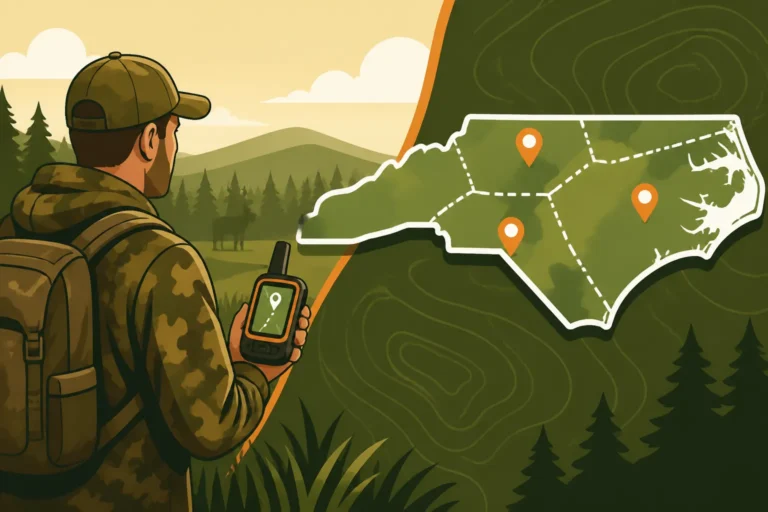
The mountains are all about elevation and contours. Deer, like all living creatures, are creatures of habit and efficiency. They'll use the easiest routes available to them to get from bedding to feeding to water. This is where detailed topographical maps become your best friend. Tools like onX Hunt or GoHunt are indispensable for digitally dissecting the terrain. Look for natural funnels like saddles between two ridge tops, benches—those flatter sections along a steep slope that deer love to use for travel or bedding—and drainages that offer protected routes through heavy cover. Reading a Ridge for Mountain Zone Deer can give you an edge.
Remote basins, deep in the hollows away from main roads and trails, often hold deer that are less pressured. These are the spots that require a serious hike, but the payoff can be significant. By identifying these areas on a map, you can plan your approach to avoid pushing deer out and minimize human scent. Pay attention to how different slopes face the sun; south-facing slopes often get more sunlight, leading to earlier green-up and more browse in spring, while north-facing slopes might offer cooler, denser bedding cover in warmer months. The deer will adapt their movements based on these microclimates and resource availability.
Identifying Food and Water Sources
In the Appalachian Mountains, acorns and other mast crops are king. When the hardwoods drop their bounty, deer will literally migrate to these areas, sometimes traveling significant distances. Scouting for active mast production – red oaks, white oaks, beech nuts, hickory – is critical. A poor mast year, however, will force deer to rely on other browse, soft mast (like wild grapes or persimmons), or even the edges of clear-cuts where new growth provides forage. Hunting After a Poor Acorn Year becomes a different game altogether.
Water sources are also non-negotiable for deer, and in steep country, they can be a real indicator of where deer are concentrating. Look for natural springs, seeps, and smaller feeder creeks, especially during dry periods when larger streams might be the only reliable source. Deer trails will often converge on these spots. Don't overlook the subtle seeps that might be just a damp spot on a slope; these can provide crucial hydration and often go unnoticed by other hunters. Observing the overall forest health and diversity can also tell you a lot about potential food sources. Are there signs of a good berry crop? Are mountain laurels prevalent (less desirable browse, but great cover)? Every detail paints a picture.
Reading Deer Sign in Mountain Terrain
Finding deer sign in Haywood County's vast national forests requires a keen eye and often a lot of walking. Rubs and scrapes, while present, might be more isolated than in farmland settings. Focus on transitional areas: where a dense thicket meets more open timber, along the edges of benches, or where two drainage systems converge. These are often natural travel corridors.
Bedding areas in the mountains tend to be on the side of ridges, offering deer a view down the slope for approaching predators and an easy escape route over the top. Look for small, relatively flat benches or thickets on sunny slopes in winter, or cooler, shadier spots in summer. Game trails in this rugged landscape will often follow the contours of the land, taking the path of least resistance. They might not be as worn as trails near agricultural fields, but they’ll be there. Learning to differentiate between fresh and old sign, and understanding how multiple trails might converge into a single, more defined path near a water source or bedding area, is vital for success.
Effective Hunting Tactics for Haywood County Deer
Once you've done your scouting homework, it's time to put boots on the ground with a plan. Haywood County's mountains demand patience, adaptability, and a deep respect for the elements.
Still-Hunting and Stand Placement in Mountain Coves
Still-hunting—moving slowly and deliberately through the woods, stopping frequently to observe—is an incredibly effective tactic in these vast, challenging landscapes. The sheer amount of ground means that waiting for a deer to come to you can be a long shot, unless you've found a truly hot sign area. Instead, you become the hunter, slowly covering ground, using the terrain to your advantage, and moving with the wind. This is where practice really pays off, learning to identify deer before they see you. Still-Hunting Nantahala Forest Ridges is a classic mountain tactic.
For those who prefer stand hunting, strategic placement is key. Focus on those saddles, benches, and convergences of trails you identified during scouting. A saddle, for instance, acts as a natural corridor for deer moving between two drainages or ridge systems. A bench on a steep slope might be a bedding area or a preferred travel route. In deep coves, deer often use the very bottom for travel, especially in thick cover. When hanging a stand, consider your entry and exit routes carefully, ensuring they are as quiet and scent-free as possible. Treestand Setups in Pisgah National Forest require careful planning for safety and effectiveness. And if you're thinking about a specific spot, Hanging a Stand on a Pisgah Ridge involves understanding the specific challenges of elevation.
Understanding Thermals and Wind Patterns
Mountain hunting adds another layer of complexity to scent management: thermals. Thermals are air currents that rise and fall with the sun. In the mornings, as the sun warms the earth, air begins to rise up the mountain slopes (updrafts). In the evenings, as the air cools, it sinks down into the hollows (downdrafts). This means your scent cone will shift throughout the day, often dramatically.
You absolutely must hunt with an understanding of these thermal shifts. In the morning, you might want to position yourself higher on a ridge, letting your scent rise above any deer moving below you. In the evening, as thermals fall, being lower in a drainage or on a bench might be more advantageous, with your scent sinking away from deer still up the slope. The wind direction is still important, of course, but it's crucial to factor in how the thermals are influencing your scent. A perfect wind direction can be undone by poor thermal strategy. Wind and Thermals on a Blue Ridge Slope can make or break your hunt, so pay close attention.
Dealing with Hunting Pressure and Finding Seclusion
Even in the vastness of Pisgah National Forest, you’ll encounter hunting pressure, especially on weekends and during the early parts of the season. Truck pull-offs along forest roads will likely have other vehicles, and you might bump into other hunters. The key is to either hunt when others aren't (weekdays, during less popular times) or to find ground that others simply aren't willing to access. Hunting Pressure on North Carolina Public Land is a reality.
This usually means walking further, embracing steeper terrain, or identifying less obvious features that deer might use. A small, brushy knob off a main ridge, a hidden bench above a particularly nasty rhododendron thicket, or a small drainage that looks too insignificant to hold deer – these are the places where you might find unpressured animals. The harder it is to get to, the less likely others have been there. Don't be afraid to put in the miles; your effort is often directly proportional to your success in these kinds of environments. Remember, deer adapt quickly to pressure, so finding their sanctuary zones is paramount.
Gear and Preparation for Haywood County Deer Hunts
The rugged topography and unpredictable weather of Haywood County demand specific gear choices and thorough preparation. This isn't the place to skimp on essentials.
Essential Mountain Hunting Gear
First and foremost, invest in high-quality, broken-in hiking boots. You'll be climbing, descending, and traversing uneven ground for miles. Ankle support and good traction are non-negotiable. Layering your clothing is also critical for comfort and safety. Mountain weather can change quickly: a cold morning can give way to a warm afternoon, and rain or even snow can move in without much warning. Wool or synthetic base layers, an insulating mid-layer, and a waterproof/windproof outer shell will serve you well. Clothing for a North Carolina Late Season is a good resource for understanding these principles.
A sturdy backpack is another essential. You'll need to carry water, snacks, navigation tools (a GPS unit or a reliable phone app like onX Hunt, with downloaded offline maps), a first-aid kit, a headlamp, and game processing supplies. Think about what you'd need if you had to spend an unexpected night out, or if you had a long pack-out of a deer. Packs for a Pisgah Forest Day Hunt need to be comfortable and capable of carrying significant weight. Finally, don't forget good optics. Binoculars are invaluable for picking apart distant slopes and identifying deer in thick cover.
Rifle and Archery Considerations
When it comes to firearms, consider the potential for longer shots across hollows or down ridges, but also the reality of dense timber. While a .30-06 or .308 Winchester are excellent all-around choices for North Carolina deer, the vast majority of shots in thick mountain timber will still be under 100 yards. Rifle Setups for North Carolina Deer Hunting can vary widely based on personal preference and the specific terrain. A reliable rifle zeroed for practical mountain ranges (e.g., 100-200 yards) is generally suitable. Heavy bullets with good energy retention are often preferred for punching through brush if needed (though avoiding brush is always ideal) and for ensuring clean kills on potentially large-bodied mountain bucks.
For bowhunters, the challenges are amplified. Steep angles can make shot geometry tricky, and dense cover often limits shooting lanes. Practice shooting from elevated positions and at steep downhill angles. A compound bow with sufficient draw weight and a well-tuned broadhead setup is paramount. Crossbows, allowed during the archery season, can offer an advantage in stability for those longer waits or for hunters with physical limitations. Bow and Crossbow Setups for North Carolina should be chosen with durability and reliability in mind, as gear failures deep in the mountains are not easily remedied.
Haywood County Public Land Deer Hunting: Pros and Cons
| Feature | Pros | Cons |
|---|---|---|
| Vast Acreage | Unlimited space to roam, escape pressure, find truly wild deer. | Overwhelming to scout, easy to get lost, long pack-outs. |
| Rugged Terrain | Deer use specific travel corridors, provides natural funnels. | Physically demanding, slow travel, difficult to recover game. |
| Natural Food Sources | Deer movements dictated by mast, predictable patterns when mast is good. | Unpredictable year-to-year mast, deer can be widely dispersed. |
| Low Deer Density | Older, smarter bucks due to less hunting pressure (in remote areas). | Fewer deer encounters, requires more patience and persistent scouting. |
| Hunting Pressure | Can be avoided by hiking deeper or hunting weekdays. | Popular access points can be crowded on weekends and opening days. |
| Wildlife Diversity | Opportunity to see other game, enjoy pristine wilderness. | Can encounter other wildlife (bears, coyotes) unexpectedly. |
Disclaimer
This article is for general informational purposes only and does not constitute professional advice. Laws, prices and regulations vary by location and change over time. Consult a qualified professional for guidance on your specific situation.