Hunting Coastal Maritime Forest Edges
Hunting the tangled, salt-laced edges of North Carolina's maritime forests can feel like stepping into an entirely different world compared to the open hardwoods of the Piedmont or the steep slopes of the mountains. The unique blend of saltmarsh, dense evergreen thickets, and constantly shifting tides presents a formidable challenge, making it incredibly tough to consistently locate and harvest deer. This guide will walk you through the specific characteristics of these coastal havens and arm you with the strategies, scouting techniques, and gear considerations you need to succeed when chasing whitetails along North Carolina's captivating yet challenging maritime forest edges.
Understanding the Coastal Maritime Forest Ecosystem for Deer Hunting
North Carolina's coast is a tapestry of diverse habitats, and the maritime forest stands out as a unique challenge and opportunity for deer hunters. These forests are shaped by their proximity to the ocean, exhibiting distinct characteristics that directly influence deer behavior and, by extension, your hunting strategy. It's not just woods near water; it's a dynamic, ever-changing environment.
The Influence of Salt, Sand, and Water
Unlike inland forests, maritime forests are constantly battered by salty air, shifting sands, and, in many areas, the regular ebb and flow of tidal waters. This creates a very specific kind of vegetation. You'll find tough, salt-tolerant trees like live oaks, wax myrtles, yaupon hollies, and loblolly pines forming incredibly dense understories and impenetrable thickets. Deer thrive in this kind of cover. They use these dense areas for bedding, escape, and travel, feeling secure in their ability to disappear at a moment's notice.
The sandy soil, often poorly drained, combines with the frequent rain and high humidity to create a consistently damp environment. This means different forage types, different scent conditions, and different travel patterns for deer. They'll often stick to slightly higher ground or the edges of these dense pockets, where movement is easier and food sources might be more accessible. Understanding this unique vegetation profile is crucial because it dictates where deer will feel safe, where they'll feed, and how they'll move through their territory. Hunters often find themselves working through knee-deep muck or navigating thorny brambles, so preparing for these conditions is essential.
How Tides Dictate Deer Movement
One of the most overlooked, yet profoundly impactful, factors in hunting coastal maritime forest edges is the tide. Tidal creeks, salt marshes, and even low-lying areas within the forest can become impassable or offer new travel corridors depending on whether the tide is high or low. Deer, being creatures of efficiency, adapt their movements to these cycles. They learn where they can cross at low tide and where they'll be forced to funnel around water at high tide.
Imagine a situation where a tidal creek normally acts as a barrier, forcing deer to use a narrow strip of high ground. At low tide, that creek might open up, revealing muddy flats that deer can cross, completely changing their established routes. Conversely, a high tide can flood low-lying thickets, pushing deer up onto higher, drier ground where they might be more exposed but also more concentrated. Learning to read a tidal creek for deer movement is a skill that takes time, but it's invaluable. Before you even step into the woods, consulting a tidal chart for your specific hunting location is as important as checking the wind. A good mapping tool, like the detailed layers available through a GoHunt subscription, can help you visualize these tidal areas and plan your approach accordingly, noting potential crossings or pinch points that change with the water level.
Scouting and Locating Deer on Maritime Edges
Scouting these coastal fringes is a completely different ballgame than looking for rubs in a mountain holler. The dense cover and unique environmental factors mean you have to adjust your approach and look for different kinds of sign. It's all about deciphering the subtle clues left behind in a habitat that's constantly trying to hide its secrets.
Finding Subtle Sign in Thick Cover
The sheer density of maritime forest vegetation means you won't often find wide, beaten-down deer trails like you might in more open country. Instead, deer tend to slip through the thickest parts, leaving behind very subtle indications of their presence. Look for "tunnels" through dense brush – these aren't always obvious trails but rather openings in the vegetation that suggest repeated passage. Pay close attention to broken twigs at deer height, faint hoof prints in soft, sandy soil near water sources, or small, fresh droppings.
You'll also need to focus on identifying key forage areas. Maritime forests offer a variety of food sources, including acorns from live oaks, berries from yaupon or wax myrtles, and various herbaceous plants that thrive in the damp conditions. Finding an area with fresh browsing on these plants can tell you exactly where deer are spending their time. Don't be afraid to get down on your hands and knees to peer into the thick stuff; often, the best sign is hidden just out of casual sight. It’s also important to consider the overall North Carolina deer herd size and density when scouting, as this can give you a better idea of how much sign you should expect to see in a given area.
Using Technology for Coastal Scouting
Modern technology is a game-changer for scouting these complex coastal habitats. Aerial photos and satellite imagery are your best friends here. They can reveal hidden sloughs, fingers of high ground, dense cover patches, and subtle transitions between forest and marsh that are almost impossible to discern from the ground. Look for darker green areas indicating dense evergreen cover, lighter areas for marsh grass, and intricate networks of creeks and guts.
When you're trying to dissect these areas, tools like a subscription to GoHunt's mapping system can be invaluable. Its detailed satellite imagery and property line overlays can help you identify potential access points, pinpoint bedding cover, and locate travel corridors that might be invisible from the ground. Beyond imagery, consider how wind and thermals on a Blue Ridge slope might influence deer behavior differently than a flat, coastal environment. On the coast, wind direction is paramount due to scent drift across open water or marsh, and the dense cover can create swirling currents that make predicting scent easier said than done. Using your GPS or phone mapping app to mark every piece of sign you find – a fresh rub, a bedding area, an active trail – helps build a comprehensive picture of deer activity over time. This data is critical for understanding the patterns of Coastal Plain versus Mountain Deer, as their adaptations to their respective environments are quite different.
Scouting for Stand Locations
Once you've identified areas of deer activity, the next step is finding a suitable stand location. This is often the trickiest part in maritime forests due to the dense canopy and lack of mature, straight trees. Look for natural funnels where deer movement is constricted by water, thickets, or changes in elevation. A narrow strip of high ground between two pocosin swamps, for instance, can be a prime ambush point.
Consider the prevailing wind patterns, but also be mindful of localized thermal shifts, especially around water. You might find pockets where the air moves differently than the general forecast, so observing actual conditions on the ground is critical. In many cases, a well-brushed-in ground blind might be more effective than a treestand, offering better concealment in the dense undergrowth. If you do opt for a treestand, focus on trees that offer decent cover and a clear shooting lane, even if it's a small one. Sometimes, the only option is to do some strategic trimming to open up a lane, but always be mindful of regulations on public land.
Effective Hunting Strategies for Coastal Forest Edges
With the unique challenges of maritime forests, standard hunting tactics often need a significant overhaul. Success here hinges on patience, stealth, and a deep understanding of how deer use this specific environment. You can't just walk in and expect to see deer like you might in a more open pine plantation.
Still-Hunting and Stalking in Dense Cover
Given the thick nature of maritime forests, still-hunting and stalking can be incredibly effective, but it demands a level of discipline and awareness that many hunters aren't accustomed to. You're not covering ground quickly; you're taking one slow, deliberate step at a time, pausing for minutes at a stretch, and scanning every shadow and clump of vegetation for the slightest flicker of movement. The key is to move at a snail's pace, often taking 15-20 minutes to cover just 50 yards.
Focus on moving silently. This means wearing appropriate clothing that won't snag or make noise, and choosing your footwear wisely. Rubber boots for swamp walking are often essential. Pay attention to the ground underfoot – avoiding crunchy leaves or cracking sticks. Use the wind to your advantage, always moving into it or with a crosswind, allowing your scent to be carried away from where you expect deer to be. When you move, think about how the deer move; they aren't crashing through cover, they're slipping through it. Try to emulate that, using existing game trails or natural openings. If you're patient enough, you'll often pick up on deer before they pick up on you, giving you time to set up for a shot.
Strategic Stand Placement Near Water and Cover
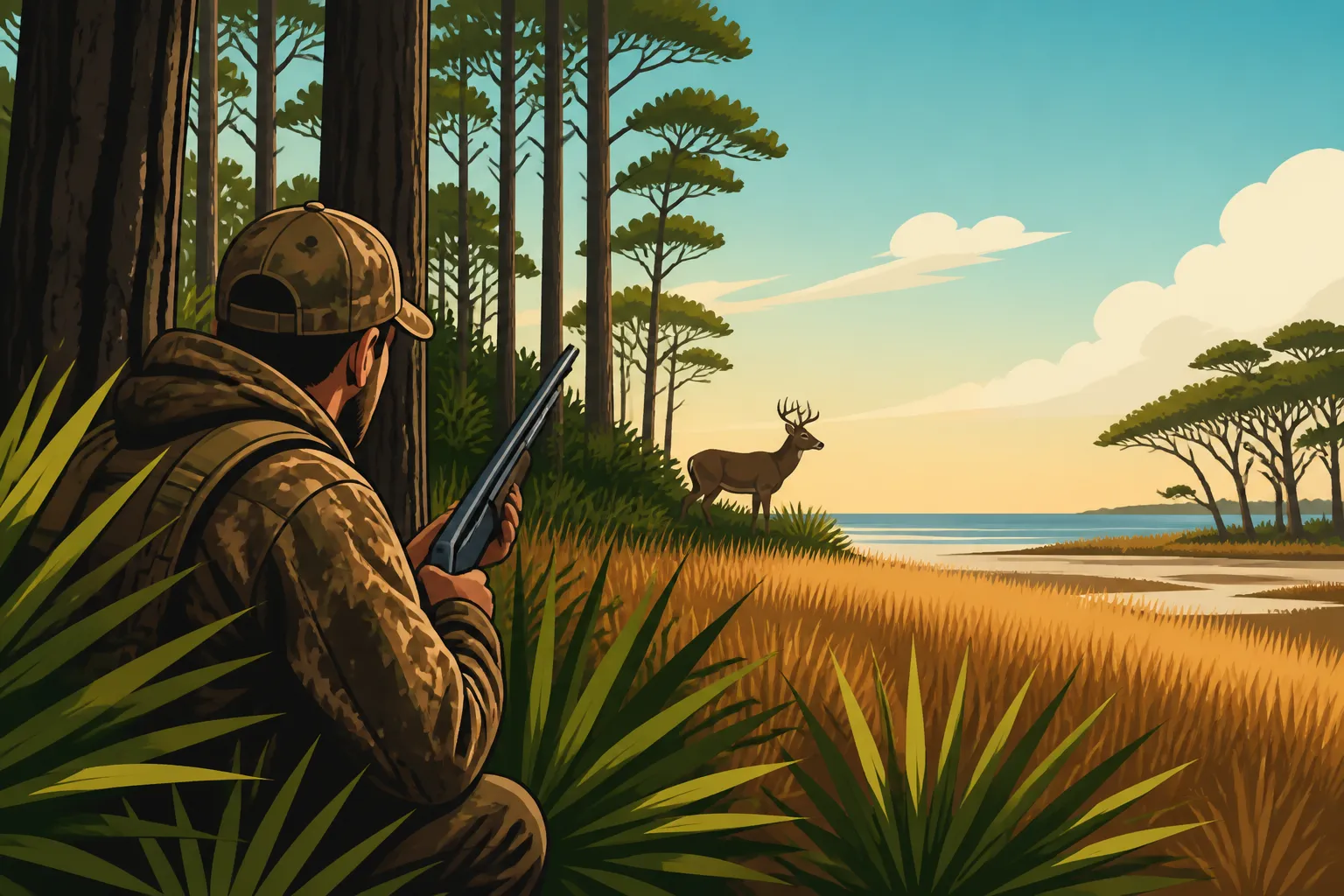
When planning to sit, stand placement is critical. Look for those natural funnels created by the terrain and vegetation. The edge where the dense maritime forest meets an open salt marsh, a tidal creek, or a clear-cut edge is often a high-traffic area. Deer will use these transitions, especially during periods of low light, to move between bedding areas in the thick stuff and feeding grounds.
Consider setting up where you have a clear view of one of these transition zones. Think about where deer will emerge and where they will go once they are in the open. As discussed earlier, the tides play a massive role, so always account for how water levels will impact deer movement through your chosen funnel. A stand overlooking a pinch point that funnels deer around a high tide can be deadly. Also, think about your approach and exit routes. You want to get to and from your stand without alerting any deer. This might mean wading a shallow creek or taking a circuitous route through dense cover before daylight. A quality map from GoHunt can help you plan these routes, identifying potential obstacles and silent travel paths.
Here's a quick reference table for coastal hunting tactics:
| Factor | Deer Behavior Impact | Recommended Tactic | Gear Consideration |
|---|---|---|---|
| High Tide | Funnels deer to higher ground, limits crossings | Focus on elevated ridges, pinch points, forest edges | Treestand/Saddle, waterproof backpack, binoculars |
| Low Tide | Opens up muddy flats, new crossing options | Scout for fresh tracks in mud, cover crossing points | Rubber boots, silent clothing, scent control gear |
| Dense Cover | Provides bedding, escape, hidden travel routes | Slow still-hunting, ground blinds in natural openings | Thick brush pants, quiet fabrics, pruning shears |
| Coastal Wind | Carries scent widely, can swirl near water | Hunt crosswind or into wind, use natural wind breaks | Scent control gear for humid coastal hunts, wind checker |
| Food Sources | Acorns (live oak), wax myrtle, yaupon berries | Identify active feeding areas, scout for fresh browse | Binoculars for spotting, game cameras (where allowed) |
Scent Control and Humidity
The coastal environment, with its high humidity and often stagnant air, presents unique challenges for scent control. Your scent will hang in the air longer and carry farther in damp conditions than it would in dry, crisp air. This means your scent control regimen needs to be meticulous. It's not just about spraying down; it's about minimizing all sources of human odor.
Shower with unscented soap, wash your hunting clothes in scent-free detergent, and store them in airtight containers. Dress in layers of wool or synthetic materials that wick moisture and don't retain odors. When you're out in the field, avoid touching anything unnecessary, and be mindful of where you place your hands. Even with the best scent control, however, it's always critical to hunt the wind. If the wind isn't right for your chosen spot, consider moving or switching to a different tactic. Remember that deer in these high-pressure, thick-cover environments are incredibly sensitive to human presence, and a single whiff of your scent can send them packing.
Essential Gear for Coastal Maritime Forest Hunting
Hunting North Carolina's coastal maritime forest edges requires a specialized gear list that addresses the unique environmental challenges. You won't just be dealing with cold; you'll be battling humidity, water, and incredibly dense vegetation.
Navigating Wet and Thick Environments
The single most important gear consideration for coastal hunting is footwear. You will encounter water, mud, and damp conditions, so a good pair of rubber boots for swamp walking is non-negotiable. Look for boots that are comfortable for long walks, provide good traction on slippery surfaces, and are completely waterproof. Knee-high or even hip-waders might be necessary for certain areas, especially if you plan to cross tidal creeks at low tide or retrieve game from flooded zones.
Beyond boots, consider durable, water-resistant clothing. Brush pants or bibs made from tough, snag-resistant material will protect you from the thorns and briars you'll inevitably encounter. A lightweight, packable rain suit is also a must, as coastal weather can change in an instant, bringing sudden downpours. Given the dense cover, a quality headlamp with a red light option is crucial for early morning entries and late-night exits. For navigation, while a phone app is great, always have a backup, like a handheld GPS or a compass and physical map, especially in areas with spotty cell service.
Optics and Other Tools for Dense Habitats
In thick coastal cover, long-range optics aren't as critical as they might be in western hunting, but good quality binoculars are still essential for picking apart shadows and identifying deer in the dense undergrowth. An 8×42 or 10×42 power is usually sufficient, offering a good balance of magnification and field of view. Look for optics with good low-light performance, as deer often move during dawn and dusk in these areas.
A rangefinder is also useful, especially if you're taking shots in tight windows. Even at short distances, accurately judging range in thick cover can be tricky. When it comes to firearms, consider a compact rifle or shotgun that handles well in brush. A lever-action .30-30 or a compact bolt-action in .308 can be excellent choices, as shots are typically at closer ranges. For bowhunters, a shorter axle-to-axle bow might be easier to maneuver in tight spots. Lastly, don't forget the tools for after the shot: a sharp field dressing knife, game bags for early archery kills, and a sturdy deer drag or cart, though in many coastal areas, a sled might be more practical for pulling a deer through mud and dense brush.
Weather-Appropriate Clothing and Scent Control
The North Carolina coast is known for its humidity, which can make things feel much warmer than the actual temperature. Layering is key, even during cooler months. Start with a moisture-wicking base layer, add an insulating mid-layer, and finish with a quiet, water-resistant outer layer. Wool is an excellent choice for its warmth-to-weight ratio and ability to retain insulating properties even when wet. When considering your hunting attire, don't forget North Carolina's blaze orange requirements. Even during archery season, certain situations may require it, so always know the rules for your specific hunting dates.
As mentioned, scent control is paramount. Scent control gear for humid coastal hunts often involves charcoal-lined clothing or specialized sprays designed to combat moisture-borne odors. While no system is foolproof, a diligent approach will significantly reduce your chances of being busted. Remember, every little bit helps when you're trying to outwit a whitetail that lives its life under the constant threat of detection.
Disclaimer
Please be aware that hunting regulations and season dates can change. Always consult the latest North Carolina Wildlife Resources Commission (NCWRC) regulations before planning any hunting trip. This guide is for informational purposes only and does not supersede official state regulations.