Reading North Carolina Mud for Fresh Deer Movement
We've all been there, standing in the woods, scratching our heads, wondering if those deer tracks we just found are from yesterday's rain or last week's downpour. It's frustrating to invest time scouting only to be unsure if the sign you're seeing is relevant to right now. But what if you could reliably tell the difference, and better yet, understand what those muddy footprints are telling you about a deer's intentions? This guide is all about honing your eye to read the language of North Carolina's mud, helping you pinpoint fresh deer movement and elevate your hunting strategy.
The Subtle Language of Mud
Mud might seem like just, well, mud. But to the seasoned hunter, it’s a canvas painted with stories of the wild, especially when it comes to white-tailed deer. Learning to read these stories can drastically improve your understanding of local deer populations and their habits.
Why Mud is a Goldmine for Deer Sign
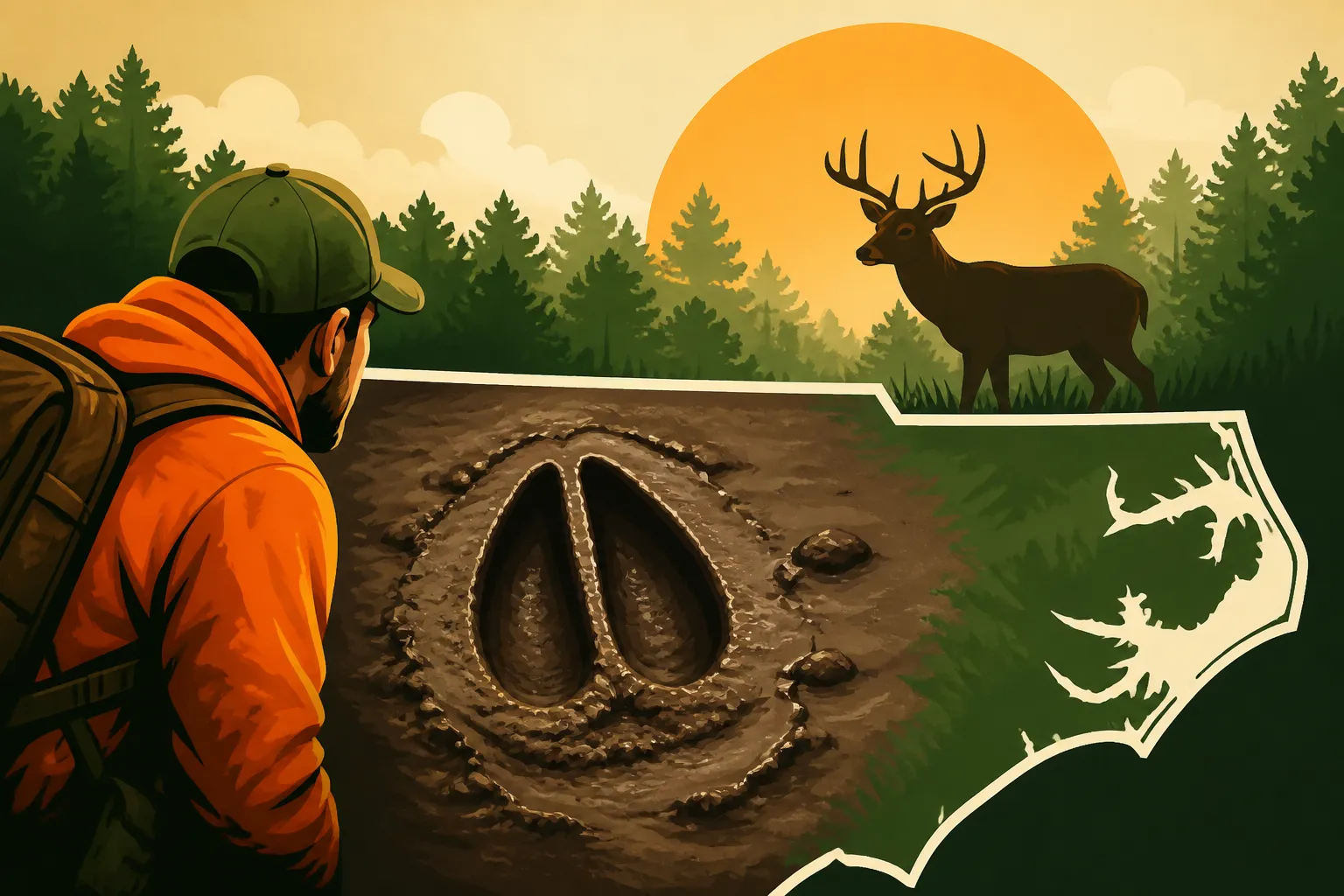
Think about it: after a good rain, every animal that crosses a soft, muddy patch leaves an impression. Unlike hard ground or thick leaf litter where tracks are fleeting or impossible to discern, mud captures a crystal-clear snapshot of activity. This isn't just about knowing a deer was there; it's about knowing when they were there, how big they were, and what direction they were headed.
For instance, imagine you’re walking a creek bottom near your favorite hunting spot in the Piedmont. A recent shower has left the ground tacky. You spot a deer track, perfectly preserved in the soft earth. The edges are sharp, almost as if it was just pressed there. There's no debris or leaf litter settled into the impression, and if you look closely, you might even see residual moisture clinging to the sides. This isn’t just old sign; this is fresh, indicating a deer has passed through very recently. This kind of detail, impossible to glean from dry ground, tells you a deer is actively using this corridor, perhaps moving between a bedding area and a cornfield.
Identifying Fresh Tracks Versus Old Sign
Differentiating between a track left an hour ago and one from several days prior is crucial for effective scouting. It’s a skill that comes with practice, but there are some tell-tale signs to look for.
The fresher a track, the sharper and more defined its edges will be. Over time, moisture evaporates, and the mud around the track will dry and crumble, rounding off those crisp edges. If you see fine mud particles flaked off into the track or small pieces of dried earth clinging to the sides, it’s likely not super fresh. Another excellent indicator of freshness is water retention. After a rain, very fresh tracks might still have a tiny bit of water or a darker, wetter appearance at the very bottom, even if the surrounding mud has begun to dry. Older tracks, conversely, will dry out completely and often lighten in color as they age.
Consider this scenario: you're out checking a popular game trail winding through the Uwharrie National Forest. Two days ago, a heavy rain fell. You find a section of trail with numerous deer tracks. Some tracks have soft, rounded edges and are partially filled with settled pine needles and small twigs. These are older. Then, further along, you spot a track with perfectly sharp edges, almost like it was stamped just minutes before. The mud within it is still slightly darker than the surrounding soil. This is your target – that deer was here very recently, making this trail an active travel route. GoHunt mapping tools can help you identify these natural travel corridors and low-lying areas where mud is likely to persist, giving you a better chance to find and interpret these vital signs.
Deciphering Deer Movement Patterns
Beyond just telling you when a deer was there, mud can reveal the story of why and how it was moving. Each track is a clue, and strung together, they form a narrative of daily life in the North Carolina woods.
Track Direction and Purpose
Understanding which way a deer was headed might seem obvious, but it’s often overlooked in the excitement of finding a track. The direction can tell you a lot about the deer’s immediate intentions – whether it’s feeding, heading to bed, or just cruising.
Deer hooves are shaped in such a way that the pointed end faces the direction of travel. So, if you find a track, simply note which way the points are facing, and you know the deer's general heading. Now, connect that with the terrain. If the tracks are leading from a dense thicket, perhaps a typical bedding area in a coastal pocosin swamp, and heading towards a known food source like a cut cornfield, you can infer the deer was moving to feed. Conversely, tracks leading from a feeding area back into heavy cover during daylight hours might indicate a deer returning to its bed. These patterns are gold for planning ambush points or determining optimal entry and exit routes. Checking Entry Routes Through Standing Soybeans can give you more specific ideas on how to approach these food sources.
Understanding Gait and Urgency
A deer’s stride and the spacing of its tracks can tell you if it was leisurely strolling, trotting nervously, or bounding away in a full-blown panic. This is invaluable for understanding pressure and safety.
A deer walking calmly will leave evenly spaced tracks, usually with the hind foot stepping near or slightly ahead of where the front foot landed. This "overstepping" indicates a relaxed, unhurried pace. If the tracks are farther apart and in a more staggered pattern, with the hind feet landing well behind the front tracks, the deer was likely trotting or running. A full bound, often seen when a deer is spooked, will show widely spaced sets of four tracks grouped together, indicating powerful leaps.
Imagine scouting along a logging road in a Game Land after a light rain. You encounter a distinct set of tracks. The tracks are evenly spaced, and the hind prints slightly overlap the front. This tells you a deer was moving through here at a calm, unalarmed walk, perhaps heading to a water source or a browse area. Now, further down the road, you see a set of tracks suddenly become widely spaced, showing signs of a burst of speed and then a jump over a downed log. This suggests the deer was likely spooked. Knowing this distinction helps you determine if a particular area is experiencing high pressure or if deer are generally feeling secure. If you find consistent, relaxed movement, it's a good sign for setting up a Ground Blind on North Carolina Public Land.
Multiple Tracks and Group Dynamics
Sometimes, you won't just find a single set of tracks, but a whole jumble. Learning to unravel these multiple tracks can offer insights into the social structure and activity of the local herd.
When you see several different-sized tracks together, it often indicates a doe with her fawns, or potentially a small bachelor group of bucks if the tracks are all larger and relatively similar in size. During the rut, you might see the tracks of a large buck closely following those of a smaller doe, often accompanied by scuffed-up ground where they've stopped or milled around. This kind of sign can be especially exciting when you're Hunting the North Carolina Rut by Zone.
For example, walking a muddy two-track in the Sandhills, you might come across the broad, deep impression of a mature buck, distinguishable by its size and deeper imprint, followed closely by two smaller, lighter tracks. This could be a buck chasing does or moving with a couple of younger bucks. If you see many tracks of varying sizes and ages converging on a specific point, like a fresh scrape line or a fallen persimmon tree, it signals a popular community spot. Taking the time to observe these interactions can reveal preferred travel routes, bedding areas, and feeding zones for the entire herd, not just a single animal. Using a tool like GoHunt can help you visualize these areas on a map and plan your approach accordingly.
Prime Muddy Hotspots in North Carolina
While deer can leave tracks anywhere the ground is soft, some areas are consistently better for finding and interpreting fresh mud sign. Knowing these hotspots in North Carolina can focus your scouting efforts and increase your chances of success.
Creek Bottoms and River Banks
North Carolina is crisscrossed with countless creeks, streams, and rivers, from the rushing waters of the mountains to the slow-moving blackwater rivers of the Coastal Plain. These riparian zones are magnets for deer.
Deer need water daily, making creek and river banks natural congregation points. More than just a drinking fountain, these areas often serve as natural travel corridors, funnels, and escape routes, especially when surrounded by thick timber or dense undergrowth. The moist soil near water sources is almost always soft, providing a perfect medium for capturing tracks.
Consider a small creek winding through a deep hollow in the Nantahala National Forest. After a few days of dry weather, a good rain washes through, leaving the creek banks saturated. You hike in and find fresh, deep tracks running parallel to the creek for hundreds of yards. These tracks are leading right past a fresh rub on a sapling. This isn't just a place deer drink; it's a superhighway. Deer often follow the path of least resistance, and the relatively flat, open ground along a creek bed offers just that. These areas are also prime for finding where Nantahala Forest Bucks Bed as they'll often bed on adjacent benches above the water.
Field Edges and Agricultural Access Points
In the agricultural heartland of North Carolina, particularly the Piedmont and Coastal Plain, deer are intimately connected to farmlands. Where fields meet the woods, especially after rain, is an excellent place to find fresh sign.
Deer regularly move from the cover of timber to feed in agricultural fields, whether it's corn, soybeans, peanuts, or winter wheat. The transition zone where these two habitats meet is a high-traffic area. After a rain, the edges of these fields, particularly at gateways, old tractor paths, or worn-down fence lines, will turn muddy. This is where deer often step out of the woods, pause, and enter the field.
Imagine scouting a Piedmont farm known for growing soybeans. A recent rain has made the field edges soft. As you walk the perimeter, you discover a muddy track leading directly from the woods into the standing beans, almost as if it was left just a few hours ago. This track gives you a clear indication of exactly where a deer is entering this food source. This spot becomes a prime candidate for a stand placement or a ground blind. Similarly, when Hunting Piedmont Farmland Deer, these muddy field edges are key to identifying active feeding patterns.
Logging Roads and ATV Trails
Across North Carolina's public lands, including National Forests and Game Lands, logging roads and ATV trails provide human access, but they also offer easy travel for deer. These compacted dirt paths, especially in low-lying areas or where water collects, become muddy track traps.
Deer, like humans, appreciate an easy walk. They frequently utilize logging roads, old two-tracks, and even designated ATV trails as travel corridors between different sections of their habitat. These paths offer less resistance than pushing through dense underbrush. When wet, these roads can hold a fantastic amount of fresh sign.
Picture yourself hiking a forest road deep within Holly Shelter Game Land. A thunderstorm passed through earlier, and the road is now a ribbon of soft, wet earth. You start finding a multitude of deer tracks, some large, some small, all headed in the same direction. These roads act as natural funnels, concentrating deer movement and making it easier for you to pattern them. If you're Finding Sign in Big Pisgah Timber, these old logging roads can be crucial arteries revealing where deer are moving through otherwise impenetrable cover. GoHunt can be particularly useful here, helping you identify these logging roads and trails on detailed satellite imagery, even before you step foot in the woods.
Integrating Mud Reading into Your Strategy
Reading mud is more than just an academic exercise; it's a practical skill that should be a cornerstone of your hunting preparation. When combined with other scouting methods, it forms a powerful approach to understanding deer and increasing your chances of success.
Post-Rain Scouting Opportunities
One of the absolute best times to scout for fresh deer sign is immediately following a rain event. The natural "reset" of the ground provides a clean slate, allowing you to quickly identify truly recent activity.
A good, soaking rain not only softens the ground but also washes away older, less relevant tracks. This means that any tracks you find after the rain are by definition fresh. This creates a perfect window to go out and scout your hunting areas. Focus on those muddy hotspots we discussed: creek banks, field edges, and logging roads. What you find in those first few hours or day after a rain can completely change your hunting plan for the upcoming week.
For example, after a strong afternoon shower in mid-October, you head out to a game trail you've been monitoring. You find fresh, deep tracks of a mature buck heading towards a white oak stand dropping acorns. This intel is invaluable! You know he was there recently, and you know his direction of travel to a prime food source. This immediate, post-rain information is often the most current and actionable you can get. This is why Scouting North Carolina Public Land Before Season is so vital, helping you identify these key areas before the pressure sets in.
Combining Mud Sign with Other Intel
No single piece of deer sign tells the whole story. The true power of mud reading comes when you combine it with other observations, creating a comprehensive picture of deer behavior.
Think of mud tracks as just one puzzle piece. When you find fresh tracks, look around. Are there fresh droppings nearby? Are there newly rubbed trees or scraped ground? Is there a primary trail leading into a bedding area? All these elements together paint a much clearer picture. For example, fresh mud tracks at a scrape line, combined with the presence of active rubs, are a much stronger indicator of a buck's presence than just tracks alone. If you're Reading a Ridge for Mountain Zone Deer, and you find fresh mud tracks on a saddle that also has fresh rubs and scrapes, you've hit the jackpot for a travel corridor.
Using modern mapping applications like GoHunt can further enhance this by allowing you to mark all your sign on a digital map. You can note where you found fresh tracks, rubs, scrapes, and even visualize the prevailing wind direction on that particular day. Over time, you'll start to see patterns emerge, connecting the mud sign to specific food sources, bedding areas, and travel routes. This systematic approach, layering different types of intel, helps you understand the bigger picture and develop a highly effective hunting strategy. Even in the late season, when Late-Season Food Sources for North Carolina Whitetails become critical, fresh mud tracks around those food sources are invaluable.
Here’s a quick summary of what different track features can tell you:
| Track Feature | What It Tells You |
|---|---|
| Sharp Edges | Very fresh, likely within hours. |
| Rounded/Crumbled Edges | Older, several hours to a day or more. |
| Residual Moisture/Darker Color | Very recent, still wet from rain or deer's hoof. |
| Settled Debris (leaves, twigs) | Older, debris has had time to fall into the track. |
| Direction of Pointed Hoof | The direction the deer was moving. |
| Evenly Spaced Tracks, Overstepping | Calm, unhurried walk; deer feels secure. |
| Widely Spaced, Staggered Tracks | Trotting or running; deer may be hurried or spooked. |
| Four Tracks Grouped Together (Bounding) | Deer was running or jumping, likely startled. |
| Depth of Track | Size and weight of the deer; deeper usually means larger animal. |
| Multiple Track Sizes | Group of deer (doe/fawns, bachelor group, rutting pair). |
Learning to read the mud isn't just about finding deer; it's about becoming a better woodsman, understanding the subtle signals the natural world constantly provides. So next time it rains, don't just stay inside – grab your boots and head out to see what stories the mud has to tell.
Disclaimer
The information provided in this guide is for informational purposes only and is not intended to be a substitute for professional advice. Always consult the North Carolina Wildlife Resources Commission (NCWRC) regulations for the most current and accurate hunting laws and guidelines. Hunting involves inherent risks, and safety should always be your top priority.