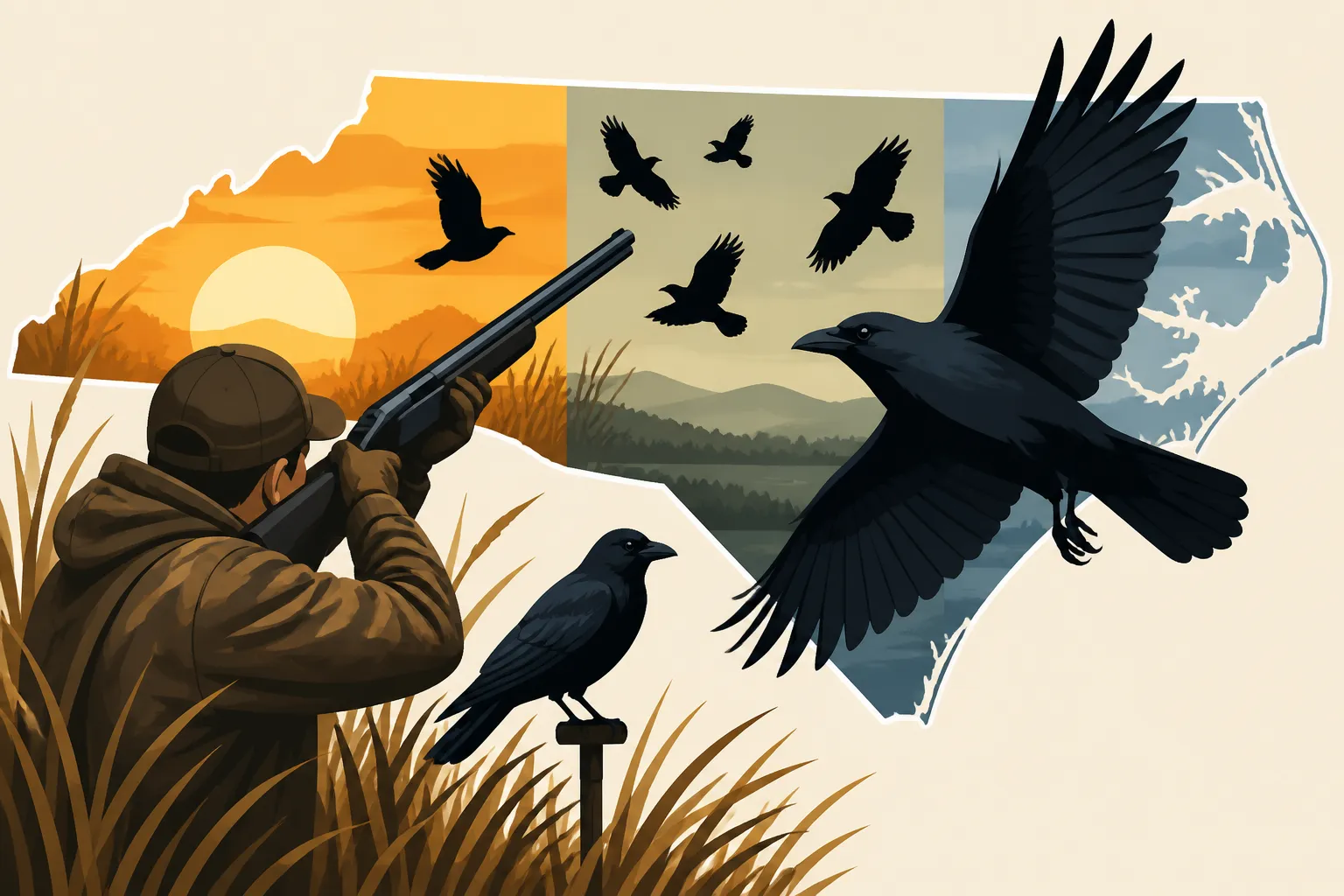
Crow Hunting Seasons and Tactics in North Carolina
Hunting crows in North Carolina can feel a bit like stepping into a different world compared to chasing deer or calling turkeys. Many hunters overlook them, or perhaps find the regulations and tactics for these incredibly intelligent birds a bit murky. But trust me, once you dive in, you'll discover a challenging, rewarding pursuit that sharpens your skills and offers year-round opportunities. This guide will walk you through North Carolina's crow hunting seasons and provide proven tactics to help you make the most of your time afield.
Understanding North Carolina's Crow Hunting Seasons
One of the first things that throws hunters off when it comes to crows is their season structure. It’s not as straightforward as the fixed dates you see for deer or bear. Crows are classified as migratory game birds, which means their seasons are established under federal guidelines but then fine-tuned by the North Carolina Wildlife Resources Commission (NCWRC). This creates a unique framework that can sometimes feel a little less clear-cut than other species, but it also offers some fantastic flexibility.
The Migratory Bird Framework and State Specifics
Federally, the Migratory Bird Treaty Act governs all migratory birds, including crows. This act sets broad parameters that states must adhere to when setting their hunting seasons. For crows, these federal guidelines typically allow for a generous season length – often more than 100 days – and states can choose to split these days into multiple segments. This flexibility is what allows North Carolina to offer a split season, often spanning many months throughout the fall, winter, and sometimes into spring.
The reason for these long seasons and typically no daily or possession limits on crows is largely due to their abundance and, in many areas, their classification as a nuisance species. Crows can cause significant crop damage and can sometimes depredate nests of other game birds, leading wildlife managers to encourage their harvest. So, while you might be used to strict bag limits for ducks or geese, you'll find crow hunting often operates under much looser restrictions, reflecting their management goals. It’s a great way to get some wingshooting practice in without the pressure of a limited bag. To hunt any migratory bird in the state, including crows, you'll need to ensure you have your proper certification. You can learn more about the requirements for a North Carolina Migratory Bird Certification.
Key Season Dates and Zones to Watch For
North Carolina typically offers one of the longest crow hunting seasons in the nation, often running for many months. While the exact dates can shift slightly year to year based on federal frameworks and state decisions, you can generally expect substantial opportunities. It's not uncommon for the season to open in early summer, take a brief break, and then resume for a very long stretch from late fall through the winter and into early spring.
The beauty of this long season is that it overlaps with many other hunting seasons, giving you plenty of chances to pursue crows. Unlike deer or turkey, crows don't have different "zones" with varying season dates across the state; it's generally a statewide season. However, always double-check the current year's regulations on the NCWRC website to confirm the exact start and end dates. They are the definitive source for any changes.
Here's a general idea of what a typical North Carolina crow hunting season might look like, though remember to consult official NCWRC resources for the most current dates:
| Season Segment | Typical Start Date | Typical End Date | Notes |
|---|---|---|---|
| Summer/Fall | Early June | Late June/Early July | Often a shorter, early season |
| Late Fall/Winter | Early November | Late February/Early March | Main, extended season |
| Spring | Early March | Late March | Sometimes a short extension |
Please note: These dates are illustrative. Always check the current North Carolina Wildlife Resources Commission regulations for precise, up-to-date season information.
You'll notice that the main segment offers extensive opportunities, making it easy to fit crow hunting into your schedule, especially during the slower periods between deer seasons or before spring turkey. It's a fantastic way to keep your wingshooting skills sharp.
Essential Crow Hunting Tactics for North Carolina
Crows are often underestimated. They're incredibly intelligent birds with excellent eyesight and a memory that allows them to quickly learn from negative experiences, such as a bad decoy spread or poor calling. This means successful crow hunting isn't just about showing up; it's about understanding their behavior, setting up meticulously, and executing a convincing strategy. Getting them to commit to your spread can be one of the toughest challenges in hunting, but also one of the most rewarding.
Decoy Spreads and Concealment
When it comes to crows, you generally can't have too many decoys. These birds are social, and they respond strongly to visual cues of other crows. A spread of 20-30 decoys is a good starting point, but don't hesitate to go larger if you have them. You want to create a scene that looks active and inviting, suggesting either a feeding frenzy or a distressed situation that draws them in.
Decoy placement is crucial. If you're hunting open fields, set them up to mimic feeding crows, perhaps with a few "sentry" crows perched on stakes or fence posts at the edges of the field. In timbered areas, place some decoys on the ground and others in lower tree limbs to simulate a roosting or gathering point. A common tactic is to use a few decoys to represent a hawk or owl "attacking" a crow, which creates a strong distress signal. You might even use a few actual dead crows, if legal and available, for ultra-realistic additions to your spread.
However, the most critical element of your setup is concealment. Crows possess vision that rivals that of any game animal. They will spot a hunter's outline, a piece of reflective gear, or even an improperly brushed-in blind from an incredible distance. A well-constructed ground blind, thoroughly brushed in with local vegetation, is paramount. You can make excellent use of a pop-up ground blind, but it absolutely must blend into its surroundings. For some insights on how to achieve this, check out our guide on Brushing In a Blind on a Field Edge. Position your blind with your back to the sun if possible, to further obscure your presence and make it harder for incoming crows to spot you.
Mastering Crow Calls and Sequences
Calling is the second half of the equation, working in tandem with your decoys to create an irresistible scenario. Crows respond to a variety of calls, each telling a different story. You'll want a mix of distress calls and rallying or fighting calls.
Electronic calls are incredibly effective for crow hunting because they can produce a wide range of realistic sounds at high volume. You can find pre-programmed sequences that mimic crow fights, crows harassing predators (like an owl or hawk), or simple gathering calls. Handheld mouth calls, like a traditional crow call, are also valuable for adding nuance and responding directly to incoming birds.
Start with a distress call, perhaps a "crow in trouble" or a "crow being attacked by a hawk" sequence. This often grabs their attention from afar. As crows begin to approach, switch to more aggressive rallying or fighting calls. These calls communicate that there's a perceived threat or exciting event happening, drawing them closer to investigate. Vary your volume and cadence; sometimes short, sharp bursts are best, while other times longer, drawn-out sequences are needed. Don't be afraid to experiment.
It's not just about blowing a call; it's about telling a story that makes them curious and agitated enough to come within shooting range. Being able to adapt your calling to how the crows are responding is a learned skill that comes with practice. The principles of calling often apply across species, so if you're interested in honing your vocalizations, you might find tips in resources like Predator Calling North Carolina Pine Plantations.
Shotguns, Ammunition, and Ethical Considerations
Like any form of hunting, choosing the right equipment and understanding ethical practices are key to success and responsible stewardship. For crow hunting, this means selecting a shotgun and ammunition that deliver the necessary punch for a clean kill on a fast-moving, relatively small target, and being mindful of your shooting limits.
Ideal Shotgun and Ammunition Choices
For crow hunting, a 12-gauge shotgun is the most popular choice due to its versatility and payload capacity, but a 20-gauge can also be highly effective. A semi-automatic or pump-action shotgun is often preferred because crows frequently come in groups, and quick follow-up shots can be the difference between multiple birds in the bag and just one. When it comes to the choke, a modified or full choke is usually ideal. These provide a tighter pattern at longer ranges, which is essential for crows that might hang up at the edge of your effective range.
Regarding ammunition, smaller shot sizes are generally favored. #6, #7.5, or even #8 lead shot typically carries enough energy for a clean kill on a crow within ethical ranges. You want a dense pattern to ensure multiple pellets strike the bird. While not always mandatory for crows, it’s worth noting that if you're hunting in areas near water where waterfowl are prevalent, or within specific game lands, non-toxic shot might be required. Always check the local regulations for your hunting spot. You can get more insights on choosing the right gun for similar birds in our guide on Shotgun Gauge Choice.
The key is to pattern your shotgun with your chosen ammunition to understand its effective range. Crows are small, and a clean kill requires a good pellet count. You might be surprised at how quickly a pattern opens up at longer distances, so knowing your gun's limits is crucial. This is similar to how turkey hunters pattern their guns, which you can read about in Turkey Chokes and Patterning.
Ethical Shooting and Scouting for Success
Ethical shooting in crow hunting means ensuring clean, humane kills. For most setups, this means keeping your shots within 30 to 40 yards. Beyond that, the pattern often spreads too thin, and the energy of the shot drops, increasing the likelihood of merely wounding a bird. Resist the urge to take "Hail Mary" shots at birds that are too far out. We owe it to the animals we pursue to ensure our shots are lethal and quick.
Before you even set up your blind and decoys, thorough scouting is essential. You need to identify where crows are feeding, roosting, or traveling. Look for large concentrations of crows flying at dawn and dusk, or listen for their distinctive calls. A good starting point is often agricultural fields, especially those with corn or other grains, as well as large timber blocks where they might roost. Overgrown clearcuts or edges of pine plantations can also be hotspots. Using mapping tools like those offered by GoHunt can be invaluable for pinpointing potential roost sites, travel corridors, and open fields. These tools allow you to study aerial photos and topographic maps to identify promising locations without spooking the birds.
Scouting isn't just about finding the crows; it's about finding the right place to ambush them. Look for natural funnels or pinch points where they tend to fly. When scouting public land, this is especially important to find less pressured areas. You can gain further insights by reading our post on Scouting North Carolina Public Land Before Season.
Maximizing Your North Carolina Crow Hunt
Crow hunting isn't just about reducing a nuisance population; it's a fantastic opportunity to sharpen your hunting skills, spend time outdoors, and even enjoy some camaraderie with fellow hunters. While it might not carry the same prestige as big game, the lessons learned in the crow blind are invaluable and directly transferable to other pursuits.
Integrating Crow Hunting into Other Seasons
One of the often-overlooked benefits of crow hunting is its utility as a skill-builder and a way to extend your time afield. The long season often overlaps with deer archery and even some gun seasons, as well as the entire small game season. This means you can incorporate crow hunting into your existing plans or use it as a standalone activity during lulls. It's a fantastic way to practice your concealment, calling sequences, and quick target acquisition without the high stakes of a once-a-year deer tag.
Think about it: setting up a ground blind, precisely placing decoys, reading bird behavior, and executing challenging wingshots – these are all skills that translate directly to waterfowl hunting, dove hunting, or even effectively using a locator call for turkeys. It’s also a low-pressure environment to try out new gear, practice your calling rhythms, or simply get comfortable with your shotgun. For hunters who enjoy the challenge of the chase throughout the year, understanding how North Carolina Deer Season Overlap With Small Game might offer additional opportunities for crow hunting could be beneficial.
Group Hunts and Enhancing the Experience
While you can certainly hunt crows solo, it’s an activity that truly shines with a group. More hunters mean more eyes, more firepower, and often, more fun. With multiple shooters, you can cover more angles and increase your chances of bringing down birds that might slip through a single hunter's spread. It also allows for strategic positioning, where one hunter might focus on calling while others are ready to shoot.
Beyond the practical advantages, group hunts foster a great sense of camaraderie. There’s something uniquely enjoyable about calling in a large flock of crows with your buddies, sharing laughs, and debriefing after a busy flight. It’s a chance to introduce new hunters to wingshooting in a relatively relaxed environment, or for seasoned hunters to share tactics and stories. Just remember that safety is paramount, especially with multiple shooters. Establish clear shooting lanes, communicate constantly, and always know where your hunting partners are. The teamwork involved in a successful crow hunt can be quite similar to organizing a Deer Drives With Three or Four Hunters, where coordination and communication lead to greater success.
Using a platform like GoHunt can also help coordinate group hunts by allowing you to share mapping data, mark prime locations, and discuss strategies with your hunting party. This ensures everyone is on the same page before you even step foot in the field, making the entire experience smoother and more effective.
Important Disclaimer
Hunting involves inherent risks, including but not limited to those associated with firearms, archery equipment, and outdoor environments. Always prioritize safety, understand and follow all local, state, and federal hunting regulations, and consider seeking professional guidance or hunter education courses before engaging in any hunting activity. The information provided in this guide is for informational purposes only and should not be considered a substitute for official regulations or expert advice.