Timber Cuts and Where Deer Move After
There’s nothing quite as frustrating as showing up to your favorite hunting spot, only to find that a timber company has come through and completely rearranged the landscape. What was once thick, mature timber, holding deer in predictable patterns, is now a jumbled mess of stumps, tops, and young saplings. It can feel like your carefully laid plans, years of scouting, and intimate knowledge of the terrain have been wiped away overnight. But don't despair! While timber cuts certainly change the game, they also create new opportunities for savvy North Carolina deer hunters. This guide will walk you through how deer react to these significant habitat alterations, helping you understand where they go, why they go there, and how you can adapt your hunting strategies to punch your tag in a post-cut world.
The Immediate Aftermath: Disruption and Adaptation
When the chainsaws stop buzzing and the heavy machinery pulls out, the initial impact on the deer herd in that specific area is one of intense disruption. Deer are creatures of habit and security, and a sudden, drastic change to their home range forces them to adapt quickly. This period can be confusing for both the deer and the hunter.
Initial Chaos and Hunter Frustration
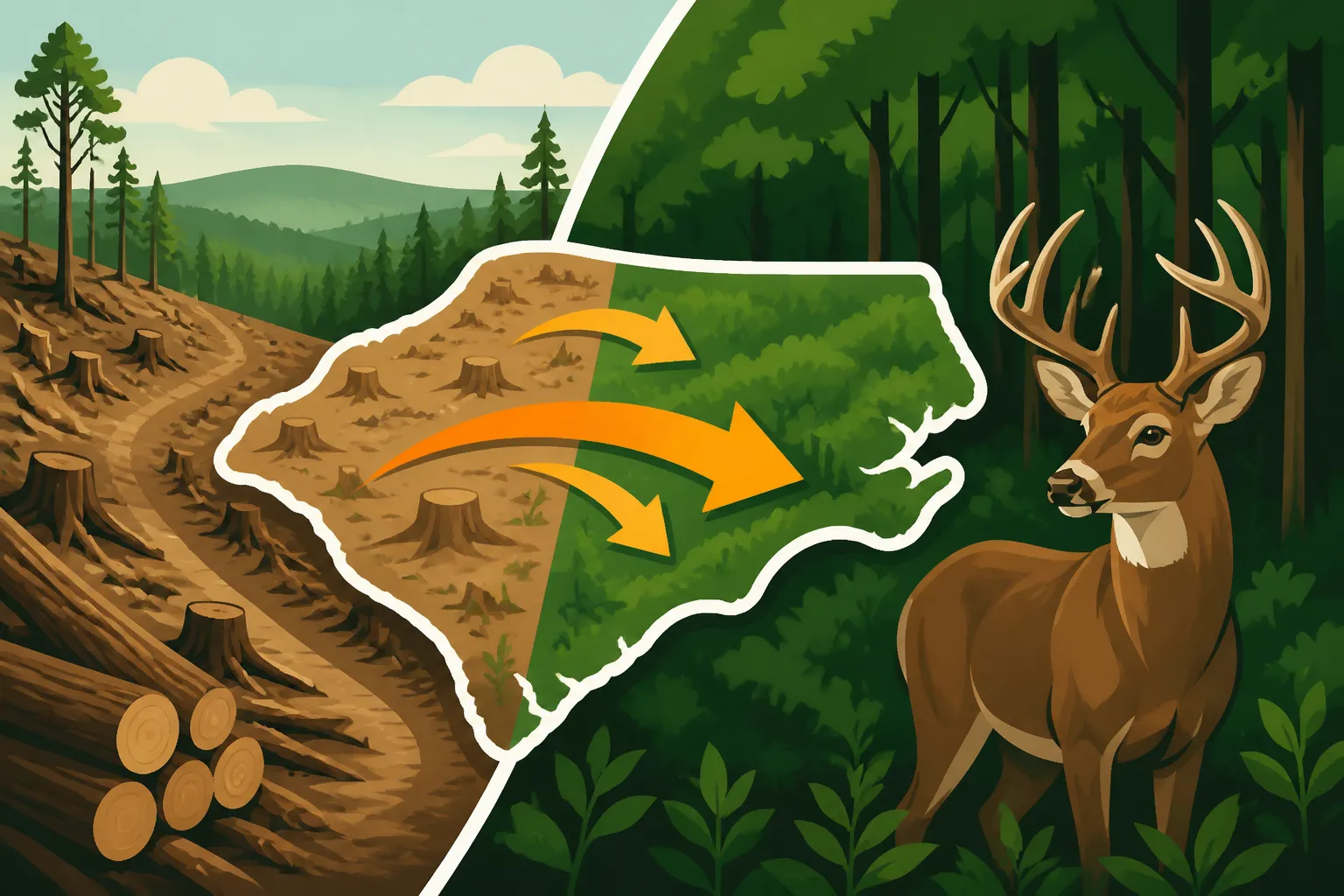
Picture it: you pull up to your usual hunting access point, eyes already scanning for that familiar trail or bedding area, only to be met with a scene that looks more like a war zone than a peaceful forest. The mature canopy that provided shade and safety is gone, replaced by tangled tops and exposed ground. Deer that were accustomed to specific travel corridors might find them impassable or too open. Their primary bedding cover could be annihilated, and traditional food sources might be buried or removed. This sudden shift often causes deer to temporarily vacate the immediate vicinity, seeking refuge in adjacent, undisturbed timber. It’s a natural, almost panicked, reaction. As hunters, this is often when we throw our hands up in frustration, wondering if our spot is ruined for good. You might spend days Scouting North Carolina Public Land Before Season and still be caught off guard by a fresh cut.
However, this initial displacement is rarely permanent. Deer won't abandon a core area entirely if suitable alternatives are nearby, especially if those alternatives still offer resources. They might shift their patterns significantly, moving to thicker edges, deep draws, or unlogged pockets that were previously overlooked. This is where patience and diligent observation become your best tools. Give them a few weeks to settle, to figure out their new normal, and you’ll start seeing signs of their adaptation.
Short-Term Food and Cover Shifts
While the initial cut seems destructive, it often provides a boom in certain food sources. The removal of the canopy allows sunlight to hit the forest floor, stimulating the growth of forbs, briars, and young sprouts that deer absolutely love to browse. Tender shoots from cut trees, especially oaks and maples, are like candy to them in the immediate aftermath. These new, easily accessible food sources, coupled with the dense tangle of logging slash, create a temporary haven.
| Stage of Cut-Over | Deer Behavior | Primary Benefit for Deer | Hunter Strategy |
|---|---|---|---|
| Fresh Cut (0-6 months) | Initial displacement, then browsing on fresh sprouts. Seeking immediate adjacent cover. | Abundant, easily accessible browse. | Hunt edges, observe adjacent undisturbed cover. |
| Early Regrowth (6-24 months) | Increased bedding in thick young growth. Browsing on new saplings and briars. | Dense bedding cover, developing browse. | Scout edges and internal pockets for bedding. |
| Mid-Regrowth (2-5 years) | Optimal bedding, good browse, increasing security. Travel corridors begin to form within. | Max security, consistent browse, shelter. | Focus on travel lanes within and near cut. |
| Late Regrowth (5-10+ years) | Becomes dense, harder to penetrate. Deer use edges, transition areas more. | Still provides cover, but browse might be higher. | Hunt clear-cut regrowth edges, internal openings. |
The logging debris itself, often referred to as "slash," also provides incredible short-term bedding and escape cover. A deer can disappear into a pile of tops and limbs, feeling secure from predators and hunters alike. These areas, while a nightmare to walk through, are often where deer will bed down during daylight hours, only venturing out into the open for newly available browse or to move to more established food plots or fields nearby. Understanding these short-term shifts is crucial. You might find deer concentrating on certain parts of the cut-over where particular browse plants are thriving or where the slash offers the densest cover.
Long-Term Habitat Evolution and New Opportunities
While the initial phase is about adaptation, the long-term impact of a timber cut is often overwhelmingly positive for deer populations, leading to improved habitat and new hunting opportunities. This ecological succession transforms the landscape into a deer magnet over time.
Regrowth as Cover and Browse
As the cut-over begins to heal and regenerate, it undergoes a phenomenal transformation. What was once an open, disrupted space slowly fills with a dense tapestry of young trees, shrubs, and briars. This "early successional habitat" is absolutely vital for deer. It provides a phenomenal combination of dense thermal and escape cover, allowing deer to hide effectively from predators and the elements, while also offering an incredible smorgasbord of browse. Think about thickets of blackberry, greenbrier, sumac, and young pine or hardwood sprouts – all prime deer food. This makes these areas incredibly attractive for bedding and feeding, especially during the colder months when other food sources might be scarce. You can find deer actively Late-Season Food Sources for North Carolina Whitetails within these regrowing areas.
This dense, regenerating cover is often so thick that it's difficult for hunters to penetrate, which provides a sanctuary for deer. They feel secure moving within these areas, often sticking to internal trails they create. As a hunter, your job is to identify these internal travel routes and the points where deer might emerge from the thick stuff. It might not look like your traditional "big woods" deer hunting, but it holds big deer, and they live and thrive in this type of environment.
Edge Effect and Transition Zones
The true magic of a timber cut, particularly as it matures, lies in the "edge effect." The boundary where the young, regenerating cut-over meets the mature, undisturbed timber creates a highly productive transition zone. Deer, like many other wildlife species, thrive in these varied habitats because they offer the best of both worlds: dense cover and abundant food in the cut-over, and the safety, familiar travel routes, and sometimes mast crops of the mature woods.
These edges become natural highways for deer movement. Bucks will cruise these edges looking for does, and does will use them to transition between bedding in the thick regrowth and feeding in the more open areas or nearby fields. Look for parallel rubs and scrapes along these lines, indicating regular travel. Funnels formed by points or fingers of timber jutting into the cut-over, or even bottlenecks created by small streams or elevation changes, become prime ambush spots. This is especially true for Hunting a Clear-Cut Regrowth Edge, where deer feel safe enough to move at all times of day. Understanding how deer use these transition zones can be the key to consistent success in areas impacted by logging.
Reading the Landscape: Scouting Cut-Overs
Hunting cut-overs effectively isn’t about luck; it’s about diligent scouting and smart interpretation of the landscape. You can’t just walk in blindly and expect to find deer. You need to know how to read the signs that the deer themselves leave behind.
Identifying Key Deer Sign
When you're walking through a cut-over, you’re looking for evidence of deer activity. Start by focusing on the perimeter, especially where the cut meets standing timber. Look for well-worn trails entering and exiting the thick stuff. These trails will often be more defined where the deer are forced through a narrower opening or bottleneck.
Inside the cut-over, it's tougher going, but specific signs stand out. Look for heavily browsed plants—young sprouts and briars with clipped ends. This tells you deer are actively feeding there. In early successional growth, deer often create "tunnels" through the thickest parts; these are essentially their highways. You might also find beds within dense pockets of slash or young trees, identifiable by matted-down vegetation. Fresh droppings and rub lines on any remaining saplings or trees are also clear indicators of presence. Don't forget to look for Scrape Lines Along a Logging Road that might run along the edge of the cut or even penetrate a bit into it.
This is where your mapping tools really shine. Use satellite imagery on apps like onX Hunt to identify different stages of timber cuts, pinpoint areas of dense regrowth, and mark potential travel corridors or bedding thickets. You can use the historical imagery to see how an area has changed over time, giving you clues about deer movement patterns.
Using Technology to Your Advantage
In today's hunting world, technology can be your best friend when deciphering complicated terrain like cut-overs. As mentioned, mapping apps are invaluable. onX Hunt, for example, allows you to overlay aerial photos with property lines, topography, and even timber harvest data if available. You can literally see the boundaries of a fresh cut, visualize the topography, and identify bottlenecks or unlogged islands of timber that deer will gravitate towards. Reading Aerial Photos for Piedmont Deer becomes an essential skill.
You can drop waypoints on deer sign, potential stand locations, or areas of particular interest. This helps you build a detailed mental (and digital) map of how deer are using the area. GoHunt and similar platforms can also provide insights into habitat types and historical weather patterns, which can influence deer behavior in these regenerating zones. Don't underestimate the power of trail cameras placed strategically along those well-used edges or within the thicker internal trails. They can confirm deer presence, identify specific bucks, and tell you when they are using certain areas, helping you fine-tune your hunting times.
Hunting Strategies for Cut-Overs
Once you’ve done your scouting and have a good understanding of how deer are using a particular cut-over, it's time to devise your hunting strategy. This often requires a bit more creativity and adaptability than hunting mature timber.
Stand Placement and Approach
Choosing the right stand location in a cut-over is critical. You generally want to be on the edges of the cut-over, looking into the thick regrowth, rather than trying to penetrate too deeply into the densest areas. Look for points of timber that jut into the cut, creating natural funnels. Identify saddles or benches along the edges that might serve as natural travel routes. Focus on pinch points where deer are forced to move through a narrower gap, perhaps between the cut-over and an unlogged creek bottom or a steep ridge. If possible, set up where you can see a good stretch of those internal deer tunnels without being seen yourself. Treestand Setups in Pisgah National Forest often involve finding these subtle transitions.
Consider using a mobile setup like a climbing stand or a saddle to adapt to new sign, as deer patterns can shift. Ground blinds can also be incredibly effective in these environments, especially if you can brush them in naturally against a pile of slash or a dense clump of young trees. The thick cover of a cut-over often offers ample material for Brushing In a Blind on a Field Edge, allowing you to become truly invisible. Your approach and exit routes are paramount. You want to be able to get to and from your stand without alerting deer that are likely bedded deep in the thick stuff. Use natural topography or dense pockets of timber for cover.
Drive Tactics and Hunter Safety
Given the dense nature of many cut-overs, deer drives can be an incredibly effective tactic, especially with a small group. With three or four hunters, you can strategically push a section of thick cover towards standers positioned on known escape routes or along hard edges. This is not about randomly running through the woods; it’s about understanding how deer will likely react when pressured.
The drivers should move slowly and deliberately, focusing on pushing deer rather than just making noise. Standers need to be positioned where they have clear shooting lanes into the likely escape corridors. Safety is absolutely paramount during any drive. Everyone involved must be aware of each other's locations, wear plenty of blaze orange, and have a clear understanding of shooting zones and safe backstops. When considering Deer Drives With Three or Four Hunters, communication and planning are key. A dense cut-over is often where deer feel safest, making them reluctant to leave, but a well-executed drive can make them move towards waiting hunters.
Remember, timber cuts are not the death knell of your hunting spot; they are simply a new chapter. By understanding how deer react, adapting your scouting, and adjusting your strategies, you can continue to find success and enjoy the bounty of North Carolina's deer herd.
Disclaimer
This article is for general informational purposes only and does not constitute professional advice. Laws, prices and regulations vary by location and change over time. Consult a qualified professional for guidance on your specific situation.