Rifle Scopes for Low-Light Mountain Coves
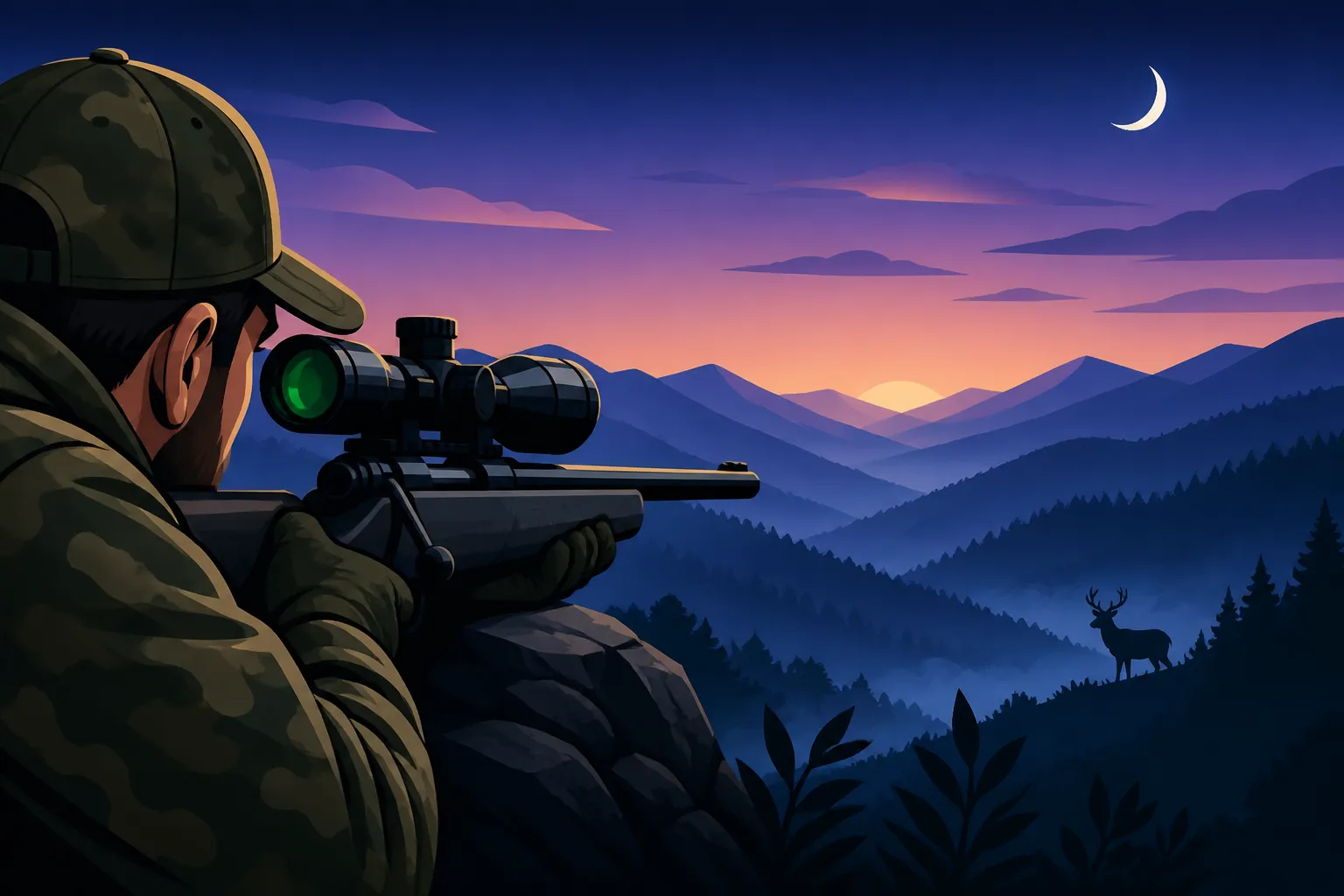
Hunting those steep, dark mountain coves and dense rhododendron thickets in North Carolina's high country often means dealing with incredibly challenging light conditions. Whether you're trying to pick out a deer moving at first light or make an ethical shot as dusk settles, your rifle scope's ability to gather and transmit light can make or break your hunt. This guide is all about helping you understand what makes a rifle scope perform in those critical low-light moments, ensuring you're prepared for whatever those rugged western North Carolina woods throw your way.
Why Low-Light Performance is Crucial in Mountain Hunting
When you're out chasing deer or even bear in the Blue Ridge Mountains, you're not always hunting wide-open fields. Instead, you're often nestled deep in a shaded hollow, under a canopy of thick hardwoods and evergreens, where the sun struggles to penetrate even at midday. These aren't your typical Piedmont farmland hunts where light is generally abundant. The very nature of mountain terrain creates perpetual low-light scenarios that demand specific equipment considerations.
The Challenge of Deep Mountain Coves and Thick Cover
Imagine setting up your stand or finding a vantage point in a deep cove in Pisgah National Forest. The sun might be shining brightly on the ridge tops, but down in that drainage, surrounded by towering trees and dense undergrowth like mountain laurel, it can feel like perpetual twilight. Deer often move through these areas during the dimmest hours, seeking cover and avoiding the more exposed slopes. Your ability to distinguish a deer's antler from a branch, or a vital zone from shadow, becomes incredibly difficult when your scope isn't pulling in every photon of available light. It’s a frustrating situation when you know deer are there, but you can’t get a clear read on them through your optic. You need every edge you can get to make a confident shot.
Ethical Shots in Fading Light
Making an ethical shot is paramount to responsible hunting, and nowhere is this more critical than in low-light conditions. A blurry image, poor contrast, or a hard-to-see reticle can lead to a rushed or poorly placed shot. In the mountains, tracking a wounded animal through thick brush and over rugged terrain in the dark is an incredibly dangerous and often unsuccessful endeavor. This isn't just about bagging a deer; it's about honoring the animal and ensuring a quick, clean kill. A quality low-light scope helps you extend your usable hunting time safely and ethically, giving you the confidence to wait for the best possible opportunity, even as the light begins to dim. It's about having the clarity to see exactly where your bullet needs to go, rather than guessing.
Understanding Scope Specifications for Low Light
The performance of a rifle scope in low light isn't magic; it's a result of specific optical and mechanical design choices. When you pick up a scope, you'll see a string of numbers like "3-9×40" or "4-16×50." These numbers, along with other features, tell you a lot about how well that scope will perform when the sun starts to dip below the ridges of Nantahala Forest.
Objective Lens Size and Exit Pupil
The most visible indicator of a scope's light-gathering capability is the objective lens size, typically the last number in the scope's description (e.g., the "50" in "4-16×50"). A larger objective lens simply has a wider aperture to let more light in. Think of it like a bigger window letting more sunshine into a room. However, what really matters for low-light performance is the exit pupil. The exit pupil is the diameter of the light beam that exits the eyepiece and enters your eye. It's calculated by dividing the objective lens diameter by the magnification. For example, a 10×50 scope (50mm objective at 10x magnification) has an exit pupil of 5mm. A 3×40 scope at 3x magnification would have an exit pupil of roughly 13.3mm.
During daylight, your eye's pupil constricts to about 2-3mm. But in low light, your pupil can dilate up to 7mm or even more, especially in younger individuals. For optimal low-light viewing, you want a scope's exit pupil to be at least as large as your dilated eye's pupil. If the scope's exit pupil is smaller than your eye's, you're not getting all the light your eye could use. This means a 50mm objective on a 10x setting (5mm exit pupil) is better than a 40mm objective on a 10x setting (4mm exit pupil) in true low-light conditions because it delivers a larger light cone to your eye. When you're trying to peer into a dark hollow, a larger exit pupil provides a brighter, more forgiving sight picture, making it easier to acquire your target and maintain a full field of view without having to perfectly align your eye with the scope.
Lens Coatings and Glass Quality
Beyond just the size of the glass, the quality of that glass and the coatings applied to it are absolutely critical. Even the biggest objective lens won't do you much good if the glass itself is hazy or if a lot of light is lost to reflection as it passes through the scope's many lenses. High-quality glass, often referred to as "ED" (Extra-low Dispersion) or "HD" (High Definition) glass, helps to minimize chromatic aberration (the colored fringing you sometimes see around objects) and delivers a sharper, clearer image. This clarity is paramount when you're trying to distinguish subtle details in a shadowed environment.
Lens coatings are microscopic layers applied to the glass surfaces that reduce glare and reflections while increasing light transmission. Most modern scopes are "multi-coated," meaning multiple layers are applied. Premium scopes will often be "fully multi-coated," meaning all air-to-glass surfaces have multiple layers of anti-reflective coatings. These coatings can significantly increase the amount of light that actually reaches your eye – from potentially 70-80% in older or cheaper scopes to 95% or more in top-tier optics. In those deep, dark coves of the Nantahala, every percentage point of light transmission makes a tangible difference, turning a murky outline into a discernible deer.
Reticle Types and Illumination
The reticle, or crosshairs, is what you use to aim. In low light, a fine, black reticle can completely disappear against a dark background, like the hide of a bear or the deep shadows of a hemlock stand. This is where an illuminated reticle truly shines. An illuminated reticle has a central dot, cross, or segment that glows, usually in red or green, with adjustable brightness settings. This allows you to place your aiming point precisely on the target, even when the rest of the sight picture is dim.
There are different styles, from simple illuminated dots to full illuminated crosshairs. For mountain hunting, where shots might be taken quickly at varying distances, a reticle that offers good visibility without being overly cluttered is ideal. Many illuminated reticles also feature an auto-off function to preserve battery life, which is a nice touch when you're miles from your truck. Consider a reticle that is intuitive and simple to use under pressure. While a complex reticle with holdover points can be useful for longer shots, in the typically closer ranges of heavy mountain timber, a clean, bold illuminated reticle is often more effective and faster to acquire.
Practical Considerations for Mountain Hunting Scopes
Choosing a scope for mountain hunting isn't just about how much light it gathers; it's also about how it handles the rigors of the environment and how it integrates with your overall hunting style. From weight to field of view, every feature plays a role in your success and comfort.
Weight and Durability in Rugged Terrain
When you're climbing those steep slopes in Pisgah, every ounce in your pack feels like a pound. A heavy rifle scope, while potentially offering better optical quality due to larger objective lenses and more robust construction, can become a burden over a long day. You're constantly ascending and descending, navigating fallen timber, and scrambling over rocks. A lightweight, yet durable scope is a true asset. Look for scopes built with aircraft-grade aluminum, O-ring sealed, and argon or nitrogen purged to prevent internal fogging – conditions you're absolutely likely to encounter with North Carolina's unpredictable mountain weather. Dropping your rifle or banging your scope against a rock isn't a hypothetical scenario; it's a very real possibility. You need an optic that can take a beating and still hold zero. Treestand Setups in Pisgah National Forest and Still-Hunting Nantahala Forest Ridges both emphasize the physical demands of this type of hunting.
Magnification Range and Field of View
While it might seem counterintuitive, you don't always need the highest magnification when hunting in thick mountain cover. In fact, too much magnification can be a hindrance. Most shots in the type of dense coves we're discussing will be at relatively close range, often under 100 yards, sometimes even under 50. At these distances, a wide field of view is invaluable for quickly acquiring a moving animal and tracking it through tight shooting lanes. A lower minimum magnification (e.g., 2x or 3x) with a wider field of view allows for faster target acquisition and better situational awareness.
A versatile magnification range, such as 3-9x or 2-10x, often hits the sweet spot for many North Carolina mountain hunters. It provides enough low-end for those close, fast shots, and enough top-end to make a precise shot if a deer steps out into a small opening at 150-200 yards. Remember, a higher magnification often means a narrower field of view and a smaller exit pupil, both of which work against you in low-light conditions.
Eye Relief and Eyebox
Eye relief is the distance your eye needs to be from the scope's eyepiece to see a full, clear image. A generous eye relief (typically 3.5 inches or more) is important for safety, especially with larger caliber rifles, to prevent the scope from striking your brow under recoil. It also provides a more comfortable shooting experience, allowing for a bit more flexibility in head position.
The "eyebox" refers to the area behind the scope's eyepiece where you can achieve a full, clear sight picture. A large, forgiving eyebox means you don't have to be perfectly aligned to see through the scope, which is a huge advantage when you're trying to get on target quickly, perhaps after an awkward movement in a treestand or while leaning around a tree. In those critical low-light moments, when a deer might just be passing through a narrow window, a forgiving eyebox means you spend less time "hunting" for the sight picture and more time focusing on the shot.
Choosing the Right Scope for Your Budget
Let's be real: quality optics can be a significant investment, but you often get what you pay for when it comes to low-light performance. However, there are excellent options across various price points. It's about finding the best value and features that align with your needs without breaking the bank.
Entry-Level vs. Mid-Range vs. Premium Optics
Scopes can range from a couple of hundred dollars to several thousand.
- Entry-Level scopes (often under a few hundred dollars) might offer basic functionality but will typically compromise on glass quality, lens coatings, and robust construction. While they'll work in good light, their performance will drop off significantly as light fades, making them less ideal for those critical low-light situations in deep mountain coves. They might also lack features like illuminated reticles or fog-proof/waterproof sealing.
- Mid-Range scopes (typically several hundred to a thousand dollars) represent a sweet spot for many hunters. Here, you start to see significant improvements in glass quality, more advanced multi-coatings, better light transmission, and often features like illuminated reticles. They are usually more durable, fog-proof, and hold zero reliably. Brands in this category often offer excellent value, balancing performance with affordability. You can usually find a scope that will perform admirably in low-light conditions without feeling like you've mortgaged the farm.
- Premium scopes (often well over a thousand dollars) offer the absolute best in optical clarity, light transmission, and mechanical precision. They use the highest quality ED/HD glass, proprietary coatings that push light transmission to 95%+, and incredibly robust construction designed for extreme conditions. These scopes truly excel in the dimmest light, often giving you precious extra minutes of shooting light at dawn and dusk. For hunters who spend a lot of time in challenging conditions and demand the very best, these are worth the investment. They can be found from top-tier European and American manufacturers.
Before you buy, spend time handling different scopes. Look through them at varying light levels, not just under bright store lights. If possible, try them outside as the sun goes down.
Features to Prioritize for Low-Light Mountain Hunting
When considering a scope for North Carolina's low-light mountain coves, prioritize these features:
- Objective Lens: Aim for at least 40mm, preferably 44mm or 50mm, especially if you plan to use higher magnifications in low light.
- Fully Multi-Coated Lenses: This is non-negotiable for maximizing light transmission. It significantly impacts how bright and clear your image will be in dim conditions.
- Illuminated Reticle: Essential for quick, precise aiming when your target is in deep shadow or against a dark background. Make sure it has adjustable brightness to avoid washing out your vision.
- Robust Construction: Look for a one-piece main tube, aircraft-grade aluminum, and nitrogen or argon purging to ensure fog-proof and waterproof performance. A scope that holds zero after a bumpy ride or an accidental bump is invaluable.
- Generous Eye Relief and Forgiving Eyebox: These enhance safety and speed of target acquisition, particularly important when wearing layers or in awkward shooting positions.
- Optimal Magnification Range: A versatile 2-10x or 3-9x is often ideal, balancing field of view with the ability to reach out if needed.
Consider how you hunt. If you're Still-Hunting Nantahala Forest Ridges and focusing on quick, close encounters, a wide field of view and excellent low-light clarity on the lower magnifications are paramount. If you're on a stand overlooking a powerline cut at last light, higher magnification might be more useful.
Maintaining Your Low-Light Scope
Your rifle scope is a precision instrument, and proper care is essential, especially when it's subjected to the harsh conditions of mountain hunting. A well-maintained scope will serve you for years, providing reliable performance when it matters most.
Cleaning and Protecting Lenses
The single most important aspect of scope maintenance for low-light performance is keeping your lenses clean. Dust, fingerprints, water spots, and smudges all degrade light transmission. Always use proper lens cleaning techniques and materials. Never use your shirt tail or a paper towel, as these can scratch the delicate coatings.
Here's a simple process:
- Blow off loose debris: Use a can of compressed air or a soft lens brush to remove any dust or dirt particles. Do not wipe a dry, dirty lens.
- Apply lens cleaning solution: Use a specialized optical cleaning solution. Apply a drop or two to a clean microfiber lens cloth, not directly to the lens.
- Gently wipe: Start from the center of the lens and wipe outwards in a circular motion. Use a clean part of the cloth for each wipe.
- Finish with dry cloth: Use a separate, clean, dry microfiber cloth to gently buff any remaining streaks.
Always keep lens caps on when not actively hunting to protect the objective and ocular lenses from scratches and dirt. A good scope cover, like a neoprene sleeve, offers an extra layer of protection when you're hiking through thick brush or in and out of your vehicle.
Storage and Handling Best Practices
When your scope isn't on your rifle or you're not actively hunting, proper storage is key. Store your rifle and scope in a cool, dry place, ideally in a padded gun case. Avoid extreme temperature fluctuations, which can stress seals and coatings. If you've been hunting in wet weather, allow your scope (and rifle) to dry thoroughly before storing it in a sealed case. A desiccant packet in your gun safe can help manage humidity and prevent rust or mildew.
When handling your rifle, avoid banging the scope against hard surfaces. If your scope takes a hard impact, it's a good idea to check its zero at the range before your next hunt. Sometimes, what looks like a minor bump can shift your point of impact. Many serious hunters use tools like GoHunt to track their hunts, plan routes, and even record shot data, which can include notes on equipment performance and maintenance history. Knowing what you've put your gear through helps you decide when it's time for a re-check or a more thorough inspection. This kind of planning and tracking can also help with Scouting North Carolina Public Land Before Season to avoid putting undue stress on your gear in the field.
Conclusion
Hunting North Carolina's low-light mountain coves is a challenging yet incredibly rewarding experience. By understanding the critical role your rifle scope plays in these conditions and choosing an optic that maximizes light transmission, clarity, and durability, you can significantly improve your chances of success while always upholding ethical hunting standards. Investing in a quality low-light scope isn't just about buying a piece of gear; it's about investing in your confidence, your safety, and the respect you give to the game animals you pursue. Take the time to research, handle different models, and prioritize the features that truly matter for the demanding environment of our beautiful mountains.
Disclaimer
This article is for general informational purposes only and does not constitute professional advice. Laws, prices and regulations vary by location and change over time. Consult a qualified professional for guidance on your specific situation.