Feral Hogs Across North Carolina
For anyone who’s spent time hunting or farming in North Carolina, the sight of rooted-up fields or wallows in a pristine creek bottom is a familiar, frustrating one. Feral hogs aren't just a nuisance; they're an invasive species causing widespread ecological and agricultural havoc across our state. This comprehensive guide is here to shed light on everything you need to know about these elusive, destructive animals, from their biology and spread to the most effective hunting and trapping strategies to help get them under control.
The Growing Problem of Feral Hogs in North Carolina
Feral hogs are perhaps one of the most significant wildlife management challenges facing North Carolina today. These aren't just wild pigs; they're an incredibly adaptable, highly intelligent, and prolific species that devastates everything from agricultural crops to delicate ecosystems. Their impact is felt deeply, not only by farmers losing significant portions of their harvest but also by wildlife managers concerned about the future of native game animals.
Where North Carolina's Feral Hogs Are Most Prevalent
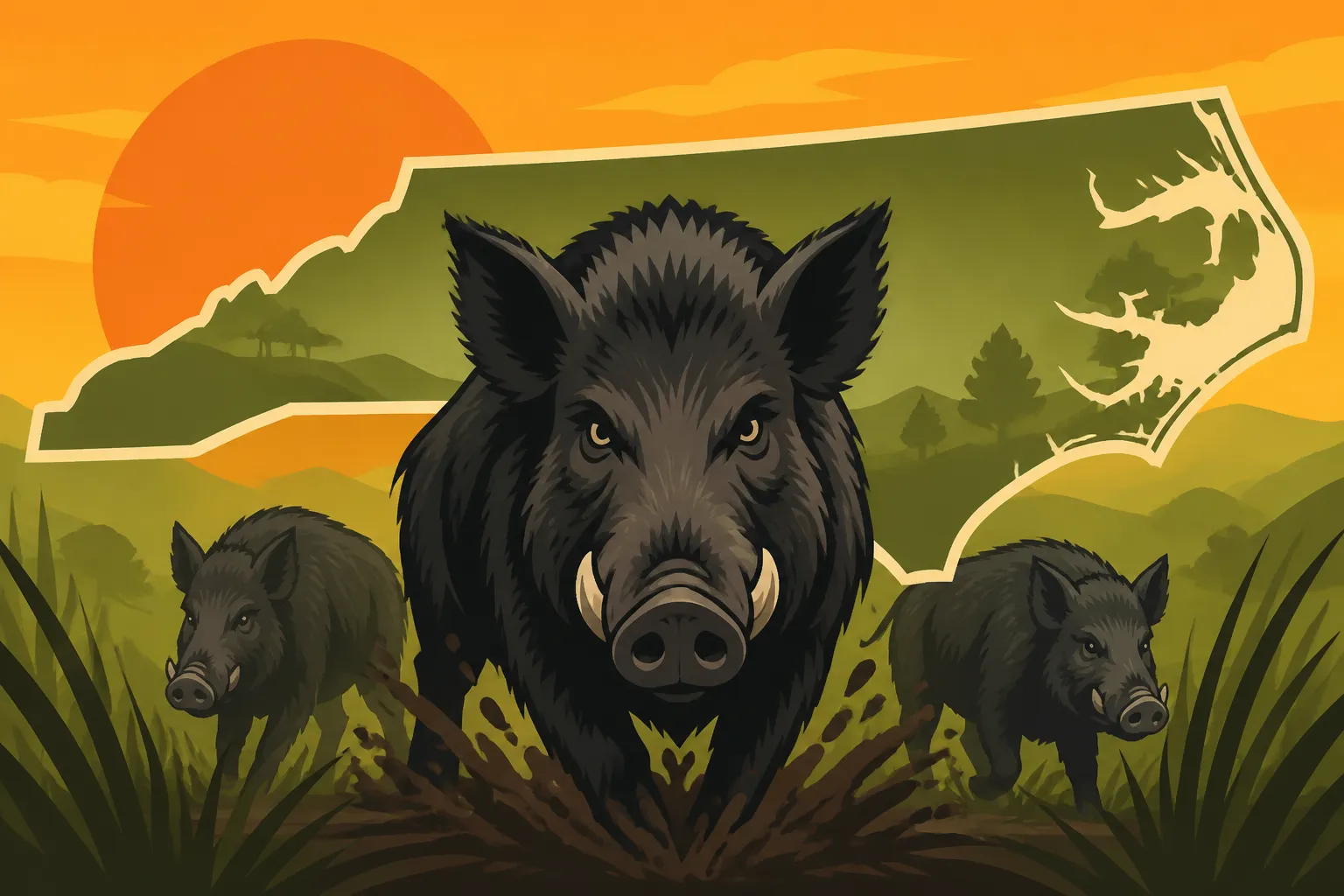
While you might encounter a feral hog almost anywhere in North Carolina, their populations are not evenly distributed. Historically, the Coastal Plain and Sandhills regions have harbored the highest concentrations of these animals. Think about the vast, dense pocosins, river bottomlands, and extensive pine plantations of counties like Bladen, Sampson, and Brunswick; these areas offer the perfect mix of thick cover, abundant food sources, and access to water. The Croatan National Forest, for example, is well-known for its hog populations, making it a challenging but rewarding area for those willing to venture into the swampy depths.
However, in recent years, their range has expanded significantly, pushing into the Piedmont and even touching the eastern edges of the Mountain region. This spread is often linked to human activity, whether intentional or accidental releases, or simply the hogs' incredible ability to travel and establish new sounders. Farms bordering river systems like the Cape Fear or Neuse are particularly vulnerable, as these waterways serve as natural corridors for hog movement. It’s becoming increasingly common to hear of them in areas that were historically free of feral swine, highlighting the urgent need for consistent control measures.
The Destructive Impact on Agriculture and Native Wildlife
The damage caused by feral hogs is staggering and multifaceted. On the agricultural front, farmers bear the brunt of their destructive rooting behavior. A sounder of hogs can decimate an entire field of corn, soybeans, peanuts, or sweet potatoes in a single night. They don't just eat what they want; they root up entire rows, making fields impassable for machinery and causing massive economic losses for hardworking North Carolina farmers.
Beyond agriculture, the environmental impact on our native wildlife and habitats is equally concerning. Feral hogs are opportunistic omnivores, meaning they'll eat just about anything. This includes preying on the fawns of our cherished white-tailed deer, consuming turkey poults and the eggs of ground-nesting birds like quail, and directly competing with deer, bears, and other wildlife for vital food sources like acorns. Their rooting also disturbs sensitive wetland habitats, degrades water quality, and facilitates the spread of invasive plant species. Effectively, they act as living rototillers, disrupting the soil structure and making it harder for native vegetation to thrive, especially in crucial areas like the Sandhills Longleaf Public Ground. It's a domino effect that impacts the entire ecosystem, making control efforts not just about protecting crops but about preserving North Carolina's natural heritage.
Understanding Feral Hog Biology and Behavior
To effectively combat the spread and impact of feral hogs, it's crucial to understand what makes them such formidable adversaries. Their biology and behavior are perfectly adapted for survival and rapid population growth, which is precisely why they pose such a persistent challenge. Without this foundational knowledge, any efforts to control them will likely fall short.
Reproductive Rates and Population Dynamics
One of the most astonishing, and concerning, aspects of feral hogs is their incredible reproductive capacity. Unlike many native game species that breed once a year, feral sows can have multiple litters annually, sometimes as many as two or even three litters in a 12-to-15-month period. To make matters even more challenging, they reach sexual maturity at a remarkably young age, often as early as 6-8 months old. Each litter can range from 4 to 12 piglets, with an average of around 6-8.
Consider a small sounder of just a few sows. Within a year, that group can exponentially grow into a significant problem. With high survival rates in North Carolina's mild climate and abundant food sources, these populations can double in size in as little as four to six months. This rapid turnover means that for control efforts to be effective, hunters and trappers need to remove a substantial percentage of the population just to keep numbers from growing, let alone reducing them. It's a treadmill that requires constant and dedicated effort, as the article How Wild Hogs Spread Across North Carolina details.
Diet, Habitat, and Movement Patterns
Feral hogs are the ultimate survivors, thanks in large part to their incredibly varied diet and adaptability to different habitats. They are true omnivores, meaning they'll eat almost anything. Their preferred diet often includes mast crops like acorns and pecans, which are abundant in North Carolina's hardwood forests. However, they'll readily consume agricultural crops, roots, tubers, fungi, insects, snakes, eggs, and even small mammals and fawns. This opportunistic feeding allows them to thrive in diverse environments, from the rich agricultural lands of the Piedmont to the dense, nutrient-poor pocosins of the coast.
Their preferred habitats often include areas with dense cover, access to water, and reliable food sources. This means you'll find them in river bottomlands, expansive swamps, thick pine plantations, and anywhere adjacent to agricultural fields. They are primarily nocturnal, especially in areas with human pressure or during warmer months, moving from their bedding areas in thick cover to feeding grounds under the cloak of darkness. Their daily movements can cover significant distances, often following established game trails or creek beds. Understanding these patterns is key to successful interception, whether you're setting a trap or scouting for a stand location. They often create wallows in muddy areas to cool off and remove parasites, leaving tell-tale signs of their presence.
Legal Framework for Hunting and Trapping Feral Hogs in North Carolina
Navigating the rules for hunting and trapping feral hogs in North Carolina can be a bit tricky, as the regulations differ significantly depending on whether you're on private or public land. It's absolutely crucial to be informed about the specific laws to ensure you're hunting legally and ethically. The North Carolina Wildlife Resources Commission (NCWRC) views feral hogs as an invasive species, and as such, has implemented specific rules to encourage their removal rather than managing them as a traditional game animal.
North Carolina's Year-Round Hog Rule on Private Land
This is perhaps the most important distinction for many hunters. On private land in North Carolina, feral hogs are classified as an unprotected, destructive invasive species. This means that there is no closed season and no bag limit for feral hogs on private lands. Hunters can pursue them year-round, day or night. This broad regulation is a direct response to the significant damage hogs cause to crops and natural resources, and the NCWRC actively encourages landowners and hunters to remove them whenever possible.
When hunting on private land, you can also use methods that are typically restricted for other game, such as artificial lights, night vision, and thermal optics. This flexibility is incredibly valuable, as hogs are often most active at night, especially in areas with hunting pressure. However, you absolutely must have landowner permission to hunt on private land. Without explicit permission, you are trespassing, which carries serious penalties. Remember, even with these liberal rules, responsible firearm use and safety always come first. For a deep dive into these specifics, refer to North Carolina's Year-Round Hog Rule on Private Land.
Regulations on North Carolina Public Game Lands
The rules change dramatically once you step onto public land in North Carolina, such as Game Lands or National Forests. On public land, feral hogs are generally not considered a game animal, but their take is typically restricted to the legal hunting seasons for other game animals like deer or bear. This means you can only hunt hogs during the established gun or archery seasons for those species, and you must use the legal weapon type for that specific season. For instance, if you're on a Game Land during archery season, you can only use archery equipment to harvest a hog. During gun season, you can use legal firearms.
This regulation is in place to minimize hunter conflicts and ensure the safe management of public resources, given the high number of hunters pursuing other species. The critical takeaway here is that you cannot simply go out and hunt hogs year-round on public land with lights and thermal gear. Always check the specific regulations for the particular Game Land or National Forest you plan to hunt, as some areas may have unique rules or special managed hunts. Using the NC Wildlife Map Tool can be incredibly helpful for understanding specific boundaries and rules. Always consult the latest NCWRC regulations for the exact public land you plan to hunt to avoid any misunderstandings or violations.
| Feature | Private Land Hunting (Feral Hogs) | Public Land Hunting (Feral Hogs) |
|---|---|---|
| Season | Year-round, no closed season | Restricted to legal deer/bear seasons |
| Bag Limit | No bag limit | No bag limit |
| Hunting Hours | Day or night | Typically daylight hours, matching game seasons |
| Weapons | Any legal firearm/archery, including thermal/night vision, lights | Legal weapons for the concurrent game season |
| Permission | Required from landowner | Required valid hunting license & Game Lands permit |
| Baiting | Legal | Generally illegal |
| Dogs | Legal in most areas | Highly restricted; check specific Game Land rules |
Effective Hunting Strategies for North Carolina Feral Hogs
Hunting feral hogs can be an incredibly rewarding, albeit challenging, endeavor. Their intelligence, keen senses, and ability to adapt to pressure make them a formidable opponent. However, by understanding their habits and employing effective strategies, you can significantly increase your chances of success. It's a different game than deer hunting, often requiring more aggressive tactics and a keen eye for subtle signs.
Still-Hunting and Stalking in Dense Cover
Still-hunting and stalking are highly effective methods, especially in the thick, dense cover that hogs favor, such as pocosins, river bottoms, and dense pine plantations. This strategy relies heavily on stealth, patience, and the ability to read sign. Start by scouting for fresh tracks, rooting, and rubs, which indicate recent hog activity. Hogs leave distinct rooting patterns, tearing up the ground to feed on roots and invertebrates, and often rub against trees or fence posts, leaving mud and hair behind.
When moving through the woods, keep the wind in your face or across your body, as hogs have an incredible sense of smell. Take one or two slow steps, then pause, listening and scanning your surroundings. Look for any movement, a patch of black, or the tell-tale shimmer of a hog's hide. Pay close attention to areas where dense cover meets more open feeding grounds, like the edges of a cut-over or a transition line between a swamp and an oak ridge. Hogs will often travel these edges. Moving slowly and quietly, much like you would when Still-Hunting Nantahala Forest Ridges for deer, but with an even greater emphasis on silence, will allow you to slip into their domain undetected.
Stand Hunting Over Bait and Food Sources
Stand hunting, particularly over bait or natural food sources, is a proven tactic for feral hogs, especially on private land where baiting is legal. If you're on private land, establishing a consistent bait site with shelled corn can draw hogs in regularly. Consistency is key – keep the bait fresh and plentiful. Set up your stand downwind from the bait site, ensuring you have a clear shot. Hogs often approach cautiously, circling downwind before committing to the bait, so position yourself to account for their approach angle. Since hogs are often nocturnal, Night Hunting Hogs With Lights on Private Land can be incredibly effective, allowing you to intercept them during their peak activity.
On public land where baiting is illegal, focus on natural food sources. This means identifying areas with abundant acorns in the fall, or scouting field edges that border dense cover. During crop maturity, such as when corn or peanuts are ripe, hunting the perimeter of these fields, especially at dawn and dusk, can yield excellent results. Hogs will often travel from their bedding areas in thick timber or swamps to these fields to feed. Look for entry routes Through Standing Soybeans or paths leading from a river bottom into a cornfield. Setting up a ground blind on a field edge, brushed in naturally, can offer excellent concealment.
Using Dogs for Feral Hog Control
Using dogs to hunt feral hogs is a traditional and highly effective method, particularly in dense, inaccessible terrain where still-hunting is extremely difficult. While regulated differently on public lands, using dogs for hog control is widely practiced on private properties in North Carolina, especially in the Coastal Plain's thick pocosins. The process typically involves two types of dogs: bay dogs and catch dogs.
Bay dogs are usually faster, more agile hounds that locate the hog and "bay" it, meaning they surround it and bark loudly to keep it in place without direct contact. This allows the hunter to approach. Catch dogs, often larger, more powerful breeds, are then released to engage the hog, catching it by the ear or leg, holding it down so the hunter can dispatch it safely. This method, often done on foot in the thickest cover, can be dangerous for both hunters and dogs, requiring proper protective gear for the dogs (like cut vests) and careful handling. It's a fast-paced, adrenaline-filled hunt that requires a deep understanding of dog behavior and hog dynamics. Running Hounds Where North Carolina Allows It for other game species shares some similarities, but hog hunting with dogs is a specialized pursuit aimed at aggressive eradication rather than traditional sport hunting.
Trapping and Advanced Control Methods
While hunting can be effective for individual hogs, trapping is often the most efficient method for controlling entire sounders of feral hogs, especially when dealing with large populations or extensive damage. Trapping allows for the capture of multiple animals at once, which is critical for making a real dent in their rapidly reproducing numbers. It requires patience, strategic placement, and a bit of psychology to outsmart these intelligent animals.
Building and Setting Effective Hog Traps
When it comes to trapping feral hogs, the type of trap and its placement are paramount. Common trap designs include large corral traps, which are circular or square enclosures made of heavy-duty hog panels, often 4-6 feet high, and equipped with a "rooter" or "drop" gate. Box traps, smaller and more portable, are also used for individual hogs or smaller sounders. The key to success lies in pre-baiting. For several days, or even weeks, before setting the trap, you should consistently bait the area around and inside the unset trap. This allows the hogs to get accustomed to feeding there, building their confidence and reducing their wariness of the structure. Use strong-smelling attractants like fermented corn or commercial hog attractants to draw them in.
Trap placement should be in known travel corridors, near wallows, or in areas with heavy rooting and feeding activity. Ensure the trap is sturdy, secure, and camouflaged as much as possible with natural vegetation. Once the hogs are regularly entering the unset trap to feed, then you can set the trigger mechanism. Many modern traps incorporate remote camera monitoring, allowing trappers to watch hog activity without disturbing the area, and even trigger gates remotely when an entire sounder is inside. This technological edge is a game-changer for effective trapping, and resources like GoHunt often highlight how mapping and scouting tools can aid in identifying prime trap locations.
Advanced Trapping Techniques and Management
To truly manage feral hog populations, especially in areas with extensive damage, advanced trapping techniques are often employed. The goal isn't just to catch a few hogs; it's to achieve "whole sounder removal." This means capturing every single hog in a family group, from the largest boar to the smallest piglet, in one fell swoop. If even a few individuals escape, they learn to be trap-shy, becoming incredibly difficult to catch in the future, and will quickly reproduce to replenish the sounder.
Advanced methods often involve large, multi-panel corral traps designed to hold an entire sounder. These traps might use motion-activated cameras or cellular-activated gates that can be triggered from a distance once all hogs are confirmed inside. Professional hog trappers or wildlife cooperatives often employ these sophisticated systems, working systematically to clear areas of hogs. It’s a labor-intensive but highly effective approach, often proving more efficient than hunting alone for significant population reduction. Trapping North Carolina Feral Hogs outlines these challenges in more detail. In North Carolina, the NCWRC works with landowners and other agencies to facilitate these large-scale efforts, understanding that a comprehensive approach is necessary to tackle the magnitude of the problem.
Processing and Utilizing Harvested Hogs
Harvesting a feral hog is just the first step; proper field dressing, handling, and butchering are essential for ensuring a quality meal and minimizing potential health risks. Unlike domestic pork, wild hogs can carry certain diseases, so handling with care and cooking thoroughly are paramount. It’s a responsibility that comes with the harvest, but one that yields some of the finest wild game meat available.
Field Dressing and Initial Care
Given North Carolina’s often warm climate, especially during early archery seasons or even into late fall, prompt field dressing is crucial to prevent meat spoilage. As soon as a hog is down, the first step is to bleed it out quickly and thoroughly. This can be done by sticking the jugular vein or severing the carotid artery near the chest. Next, gut the animal immediately. Remove all internal organs, taking care to avoid rupturing the intestines. For smaller hogs, you might be able to drag them to a more suitable processing area, but for larger animals, field quartering might be necessary.
Once gutted, the carcass needs to be cooled down as rapidly as possible. If you’re far from your vehicle, pack the cavity with ice or, at the very least, prop the cavity open to allow air circulation. In warmer temperatures, leaving the hide on can actually trap heat, so skinning in the field might be a good option if conditions allow. Always wear gloves when handling feral hogs to minimize direct contact with blood and bodily fluids. While rare, diseases like brucellosis can be transmitted, so good hygiene is critical. Make sure to check the North Carolina Deer Reporting Requirements for details on reporting your harvest, though rules for feral hogs may differ from those for deer.
Butchering and Cooking Wild Pork
Butchering a feral hog is similar to butchering domestic pork, but with a few key differences. Wild hogs typically have tougher muscle fibers and less fat, meaning certain cuts might benefit from different cooking methods. Start by skinning the hog (if not already done) and then breaking it down into primal cuts: shoulders, hams, loins, and ribs. The shoulders and hams are often best slow-cooked, braised, or used for pulled pork, as they contain more connective tissue. The loins and backstraps are lean and tender, excellent for grilling or roasting. Ribs can be slow-cooked or smoked for delicious results.
When preparing wild pork, it’s imperative to cook it to a safe internal temperature of 160°F (71°C). This is especially important to kill any potential parasites like Trichinella, though the risk in wild hogs is relatively low compared to historical concerns. Using a meat thermometer is the best way to ensure safety. Wild hog meat has a distinct, rich flavor, often less fatty and more gamey than domestic pork, which many hunters find superior. Don't be afraid to experiment with marinades and seasonings that complement game meat. Remember, utilizing your harvest honors the animal and provides delicious, lean protein for your table.
Disclaimer
This guide is intended for informational purposes only and does not constitute legal advice. Hunting and trapping regulations in North Carolina are subject to change. Always consult the latest North Carolina Wildlife Resources Commission (NCWRC) regulations and local ordinances before engaging in any hunting or trapping activities. It is your responsibility to understand and adhere to all applicable laws.