Rattling Volume in Thick Pine Cover
There’s nothing quite like the anticipation of clashing antlers together, hoping to draw in that big North Carolina buck. But let's be honest, trying to make an effective rattling sequence in those dense pine thickets we have across much of the state can feel like you're shouting into a pillow. The sound just doesn't carry, or it sounds completely unnatural. You end up wondering if you’re doing more harm than good. This guide is all about mastering the art of rattling, specifically focusing on how to adjust your volume and tactics to be effective in North Carolina's challenging, thick pine cover, ensuring your efforts don't go unheard or, worse, misinterpreted by a wary deer.
Understanding Sound Travel in North Carolina Pine Thickets
The challenge of rattling in dense pine isn't just about making noise; it's about understanding how that noise travels—or doesn't—through a complex acoustic environment. Many hunters, myself included, have stood in a young loblolly plantation, clanging away, and wondered if anything beyond 20 yards could even hear us.
The Acoustic Challenges of Dense Pine
Imagine trying to have a conversation through a thick wool blanket; that's essentially what sound waves encounter when you're rattling in a dense pine thicket. The sheer volume of needles, branches, and often a thick understory of briars and saplings acts as an incredible sound dampener. Each obstacle absorbs and scatters sound energy, preventing it from traveling far and making it difficult for deer to accurately pinpoint its source. This is especially true in areas with tight rows of planted pines, where the uniform growth creates an almost impenetrable acoustic barrier.
Traditional, aggressive rattling sequences that might work wonders in more open hardwoods or ag fields simply become a muffled, unconvincing mess in these environments. Instead of sounding like two bucks duking it out, it can sound like a distant, indistinct thumping, or worse, just a sudden, jarring noise that puts deer on high alert without the benefit of a clear auditory picture. Whether you're in the regrowth of a clear-cut in the Coastal Plain or a dense stand of pines on the edge of the Piedmont, the physics of sound absorption remain the same, demanding a different approach from the hunter.
How Deer Perceive Sound in Thick Cover
Deer, with their incredible sense of hearing, rely heavily on auditory cues, especially in their dense, visually obstructed habitats. They're not just hearing a sound; they're trying to interpret it: What is it? How far away is it? Is it a threat or an opportunity? In thick pine cover, where visibility is often limited to mere yards, their reliance on sound intensifies. However, the same acoustic dampening that frustrates us also affects how they receive the sound.
A loud, aggressive rattle might reach them, but its origin will be harder to discern, and it might sound more distant or muffled than it actually is. Conversely, a subtle, realistic rattle, even if quiet, can be incredibly effective if it aligns with their expectations of what bucks sound like when sparring in close quarters. They’re listening for the nuanced cracks of antlers, the scuffling of hooves, and the heavy breathing that accompanies a real fight. Furthermore, factors like wind and thermals play a massive role. A stiff wind can carry sound away or distort it, while calm air or subtle thermals can allow even soft sounds to travel farther and more clearly. Understanding these dynamics is crucial for making your rattling efforts truly resonate with the local deer.
Adjusting Your Rattling Volume and Intensity
The key to successful rattling in thick pine cover isn't about making the most noise, but rather the right noise, at the right volume, for the specific situation. It’s a nuanced dance between imitating natural sounds and compensating for environmental factors.
Soft Rattling for Close Encounters
In dense pine, where deer might only be a few yards away without you even knowing it, soft rattling is often your best bet. Think of it as mimicking two young bucks, or a non-dominant buck, engaging in a light sparring match. This isn't about a violent, crashing fight; it's about subtle, controlled clicks, clacks, and rubs of the antlers.
You’d use this approach when you're setting up near known bedding areas, tight travel corridors between thicker cover, or even just slowly still-hunting through a thicket and want to test the waters. The goal is to create just enough sound to pique a deer's curiosity without startling them. A quick, 10-15 second sequence of soft, realistic antler contact, followed by 5-10 minutes of intense listening and scanning, can be incredibly effective. The deer might already be very close, so a sudden loud crash could send them bolting. Instead, a soft, inviting sound, coupled with a few light grunts, might just convince that hidden buck to take a few steps your way to investigate the "new arrivals." This is where knowing how to articulate a good grunt call can really shine, complementing the soft antler sounds.
Moderate Volume for Drawing Them In
There are times when you need a bit more reach, but still want to avoid sounding like a freight train. This is where moderate rattling comes into play. You’re still aiming for realism, but increasing the intensity just enough to push the sound through a bit more pine needles and underbrush, without losing its authenticity.
A moderate sequence might involve slightly harder antler clashes, maybe for 20-30 seconds, mimicking a mid-level sparring match where bucks are getting a bit more serious. It’s not a full-blown brawl, but more than just a friendly tap. You’ll want to incorporate some pushing and grinding of the antlers, simulating a buck trying to gain dominance. This works well in slightly more open sections of a thicket, or along the edges where dense cover meets a small clearing or a logging road. You might be trying to pull a buck out of a slightly deeper bedding area, or intercept one moving through a transition zone. Just like with soft rattling, follow your sequence with a long period of silence and observation. Deer in thick cover can approach silently, taking their sweet time to circle downwind and scent-check the area before revealing themselves.
Rarely Aggressive: When to Go Loud and Why It's Rare in Thick Pine
Let’s be clear: aggressive, loud rattling in thick pine cover is almost always counterproductive. In wide-open spaces, a thunderous crash can project sound for hundreds of yards, signaling a major fight that draws in distant bucks. In dense pine, that same sound often gets muffled and distorted, losing its realistic quality. Instead of sounding like a fight, it can sound like an alarming, unnatural noise that sends deer scurrying in the opposite direction.
The only scenarios where you might consider a slightly more aggressive sequence would be during extremely high winds, when ambient noise is already significant, and you need to punch through it. Even then, you risk blowing out any deer within 50-100 yards who will interpret it as a threat due to the distorted sound. Or, perhaps, if you are positioned on the very edge of an exceptionally thick pine block, looking out over a more open area, and are trying to draw a buck from the pine into the open. In these rare cases, the loud rattling might serve to pull a buck to the edge of the thicket, but still, your expectations for a deer to come crashing in are likely unrealistic. For the vast majority of North Carolina's thick pine habitats, err on the side of caution and subtlety; it's almost always the more effective approach.
Strategic Rattling Tactics for Thick North Carolina Pine
Effective rattling in dense pine goes beyond just how loudly you clash your antlers. It's about setting the stage, telling a believable story, and having the patience to let the narrative unfold.
Positioning for Optimal Sound and Visuals
Your setup is paramount when rattling in thick cover. You can't just plop down anywhere. First, always consider the wind. You want to be downwind of where you expect deer to approach, as they will almost certainly try to circle and get your scent. This means setting up so the prevailing wind carries your scent away from their likely approach path. Second, within the thicket, look for any natural openings, subtle travel corridors, or slightly elevated terrain features. These aren't just good spots for a deer to walk; they also help sound travel a bit further and more clearly.
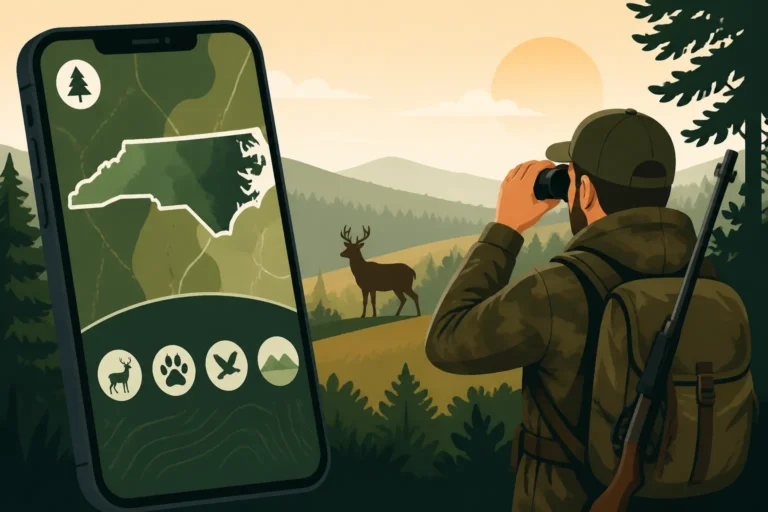
Using a good mapping app like GoHunt can be invaluable here. You can identify those subtle ridge lines, creek bottoms, or powerline cuts that might create a natural funnel or a slightly less dense area within a sea of pines. Set up on the edge of these features. You’ll also need clear, short shooting lanes, as any deer responding to your rattle will likely appear quickly and close by. It’s often better to have a few 20-30 yard lanes in thick cover than to try for 100-yard shots in denser spots. Remember, the goal isn't just to make noise, but to invite a deer into a position where you can ethically take a shot. Hanging a stand on a Pisgah ridge or setting up on a Piedmont field edge requires similar attention to detail, but in thick pine, the distances shrink dramatically.
Incorporating Grunts and Deer Calls
Rattling in isolation can be effective, but in thick cover, adding vocalizations makes your story much more convincing. Imagine two bucks fighting: there's noise, but there are also grunts, snorts, and heavy breathing. Incorporating grunts, especially dominant grunts or tending grunts, can really seal the deal.
Start with your rattling sequence – soft or moderate, depending on the situation – and then follow it immediately with a few deep grunts. This gives the impression of a heated interaction, making the scene more irresistible to a curious buck. You can also mix in some tending grunts during a quieter rattling sequence to portray a buck actively pursuing a doe. Don't be afraid to experiment with other calls too, like a fawn bleat if you think a doe might be nearby. The key is to make the entire sequence sound like a living, breathing interaction, drawing on the deer's natural curiosity and dominance instincts. Remember, the goal is to create a realistic scenario, and real deer make more than just antler noise.
The Importance of Patience and Observation
This is where many hunters, myself included, lose patience. You rattle for a minute, wait two, and then move on. But in thick pine, responding deer are rarely in a hurry. They are smart, cautious, and adept at navigating their dense world silently. A buck responding to your rattle might take 10, 15, or even 20 minutes to circle downwind, assess the situation, and finally approach.
After each rattling and calling sequence, commit to a minimum of 10-15 minutes of absolute silence and intense observation. Scan every shadow, every cluster of pines, every movement. Look for subtle cues: a flicking ear, a twitching tail, a flash of white belly, or even just the sudden appearance of a dark patch that wasn't there a moment ago. Deer in thick cover are masters of stealth. Sometimes, a second or third calling sequence, identical to the first, after a long waiting period, can finally convince a reluctant buck to commit. Knowing how to read a ridge for mountain zone deer for subtle signs is a similar skill that transfers well to this patience game. This isn't a sprint; it's a marathon of subtle sounds and unwavering focus.
Gear and Environmental Considerations
Beyond technique, having the right gear and understanding how the environment impacts your efforts are crucial for maximizing your chances in North Carolina's thick pine cover.
Choosing the Right Rattling Antlers
When it comes to rattling, the tool can be just as important as the technique. You've got options: real antlers, synthetic antlers, or rattling bags.
- Real Antlers: These offer the most authentic sound, hands down. The natural bone-on-bone contact creates a spectrum of sounds that's hard to replicate. If you're using real antlers, consider a set from a younger buck for softer, more subtle sounds, or a larger, heavier set for when you need a bit more 'oomph' (though still used sparingly in thick pine). The drawback is they can be bulky and noisy to carry.
- Synthetic Antlers: Brands like Rattlin' Racks make excellent synthetic antlers that are designed to sound realistic while being more durable, often lighter, and quieter to carry. They can be easier to control for varied volumes. The Primos Rattling Bag is another fantastic option, allowing you to create subtle sounds with just one hand, perfect for sitting in a ground blind or stand where movement is restricted. These are often easier to manipulate for the subtle clashes and grinds that are so effective in dense cover.
- Rattling Bags: These are incredibly versatile for thick cover. They allow for very controlled, soft sounds, mimicking light sparring or even just a buck rubbing his antlers on a tree. They're compact, quiet to carry, and can be operated with minimal movement.
Ultimately, experiment with different types to find what you're most comfortable with and what gives you the most realistic and controllable sound for the tight confines of pine thickets.
Wind, Thermals, and Ambient Noise
These environmental factors are often overlooked but can make or break your rattling success.
- Wind: Wind is a double-edged sword. A light, steady breeze can help carry your sound, but a strong, gusting wind will distort it, make it harder for deer to pinpoint, and can make your rattling sound less natural. It also carries your scent far and wide. On windy days, you might need to increase your volume slightly (still keeping realism in mind) and position yourself directly into or across the wind from where you expect deer, forcing them to come in head-on to pick up your scent. Or, consider calling during lulls when the wind dies down.
- Thermals: In North Carolina's rolling Piedmont and especially the mountainous regions, thermals play a significant role. Air flows downhill in the morning and uphill in the evening. If you're calling in a creek bottom or a hollow surrounded by pines, your sound (and scent) will follow these air currents. Understanding Wind and Thermals on a Blue Ridge Slope is crucial. Rattling when thermals are stable or working in your favor can give your sounds better projection and direction.
- Ambient Noise: The forest is rarely silent. Rustling leaves, chirping birds, distant traffic, or even the subtle creak of trees can mask your rattling efforts. Sometimes, calling during a louder gust of wind or a passing squirrel's chatter can blend your sounds in more naturally, making them less alarming. Conversely, in dead-still conditions, even a soft rattle can sound incredibly loud and startling, so adjust your volume accordingly.
| Rattling Volume | Scenario in Thick Pine | Sound Description | Likely Outcome (with patience) |
|---|---|---|---|
| Soft/Subtle | Bedding areas, tight cover, stalking | Light clicks, gentle scrapes, minimal force, short bursts | Draws in curious deer already close, non-threatening |
| Moderate | Edge of thicket, small clearings, transition zones | Controlled clashes, grinding, pushing, longer sequences | Appeals to active bucks, covers slightly more ground |
| Aggressive/Loud | Rarely effective in thick pine | Heavy crashes, violent antler contact, extended duration | Risks spooking deer, distorted sound, only in high wind |
Remember, North Carolina's pine country, whether it's a coastal plain pocosin swamp or a Piedmont cut-over, demands a thoughtful and subtle approach to rattling. Don't be afraid to experiment, but always prioritize realism and adapt to the specific conditions of your hunting area. Finding ground others walk past often means hunting those thick, nasty spots, and rattling effectively there can make all the difference.
Disclaimer
Hunting is an inherently dangerous activity. Always prioritize safety, adhere to all local and state regulations, and ensure you have proper training and licensing before heading into the field. The information provided in this guide is for informational purposes only and should not replace professional instruction or local wildlife agency guidelines.