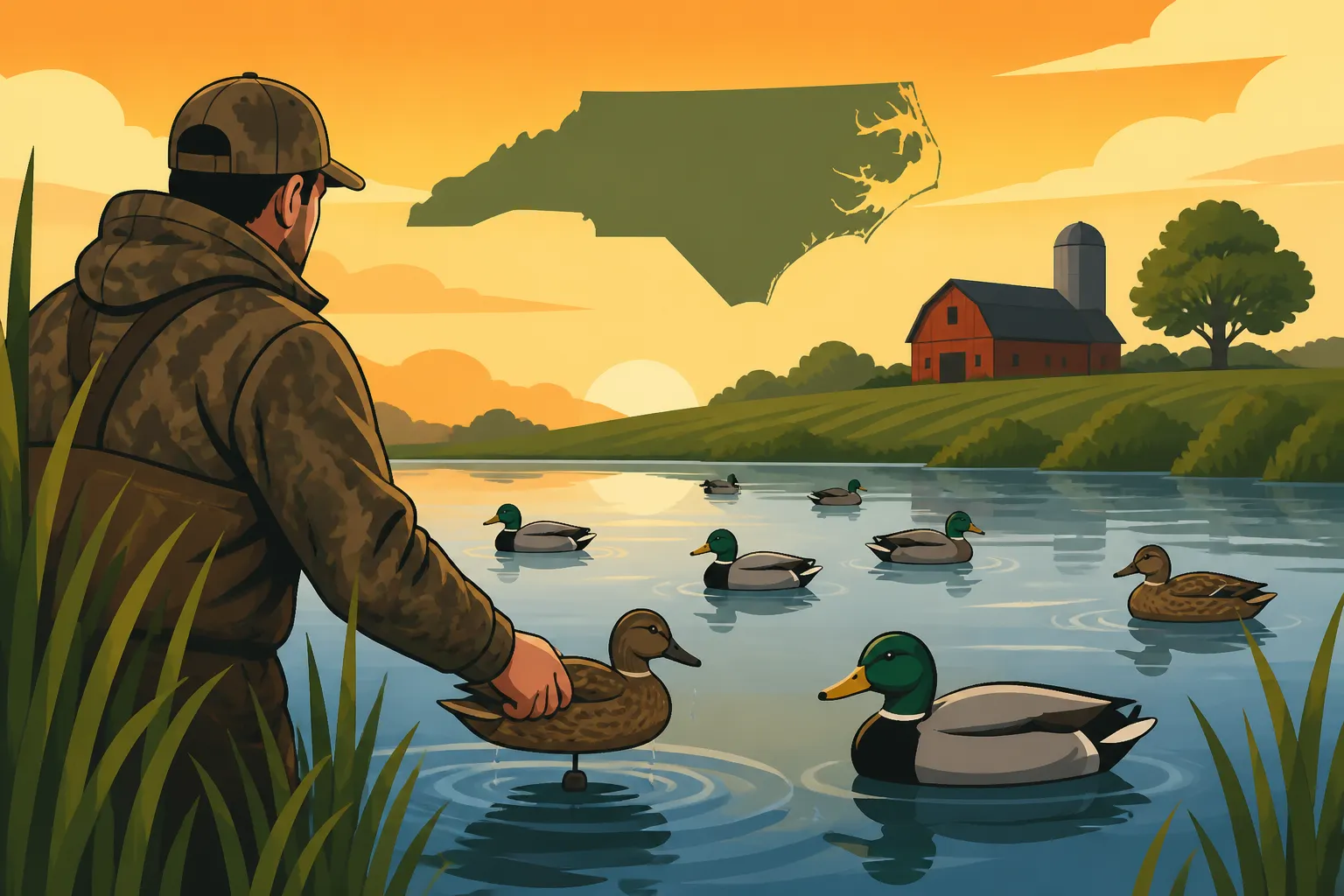
Setting Decoys on a Farm Pond
There’s nothing quite as frustrating as waking up before dawn, hauling a bag of decoys through the muck, only to watch ducks cup their wings, get a look at your setup, and then flare off into the sunrise without so much as a second glance. It feels like you did everything right—you got up early, you’re in a good spot—but those birds just aren't committing. Setting decoys on a farm pond can be incredibly rewarding, but it’s an art form, not just a chore. This comprehensive guide is here to walk you through the nuances of making your farm pond decoy spread irresistible to North Carolina waterfowl, ensuring those ducks finish right in front of your blind.
Understanding Farm Pond Dynamics and Duck Behavior
Hunting farm ponds in North Carolina offers a unique and often intimate experience with waterfowl. These smaller bodies of water, dotted across the Piedmont and Coastal Plain, can be magnets for ducks and geese, especially when larger rivers or sounds are pressured. But successfully hunting them requires more than just tossing out a few plastic birds; it demands a deep understanding of why ducks use these ponds in the first place and how their behavior changes with conditions.
Why Ducks Use Farm Ponds: Food, Rest, and Seclusion
Ducks and geese aren't looking for a five-star resort when they hit a farm pond; they're looking for survival essentials: food, rest, and safety from predators and hunting pressure. During the colder months, a quiet farm pond offers a sanctuary. Many ponds are surrounded by agricultural fields—corn, soybeans, even peanuts—that offer a readily available food source. Ducks will often feed in these fields at night and then retreat to the safety of a secluded pond during the day to digest and rest.
Waterfowl are inherently creatures of habit, and they'll quickly key in on unpressured ponds. They might use a small pond tucked away in the woods as a midday loafing spot, or a larger pond bordered by standing crops as a primary feeding and resting area. Recognizing these patterns is crucial. If you notice a pond consistently holding birds but they’re not committing to your spread, it might be that your setup doesn't offer the visual cues of safety and abundance they're seeking. Tools like the GoHunt app can be invaluable for scouting, allowing you to examine aerial photos for potential food sources or overlooked, secluded ponds that might not see much pressure. This initial reconnaissance, even before you set foot on the property, can drastically improve your chances.
Reading the Pond: Water Depth, Vegetation, and Wind
Every farm pond is a unique ecosystem, and a successful hunter learns to read its features like a book. Water depth, shoreline vegetation, and most importantly, wind direction, all play a massive role in how ducks will approach and land. Shallow areas near the edges, especially those with emergent vegetation like smartweed, millet, or even leftover corn stubble, are prime feeding grounds. Deeper water in the middle might be preferred for loafing or diving ducks, though dabblers will often stick to the edges.
The wind is your biggest ally and, if ignored, your worst enemy. Ducks almost always land and take off into the wind. This is not just a preference; it’s a physical necessity for lift and control. Therefore, your decoys need to be positioned so that the ducks are flying into the wind and toward your landing zone, which should ideally be right in front of your blind. If the wind shifts during your hunt, you may need to adjust your spread. Similarly, heavy vegetation along the banks provides natural cover, both for the ducks and for your blind. A pond with a good mix of open water and some cattails or button bushes offers a more natural look to wary birds than a perfectly manicured pond with no cover. As you scout, pay close attention to where ducks naturally land and loaf; these areas often give away ideal spots for your spread and blind placement. Understanding North Carolina Waterfowl Zones and Seasons can help you anticipate which species might be present and what their typical behaviors are for that time of year.
Essential Decoy Spreads for North Carolina Farm Ponds
You've done your scouting, you understand the pond, now it's time to set the stage. The goal of any decoy spread is to mimic a group of contented, feeding, and resting ducks, creating a visual invitation that screams "safety and food!" But just like every pond is different, so too should your decoy spread adapt to the conditions and the species you're targeting.
The J-Hook and U-Shape: Classic Spreads for Ponds
For smaller farm ponds, where space might be limited, the J-hook and U-shape are workhorse spreads that consistently draw ducks. The core principle of these spreads is to create a large, inviting open water "landing zone" directly in front of your blind.
The J-Hook Spread: Imagine a large "J" laid out on the water. The curved part of the "J" extends out from your blind, and the long, straight tail runs parallel to the bank or out into the pond. The key is that the open water within the curve of the "J" is your designated landing strip. Ducks flying into the wind will see the main body of decoys, turn to face the wind, and aim for that welcoming gap.
- Setup: Place the bulk of your decoys (around two-thirds) in the main curve of the "J," positioning them to look like they’re feeding or loafing. The remaining third can form the "tail" of the "J," stretching out as if ducks are coming and going. Crucially, the mouth of the "J" should always face directly into the prevailing wind. This forces ducks to finish their approach precisely where you want them.
- Why it works: It’s intuitive for ducks. They see the established group, identify the safe landing zone, and commit. It also provides good visibility from multiple approach angles.
The U-Shape (or Horseshoe) Spread: Similar to the J-hook but symmetrical, the U-shape spread creates a larger, more defined landing pocket. It's excellent for slightly wider ponds or when you anticipate ducks approaching from a broader arc.
- Setup: Position decoys in a "U" shape, with the open end of the "U" facing your blind. Again, the open water inside the "U" is your landing zone. Ensure the "arms" of the "U" are wide enough to provide a clear path for landing, but close enough to funnel ducks into shooting range. The entire spread should be oriented so the open end is facing directly into the wind, encouraging ducks to land there.
- Why it works: The U-shape creates an even more pronounced funnel. Ducks see the security of the established flock on both sides and naturally head for the middle. It’s particularly effective for shy birds that might be hesitant to land right on top of a dense spread.
For both spreads, adding a few jerk strings or spinners (where legal) can bring your spread to life, simulating movement and further enhancing the illusion of live birds. Just be mindful of local regulations regarding motorized decoys.
Confidence Decoys and Species-Specific Placement
Sometimes, it's not just about the number of ducks, but the types of birds that give your spread credibility. This is where confidence decoys come into play, along with species-specific placement.
Confidence Decoys: These are decoys of species that ducks perceive as non-threatening and indicative of a safe environment. Full-bodied Canada Goose decoys are perhaps the most common confidence decoys used in North Carolina. Ducks often feel safer landing among geese, which are larger and generally less wary of hunters than ducks.
- Placement: Place your goose decoys slightly upwind and outside your main duck spread, or along the edges of the landing zone. They should look relaxed and undisturbed, signaling "all clear" to approaching ducks. Even a pair or small flock of three to five goose decoys can make a huge difference. For those dabbling in goose hunting, understanding North Carolina Duck and Goose Bag Limits is key.
- Other options: Some hunters also use coot decoys, as coots are often found alongside ducks and geese, and their presence can add to the natural feel of a busy, safe pond.
Species-Specific Placement: North Carolina farm ponds are often frequented by Mallards, Wood Ducks, and various Teal species, especially during the early season. While a mixed bag of duck decoys is often effective, thinking about the behaviors of individual species can improve your results.
- Mallards: These are the quintessential puddle ducks and often the primary target. Use a good number of Mallard decoys, scattering some closer to the bank as if feeding, and others in the main body of the spread.
- Wood Ducks: Known for their incredible beauty and often found in wooded swamps and smaller ponds, Wood Ducks can be wary. A few Wood Duck decoys mixed into your spread, particularly near cover or the shallow edges, can appeal to these birds. They might be more inclined to land near their own kind, especially if you're hunting smaller, more secluded ponds. You might also consider specific tactics when Hunting Flooded Timber for Wood Ducks, though a farm pond is a different habitat.
- Teal: Blue-winged and Green-winged Teal are fast-flying and often early migrants. If you're hunting during the early teal season or anticipate seeing these smaller ducks, a few teal decoys can be effective. Place them a bit closer together than your larger duck decoys, as teal often flock tightly.
A general rule of thumb is to use 70-80% Mallard decoys if you have a mixed spread, with the remaining percentage made up of other common local species like Wood Ducks and Teal, plus your confidence decoys. The more realistic your spread appears, the more likely those wary birds will commit.
| Decoy Spread Type | Description | Ideal Conditions | Target Species | Advantages |
|---|---|---|---|---|
| J-Hook | Decoys form a "J" shape with an open landing zone. | Moderate wind, smaller ponds, general dabbler hunting. | Mallards, Wood Ducks, Teal | Creates clear landing strip, good visibility from multiple approach angles. |
| U-Shape | Decoys form a "U" or horseshoe, creating a central open pocket. | Moderate to strong wind, wider ponds, wary birds. | Mallards, Teal, Widgeon | Strong funneling effect, appears secure. |
| Loafing Pond | Decoys scattered loosely across a resting area, often with a few sleepers. | Low wind, midday lulls, ducks seeking rest. | All dabblers | Replicates natural resting behavior, looks unpressured. |
| Field Edge | Decoys placed along shallow edges, mimicking feeding ducks. | Ponds adjacent to corn or bean fields, low water levels. | Mallards, Pintails | Capitalizes on food-seeking behavior, very natural look. |
| Family Group | Small, tight clusters of 3-5 decoys near shore or cover. | Very small ponds, pressured birds, late season. | Wood Ducks, Mallards | Minimalist, highly natural, less intimidating than a large spread. |
Practical Tips for Setting Decoys Effectively
Even with the right spread theory, the execution on the water can make or break your hunt. Beyond just putting plastic birds in the water, there are several practical considerations that often separate successful farm pond hunters from those who spend mornings watching ducks fly by.
Concealment and Blind Placement Near the Spread
You can have the most perfectly crafted decoy spread in the world, but if ducks see you, it's game over. Concealment is absolutely paramount, especially on smaller farm ponds where ducks are often eye-level with the bank. Your blind placement must be thoughtful and strategic, always considering the wind direction relative to your decoy spread.
- Wind and Approach: Remember, ducks land into the wind. This means they will fly over your spread and turn to face the wind, landing into the open pocket. Your blind should be positioned downwind of your primary landing zone, offering you the best shots as they slow down for approach. If you’re tucked into a corner, make sure your blind allows for shots in the direction the ducks will be landing.
- Blending In: A blind should be a natural extension of the shoreline. Use natural vegetation to brush it in thoroughly. Cut branches, cattails, cornstalks, whatever is available locally, to break up your outline. Don't leave any gaps. Ducks have incredible eyesight, and a silhouette against the sky, or even an unnatural lump on the bank, will send them packing. This applies whether you're using a full-blown permanent blind or a simple layout blind. For different types of hunting, understanding how to utilize a Layout Blind Hunting Coastal Plain Fields can also provide useful concealment tips.
- Shadows and Sunlight: Pay attention to the sun's position. Early morning sun can cast long shadows, or if it's directly in your face, it can silhouette you. Try to position your blind so that the rising sun is either behind you or to your side, allowing you to see approaching birds clearly without being backlit. The GoHunt app often includes sun and moon charts, which can be useful for planning your blind orientation.
- Boat Concealment: If you're hunting from a boat, it needs to be just as camouflaged as a shore blind. Push it into dense vegetation, cover it with a camo net, and break up its outline with local brush. A shining aluminum boat in the middle of a pond is an instant deal-breaker.
Wind Direction and Decoy Movement
The wind is not just about where ducks land; it's also about how your decoys behave. Lifelike movement is a huge factor in convincing wary birds that your spread is real. Wind provides that movement naturally.
- Anchoring: Ensure your decoys are weighted and anchored securely so they don't drift out of formation, but still allow for natural bobbing and turning in the wind. Long lines are great for deeper water, while shorter, heavier weights work for shallow edges.
- Motion Decoys: While rules vary by state and sometimes by season, North Carolina allows the use of spinning wing decoys and jerk strings for waterfowl. These can be absolute game-changers, especially on still days with no natural wind movement. A spinning wing decoy mimics a duck actively landing, flashing the white underside of its wings, which is a powerful visual attractor. Jerk strings allow you to create ripples and bobbing motion in your stationary decoys, making the entire spread appear alive. Even just a little movement can make the difference between ducks circling and committing.
- Still Water Challenges: On truly still days, without any wind, your spread can look lifeless. This is when motion decoys become critical. If you can't use them or don't have them, try adding a few "feeder butt" decoys that look like ducks actively feeding with their heads down. These also break up the monotony of upright decoys and suggest contentedness. It’s also during these calm conditions that your calling skills will be tested; subtle quacks and chuckles become more important to add an auditory layer to your static spread.
Adapting to Changing Conditions
North Carolina weather can be notoriously fickle, and what worked perfectly at sunrise might be completely ineffective by mid-morning. The most successful farm pond hunters are masters of adaptation.
- Wind Shifts: If the wind changes direction significantly, you must adjust your spread. This might mean pulling up all your decoys and re-setting them to maintain that critical into-the-wind landing zone. It’s a pain, but it's often the difference between a bust and a successful hunt. If you notice birds flaring consistently, a wind shift is one of the first things to check.
- Duck Behavior: Pay attention to how the ducks are reacting. Are they flaring far out? Are they circling but not committing? Are they landing short or long? Each of these behaviors tells you something about what they perceive. If they're landing short, maybe your landing zone isn't clear enough, or your blind is too obvious. If they're flaring wide, perhaps your spread is too dense, or there's too much pressure in the area. Checking the Duck Migration Timing Through North Carolina can also give you insight into what species to expect and their general wariness levels.
- Adding/Removing Decoys: Sometimes less is more. On smaller, heavily pressured ponds, a large spread can be intimidating. Try reducing your numbers to a "family group" of half a dozen decoys. Other times, if you're getting a lot of attention but no commitment, adding a few more Mallard or Wood Duck decoys to make the spread look more "robust" might do the trick. A pair of well-placed Waders for Cattail Marsh Hunting is essential for these adjustments.
- Calling: Decoys are visual, but calling adds an auditory element that can seal the deal. Use a variety of calls—hail calls to get attention, greeting calls to invite them in, and soft feed chuckles and contented quacks when they’re working the spread. Don't overcall, especially with birds working close. The GoHunt app, while not a calling tool, can help you scout additional ponds or check harvest reports to see what species are being taken in your region, informing your calling strategy.
- Legal Requirements: Always ensure you’re up to date on all federal and state regulations, including the North Carolina Federal Duck Stamp Requirement and North Carolina HIP Certification for Bird Hunters, before heading out.
By paying attention to these details, continuously observing duck behavior, and being willing to adjust your setup, you'll dramatically increase your chances of having a successful and memorable farm pond hunt in North Carolina.
Disclaimer
The information provided in this guide is for informational purposes only and is not a substitute for official regulations. Hunters are responsible for knowing and adhering to all current North Carolina Wildlife Resources Commission (NCWRC) hunting laws, seasons, and bag limits. Always consult the latest NCWRC publications and resources before engaging in any hunting activities. Safety should always be your top priority.